
HPV oropharyngeal cancer is rising fast, and the shift was forecast long ago. More than a decade ago, a landmark SEER-based analysis warned that if trends held, the annual number of HPV-positive oropharyngeal cancers in the United States would surpass that of cervical cancers by 2020 — and most of those oropharyngeal cancers would occur in men [Chaturvedi AK, Human Papillomavirus and Rising Oropharyngeal Cancer Incidence in the United States, 2011].
That trajectory has held. By the CDC’s most recent counts (2018–2022), about 49,908 HPV-associated cancers occur annually in the US, and oropharyngeal cancer is now the most common HPV-associated cancer in men, while cervical cancer remains the most common in women [CDC, Cancers Associated with Human Papillomavirus, United States]. (These are site-based totals rather than HPV-confirmed counts, but the epidemiologic direction is unmistakable.) For a virus the public still files under “women’s health,” that is a striking reversal. This article walks through what HPV is, how it spreads, which cancers it causes beyond the cervix, why HPV-related oropharyngeal cancer behaves so differently in the clinic, and why vaccinating both sexes matters.
What Is HPV and How Is It Transmitted?
Human papillomavirus is the most common sexually transmitted infection in the world. There are more than 200 viral types, of which roughly 14 are high-risk (oncogenic), with HPV-16 and HPV-18 causing the majority of HPV-related cancers.
Transmission happens through skin-to-skin and mucosal contact — vaginal, anal, and oral sex all transmit it. Most infections are cleared by the immune system within one to two years and never cause symptoms. The problem is persistence: when a high-risk type lingers for years, its E6 and E7 proteins switch off the tumor-suppressor proteins p53 and Rb, and that is the engine of cancer. HPV is the clearest example we have of a sexually transmitted, cancer-causing virus.
The Cancers HPV Causes — and Its Favorite Target
HPV’s leading cancer target is the oropharynx, the middle part of the throat. Within the oropharynx, it concentrates in two subsites: the tonsils and the base of the tongue. The reason is anatomical. These sites are lined by lymphoepithelial tissue — the deep, irregular crypts of the tonsils and the lymphoid tissue of the tongue base create a sheltered environment where the virus can persist and integrate.
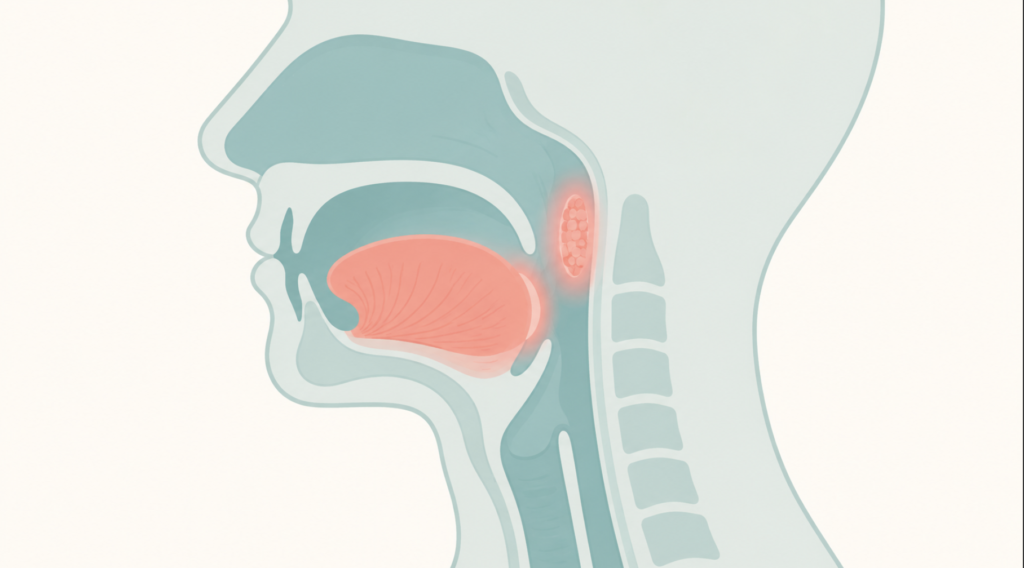
The numbers reflect this preference. In tonsil and base-of-tongue tumors, roughly 60% or more are HPV-positive, far higher than other oropharyngeal subsites [National Cancer Institute, Oropharyngeal Cancer Treatment (PDQ) — Health Professional Version, 2024]. HPV also causes cervical, anal, penile, vulvar, and vaginal cancers — but in high-income countries, oropharyngeal cancer is now the most common HPV-related cancer in men.
Clinical Perspective : Subsite alone shifts the pre-test probability. A tumor of the tonsil or base of tongue in a non-smoker should be regarded as HPV-associated until proven otherwise, whereas soft palate and pharyngeal wall tumors behave more like the classic smoking- and alcohol-related cancers.
What HPV Oropharyngeal Cancer Actually Looks Like
This is where HPV-positive disease diverges most from classic head and neck cancer, and where it catches clinicians off guard.
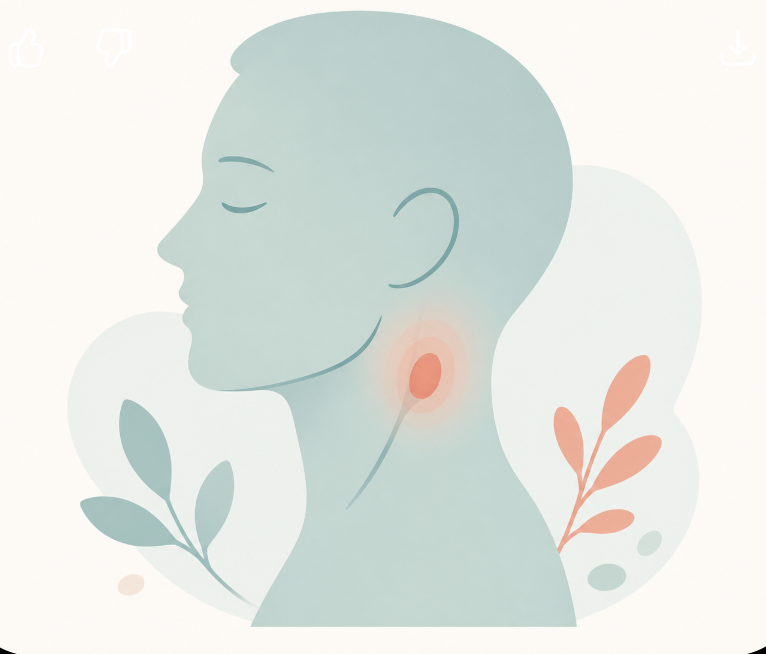
The primary tumor is often tiny — sometimes only a few millimeters — and can be clinically occult, hidden inside the folds of tonsil tissue. Instead, the disease usually announces itself in the neck. The most common first sign is a painless, enlarged lymph node high in the neck, and these nodes are characteristically cystic (fluid-filled) rather than solid. In one large series, a neck mass was the presenting feature in 85% of HPV-positive (p16-positive) tumors versus 57% of HPV-negative tumors [McGarey PO, Diagnostic Delay in HPV-Related Oropharyngeal Squamous Cell Carcinoma, 2024].
The histology is distinct too: typically nonkeratinizing or basaloid squamous cell carcinoma, poorly differentiated. Diagnosis is confirmed with p16 immunostaining (positive when ≥70% of tumor cells stain) and direct HPV testing.
The trap is that all of this mimics benign disease. A cystic neck node in a younger adult is easily mistaken for a branchial cleft cyst, and needle aspiration of a cystic node can come back non-diagnostic. One case series found patients waited a median of 42 months from first noticing a neck lump to a correct diagnosis [Davis KS, From Presumed Benign Neck Masses to Delayed Recognition of HPV-Positive Oropharyngeal Cancer, 2020].
Clinical Perspective : A persistent neck lump in a non-smoking adult warrants a full cancer workup rather than repeated courses of antibiotics. A “non-diagnostic” aspirate from a cystic node is not reassurance — it is an indication to examine the tonsils and base of tongue more closely.
Staged High, Yet Survives Well — The Paradox
Because HPV-positive tumors seed the lymph nodes early, patients often present at a higher N-stage, which sounds ominous. Yet their outcomes are markedly better. The landmark analysis of the RTOG 0129 trial showed tumor HPV status to be a strong, independent predictor of survival: three-year overall survival was 82.4% for HPV-positive versus 57.1% for HPV-negative oropharyngeal cancer [Ang KK, Human Papillomavirus and Survival of Patients with Oropharyngeal Cancer, 2010].
Two things explain the paradox. First, the primary tumor is usually small (early T-stage). Second, and most importantly, HPV-positive tumors are intrinsically more sensitive to radiation and chemotherapy. The cancer that looks more advanced on paper often melts away with treatment.
This is why staging itself was rewritten. The AJCC 8th edition (2017) gave HPV-associated (p16-positive) oropharyngeal cancer its own TNM staging system, separate from p16-negative disease, because applying the old criteria over-staged these patients relative to their excellent prognosis.
The forthcoming AJCC Version 9, effective January 1, 2026, keeps p16-positive oropharyngeal cancer as a distinct staged entity [American Joint Committee on Cancer, Oropharynx (HPV-Associated) Cancer Staging System, Version 9, 2026]. It is also why the central research question in this disease is no longer “how do we cure more patients” but “how do we cure them with less” — treatment de-escalation aimed at preserving swallowing and salivary function in patients likely to live for decades.
Does the Vaccine Work? Real-World Country Data
Yes — and the evidence is now population-level, not theoretical. Australia launched the world’s first national HPV program in 2007 (girls), added boys in 2013, and moved to a single-dose schedule in 2023. A decade-on review documented steep drops in HPV infection, genital warts, and pre-cancerous cervical lesions, with a clear herd effect in unvaccinated men [Patel C, The Impact of 10 Years of HPV Vaccination in Australia, 2018]. Australia is now on track to effectively eliminate cervical cancer as a public health problem by the mid-2030s.
The effect is not limited to wealthy nations. Rwanda became the first African country to introduce national HPV vaccination in 2011 and has sustained high coverage; the prevalence of vaccine-targeted HPV types in young women fell substantially after the program began [Sayinzoga F, Human Papillomavirus Vaccine Effect Against Human Papillomavirus Infection in Rwanda, 2023]. Because the vaccine also reduces oral HPV infection, it is expected to drive down HPV-positive oropharyngeal cancers as vaccinated cohorts age.
HPV Policy and Coverage Around the World

Programs and coverage vary widely by region, and the male gap is the recurring theme.
| Region | Country | Program design | Boys included? |
|---|---|---|---|
| West | Australia | National, school-based, single-dose | Yes (2013) |
| West | UK / Sweden | Gender-neutral national | Yes |
| West | USA | Recommended, coverage varies by state | Yes |
| West | France | National | Yes (2021) |
| East | South Korea | National program for girls; gender-neutral advocated, not yet adopted | Yes (May 2026) |
| East | Japan | Active recommendation resumed after long suspension | Female-focused |
| East | China | Girls (regional rollout); male use under study | Not yet |
| Africa | Rwanda | National since 2011, high coverage | Girls only |
| Middle East | Varies | Limited national programs | Mostly girls |
South Korea was a telling case. The male burden of HPV-related oropharyngeal, anal, and laryngeal cancer is rising quickly, yet HPV vaccination is still framed largely as a female, cervical-cancer issue, and there is no gender-neutral national program. Korean specialty societies have published a formal position statement urging gender-neutral vaccination for ages 9–26 [Min KJ, Position Statement about Gender-Neutral HPV Vaccination in Korea, 2024].
Why Preventing a Sexually Transmitted Cancer Virus Matters
There is no Pap smear for the throat. Cervical cancer can be screened and pre-cancers removed; oropharyngeal, anal, and penile cancers have no equivalent organized screening, so they are usually found only once they cause symptoms or a neck lump. That makes primary prevention — the vaccine — the main tool we have for HPV cancers in men.
Vaccinating only girls leaves half the population directly unprotected against cancers that have no safety net. This is the core argument for gender-neutral programs: they protect men directly and strengthen herd immunity for everyone.
Key Takeaways
- HPV’s main cancer target is the oropharynx, especially the tonsils and base of the tongue, where lymphoepithelial crypts let the virus persist.
- HPV-positive oropharyngeal cancer often presents as a painless, cystic neck lump while the primary tumor stays small and hidden, leading to frequent diagnostic delays.
- Despite presenting at a higher nodal stage, HPV-positive oropharyngeal cancer has far better survival (3-year overall survival ~82% vs ~57%) because it responds strongly to radiation and chemotherapy.
- The HPV vaccine is proven primary cancer prevention at the population level, from Australia to Rwanda.
- Men have no screening equivalent to the Pap smear, which is why gender-neutral vaccination matters.
FAQ
Can men get cancer from HPV? Yes. HPV causes throat (oropharyngeal), anal, and penile cancers in men, and in high-income countries oropharyngeal cancer is now the most common HPV-related cancer in men. Most patients are middle-aged men, often non-smokers.
Why is HPV oropharyngeal cancer survival higher than other head and neck cancers? HPV-positive tumors are biologically more sensitive to radiation and chemotherapy. Even when they look more advanced because they have spread to neck lymph nodes early, they respond far better to treatment, giving substantially higher five-year survival than HPV-negative tumors.
Why does HPV oropharyngeal cancer often start as a neck lump? Because it spreads to the neck lymph nodes early while the original tumor in the tonsil or tongue base stays very small. Patients frequently notice a painless, sometimes cystic node before any throat symptoms.
Should boys get the HPV vaccine? Yes. Vaccinating boys protects them directly against HPV cancers that have no routine screening, and it boosts herd immunity for the whole population. Gender-neutral vaccination is increasingly recommended as the default program design.
Joonpyo Hong, MD is a board-certified otolaryngologist practicing in Korea. This article reflects his clinical interpretation of published research and does not constitute individual medical advice.
References
- Ang KK, Harris J, Wheeler R, et al. Human papillomavirus and survival of patients with oropharyngeal cancer. N Engl J Med. 2010;363(1):24-35.
- Chaturvedi AK, Engels EA, Pfeiffer RM, et al. Human papillomavirus and rising oropharyngeal cancer incidence in the United States. J Clin Oncol. 2011;29(32):4294-4301.
- Davis KS, Byrd JK, Mehta V, et al. From presumed benign neck masses to delayed recognition of human papillomavirus-positive oropharyngeal cancer. Laryngoscope. 2020;130(2):392-397.
- McGarey PO Jr, Hamdi O, Donaldson L, et al. Diagnostic delay in HPV-related oropharyngeal squamous cell carcinoma. Int Arch Otorhinolaryngol. 2024;28(1):e42-e49.
- Patel C, Brotherton JML, Pillsbury A, et al. The impact of 10 years of human papillomavirus (HPV) vaccination in Australia: what additional disease burden will a nonavalent vaccine prevent? Euro Surveill. 2018;23(41):1700737.
- Sayinzoga F, Tenet V, Heideman DAM, et al. Human papillomavirus vaccine effect against human papillomavirus infection in Rwanda: evidence from repeated cross-sectional cervical-cell-based surveys. Lancet Glob Health. 2023;11(7):e1096-e1104.
- Min KJ, Ouh YT, Bae S, et al. Position statement about gender-neutral HPV vaccination in Korea. Vaccines (Basel). 2024;12(10):1110.
- National Cancer Institute. Oropharyngeal cancer treatment (PDQ) — health professional version. Bethesda, MD: National Cancer Institute; 2024.
- Centers for Disease Control and Prevention. Cancers associated with human papillomavirus, United States. Atlanta, GA: US Department of Health and Human Services, CDC; 2024.
- American Joint Committee on Cancer. Oropharynx (HPV-associated) cancer staging system, version 9. Chicago, IL: American Joint Committee on Cancer; 2024 (effective January 1, 2026).
For more interesting contents:
https://curiousmd.com/ai-de-escalation-in-hpv-throat-cancer/
https://curiousmd.com/hpv-vocal-cord-cancer-young-non-smokers/
https://curiousmd.com/leukoplakia-white-patches-cancer-risk/
Link out to:
CDC — Cancers Associated with HPV (US statistics)
: https://www.cdc.gov/united-states-cancer-statistics/publications/hpv-associated-cancers.html
NCI PDQ — Oropharyngeal Cancer Treatment (Health Professional)
: https://www.cancer.gov/types/head-and-neck/hp/adult/oropharyngeal-treatment-pdq
https://www.nejm.org/doi/abs/10.1056/NEJMoa0912217 (DOI: 10.1056/NEJMoa0912217)
https://www.who.int/news-room/fact-sheets/detail/cervical-cancer