
Your eight-month-old looks up at you, vocalizes, and waits. That pause — that small expectation of a reply — is the moment language is being built in her brain. The research on the language critical period tells parents this much: the back-and-forth moment is what does the work. Not the educational video playing across the room, not the bilingual flashcards, not even how much you talk in total.
Parents hear a lot about “the critical period” for language, often framed as a window that closes and a chance you can miss. The science is more reassuring than that, but it is also more specific. The infant brain absorbs language especially efficiently in the first few years — and within that span, the kind of input it receives matters as much as the amount. This article walks through what the research actually shows, what to do about it day to day, and the one medical issue that can quietly undo all of it.
What the Language Critical Period Actually Means
The term “critical period” appears throughout the popular literature, but contemporary researchers more often describe a series of overlapping sensitive periods — windows during which the brain absorbs particular aspects of language with unusual efficiency, but outside of which learning still occurs.
The sharpest of these sensitive periods is for speech-sound perception. Newborns can distinguish a wide range of consonant and vowel contrasts found across human languages. By the first birthday, they have specialized for the sounds they hear daily and become less sensitive to many of the rest. The often-cited examples — Japanese-learning infants becoming less sensitive to the English “r” versus “l” contrast, or English-learning infants losing fine-grained sensitivity to Mandarin tone differences — illustrate the pattern, though the specifics vary by language pair and experimental design. The general shape, however, is consistent: phonetic discrimination narrows most visibly between roughly 6 and 12 months.
Vocabulary and grammar follow much longer trajectories. Vocabulary grows throughout childhood, and grammar remains learnable well into school age. So the practical question for parents of infants and toddlers is not “have I missed the window?” — it is “what kind of input is most useful during the years when the brain absorbs it most efficiently?”
What Actually Works: The Four Evidence-Based Habits
Decades of research, much of it from Patricia Kuhl’s lab at the University of Washington, converge on a short list. None of it is exotic. All of it is grounded in randomized trials or controlled experiments.
1. Talk Face to Face, in Real Time
In a now-classic experiment, 9-month-old American infants were given twelve sessions of exposure to Mandarin Chinese. One group sat with a live native speaker who played and read with them. A second group received identical Mandarin content via television. A third heard the audio only. After exposure, the live-interaction group could discriminate Mandarin sounds at the level of native Mandarin-learning infants. The video and audio groups showed no learning at all [Kuhl, Foreign-language experience in infancy: Effects of short-term exposure and social interaction on phonetic learning, 2003].
The implication is direct. Babies’ brains gate language learning behind social engagement — eye contact, shared attention, response to their reactions. Audio playing in the room does not pass the gate.
2. Use Parentese (Not Baby Talk)
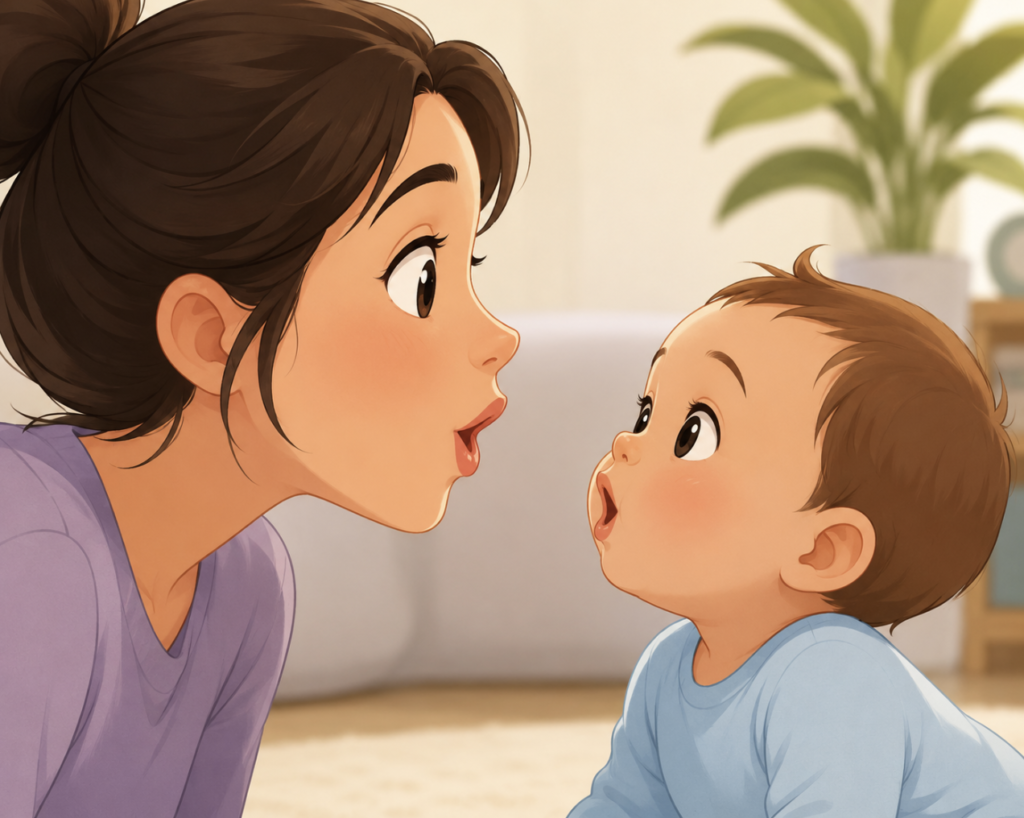
Parentese is the slow, high-pitched, melodically exaggerated speech most adults instinctively slip into with infants. It is not “baby talk” — it uses real words, just delivered with stretched vowels, clearer consonants, and more sing-song intonation.
Normal speech: “Do you want some milk?” Parentese: “Dooo you waaant some miiiilk? Mmm, miiilk!”
In a randomized controlled trial, one group of parents was coached in parentese starting when their infants were 6 months old; a control group received no coaching. The coached parents used more parentese, had more conversational turns with their babies, and their children had measurably larger vocabularies at 18 months [Ferjan Ramírez, Parent coaching increases conversational turns and advances infant language development, 2020]. A follow-up of the same children showed the language advantage was still present at 30 months of age [Huber, Parent coaching from 6 to 18 months improves child language outcomes through 30 months of age, 2023].
If you already do this without thinking, the research says: keep doing it.
3. Take Turns
Babies start “conversations” before they have words — with coos, babbles, gestures, eye gaze. The parental move that matters most is treating each of these as a turn worth answering. Coo back. Wait. Respond to her babble as if it meant something. In the parent-coaching trial above, both parental parentese use and the number of parent-child conversational turns were correlated with children’s vocabulary growth — and a separate neuroimaging study found that conversational turns predicted brain activation in language-processing regions independent of how many total words children heard [Romeo, Beyond the 30-Million-Word Gap: Children’s Conversational Exposure Is Associated With Language-Related Brain Function, 2018].
This reframes language stimulation. It is not about flooding a baby with words. It is about treating her as a conversational partner from the start.
4. Read Aloud — Even Before She Understands
The American Academy of Pediatrics recommends shared reading beginning in infancy as part of routine well-child care. The strongest direct evidence comes from older age ranges: a meta-analysis of 19 randomized trials covering nearly 2,600 children aged 1 to 6 years found that book-sharing interventions produced small-to-moderate gains in both expressive (d = 0.41) and receptive (d = 0.26) language [Dowdall, Shared Picture Book Reading Interventions for Child Language Development: A Systematic Review and Meta-Analysis, 2019]. Starting earlier — in the first year, even before the baby clearly understands the words — has support in observational and pediatric guideline literature, though randomized trial evidence is concentrated at ages 1 and above.
The mechanism is the same as the other three: books generate joint attention, give parents a reason to use varied vocabulary they would not otherwise reach for, and create natural turn-taking (“What’s that?” “Where’s the dog?”).
What Does Not Replace Live Interaction
Background TV
When a television is audible in the home — even when no one is watching — adults speak fewer words to their children, children vocalize less, and conversational turns drop. A population-based observational study using daylong audio recordings quantified this effect across more than 300 children [Christakis, Audible television and decreased adult words, infant vocalizations, and conversational turns, 2009]. The damage is not from the screen content. It is from what the noise displaces.
Practical translation: if a TV or YouTube is on as background noise around an infant, turn it off when no one is actively watching.
Audio-Only “Language Exposure” and Bilingualism
For families wondering about early second-language exposure — including the common Korean question about when to start English — the research points in a clearer direction than parenting culture sometimes suggests. Who speaks the language to the baby, how often, and in what kind of interaction matter more than the chronological timing of when exposure starts.
In the Kuhl Mandarin study, structured exposure delivered by a live person produced phonetic learning while identical content delivered by audio alone did not [Kuhl, Foreign-language experience in infancy: effects of short-term exposure and social interaction on phonetic learning, 2003]. The parent-coaching trials reinforced the same principle for first-language development — what changed children’s outcomes was the parent’s interactive use of language, not raw exposure time [Ferjan Ramírez, Parent coaching increases conversational turns and advances infant language development, 2020].
The practical implication: a bilingual playlist, a YouTube channel, or a language-learning app for babies is not equivalent to a person speaking that language to the child, regardless of how early it begins.
Reassurance for Real-Life Parents
A few points the research is clearer about than parenting culture often gives credit for.
Quality matters more than total hours, but both matter. Working parents who have focused, face-to-face interactions during feeding, bath time, dressing, and the commute home are providing the right kind of input. The research is clearest that responsive, back-and-forth interactions are the active ingredient — though raw exposure time is not irrelevant, the texture of those interactions does most of the work.
Other caregivers count. Grandparents, daycare teachers, nannies — any adult engaging in parentese-style, responsive conversation with the baby is delivering the same kind of input. The brain is not picky about whose voice it is.
Adequately rich bilingual exposure does not harm language development. Children raised hearing two languages reach typical milestones when both come from live, responsive speakers. Per-language vocabulary may run slightly smaller while total vocabulary across both languages remains normal, and any brief mixing around 18–24 months sorts itself out. The clinically important variable is not whether English (or any second language) starts early or late — it is whether the exposure comes through real human interaction rather than primarily video or apps.
If your baby is already 18 months and you are reading this in mild panic — you have not missed a deadline. Every habit in this article works just as well starting now. Phonetic perception is one of the earliest-narrowing skills, but vocabulary and grammar continue to develop for years to come.
The Clinical Catch: Hearing Is the Gate
Everything described here assumes one thing: that sound is reaching the auditory cortex during these formative years. Otolaryngology practice is where that assumption breaks down.
Two issues matter most for parents.
Congenital hearing loss. Korea has had universal newborn hearing screening since 2018. If a baby was screened and passed, congenital sensorineural hearing loss is unlikely but not impossible — some forms develop after the newborn period. If a baby missed screening or screening was inconclusive, follow up. For infants who do have severe hearing loss, cochlear implantation before 12 months of age produces substantially better spoken-language outcomes than implantation between 12 and 24 months [Dettman, Long-term communication outcomes for children receiving cochlear implants younger than 12 months, 2016; Nicholas, Spoken language benefits of extending cochlear implant candidacy below 12 months of age, 2013].
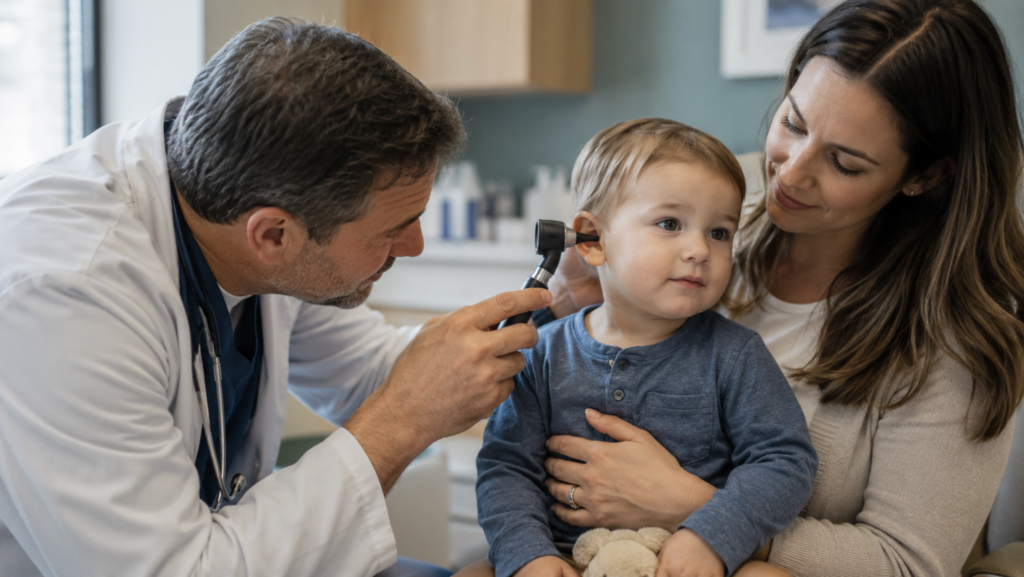
Recurrent middle-ear fluid. Far more common than congenital deafness — and far more frequently missed. A toddler with chronic otitis media with effusion hears the world through a layer of muffled water. The child may still respond to loud sounds, so parents and even pediatricians can miss it. Most cases of middle-ear effusion are observed for about three months before active treatment, as many resolve on their own; however, when effusion persists, especially when it is bilateral and accompanied by concerns about language development, restoring hearing through appropriate management can improve the language input the brain receives.
Key Takeaways
- The brain absorbs language especially efficiently in the first few years, with phonetic perception narrowing most visibly between 6 and 12 months; vocabulary and grammar develop over much longer trajectories.
- Live, face-to-face interaction is the active ingredient — the same content delivered through audio or video alone has not produced equivalent phonetic learning in controlled experiments.
- Parentese (slow, high-pitched, exaggerated real-word speech) combined with parent-child turn-taking is supported by randomized trial evidence.
- Background TV is associated with measurable reductions in adult words, child vocalizations, and conversational turns in the home.
- Undetected hearing loss — congenital or from recurrent middle-ear fluid — can interfere with the language input the brain needs, and is worth ruling out when a child’s language development lags.
FAQ
How many minutes a day of “language stimulation” does my baby need? There is no specific minute target in the research, and that is good news. What matters is the texture of the interactions you already have — diaper changes, feeding, bath, walks. If those moments include eye contact, real words, and waiting for the baby to respond, you are doing the work. A few high-quality interactions outweigh hours of ambient talk.
I’m a working parent — am I shortchanging my baby? Not if the time you do have is responsive and face-to-face. Research consistently shows that the quality of back-and-forth interactions matters more than the total volume of speech a child hears, and consistent caregivers — daycare teachers, grandparents, or nannies — who use parentese and respond to the baby provide the same input.
Is it bad for my baby to hear two languages? No. Adequately rich bilingual exposure does not delay language development. The clinically important factor is not whether the second language starts in infancy or later, but whether it comes through live, interactive speakers rather than primarily through video or audio. A grandparent who speaks Korean while a parent speaks English provides the kind of input the brain uses well; a daily English-language YouTube channel does not substitute for either.
At what age can my child watch videos and have it count as language input? Children begin to show some transfer of learning from screens to real-world language around their second birthday, though even then screens supplement live interaction rather than replace it. Under 18 months, the available research has not shown meaningful language gains from screens, and screens often displace richer live input — which is the larger concern at that age.
My toddler isn’t talking much yet — when should I be concerned? For a 24-month-old who is not yet combining two-word phrases, a hearing evaluation is worth considering as a first step before labeling the child a late talker. Recurrent ear infections with fluid behind the eardrum cause mild, fluctuating hearing loss that often goes unnoticed because the child still responds to loud sounds. Identifying and managing any hearing problem early helps protect the same sensitive period the language research depends on.
Joonpyo Hong, MD is a board-certified otolaryngologist practicing in Korea. This article reflects his clinical interpretation of published research and does not constitute individual medical advice.
References
- Kuhl PK, Tsao FM, Liu HM. Foreign-language experience in infancy: Effects of short-term exposure and social interaction on phonetic learning. Proc Natl Acad Sci U S A. 2003;100(15):9096-9101.
- Ferjan Ramírez N, Lytle SR, Kuhl PK. Parent coaching increases conversational turns and advances infant language development. Proc Natl Acad Sci U S A. 2020;117(7):3484-3491.
- Huber E, Ferjan Ramírez N, Corrigan NM, Kuhl PK. Parent coaching from 6 to 18 months improves child language outcomes through 30 months of age. Dev Sci. 2023;26(6):e13391.
- Romeo RR, Leonard JA, Robinson ST, et al. Beyond the 30-million-word gap: Children’s conversational exposure is associated with language-related brain function. Psychol Sci. 2018;29(5):700-710.
- Dowdall N, Melendez-Torres GJ, Murray L, Gardner F, Hartford L, Cooper PJ. Shared picture book reading interventions for child language development: A systematic review and meta-analysis. Child Dev. 2020;91(2):e383-e399.
- Christakis DA, Gilkerson J, Richards JA, et al. Audible television and decreased adult words, infant vocalizations, and conversational turns: a population-based study. Arch Pediatr Adolesc Med. 2009;163(6):554-558.
- Dettman SJ, Dowell RC, Choo D, et al. Long-term communication outcomes for children receiving cochlear implants younger than 12 months: A multicenter study. Otol Neurotol. 2016;37(2):e82-e95.
- Nicholas JG, Geers AE. Spoken language benefits of extending cochlear implant candidacy below 12 months of age. Otol Neurotol. 2013;34(3):532-538.
For more interesting contents:
https://curiousmd.com/fetal-hearing-development-womb/
https://curiousmd.com/child-snoring-not-normal-by-age/
https://curiousmd.com/sleep-cycles-by-age/
Link out to:
https://www.healthychildren.org/English/news/Pages/beyond-literacy-shared-reading-starting-in-infancy-offers-lifelong-benefits.aspx
https://www.washington.edu/news/2020/02/03/not-just-baby-talk-parentese-helps-parents-babies-make-conversation-and-boosts-language-development/
https://www.cdc.gov/hearing-loss-children/articles/baby-hearing-screening-infographic.html