
The rivalry of Novo Nordisk vs Eli Lilly is one of the biggest business stories in medicine this decade, and for most of its history it was not much of a contest. Novo, the Danish insulin maker, turned a diabetes hormone into a mainstream obesity treatment and became Europe’s most valuable company on the strength of Wegovy. At its peak in mid-2024 the company was worth more than $650 billion [Sherwood News, Novo Market Cap, 2026].
The fall that followed was steep. By 24 February 2026, Novo’s market value had dropped below $200 billion, back to where it stood before Wegovy was approved, a loss of more than two-thirds of its value [BioSpace, Novo Valuation, 2026]. In the same period, Eli Lilly became the first drugmaker ever worth $1 trillion [BioSpace, Novo Valuation, 2026]. Novo has since replaced its chief executive, announced 9,000 job cuts and said it expects 2026 sales to be flat or lower [Fierce Pharma, Novo Layoffs, 2025; Novo Nordisk, H1 2026 Report, 2026].
The obvious explanation is that Lilly had a better drug, and the clinical data do support that. It explains only part of what happened, though. Semaglutide, Novo’s molecule, still works well, and it was the first of these drugs to prove heart protection in people with obesity but no diabetes.
Semaglutide kept working. What shifted was the market, which ended up rewarding several things at once. The strongest molecule mattered, but so did factories that could keep up with demand and a cheaper way to reach patients, and Lilly got to each of these before Novo did.
The First Mover: How Novo Built the Obesity Market
Novo’s liraglutide injection, sold as Saxenda, reached the US market for weight management in 2014. Its successor, Wegovy (semaglutide), won FDA approval in June 2021 as the first new drug for chronic weight management in adults since 2014 [FDA, Wegovy Approval, 2021]. Both drugs mimic GLP-1 (glucagon-like peptide-1), a gut hormone that acts on the brain’s appetite centers.
Wegovy’s trial results were strong. In the STEP 1 trial of 1,961 adults with obesity but no diabetes, semaglutide cut body weight by 14.9% over 68 weeks, compared with 2.4% on placebo [Wilding, STEP 1, 2021]. For a 100 kg person, that is about 15 kg. Demand soon outran supply.
Lilly’s competing drug came out of its diabetes pipeline. Tirzepatide was approved for type 2 diabetes as Mounjaro in May 2022 and for weight management as Zepbound in November 2023, about two and a half years after Wegovy [FDA, Zepbound Approval, 2023]. By then Novo had a long head start, and patients already knew its brand names.
| Company | Brand | Active ingredient | Receptors targeted | Form | Main US use | US approval |
|---|---|---|---|---|---|---|
| Novo Nordisk | Saxenda | liraglutide | GLP-1 | Daily injection | Weight management | 2014 |
| Novo Nordisk | Ozempic | semaglutide | GLP-1 | Weekly injection | Type 2 diabetes | 2017 |
| Novo Nordisk | Wegovy | semaglutide | GLP-1 | Weekly injection | Weight management | 2021 |
| Novo Nordisk | Wegovy pill | semaglutide | GLP-1 | Daily tablet | Weight management | 2025 |
| Eli Lilly | Mounjaro | tirzepatide | GIP + GLP-1 | Weekly injection | Type 2 diabetes | 2022 |
| Eli Lilly | Zepbound | tirzepatide | GIP + GLP-1 | Weekly injection | Weight management | 2023 |
| Eli Lilly | Foundayo | orforglipron | GLP-1 | Daily tablet | Weight management | 2026 |
Novo’s lead came from timing and brand recognition rather than from having the most effective molecule. That difference shaped the next five years.
The Molecule Gap: Why Tirzepatide Hit Harder
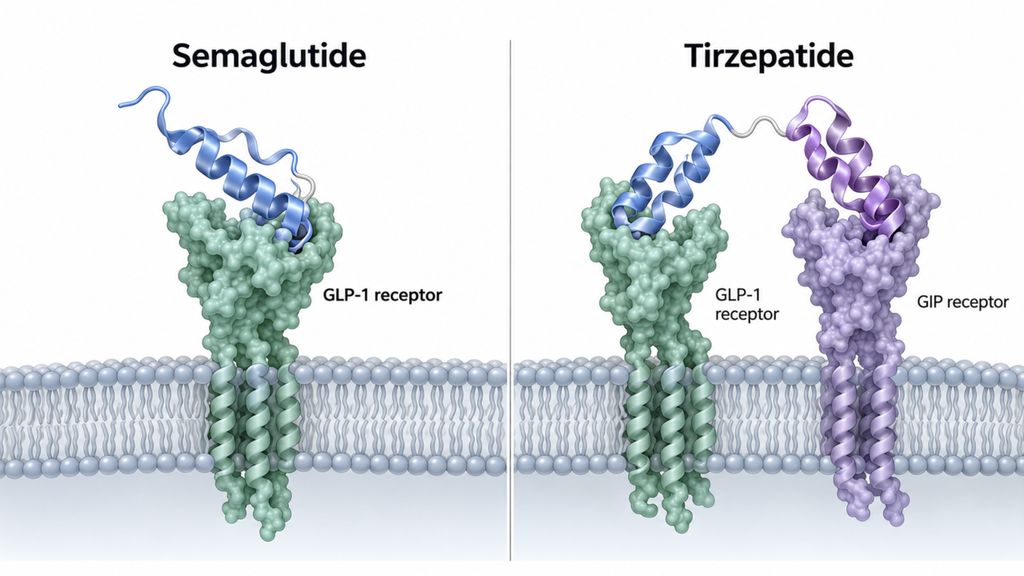
Semaglutide activates one gut-hormone receptor, GLP-1. Tirzepatide activates two: GLP-1 and GIP (glucose-dependent insulinotropic polypeptide), another hormone the intestine releases after a meal [FDA, Zepbound Approval, 2023; Liu, GLP-1 and GIP Mechanisms, 2024]. Whether that second receptor accounts for any of the extra weight loss in people, and how much, is still debated. GIP reduces food intake in rodents, but that effect has not been clearly shown in humans [Nauck, Tirzepatide Review, 2022]. The two-receptor design explains why Lilly built the drug this way. The evidence that it works better comes from trials.
The pivotal studies, read side by side, pointed to a gap early on. In SURMOUNT-1, the highest dose of tirzepatide (15 mg) produced a 20.9% weight loss at 72 weeks, versus 3.1% on placebo, or about one-fifth of body weight [Jastreboff, SURMOUNT-1, 2022]. STEP 1 had shown about 15% for semaglutide. Because the two trials enrolled different patients and ran for different lengths, that comparison was only suggestive.
A direct comparison arrived in 2025. SURMOUNT-5 randomized 751 adults with obesity but no diabetes to the highest tolerated dose of either drug for 72 weeks. Tirzepatide produced a 20.2% average weight loss, versus 13.7% with semaglutide, and took 18.4 cm off the waist versus 13.0 cm [Aronne, SURMOUNT-5, 2025]. For a 100 kg person, that is roughly 20 kg versus 14 kg, or about half again as much weight lost. The trial was open-label and funded by Lilly, though body weight is a hard outcome to fudge.
Semaglutide does have one advantage tirzepatide has not yet matched. In SELECT, 17,604 people with established heart disease and overweight or obesity, but no diabetes, took semaglutide or placebo for a mean of 39.8 months. Semaglutide lowered the risk of heart attack, stroke or cardiovascular death by 20% (hazard ratio 0.80), with events in 6.5% versus 8.0% of patients [Lincoff, SELECT, 2023]. That works out to about 1.5 fewer major events per 100 people over roughly three years.
Tirzepatide’s own heart trial, SURPASS-CVOT, tested a different population, people with type 2 diabetes, against a different comparator, an older GLP-1 drug. It showed tirzepatide was at least as good but did not prove it better [Nicholls, SURPASS-CVOT, 2025]. In August 2026 the FDA added a heart-risk indication to Mounjaro’s label for people with type 2 diabetes. In people with obesity but no diabetes, semaglutide proved heart protection first.
The two drugs have similar side effects. For both, the most common problems are nausea, diarrhea and other stomach complaints, mostly mild and concentrated in the early dose-increase weeks [Aronne, SURMOUNT-5, 2025; Karagiannis, Tirzepatide Meta-analysis, 2022].
So the difference in weight loss is real. Whether it turned into market share depended on whether patients could actually get the drug.
Self-Inflicted Wounds: Shortages, Compounders and a Disappointing Sequel
Demand outran supply at both companies. Semaglutide and tirzepatide injections were both on the FDA drug shortage list from 2022. The FDA declared tirzepatide’s shortage resolved on 19 December 2024 and semaglutide’s on 21 February 2025 [FDA, Compounding Policy, 2026], so the shortages lasted roughly two to three years.
That gap is widely seen as what created a large compounded-drug market. Federal rules let pharmacies make copies of a drug while it is officially in shortage, and many did. After the shortages ended, compounded versions stayed on the market in altered forms, some made in facilities without licenses for sterile compounding [DiStefano, Compounded GLP-1 Market, 2026]. For Novo, this meant part of the demand it had built went to copies it did not make.
Lilly faced the same crunch and made capacity a public priority. In early 2025 the company projected 60% more saleable incretin doses in the first half of 2025 than a year earlier, or about 1.6 times as many [Eli Lilly, Q4 2024 Earnings, 2025]. That was a company projection, not an audited figure.
Novo’s pipeline then disappointed. Its next-generation drug, CagriSema, pairs semaglutide with cagrilintide, an amylin analogue. In December 2024 the first big trial came in at 22.7% weight loss at 68 weeks, a result most drugmakers would celebrate. Novo, however, had set expectations at 25%, and its shares fell 20% in a single day, the sharpest one-day drop in its history, erasing about €90 billion [Euronews, Novo Shares Plunge, 2024]. The 22.7% figure assumes patients stayed on the drug. Counting everyone regardless of adherence, the published result was a 20.4% loss versus 3.0% on placebo [Garvey, REDEFINE 1, 2025].
A second trial did more damage. In February 2026, Novo’s own head-to-head trial, REDEFINE 4, could not show that CagriSema matched tirzepatide: weight loss was about 23% versus 25.5% over 84 weeks, in results not yet published in a journal [HCPLive, REDEFINE 4, 2026]. Within days, Novo’s value fell below $200 billion [BioSpace, Novo Valuation, 2026].
Leadership changed in between. Chief executive Lars Fruergaard Jørgensen left in May 2025, and Maziar Mike Doustdar took over in August. In September he announced 9,000 job cuts, roughly one in nine employees, aiming to save $1.3 billion a year [Fierce Pharma, Novo Layoffs, 2025].
The shortages were a supply problem that more factories could fix. Setting a 25% target and then missing it hurt Novo’s credibility, which is harder to rebuild.
How the Lead Flipped: A Timeline of Market Share
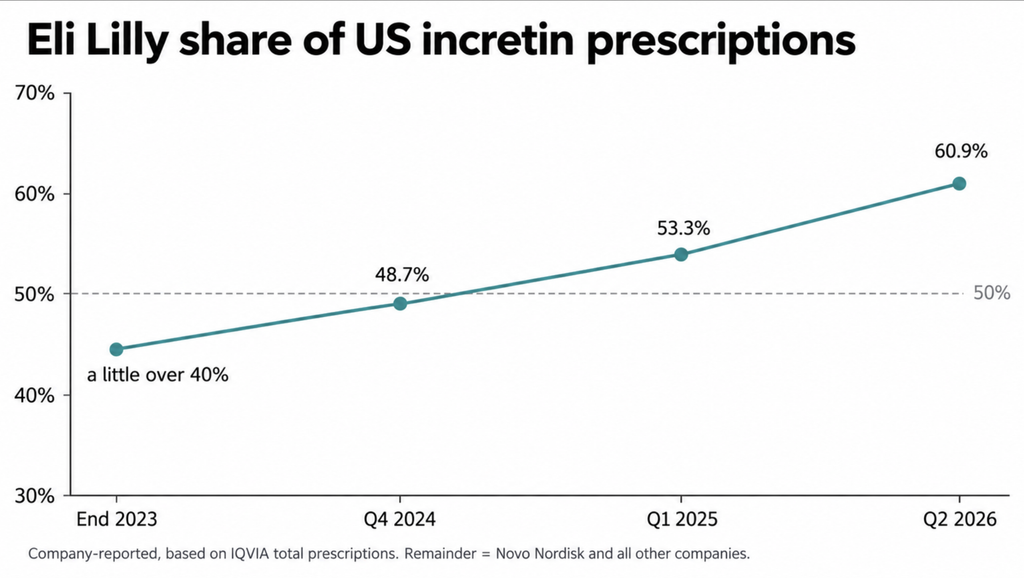
Prescription data show when the lead changed hands. By Lilly’s own count, based on IQVIA prescription data, its share of total US incretin prescriptions, covering both diabetes and obesity drugs, was a little over 40% at the end of 2023. It reached 48.7% at the end of 2024 and 53.3% in the first quarter of 2025, the first time it held a majority [Eli Lilly, Q4 2024 Earnings, 2025; Eli Lilly, Q1 2025 Earnings, 2025]. By the second quarter of 2026 it stood at 60.9%, or about six in ten [Eli Lilly, Q2 2026 Earnings, 2026]. Independent US health-record data from Truveta also show tirzepatide as the most-prescribed GLP-1 drug in its records through June 2026 [Truveta, GLP-1 Prescribing Trends, 2026].
The remaining share is not all Novo’s, since it includes every other company’s incretin drugs. Novo also disputes part of the picture. Measured by new patient starts rather than total prescriptions, Novo says its Wegovy brand, helped by the new pill, still leads the US market among branded obesity medicines [Novo Nordisk, H1 2026 Report, 2026]. Which company is ahead depends on the measure you use.
Price and sales channel mattered too. In August 2024, Lilly began selling Zepbound vials directly to self-paying patients through its LillyDirect pharmacy for $399 to $549 a month, less than half the list price of rival obesity injections by its own comparison [Eli Lilly, Zepbound Vials, 2024]. At the end of the first quarter of 2025, Lilly reported over 60% of US branded obesity prescriptions and 74% of new ones, about three of every four [Eli Lilly, Q1 2025 Earnings, 2025]. There is no way to isolate how much of that share came from the vials.
Revenue moved the same way. In the second quarter of 2026, Lilly’s revenue rose 48% to $23.0 billion. Mounjaro brought in $9.9 billion and Zepbound $4.9 billion, about $14.9 billion together [Eli Lilly, Q2 2026 Results, 2026]. Novo’s total company sales that quarter were DKK 78.5 billion, roughly $12 billion at the exchange rate implied in contemporaneous reporting [Novo Nordisk, H1 2026 Report, 2026; BioPharma Dive, Q2 2026 Earnings, 2026]. Tirzepatide alone outsold all of Novo. In the first half of 2026, Ozempic sales fell 2% and injectable Wegovy grew only 7% [Novo Nordisk, H1 2026 Report, 2026].
Novo Nordisk vs Eli Lilly: The Map Today in the US, Europe and Asia
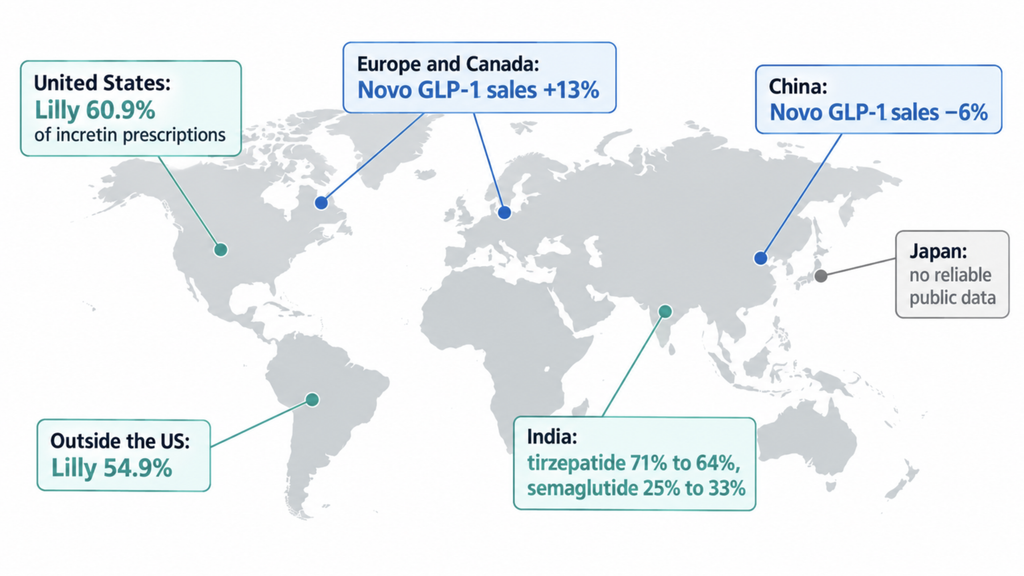
Outside the US the picture is messier, and there is less data. Lilly reports holding 54.9% of incretin prescriptions outside the US in the second quarter of 2026, a little over half [Eli Lilly, Q2 2026 Earnings, 2026]. Trade press reported that Lilly overtook Novo outside the US by early 2026 [GxP News, Lilly Overtakes Novo Outside US, 2026]. Mounjaro’s non-US sales reached $5.2 billion in the quarter, up 172% in a year, nearly tripling [Eli Lilly, Q2 2026 Results, 2026].
| Region | Best available signal | Lilly side | Novo side | Nature of the data |
|---|---|---|---|---|
| United States | Share of total incretin prescriptions, Q2 2026 | 60.9% | Claims lead in new obesity-patient starts | Company-reported, IQVIA-based |
| Outside the US (all) | Share of incretin prescriptions, Q2 2026 | 54.9% | Not reported | Company-reported |
| Europe and Canada | Sales growth, 2026 | No Europe-only figure; Mounjaro sales outside the US +172% | Novo GLP-1 sales +13% | Company filings; no Europe-only share figure published |
| India | Market share after generics, February to March 2026 | Tirzepatide 71% to 64% | Semaglutide 25% to 33% | Industry data (Pharmarack) via press |
| China | Sales growth, first half 2026 | Not reported | Novo GLP-1 sales −6% | Company filing; generic entry staggered |
| Japan | Not reported | Not reported | Not reported | No reliable public share data |
No one has published a reliable Europe-only share figure, so the best signal there is growth. Novo’s GLP-1 sales in Europe and Canada grew 13% in the first half of 2026, far slower than Mounjaro abroad [Novo Nordisk, H1 2026 Report, 2026]. The direction is clear even if the exact split is not.
Asian markets are moving in different directions. In India, where semaglutide’s patent expired on 20 March 2026, cheap generics arrived within weeks. According to Pharmarack data, tirzepatide’s share of the market fell from 71% to 64% in a single month, while semaglutide, branded and generic combined, rose from 25% to about a third, 33%. Novo still sells most of that semaglutide and cut some prices by up to 48% [Business Standard, India GLP-1 Market, 2026]. Generics in India sell at discounts of up to 90%, a tenth of the brand price [IQVIA, Off-patent Semaglutide, 2026].
In China, Novo’s GLP-1 sales fell 6% in the first half of 2026, and regulatory requirements are staggering generic entry country by country [Novo Nordisk, H1 2026 Report, 2026; IQVIA, Off-patent Semaglutide, 2026]. There are no reliable public share figures for Japan, and this analysis does not estimate one.
The countries where semaglutide lost exclusivity in 2026, including India, China, Brazil, Turkey and Canada, are home to 38% of the world’s adults with obesity, nearly four in ten [Meadowcroft, Obesity Outlook 2026–2030, 2026]. In those markets, both companies’ brands now compete against cheaper copies, and the price of the molecule matters as much as the rivalry between Novo and Lilly.
Can Novo Fight Back? Pills, Next-Generation Drugs and the Price War
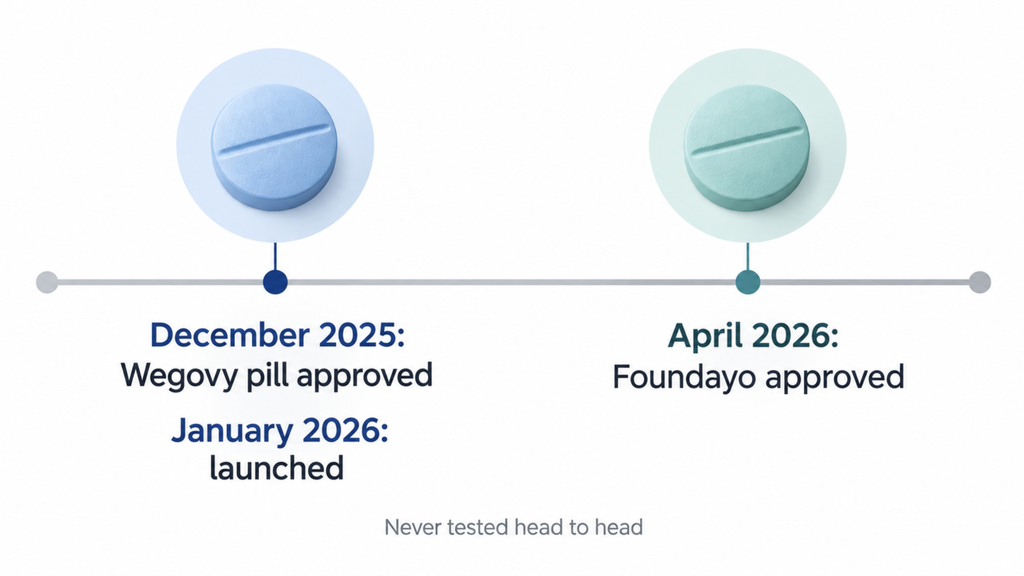
Novo’s best recent news has been a pill. The FDA approved the Wegovy pill, an oral form of semaglutide, in December 2025, and Novo launched it in January 2026 [Novo Nordisk, Wegovy Pill Approval, 2025]. In the OASIS 4 trial, it produced a 13.6% weight loss at 64 weeks, versus 2.2% on placebo [Wharton, OASIS 4, 2025]. Lilly’s pill, Foundayo (orforglipron), was approved in April 2026, about three months later [Eli Lilly, Foundayo Approval, 2026]. In its ATTAIN-1 trial the highest dose, 36 mg, produced an 11.2% weight loss at 72 weeks, versus 2.1% on placebo [Wharton, ATTAIN-1, 2025].
Those two numbers can’t be compared directly. The trials ran for different lengths and the pills were never tested head to head, so there is no fair way yet to say which works better. The companies sell them differently. Foundayo is a small, non-peptide molecule, and Lilly markets it as the only GLP-1 pill that can be taken at any time of day without food or water restrictions. Both launched at a $149-a-month self-pay price for the starting dose.
So far, Novo’s pill has sold faster. It reached about 2.9 million US prescriptions in the second quarter of 2026 [Novo Nordisk, H1 2026 Report, 2026]. In their respective second weeks on the market, the Wegovy pill logged 18,410 prescriptions to Foundayo’s 3,707, roughly five to one, although the two launched months apart [pharmaphorum, Foundayo vs Wegovy, 2026]. Foundayo brought in $98 million in the second quarter, and Wegovy pill sales also came in below analysts’ expectations [Eli Lilly, Q2 2026 Results, 2026; BioPharma Dive, Q2 2026 Earnings, 2026].
On paper, the next generation of molecules favors Lilly. Its retatrutide, which targets three hormone receptors, reached about a quarter of body weight, a 24.2% loss at 48 weeks on the 12 mg dose, in a phase 2 trial [Jastreboff, Retatrutide Phase 2, 2023]. Lilly reports a 25.9% loss in its first phase 3 readout, not yet peer-reviewed [Eli Lilly, Q2 2026 Earnings, 2026]. Novo’s amycretin, now renamed zenagamtide, showed a 22.0% loss at 36 weeks in a small early study of 125 people [Dahl, Amycretin Phase 1b/2a, 2025]. Both look promising, and neither has been proven yet.
Prices are also coming down. Under a November 2025 deal with the White House, both companies agreed to sell their obesity drugs to Medicare at $245 a month, with a $50 copay for patients, and for about $350 to cash-paying patients through the TrumpRx portal. That is roughly a quarter of Wegovy’s $1,350 list price and about a third of Zepbound’s $1,080 [BioPharma Dive, Trump Pricing Deal, 2025]. Novo has since said it will cut Wegovy’s US list price by about half, and Ozempic’s by 35%, from January 2027 [Novo Nordisk, H1 2026 Report, 2026]. Lilly, meanwhile, raised its 2026 revenue forecast to $85 billion to $87 billion, while Novo expects adjusted sales to range from flat to a 6% decline [Eli Lilly, Q2 2026 Results, 2026; Novo Nordisk, H1 2026 Report, 2026].
Novo still has real strengths. It has the heart-outcomes evidence and a familiar brand, and its pill is outselling Lilly’s. What it has lost is the head start that carried it through its first decade in obesity drugs.
Novo built this market by getting there first. Holding on to it has depended more on supply and price, and on both, Lilly has been ahead.
Key Takeaways
- Novo Nordisk created the modern obesity-drug market, but its lead came from timing and brand rather than from having the most effective molecule.
- In the only head-to-head obesity trial, tirzepatide produced about half again as much weight loss as semaglutide, roughly 20% versus 14% of body weight.
- Semaglutide was the first of these drugs to prove heart protection in people with obesity but no diabetes, an advantage that market share does not reflect.
- Supply shortages, a missed 25% target for CagriSema and a lost head-to-head trial turned a clinical gap into a crisis of confidence for Novo.
- By Lilly’s count, it now fills about six in ten US incretin prescriptions and just over half elsewhere, although generics in India and other markets are changing the market for both companies.
- The next round will be fought over pills, prices and patent expiries more than over another few percentage points on the scale.
FAQ
Is Zepbound more effective than Wegovy for weight loss?
Yes. In the only head-to-head trial in adults with obesity but no diabetes, tirzepatide (Zepbound) produced a 20.2% average weight loss at 72 weeks, versus 13.7% for semaglutide (Wegovy). The trial was open-label and funded by Lilly, and individual responses vary, but the average difference was large [Aronne, SURMOUNT-5, 2025].
Does semaglutide have any advantage over tirzepatide?
Yes. Semaglutide has a completed trial showing a 20% lower risk of heart attack, stroke or cardiovascular death in people with heart disease and obesity but no diabetes. Tirzepatide’s heart trial was done in people with type 2 diabetes against a different comparator, so the two results are not directly comparable [Lincoff, SELECT, 2023].
Has Eli Lilly overtaken Novo Nordisk everywhere?
No. Lilly reports holding about six in ten US incretin prescriptions and a little over half elsewhere. But in India, generic semaglutide pushed tirzepatide’s share down from 71% to 64% within a month of the patent expiring, and Novo says Wegovy still leads US new obesity-patient starts [Business Standard, India GLP-1 Market, 2026].
Are the new obesity pills as effective as the injections?
It depends. In their own trials, the Wegovy pill produced a 13.6% weight loss and Foundayo 11.2%. Neither pill has been tested head to head against the other or against an injection, so their relative strength is not settled [Wharton, OASIS 4, 2025].
References
- Wilding JPH, Batterham RL, Calanna S, et al. Once-weekly semaglutide in adults with overweight or obesity. N Engl J Med. 2021;384(11):989-1002.
- Jastreboff AM, Aronne LJ, Ahmad NN, et al. Tirzepatide once weekly for the treatment of obesity. N Engl J Med. 2022;387(3):205-216.
- Aronne LJ, Horn DB, le Roux CW, et al. Tirzepatide as compared with semaglutide for the treatment of obesity. N Engl J Med. 2025;393(1):26-36.
- Lincoff AM, Brown-Frandsen K, Colhoun HM, et al. Semaglutide and cardiovascular outcomes in obesity without diabetes. N Engl J Med. 2023;389(24):2221-2232.
- Nicholls SJ, et al. Cardiovascular outcomes with tirzepatide versus dulaglutide in type 2 diabetes. N Engl J Med. 2025;393:2409-2420.
- Nauck MA, D’Alessio DA. Tirzepatide, a dual GIP/GLP-1 receptor co-agonist for the treatment of type 2 diabetes with unmatched effectiveness regrading glycaemic control and body weight reduction. Cardiovasc Diabetol. 2022;21(1):169.
- Liu QK. Mechanisms of action and therapeutic applications of GLP-1 and dual GIP/GLP-1 receptor agonists. Front Endocrinol (Lausanne). 2024;15:1431292.
- Karagiannis T, Avgerinos I, Liakos A, et al. Management of type 2 diabetes with the dual GIP/GLP-1 receptor agonist tirzepatide: a systematic review and meta-analysis. Diabetologia. 2022;65(8):1251-1261.
- DiStefano MJ, Tilley A, Paratane D, et al. Postshortage compounded GLP-1 RA market in 2 states with potentially high demand. JAMA Health Forum. 2026;7(7):e262207.
- Garvey WT, Blüher M, Osorto Contreras CK, et al. Coadministered cagrilintide and semaglutide in adults with overweight or obesity. N Engl J Med. 2025;393(7):635-647.
- Wharton S, Lingvay I, Bogdanski P, et al. Oral semaglutide at a dose of 25 mg in adults with overweight or obesity. N Engl J Med. 2025;393(11):1077-1087.
- Wharton S, Aronne LJ, Stefanski A, et al. Orforglipron, an oral small-molecule GLP-1 receptor agonist for obesity treatment. N Engl J Med. 2025;393(18):1796-1806.
- Jastreboff AM, Kaplan LM, Frías JP, et al. Triple-hormone-receptor agonist retatrutide for obesity — a phase 2 trial. N Engl J Med. 2023;389(6):514-526.
- Dahl K, Toubro S, Dey S, et al. Amycretin, a novel, unimolecular GLP-1 and amylin receptor agonist administered subcutaneously: results from a phase 1b/2a randomised controlled study. Lancet. 2025;406(10499):149-162.
- U.S. Food and Drug Administration. FDA approves new drug treatment for chronic weight management, first since 2014 [Internet]. 2021 Jun 4. Available from: https://content.govdelivery.com/accounts/USFDA/bulletins/2e2adc7
- U.S. Food and Drug Administration. FDA approves new medication for chronic weight management (Zepbound) [Internet]. 2023 Nov 8. Available from: https://content.govdelivery.com/accounts/USFDA/bulletins/37a0d49
- U.S. Food and Drug Administration. FDA clarifies policies for compounders as national GLP-1 supply begins to stabilize [Internet]. Updated 2026. Available from: https://www.fda.gov/drugs/drug-alerts-and-statements/fda-clarifies-policies-compounders-national-glp-1-supply-begins-stabilize
- Eli Lilly and Company. Lilly releases Zepbound (tirzepatide) single-dose vials, expanding supply and access for adults living with obesity [Internet]. 2024 Aug 27. Available from: https://investor.lilly.com/news-releases/news-release-details/lilly-releases-zepboundr-tirzepatide-single-dose-vials-expanding
- Eli Lilly and Company. Q4 2024 earnings call presentation [Internet]. 2025 Feb. Available from: https://investor.lilly.com/static-files/09d156c0-f88d-420b-b5f1-1ed2b417461b
- Eli Lilly and Company. Q1 2025 earnings call presentation [Internet]. 2025 May. Available from: https://investor.lilly.com/static-files/761fadb8-b911-46d5-85b3-8bac4e054d73
- Eli Lilly and Company. Q2 2026 earnings call presentation [Internet]. 2026 Aug. Available from: https://investor.lilly.com/static-files/ab69001c-650b-44f6-b629-309ee33f2335
- Eli Lilly and Company. Lilly reports second-quarter 2026 financial results [Internet]. 2026 Aug 5. Available from: https://investor.lilly.com/news-releases/news-release-details/lilly-reports-second-quarter-2026-financial-results-raises-full
- Eli Lilly and Company. FDA approves Lilly’s Foundayo (orforglipron) [Internet]. 2026 Apr 1. Available from: https://investor.lilly.com/news-releases/news-release-details/fda-approves-lillys-foundayotm-orforglipron-only-glp-1-pill
- Novo Nordisk. FDA approves Novo Nordisk’s Wegovy pill [Internet]. 2025 Dec 22. Available from: https://www.prnewswire.com/news-releases/fda-approves-novo-nordisks-wegovy-pill-the-first-and-only-oral-glp-1-for-weight-loss-in-adults-302648344.html
- Novo Nordisk. Financial report for the period 1 January 2026 to 30 June 2026 [Internet]. 2026 Aug 4. Available from: https://ml-eu.globenewswire.com/Resource/Download/59861be7-056f-420d-985b-a7e976f8426d
- Fierce Pharma. Novo Nordisk to lay off 9,000 workers as new CEO aims to save $1.3B per year by late 2026 [Internet]. 2025 Sep 10. Available from: https://www.fiercepharma.com/pharma/novo-nordisk-lay-9000-workers-new-ceo-aims-save-13b-year-late-2026
- BioSpace. Novo returns to pre-Wegovy valuation as Lilly makes history as first-ever $1T pharma [Internet]. 2026 Feb. Available from: https://www.biospace.com/business/novo-returns-to-pre-wegovy-valuation-as-lilly-makes-history-as-first-ever-1t-pharma
- Sherwood News. Novo Nordisk has lost most of its post-Wegovy market cap gains [Internet]. 2026 Feb 9. Available from: https://sherwood.news/markets/novo-nordisk-has-lost-most-of-its-post-wegovy-market-cap-gains/
- Euronews. Novo Nordisk shares plunge on the back of disappointing trial results [Internet]. 2024 Dec 23. Available from: https://www.euronews.com/business/2024/12/23/novo-nordisk-shares-plunge-on-the-back-of-disappointing-trial-results
- HCPLive. CagriSema demonstrates weight loss, fails to achieve primary endpoint compared to tirzepatide [Internet]. 2026 Feb 23. Available from: https://www.hcplive.com/view/cagrisema-demonstrates-weight-loss-fails-to-achieve-primary-endpoint-compared-to-tirzepatide
- Truveta Research. GLP-1 RA prescribing trends: January 2019–June 2026 [Internet]. 2026. Available from: https://www.truveta.com/blog/research/glp-1-ra-prescription-trends-january-2019-june-2026/
- GxP News. Eli Lilly overtakes Novo Nordisk in GLP-1 market share outside US [Internet]. 2026 May 4. Available from: https://gxpnews.net/en/2026/05/eli-lilly-overtakes-novo-nordisk-in-glp-1-market-share-outside-us/
- Business Standard. Eli Lilly’s Mounjaro sales dip as semaglutide generics flood Indian market [Internet]. 2026 Apr 9. Available from: https://www.business-standard.com/industry/news/eli-lilly-s-mounjaro-sales-dip-as-semaglutide-generics-flood-indian-market-126040900527_1.html
- IQVIA. Your questions answered: off-patent semaglutide in 2026 [Internet]. 2026 Apr. Available from: https://www.iqvia.com/locations/emea/blogs/2026/04/your-questions-answered-off-patent-semaglutide-in-2026
- Meadowcroft O, Rickwood S, Greenwalt L. The outlook for obesity from 2026 to 2030 [Internet]. IQVIA; 2026 Apr 21. Available from: https://www.iqvia.com/locations/emea/blogs/2026/04/the-outlook-for-obesity-from-2026-to-2030
- pharmaphorum. Lilly falls on slower start for Foundayo versus Wegovy [Internet]. 2026 Apr 27. Available from: https://pharmaphorum.com/news/lilly-falls-slower-start-foundayo-versus-wegovy
- BioPharma Dive. Novo, Lilly cut deal with Trump to lower prices of obesity drugs [Internet]. 2025 Nov 6. Available from: https://www.biopharmadive.com/news/lilly-novo-trump-obesity-drug-pricing-deal-zepbound-wegovy/804905/
- BioPharma Dive. Lilly climbs, Novo falls as obesity drug battle intensifies [Internet]. 2026 Aug 5. Available from: https://www.biopharmadive.com/news/lilly-novo-earnings-2q-2026-wegovy-pill-foundayo-obesity/827027/
Joonpyo Hong, MD is a board-certified otolaryngologist practicing in Korea. This article reflects his clinical interpretation of published research and does not constitute individual medical advice.
This article is not intended to advertise or promote any specific company or product.
For more articles:
https://curiousmd.com/biotech-rd-productivity/
https://curiousmd.com/tirzepatide-for-sleep-apnea/
https://curiousmd.com/ozempic-ear-side-effect-weight-loss-clogged-ears/
Link out to:
- FDA: Wegovy approval, the first new chronic weight-management drug since 2014
- FDA: Semaglutide and tirzepatide shortages and the end of mass compounding
- IQVIA: The outlook for obesity from 2026 to 2030
- Novo Nordisk: First-half 2026 financial report
- Fierce Pharma: Novo Nordisk’s 9,000-person restructuring
- Business Standard: Generic semaglutide reshapes India’s obesity-drug market