
Picture a typical case: the repositioning maneuver worked, the positional test is clean, and yet the patient keeps saying, “I still feel like I’m on a boat, worse in the supermarket, worse when I scroll my phone.” After successful treatment of benign paroxysmal positional vertigo (BPPV), residual dizziness has been reported in 23 to 70% of patients [Kingma, Enhancing patient care in BPPV-related residual dizziness, 2025]. Much of it fades. When it lingers for months, though, it can be the beginning of PPPD chronic dizziness.
For decades, people like this fell into the gap between “your tests are normal” and “it must be stress.” In 2017 the field finally gave the pattern a name and a set of criteria. This article covers what persistent postural-perceptual dizziness (PPPD) is, why it was defined, how it is diagnosed and treated, and whether it is “real.” It is written for clinicians who want to use the diagnosis well, and for patients who deserve a clear explanation.
What Is PPPD? A Name for Dizziness That Outlasts Its Cause
Persistent postural-perceptual dizziness is a chronic functional vestibular disorder. Its core feature is dizziness, unsteadiness, or non-spinning vertigo on most days for 3 months or more [Staab, Diagnostic criteria for PPPD, 2017]. Patients tend to describe rocking, swaying, or a floor that doesn’t feel solid, rather than a spinning room.
It typically gets worse when the person is upright, when they are moving (walking, riding in a car), and when the visual scene is busy or in motion: supermarket aisles, crowds, a scrolling screen. One review estimates that women are affected about twice as often as men (roughly 2:1), usually with onset between ages 30 and 50 [Moreno-Ajona, PPPD versus vestibular migraine, 2026].
The word that matters most in the definition is “functional.” The Bárány Society consensus states that PPPD is neither a structural nor a psychiatric condition. The balance system is built normally but operates abnormally [Staab, Diagnostic criteria for PPPD, 2017]. Think of a smoke alarm that went off during a real fire and got stuck on its most sensitive setting. Nothing is wrong with the hardware; the setting is what needs fixing.
Where the Diagnosis Came From: Four Older Names, One Consensus
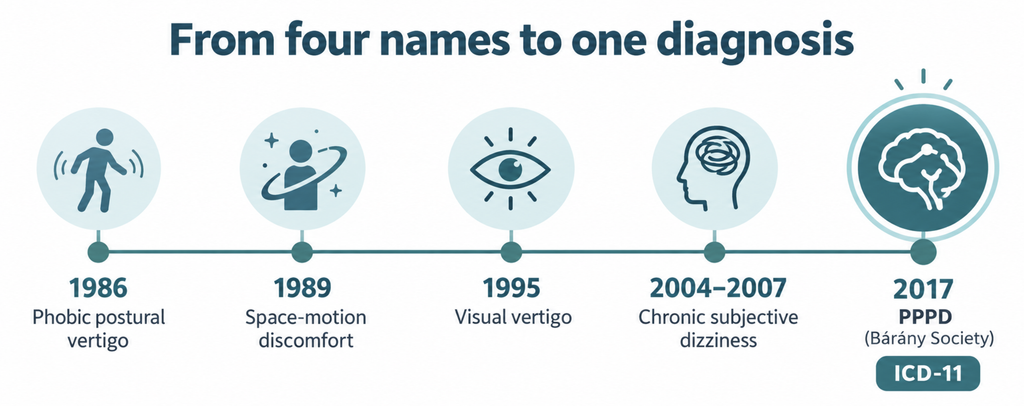
The problem itself is old. The label “psychogenic vertigo” appeared as early as 1958, and that framing likely added stigma [Moreno-Ajona, PPPD versus vestibular migraine, 2026]. In the decades that followed, researchers described overlapping syndromes under different names [Staab, Diagnostic criteria for PPPD, 2017]:
- Phobic postural vertigo (Brandt and Dieterich, 1986)
- Space-motion discomfort (1989)
- Visual vertigo (Bronstein, 1995)
- Chronic subjective dizziness (described in 2004, defined more explicitly in 2007)
In 2017, a Bárány Society committee merged their core features into a single diagnosis, which was also included in the World Health Organization’s ICD-11. The reasons were practical. With four overlapping names, research was inconsistent, and patients who “tested normal” had no diagnosis to guide treatment. A single positive definition let researchers study the condition and compare treatments, and it gave clinicians something more useful to tell patients than “nothing is wrong.”
How PPPD Chronic Dizziness Is Diagnosed
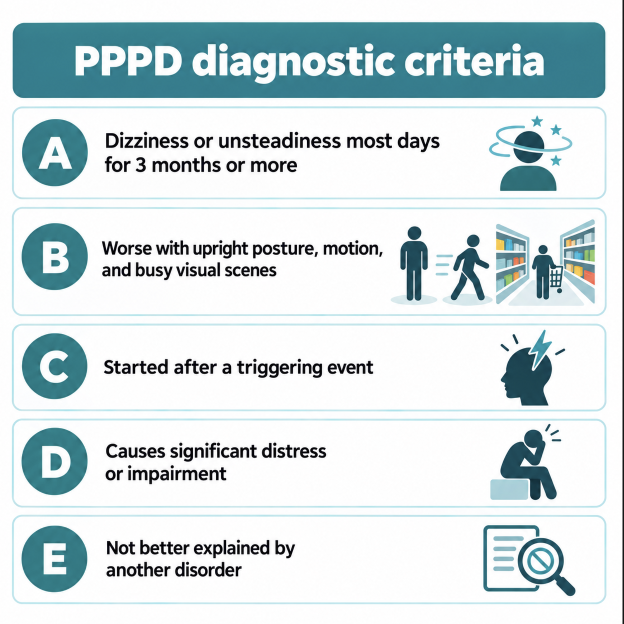
PPPD is a clinical diagnosis. No blood test, scan, or single vestibular test confirms it, and there is no validated biomarker [Eggers, Vestibular migraine and PPPD, 2024]. A patient must meet all five criteria [Staab, Diagnostic criteria for PPPD, 2017]:
| Criterion | What it requires | A question to ask in clinic |
|---|---|---|
| A | Dizziness, unsteadiness, or non-spinning vertigo on most days for 3 months or more | “Is it there most days, and for how long?” |
| B | Persistent, and worse with upright posture, motion, and moving or complex visual scenes | “Is it worse standing, in shops, or looking at screens?” |
| C | Began after a vestibular, medical, or psychological event | “What happened when it started?” |
| D | Causes significant distress or impairment | “What have you stopped doing?” |
| E | Not better accounted for by another disorder | “Does another active condition fully explain this?” |
Examination and testing still matter, because they pick up other conditions and show whether an ongoing disorder explains all of the symptoms or only some of them [Staab, Persistent Postural-Perceptual Dizziness, 2020].
For clinicians. Criterion B tends to be the most useful at the bedside. The combination of upright posture, motion, and visual complexity is what separates PPPD from vague “chronic dizziness.” Normal vestibular results don’t argue against the diagnosis; tests and imaging are usually negative [Popkirov, PPPD: a common, characteristic and treatable cause of chronic dizziness, 2018].
Is PPPD a Diagnosis of Exclusion? Can It Coexist With Other Conditions?
No. PPPD is recognized by its own characteristic pattern, not simply because everything else came back negative [Popkirov, PPPD: a common, characteristic and treatable cause of chronic dizziness, 2018]. The consensus document also says PPPD can coexist with other diseases, and that another active illness does not necessarily rule it out [Staab, Diagnostic criteria for PPPD, 2017].
Both PPPD and coexistence are common. One review estimates that PPPD is the primary diagnosis in about 10% of cases at specialized dizziness clinics, and in up to 20% when cases alongside other vestibular disorders are counted. Up to 17% of people with PPPD also meet vestibular migraine criteria, and 53% report migraine headaches [Moreno-Ajona, PPPD versus vestibular migraine, 2026].
In practice, the skill lies in telling attacks apart from the background. A patient with Ménière’s disease or vestibular migraine may have distinct spinning episodes and, underneath them, a constant daily unsteadiness that gets worse in busy places. The episodes belong to the other condition. The persistent background may be PPPD, and each needs its own treatment [Eggers, Vestibular migraine and PPPD, 2024].
What Causes PPPD? Known Triggers and Proposed Mechanisms
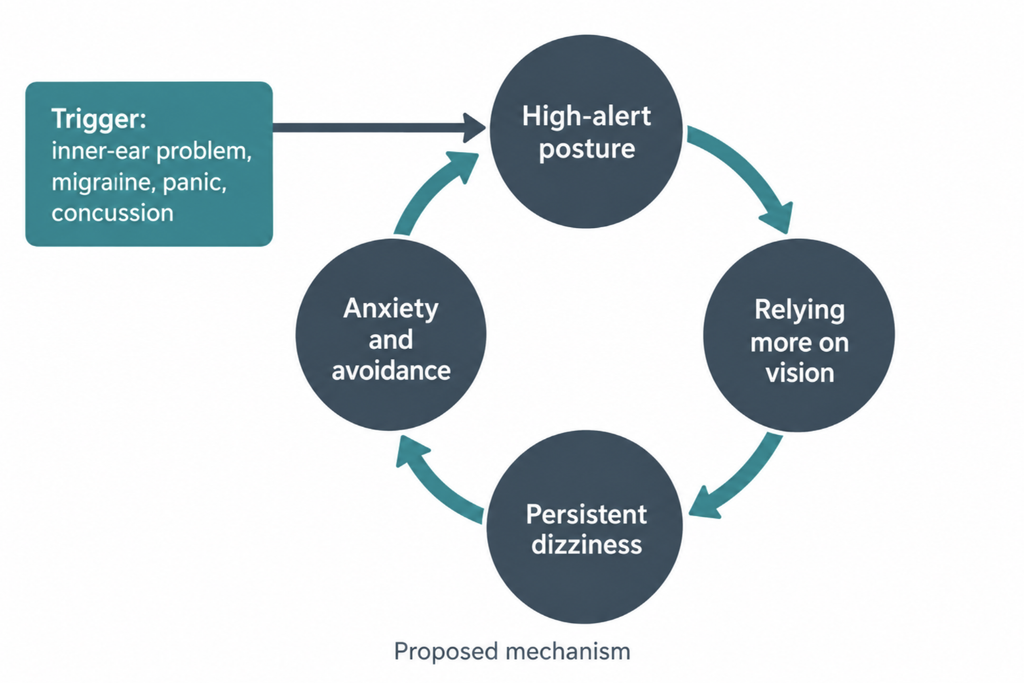
PPPD usually follows a triggering event, although a clear trigger isn’t always found [Moreno-Ajona, PPPD versus vestibular migraine, 2026]. The consensus document summarizes the common ones: peripheral or central vestibular disorders such as vestibular neuritis or BPPV (25 to 30% of cases), vestibular migraine (15 to 20%), and concussion or whiplash (10 to 15%). Panic attacks and anxiety-related dizziness were also frequent triggers [Staab, Diagnostic criteria for PPPD, 2017].
The puzzling part is that the trigger settles while the dizziness stays. Studies of people recovering from acute vestibular illness offer some clues. After vestibular neuritis, poor recovery was linked to visual dependence, heightened arousal, anxiety, and fear of bodily sensations, and not to how damaged the inner ear looked on testing [Cousins, Predictors of clinical recovery from vestibular neuritis, 2017]. An earlier study found that early fear of bodily sensations, combined with a severe initial episode, predicted ongoing dizziness three months later [Heinrichs, Predicting continued dizziness, 2007].
The proposed explanation is that the balance system switched to an emergency strategy and never switched back. People with PPPD appear to hold a stiffened, high-alert posture even on firm ground [Staab, PPPD: Review and Update on Key Mechanisms, 2023]. In one small study, 20 patients did worse than healthy controls across multiple balance-test conditions [Söhsten, Posturographic profile of patients with PPPD, 2016]. The brain also seems to lean more on vision than on the inner ear, which may be why supermarkets and screens set off symptoms [Indovina, Brain Correlates of PPPD, 2021].
Imaging studies add a physiological layer. Activity and connectivity in vestibular processing areas appear reduced, while connections between the prefrontal cortex (attention and emotion) and visual and motor regions appear increased [Indovina, Brain Correlates of PPPD, 2021]. These findings describe how the system may be running differently. They don’t prove cause, and they can’t be used as a diagnostic test.
How Is PPPD Treated? Non-Drug and Drug Options
The aim of treatment is mainly to recalibrate the balance system, with suppressing the dizziness a secondary concern. Current reviews describe a combination of education, specialized vestibular rehabilitation, cognitive behavioral therapy (CBT), and in some cases serotonergic medication [Popkirov, Treatment of PPPD and Related Disorders, 2018]. They put clear communication first: patients need to hear that their symptoms have a name, a mechanism, and a treatment plan [Popkirov, PPPD: a common, characteristic and treatable cause of chronic dizziness, 2018].
Non-Drug Treatment
Vestibular rehabilitation. Habituation exercises expose the brain to movement and visual stimulation a little at a time, until it stops over-reacting. A meta-analysis of 8 studies found that rehabilitation improved Dizziness Handicap Inventory scores by about 22 points on the 100-point scale compared with controls, although the authors called for more randomized trials [Li, VRT in patients with PPPD, 2025]. Programs have to be tailored: in patients with migraine, poorly adjusted exercises can aggravate symptoms [Moreno-Ajona, PPPD versus vestibular migraine, 2026].
Cognitive behavioral therapy. CBT goes after the hypervigilance, avoidance, and “safety behaviors” that keep the cycle going. In a randomized trial of 41 patients with chronic subjective dizziness (a predecessor diagnosis), three sessions reduced dizziness handicap and avoidance compared with a wait-list [Edelman, CBT for chronic subjective dizziness, 2012]. Reviews increasingly favor pairing rehabilitation with psychologically informed approaches [Popkirov, Treatment of PPPD and Related Disorders, 2018].
Newer approaches. Non-invasive brain stimulation and virtual-reality rehabilitation are being studied, but the evidence is early. A Cochrane review found only one eligible trial with adequate follow-up, a brain-stimulation study of 24 people, which is too small to draw conclusions from [Webster, Non-pharmacological interventions for PPPD, 2023]. A network meta-analysis of 11 RCTs (518 patients) suggested neuromodulation might help, but 81.8% of the included studies were at high risk of bias [Shen, Non-pharmacological interventions for PPPD, 2026].
Medication
SSRIs and SNRIs are the drugs usually discussed, and they may help even patients who don’t have anxiety or depression [Moreno-Ajona, PPPD versus vestibular migraine, 2026]. Most of the supporting evidence is uncontrolled, though. In an open-label sertraline study of 24 patients with chronic subjective dizziness, 11 of the 15 who completed it (73%) responded [Staab, Sertraline for chronic subjective dizziness, 2004]. A Cochrane review, on the other hand, found no placebo-controlled trials that met its criteria, so the true effect is still uncertain [Webster, Pharmacological interventions for PPPD, 2023]. Whether to use medication is a decision for an individual conversation with a physician.
Vestibular suppressants (antihistamine-type dizziness pills and benzodiazepines) are another matter. For BPPV, the American Academy of Otolaryngology-Head and Neck Surgery guideline recommends against routine use [Bhattacharyya, Clinical Practice Guideline: BPPV (Update), 2017]. PPPD treatment depends on the brain re-learning normal balance, so sedating the system over the long term generally works against it.
What about recovery? Long-term data on PPPD itself are limited. One older follow-up tracked 106 patients with phobic postural vertigo: after a mean of 8.5 years, 75% had improved and 27% were in complete remission. Setbacks were common, and 47% of those who improved had temporary relapses [Huppert, Phobic postural vertigo long-term follow-up, 2005].
Clinical Perspective. In an ENT setting, PPPD often hides behind a success story. The BPPV was repositioned, the vestibular neuritis compensated, and the patient was told everything is fine, yet the unsteadiness continues. Recognizing the pattern early, explaining it plainly, and shifting the patient from long-term suppressants toward rehabilitation is often where things turn around.
Is PPPD Real? Psychiatric Disorder or Physiological Problem?
It’s an understandable question. Test results are usually normal, anxiety often comes along with the condition, and one of its ancestors was literally called “psychogenic vertigo.” Patients sometimes hear the diagnosis as “it’s all in your head.”
The consensus answer is that PPPD is real, and that it is functional rather than psychiatric [Staab, Diagnostic criteria for PPPD, 2017]. It now belongs to the functional neurological disorders, a group in which symptoms are genuinely experienced and driven by altered brain network function. Psychological stressors are common risk factors in these disorders, but they are often absent [Hallett, Functional neurological disorder, 2022]. In a cohort of 345 patients with chronic dizziness, researchers warned that high rates of secondary anxiety can create a false impression that the dizziness is psychogenic [Staab, Expanding the differential diagnosis of chronic dizziness, 2007]. In many patients, the anxiety comes after the dizziness rather than causing it.
At the group level, posture testing and brain imaging show measurable differences in how people with PPPD process balance and visual information [Indovina, Brain Correlates of PPPD, 2021]. “Functional” describes how the system is running. It says nothing about whether the symptoms are imagined.
The debate isn’t settled, and the open questions deserve an honest look:
- No biomarker. Diagnosis still rests on symptom-based criteria [Eggers, Vestibular migraine and PPPD, 2024].
- Thin treatment evidence. Cochrane reviews found almost no long-term randomized trials [Webster, Pharmacological interventions for PPPD, 2023].
- Overlap with migraine. Some researchers argue that part of what gets called PPPD may be chronic vestibular migraine, which needs different treatment [Moreno-Ajona, PPPD versus vestibular migraine, 2026].
- A spectrum in the general population. In a UK study, about 9%, 4%, and 11% of three non-clinical groups scored above the 25th percentile of PPPD patients on a visual vertigo scale. That suggests some brains may be predisposed before any trigger comes along [Powell, PPPD is on a spectrum in the general population, 2020].
These gaps don’t make the symptoms any less real, but the definition may be refined, and perhaps subdivided, as the research matures.
If You Think You Might Have PPPD: What to Tell Your Doctor
If dizziness has lingered for months after an inner-ear problem, a migraine attack, a concussion, or a period of intense stress, it’s worth pursuing rather than accepting “it’s nothing.” It helps to bring specifics:
- When it started, and what was happening around then
- Whether it is present most days, and whether it is constant or comes in attacks
- Whether standing, walking, car rides, shops, crowds, or screens make it worse
- What you have stopped doing because of it
- Every dizziness medication you take, and for how long
A short symptom diary makes this conversation much more productive. An otolaryngologist, neurologist, or dizziness clinic can then work out whether PPPD, another condition, or both are involved.
Key Takeaways
- PPPD is a chronic functional vestibular disorder, defined by the Bárány Society in 2017 and included in ICD-11.
- It causes dizziness or unsteadiness on most days for 3 months or more, made worse by upright posture, motion, and complex visual scenes.
- PPPD is not a diagnosis of exclusion, and it can coexist with BPPV, vestibular migraine, Ménière’s disease, or anxiety.
- Vestibular rehabilitation and CBT are the main treatments, sometimes with SSRIs or SNRIs, though controlled evidence is still limited.
- Normal test results don’t mean the dizziness is imaginary. “Functional” refers to how the balance system operates, not to whether the symptoms are real.
FAQ
Is PPPD a psychological condition?
No. The Bárány Society classifies PPPD as a chronic functional vestibular disorder, not a psychiatric one [Staab, Diagnostic criteria for PPPD, 2017]. Anxiety can make symptoms worse, but it’s a risk factor, not a requirement.
Can you have PPPD and vestibular migraine (or BPPV) at the same time?
Yes. PPPD can coexist with other vestibular conditions, and up to 17% of people with PPPD also meet vestibular migraine criteria [Moreno-Ajona, PPPD versus vestibular migraine, 2026]. The attacks and the constant background dizziness are treated separately.
How long does PPPD last, and can it go away?
It varies. PPPD often lasts a long time, but it can improve. In an older follow-up of a predecessor diagnosis, 75% of patients improved over several years, and those diagnosed sooner tended to do better [Huppert, Phobic postural vertigo long-term follow-up, 2005].
What is the best treatment for PPPD?
Usually a combination of vestibular rehabilitation, CBT, and sometimes SSRIs or SNRIs, tailored to the patient [Popkirov, Treatment of PPPD and Related Disorders, 2018]. No single treatment has strong placebo-controlled evidence yet.
Should I take dizziness pills for PPPD?
Usually not. Long-term vestibular suppressants are not recommended for routine use in BPPV [Bhattacharyya, Clinical Practice Guideline: BPPV (Update), 2017], and they may work against the re-learning that PPPD treatment depends on. Talk to your doctor before changing any medication.
References
- Staab JP, Eckhardt-Henn A, Horii A, Jacob R, Strupp M, Brandt T, et al. Diagnostic criteria for persistent postural-perceptual dizziness (PPPD): Consensus document of the committee for the Classification of Vestibular Disorders of the Bárány Society. J Vestib Res. 2017;27(4):191-208.
- Kingma H, Manzari L, Özgirgin N. Enhancing patient care in BPPV-related residual dizziness: introducing the CLEAR algorithm to support BPPV-RD recognition and follow-up strategies. Front Neurol. 2025;16:1689617.
- Moreno-Ajona D. Persistent postural-perceptual dizziness versus vestibular migraine: A narrative review. Headache. 2026;66(1):298-306.
- Eggers SDZ, Staab JP. Vestibular migraine and persistent postural perceptual dizziness. Handb Clin Neurol. 2024;199:389-411.
- Staab JP. Persistent Postural-Perceptual Dizziness. Semin Neurol. 2020;40(1):130-137.
- Popkirov S, Staab JP, Stone J. Persistent postural-perceptual dizziness (PPPD): a common, characteristic and treatable cause of chronic dizziness. Pract Neurol. 2018;18(1):5-13.
- Cousins S, Kaski D, Cutfield N, Arshad Q, Ahmad H, Gresty MA, et al. Predictors of clinical recovery from vestibular neuritis: a prospective study. Ann Clin Transl Neurol. 2017;4(5):340-346.
- Heinrichs N, Edler C, Eskens S, Mielczarek MM, Moschner C. Predicting continued dizziness after an acute peripheral vestibular disorder. Psychosom Med. 2007;69(7):700-7.
- Söhsten E, Bittar RS, Staab JP. Posturographic profile of patients with persistent postural-perceptual dizziness on the sensory organization test. J Vestib Res. 2016;26(3):319-26.
- Staab JP. Persistent Postural-Perceptual Dizziness: Review and Update on Key Mechanisms of the Most Common Functional Neuro-otologic Disorder. Neurol Clin. 2023;41(4):647-664.
- Indovina I, Passamonti L, Mucci V, Chiarella G, Lacquaniti F, Staab JP. Brain Correlates of Persistent Postural-Perceptual Dizziness: A Review of Neuroimaging Studies. J Clin Med. 2021;10(18).
- Popkirov S, Stone J, Holle-Lee D. Treatment of Persistent Postural-Perceptual Dizziness (PPPD) and Related Disorders. Curr Treat Options Neurol. 2018;20(12):50.
- Li Y, Pei X, Ding R, Liu Z, Xu Y, Wang Z, et al. Effect of vestibular rehabilitation therapy in patients with persistent postural perceptual dizziness: a systematic review and meta-analysis. Front Neurol. 2025;16:1599201.
- Edelman S, Mahoney AE, Cremer PD. Cognitive behavior therapy for chronic subjective dizziness: a randomized, controlled trial. Am J Otolaryngol. 2012;33(4):395-401.
- Webster KE, Kamo T, Smith L, Harrington-Benton NA, Judd O, Kaski D, et al. Non-pharmacological interventions for persistent postural-perceptual dizziness (PPPD). Cochrane Database Syst Rev. 2023;3(3):CD015333.
- Shen J, Zhao X, Huo Y, Chen S, Deng W, Zheng W, et al. Comparative efficacy of non-pharmacological interventions for persistent postural-perceptual dizziness: a systematic review and network meta-analysis of balance, anxiety, and depression outcomes. J Neurol. 2026;273(6).
- Staab JP, Ruckenstein MJ, Amsterdam JD. A prospective trial of sertraline for chronic subjective dizziness. Laryngoscope. 2004;114(9):1637-41.
- Webster KE, Harrington-Benton NA, Judd O, Kaski D, Maarsingh OR, MacKeith S, et al. Pharmacological interventions for persistent postural-perceptual dizziness (PPPD). Cochrane Database Syst Rev. 2023;3(3):CD015188.
- Bhattacharyya N, Gubbels SP, Schwartz SR, Edlow JA, El-Kashlan H, Fife T, et al. Clinical Practice Guideline: Benign Paroxysmal Positional Vertigo (Update). Otolaryngol Head Neck Surg. 2017;156(3_suppl):S1-S47.
- Huppert D, Strupp M, Rettinger N, Hecht J, Brandt T. Phobic postural vertigo–a long-term follow-up (5 to 15 years) of 106 patients. J Neurol. 2005;252(5):564-9.
- Hallett M, Aybek S, Dworetzky BA, McWhirter L, Staab JP, Stone J. Functional neurological disorder: new subtypes and shared mechanisms. Lancet Neurol. 2022;21(6):537-550.
- Staab JP, Ruckenstein MJ. Expanding the differential diagnosis of chronic dizziness. Arch Otolaryngol Head Neck Surg. 2007;133(2):170-6.
- Powell G, Derry-Sumner H, Rajenderkumar D, Rushton SK, Sumner P. Persistent postural perceptual dizziness is on a spectrum in the general population. Neurology. 2020;94(18):e1929-e1938.
Joonpyo Hong, MD is a board-certified otolaryngologist practicing in Korea. This article reflects his clinical interpretation of published research and does not constitute individual medical advice.
For more articles:
https://curiousmd.com/why-bppv-keeps-coming-back/
https://curiousmd.com/video-head-impulse-test-vhit/
https://curiousmd.com/menieres-disease-vs-syndrome/
Link out to:
https://vestibular.org/article/diagnosis-treatment/types-of-vestibular-disorders/persistent-postural-perceptual-dizziness/ — Vestibular Disorders Association (VeDA) overview of PPPD, covering diagnostic criteria, rehabilitation, medication, and counseling.
https://vestibular.org/blog/when-conditions-overlap-pppd-vestibular-migraine-and-other-comorbidities/ — VeDA explainer on how PPPD overlaps with vestibular migraine and other conditions.
https://my.clevelandclinic.org/health/diseases/persistent-postural-perceptual-dizziness — Cleveland Clinic’s plain-language guide to PPPD symptoms, diagnosis, and treatment.
https://www.mayoclinic.org/medical-professionals/otolaryngology/news/resolving-persistent-postural-perceptual-dizziness-pppd/mac-20596513 — Mayo Clinic’s clinician-facing article on a multidisciplinary approach to PPPD.