
Have you ever wondered whether training with a cold still counts? Every winter, people who lift ask some version of the same question: does a workout still count if you do it with a cold? Feeling miserable is taken for granted. The worry is that the session is wasted effort. There’s no settled answer, and working out why there isn’t tells you more than a yes or no would.
One narrow question is in scope here: does an upper respiratory infection change how muscle grows in response to strength training? Safety is a separate question with a separate evidence base. If you have a fever, chest symptoms, or significant body aches, that one belongs in a consultation room.
The question is built on a myth
Almost everyone asking works from the same mental model: you train, you tear muscle fibers, the body repairs them, and they come back stronger. If that were right, an infection that interferes with repair would sabotage your gains directly. The model holds up poorly.
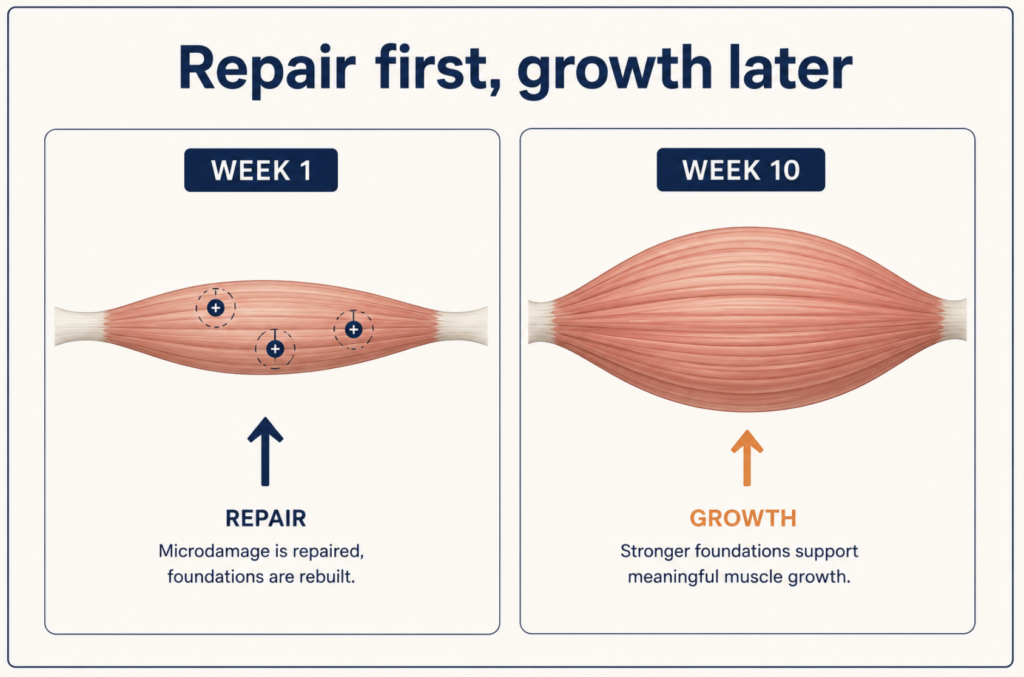
Researchers tracked ten young men through ten weeks of resistance training, measuring day-to-day muscle protein synthesis with deuterated water and taking biopsies to grade actual structural damage [Damas, Resistance training-induced changes in integrated myofibrillar protein synthesis, 2016]. In week one, damage peaked and so did protein synthesis. But that early surge bore no relationship to how much muscle the men eventually gained. Only after damage faded, at weeks three and ten, did protein synthesis begin tracking with growth, and then it tracked closely.
So the early response looks like repair work. Construction comes later. The same group went on to argue that protocols causing minimal damage still produce comparable growth [Damas, The development of skeletal muscle hypertrophy through resistance training, 2018].
Ten participants and no control group is a small study making a large point, so hedge accordingly. Still, it changes what you should be asking. The question stops being whether a cold slows repair and becomes whether infection dampens the growth signal itself.
What infection does to the growth machinery
Systemic infection suppresses the mTOR pathway in muscle, largely through TNF-alpha [Lang, Regulation of muscle protein synthesis during sepsis and inflammation, 2007]. mTOR is the switch that turns mechanical tension into new muscle protein. In one experiment, infected animals still responded normally to IGF-1 but stopped responding to leucine, the amino acid that ordinarily triggers protein synthesis after a meal [Lang, Differential effect of sepsis on ability of leucine and IGF-I to stimulate muscle translation initiation, 2004]. The machinery was still running. It had just stopped taking one of its usual cues.
The caveat here matters more than the finding. All of it comes from sepsis and endotoxin models in animals, where the inflammatory load runs orders of magnitude beyond a head cold. None of it is evidence about your Tuesday workout.
Which leaves an obvious objection. A cold lives in the nose and throat, so why would your quadriceps care at all? Mice infected with influenza offer a partial answer. Their muscles showed increased expression of inflammatory and atrophy genes and decreased expression of the positive regulators of muscle mass, and there was no evidence that the virus had reached muscle tissue itself [Bartley, Aging augments the impact of influenza respiratory tract infection on muscle, 2016]. The signal got there even though the pathogen didn’t.
One animal study with one virus is a proposed mechanism and nothing firmer. It’s enough to make “it’s only in my nose” look shaky. It isn’t enough to prove anything past that.
What we know about human strength during a cold
The two studies worth reading here are old and small, and both were carefully designed.
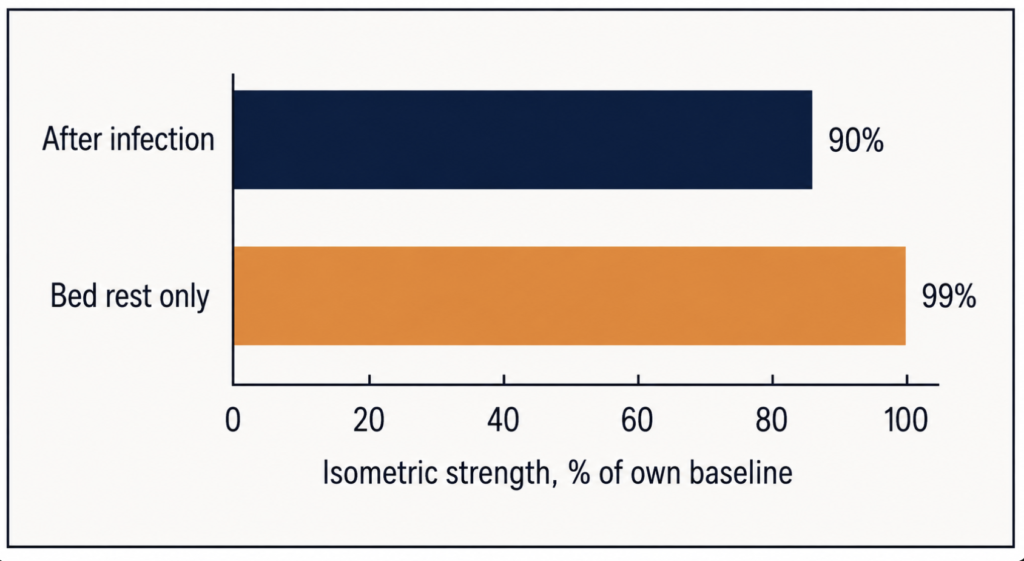
In the first, thirty-nine patients recovering from acute infections were compared against twenty-two healthy men confined to bed for the same period. Isometric strength in the patient group sat at 85.4 to 95.3 percent of their own four-month baseline, while the bed-rest controls stayed between 96.3 and 102.5 percent [Friman, Effect of acute infectious disease on isometric muscle strength, 1977]. That design pulls apart the effect of infection and the effect of simply lying around. One detail shapes how you read it: measurements were taken after fever had resolved, so what it captures is weakness lingering into recovery, not weakness at the peak of the illness.
In the second, seven volunteers were inoculated with a fever-causing virus. Strength and endurance dropped during the fever, and the size of the drop tracked with how much muscle ache the volunteers reported, not with their temperature [Friman, Does fever or myalgia indicate reduced physical performance capacity in viral infections, 1985]. Seven subjects makes that an observation and nothing more, though it does hint that how achy you feel is the more useful signal.
Nobody has measured training with a cold and muscle growth
The nearest available evidence answers a different question. Volunteers inoculated with rhinovirus and assigned to forty minutes of moderate exercise every other day for ten days showed no difference in symptom severity or illness duration from a non-exercising group [Weidner, The effect of exercise training on the severity and duration of a viral upper respiratory illness, 1998]. Reassuring, but that was aerobic exercise, and what it measured was the illness.
A review of seventeen studies found that athletes consistently report reduced training capacity while sick, on self-reported measures [Kaulback, The effects of acute respiratory illness on exercise and sports performance outcomes in athletes, 2023]. That may be the most practical finding available. Even if muscle keeps responding normally, you can’t generate the same tension, and a smaller stimulus is a smaller stimulus.
Skipping a few sessions costs you nothing
In athletes and military recruits, about eighty percent of acute respiratory illnesses cost no training days at all, with symptoms averaging 7.1 days [Snyders, Acute respiratory illness and return to sport, 2022].
Missed sessions are cheaper than people think. Seventeen young men who stopped training entirely for three weeks retained their strength, and in the higher-intensity group their muscle size as well [Yasuda, Effects of short-term detraining following blood flow restricted low-intensity training, 2015]. In older adults, twelve to twenty-four weeks of detraining produced no significant loss of muscle size [Grgic, Use it or lose it?, 2022]. Neither study looked at a gap of a few days, because a few days is too short to be worth studying. Which is roughly the answer.
Clinical Perspective
Nobody can say that training with a cold blunts your gains, because nobody has measured it. The framing behind the question is usually backwards anyway. A session where you manage half your normal load gives you a weaker stimulus and a worse hour, and counting it as a partial win overstates what you got.
Muscle accumulates over weeks, so one or two absences leave no visible mark. The argument for sitting out has nothing to do with rest speeding recovery, which the one available trial doesn’t support. You’re simply not giving anything up.
The reason to stay out of the gym has nothing to do with your muscles
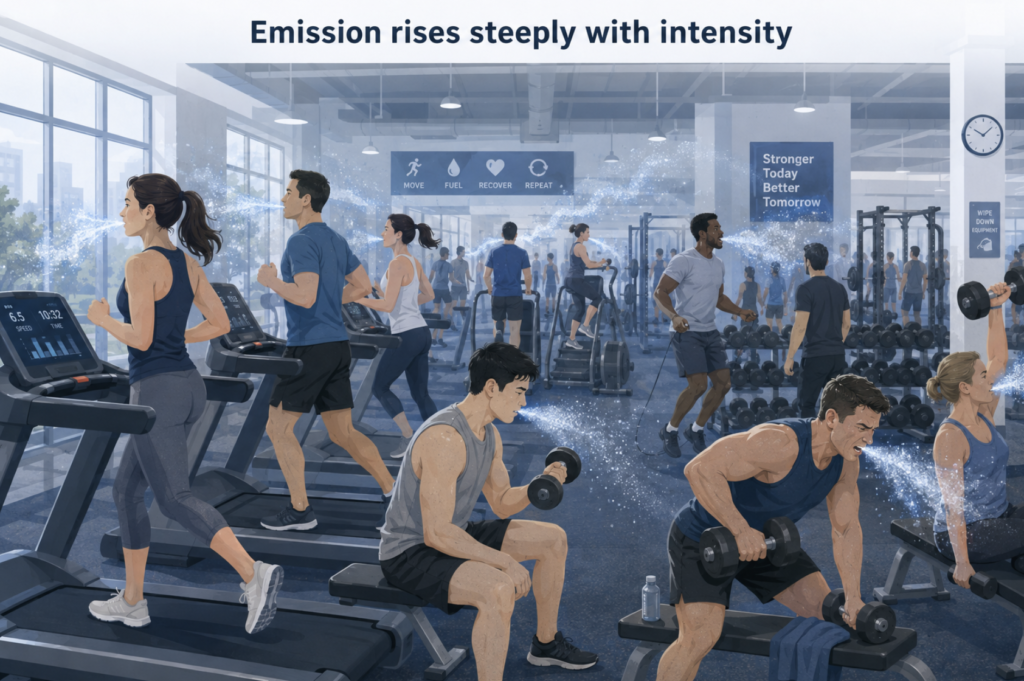
Aerosol particle emission climbs steeply with exercise intensity. Researchers measuring exhaled particles across a graded test to exhaustion found emission rising modestly at easy workloads and then exponentially once effort passed a moderate threshold, with endurance-trained subjects emitting the most at maximum [Mutsch, Aerosol particle emission increases exponentially above moderate exercise intensity, 2022]. During the pandemic, a cluster traced to high-intensity fitness dance classes in Cheonan, South Korea spread across twelve sports facilities [Jang, Cluster of coronavirus disease associated with fitness dance classes, 2020].
Two caveats. Both studies involve SARS-CoV-2, not the average cold, and the steepest measurements come from all-out cycling and group dance classes, a long way from a normal session on the rack. An older review also notes that common colds are surprisingly reluctant to transmit [Weidner, Sport, exercise, and the common cold, 1996]. Fair enough, though that observation predates what we now know about rooms full of people breathing hard indoors.
Something light at home is defensible. A shared gym is a different matter, and that call is about the people around you, not about the evidence on hypertrophy.
Key Takeaways
The “tear it down to build it back stronger” model is poorly supported. Early post-workout protein synthesis appears to serve repair, and growth tracks with it only later.
Severe infection suppresses muscle protein synthesis in animals, but that evidence comes from sepsis, not head colds.
No study has measured muscle growth from resistance training during an upper respiratory infection.
Missing a few sessions has no measurable effect on muscle size, because hypertrophy accumulates over weeks.
Aerosol emission rises sharply with exercise intensity, which makes a shared gym the wrong place to be while symptomatic.
FAQ
Will I lose muscle if I skip the gym for a week with a cold? No. Studies of complete training cessation lasting three weeks or longer show strength and muscle size are largely retained. Muscle is built through weeks of accumulated stimulus, so a week’s gap sits within the noise. What you notice on returning is usually a temporary drop in performance, not lost tissue.
Is body ache a better guide than fever? Possibly. In a small inoculation study, the drop in strength tracked with reported muscle ache instead of temperature. Seven subjects makes that an observation and not a rule, but how achy you feel is a reasonable signal to weigh.
Can I train at home instead? Yes, within limits. With mild symptoms confined to the head, light training at home is unlikely to prolong the illness, based on a trial using aerobic exercise. Expect to lift less than usual. Fever, chest symptoms, or significant aching is a different question, and worth discussing with a doctor.
References
- Damas F, Phillips SM, Libardi CA, Vechin FC, Lixandrão ME, Jannig PR, et al. Resistance training-induced changes in integrated myofibrillar protein synthesis are related to hypertrophy only after attenuation of muscle damage. J Physiol. 2016;594(18):5209-22.
- Damas F, Libardi CA, Ugrinowitsch C. The development of skeletal muscle hypertrophy through resistance training: the role of muscle damage and muscle protein synthesis. Eur J Appl Physiol. 2018;118(3):485-500.
- Lang CH, Frost RA, Vary TC. Regulation of muscle protein synthesis during sepsis and inflammation. Am J Physiol Endocrinol Metab. 2007;293(2):E453-9.
- Lang CH, Frost RA. Differential effect of sepsis on ability of leucine and IGF-I to stimulate muscle translation initiation. Am J Physiol Endocrinol Metab. 2004;287(4):E721-30.
- Bartley JM, Pan SJ, Keilich SR, Hopkins JW, Al-Naggar IM, Kuchel GA, et al. Aging augments the impact of influenza respiratory tract infection on mobility impairments, muscle-localized inflammation, and muscle atrophy. Aging (Albany NY). 2016;8(4):620-35.
- Friman G. Effect of acute infectious disease on isometric muscle strength. Scand J Clin Lab Invest. 1977;37(4):303-8.
- Friman G, Wright JE, Ilbäck NG, Beisel WR, White JD, Sharp DS, et al. Does fever or myalgia indicate reduced physical performance capacity in viral infections? Acta Med Scand. 1985;217(4):353-61.
- Weidner TG, Cranston T, Schurr T, Kaminsky LA. The effect of exercise training on the severity and duration of a viral upper respiratory illness. Med Sci Sports Exerc. 1998;30(11):1578-83.
- Kaulback K, Pyne DB, Hull JH, Snyders C, Sewry N, Schwellnus M. The effects of acute respiratory illness on exercise and sports performance outcomes in athletes – a systematic review by a subgroup of the IOC consensus group on “Acute respiratory illness in the athlete”. Eur J Sport Sci. 2023;23(7):1356-74.
- Snyders C, Pyne DB, Sewry N, Hull JH, Kaulback K, Schwellnus M. Acute respiratory illness and return to sport: a systematic review and meta-analysis by a subgroup of the IOC consensus on ‘acute respiratory illness in the athlete’. Br J Sports Med. 2022;56(4):223-31.
- Yasuda T, Loenneke JP, Ogasawara R, Abe T. Effects of short-term detraining following blood flow restricted low-intensity training on muscle size and strength. Clin Physiol Funct Imaging. 2015;35(1):71-5.
- Grgic J. Use it or lose it? A meta-analysis on the effects of resistance training cessation (detraining) on muscle size in older adults. Int J Environ Res Public Health. 2022;19(21):14048.
- Mutsch B, Heiber M, Grätz F, Hain R, Schönfelder M, Kaps S, et al. Aerosol particle emission increases exponentially above moderate exercise intensity resulting in superemission during maximal exercise. Proc Natl Acad Sci U S A. 2022;119(22):e2202521119.
- Jang S, Han SH, Rhee JY. Cluster of coronavirus disease associated with fitness dance classes, South Korea. Emerg Infect Dis. 2020;26(8):1917-20.
- Weidner TG, Sevier TL. Sport, exercise, and the common cold. J Athl Train. 1996;31(2):154-9.
Joonpyo Hong, MD is a board-certified otolaryngologist practicing in Korea. This article reflects his clinical interpretation of published research and does not constitute individual medical advice.
For more articles:
https://curiousmd.com/acetaminophen-vs-nsaids-evidence/
https://curiousmd.com/cough-that-wont-go-away-after-a-cold/
Link out to:
- https://pmc.ncbi.nlm.nih.gov/articles/PMC5023708/ — The Journal of Physiology study that tracked muscle protein synthesis and muscle damage across ten weeks of resistance training. Full text, free to read.
- https://pmc.ncbi.nlm.nih.gov/articles/PMC9295808/ — The PNAS study behind the claim that aerosol emission climbs exponentially past moderate exercise intensity, with the full figures. Open access.
- https://wwwnc.cdc.gov/eid/article/26/8/20-0633_article — The CDC’s Emerging Infectious Diseases report on the Cheonan fitness class outbreak, with the full contact-tracing detail.
- https://www.pnas.org/doi/10.1073/pnas.2220882120 — A follow-up study from the same group showing that resistance training emits considerably less than endurance sessions. Worth reading if you lift rather than spin.