
Patients skip antibiotic doses constantly, and clinicians almost never bring it up. Is skipping antibiotic doses a serious problem?
Consider a fairly ordinary visit. An adult with acute bacterial rhinosinusitis was prescribed amoxicillin-clavulanate three times daily and comes back on day five. The facial pressure eased by the second morning, then crept back. Asked about the medication, the patient answers with mild embarrassment: the morning dose went down reliably, the midday dose was forgotten at work most days, and the evening dose depended on when dinner happened.
This patient did not stop treatment. Nothing was thrown away and nothing was refused. The course was simply taken unevenly, a pattern that sits in the blind spot between “took the antibiotic” and “didn’t take the antibiotic,” and one that standard counselling rarely names.
The instinct is to reach for the familiar warning about resistance, which turns out to be the least defensible part of the conversation. A quieter pharmacological point turns out to be the sturdiest. There is also a structural irony worth sitting with: in a randomised study of outpatients treated for respiratory tract infections, adherence measured by pill count reached 97.6% for once-daily regimens, 66.0% for twice-daily, and 23.5% for three-times-daily dosing, with overall adherence of 76.6% across 406 patients [Kardas, Patient adherence in respiratory tract infections, 2001].
Choosing the right antibiotic and keeping the right antibiotic are different problems, and in upper respiratory infection they often point in opposite directions.
The antibiotics most recommended are the ones taken worst
Fewer than one in four patients on a three-times-daily regimen took it as written, two in three managed a twice-daily schedule, and nearly everyone managed once a day. Dosing frequency, not motivation or education, was the dominant variable.
A later trial using electronic monitoring (pill bottles that record each opening) found the same gradient and located it more precisely. Overall adherence was 93.7% on a once-daily regimen against 81.3% on twice-daily. The sharper finding concerned timing rather than quantity: correct intervals between doses were maintained 74.4% of the time on once-daily dosing and 56.4% of the time on twice-daily [Kardas, Once-daily vs twice-daily compliance, 2007]. Patients swallow most of their pills, but not at the intervals the regimen assumes.
Both studies carry real limits. They were conducted in the early 2000s, they enrolled respiratory tract infections broadly rather than upper respiratory infection specifically, and the electronic-monitoring trial studied a lower respiratory condition. The size and consistency of the gradient make it hard to dismiss, but these numbers describe respiratory infection in general and should not be quoted as an upper-airway statistic.
The awkward part is what the gradient collides with. Amoxicillin and amoxicillin-clavulanate, the agents current otolaryngology guidance names as first-line therapy for acute bacterial sinusitis [Payne, Adult Sinusitis Update, 2025], are typically dosed two or three times daily. The drugs the evidence most wants patients to take are the drugs patients are least able to take correctly.
Clinical Perspective: Most clinic counselling emphasises finishing the bottle and says nothing about spacing. Judging by the pharmacology, spacing is the part that carries more weight. A patient who keeps most doses on schedule is in better shape than one who takes the same number of doses in a bunched, irregular pattern.
What skipping antibiotic doses does to drug levels
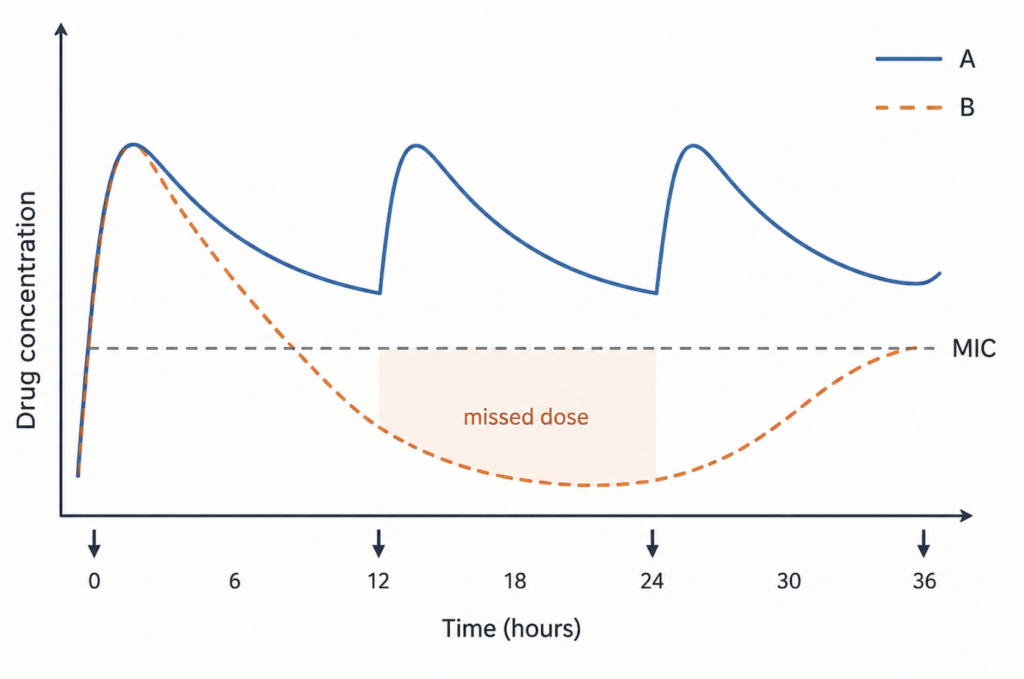
Antibiotics do not all kill in the same way, and the difference decides whether timing matters.
For beta-lactams (the penicillin family, which includes amoxicillin), killing depends on duration of exposure rather than peak height. The predictive measure is the proportion of each dosing interval during which the free drug concentration stays above the minimum inhibitory concentration, or MIC: the lowest concentration that stops the organism from growing. This measure is usually written as fT>MIC, and it is the parameter that best predicts whether a beta-lactam works [Craig, PK/PD parameters, 1998].
A dosing schedule is therefore a calculation rather than an arbitrary convenience. Contemporary pharmacokinetic modelling of oral beta-lactams for ear infection sets the target for amoxicillin-based regimens at free concentrations above the MIC for at least 50% of the interval [Fallon, PD target attainment of oral beta-lactams in AOM, 2008], and analyses comparing the periods before and after pneumococcal conjugate vaccination found that vaccination did not meaningfully change the probability that standard regimens reach that target [Ibar-Bariain, PK/PD analysis of AOM therapy before and after PCV7, 2019]. Both are modelling studies rather than measurements of patient outcomes; they describe how regimens are designed, not how many patients recover. The eight-hour instruction on the label exists because that is roughly how long one dose of amoxicillin keeps concentrations above the target.
Skip a dose and the concentration curve dips below the MIC for a stretch of hours. During that stretch, the pressure holding the bacterial population in check lifts. This is well-established pharmacology, and it is the honest core of the case for taking antibiotics on schedule.
It is also where the honest account stops. No study in upper respiratory infection has demonstrated that patients who miss doses go on to fail treatment more often. The mechanism is clear; the clinical consequence has not been measured in this setting. Anyone who states otherwise is extrapolating.
A missed dose creates a gap in coverage. Whether that gap changes the outcome of a sinus infection is a separate question, and it has not been answered.
Clinical Perspective: Knowing how a drug works is a reason to take it properly. It is not proof that taking it improperly causes harm, and most patient education slides from the first claim to the second without noticing. Patients tend to notice when a warning outruns its evidence. Explaining how the drug was designed to work is firmer ground than predicting a resistant infection.
Not all antibiotics carry the same weight: the AWaRe classification
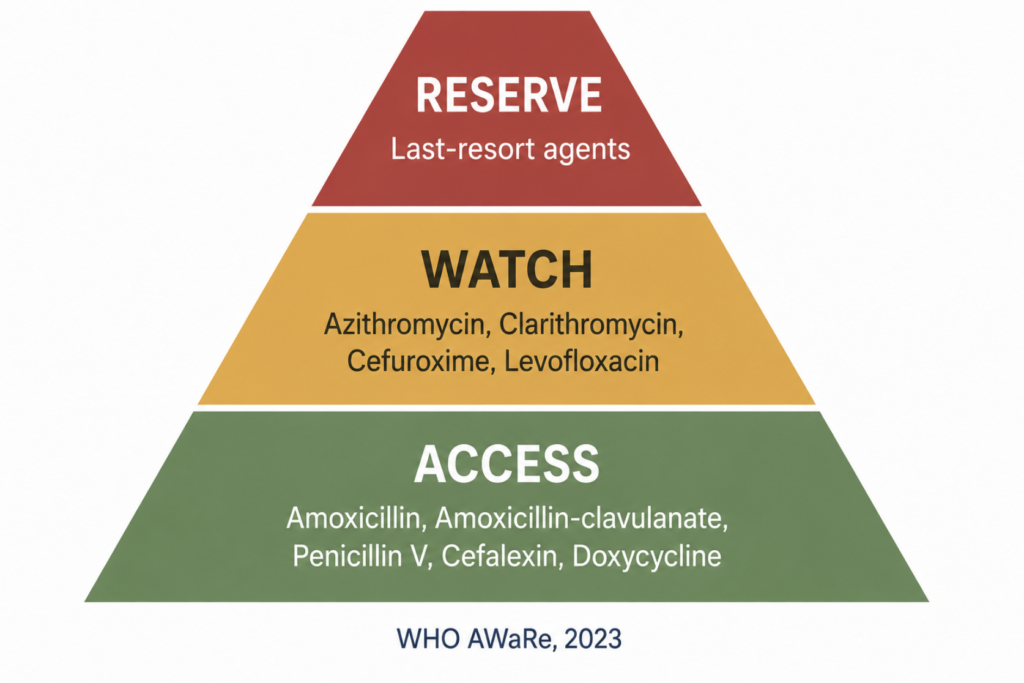
The World Health Organization sorts antibiotics into three groups under a framework called AWaRe. Access agents are narrow in spectrum and preferred as first-line therapy. Watch agents are broader, carry higher resistance potential, and are meant for a limited set of indications. Reserve agents are last-resort drugs for multidrug-resistant infection [WHO, AWaRe classification of antibiotics, 2023]. In 2024, United Nations member states committed to a target of 70% of all human antibiotic use coming from the Access group by 2030 (WHO AWaRe classification).
Placing the antibiotics commonly used for upper respiratory infection into that framework, alongside how each behaves pharmacologically, produces an uncomfortable pattern.
| Antibiotic | AWaRe group (WHO 2023) | How it kills | Typical dosing | Vulnerability to uneven timing |
|---|---|---|---|---|
| Amoxicillin | Access | Time above MIC | 2 to 3 times daily | Highest |
| Amoxicillin-clavulanate | Access | Time above MIC | 2 to 3 times daily | Highest |
| Penicillin V | Access | Time above MIC | 3 to 4 times daily | Highest |
| Cefalexin | Access | Time above MIC | 3 to 4 times daily | High |
| Doxycycline | Access | Total exposure | Twice daily | Moderate |
| Cefuroxime, cefpodoxime, cefdinir | Watch | Time above MIC | Twice daily | High |
| Clarithromycin | Watch | Time above MIC | Twice daily | Moderate |
| Levofloxacin, moxifloxacin | Watch | Peak and total exposure | Once daily | Moderate |
| Azithromycin | Watch | Total exposure, long tissue persistence | Once daily | Lowest |
The ranking works out backwards. Amoxicillin sits in the Access tier because it is narrow, cheap, and appropriate as first-line therapy, and it is at the same time the agent whose effect depends most tightly on even spacing, with the shortest half-life and the most frequent dosing. Azithromycin sits in the Watch tier, and it is the agent most forgiving of a forgotten dose.
Two caveats belong here. National bodies adapt the WHO list rather than adopting it wholesale, so an agent’s tier can differ between countries. And the specific target percentage has been questioned in the literature on the grounds that its epidemiological justification is not firmly established. AWaRe is a stewardship instrument, not a hierarchy of drug quality.
Clinical Perspective: The antibiotic that is safest to choose is not the one that is safest to be careless with. That has a practical consequence at the point of prescribing: the drug with the strongest claim to first-line status is also the one that most needs an explicit conversation about timing.
Azithromycin’s long tail
The cost of azithromycin’s convenience has been measured directly.
In a randomised, double-blind, placebo-controlled trial, healthy volunteers received azithromycin (74 participants), clarithromycin (74), or placebo (76), and throat swabs were taken repeatedly over 180 days. Both macrolides raised the proportion of macrolide-resistant streptococci in the throat compared with placebo at every point measured. The rise peaked at day eight in the clarithromycin group, with a mean increase of 50.0% (95% confidence interval 41.7 to 58.2), and at day four in the azithromycin group, at 53.4% (43.4 to 63.5). Four weeks in, the two drugs had separated: the azithromycin group still carried 17.4 percentage points more resistance than the clarithromycin group (9.2 to 25.6) [Malhotra-Kumar, Effect of azithromycin and clarithromycin on pharyngeal carriage, 2007].
In plain terms, a single course raised the resistant share of throat streptococci by roughly fifty percentage points at its peak, so about half the population flipped. A month later, the drug that was easiest to take was the one that had left the deeper mark.
The mechanism fits. Azithromycin persists in tissue far longer than a beta-lactam, which means the concentration does not stop at the end of the course. It trails downward through low levels for days, and a long tail of low-level exposure is precisely the condition under which resistant organisms hold an advantage over susceptible ones.
The study’s limits should be stated. These were healthy volunteers, not patients with infection, and the endpoint was carriage in the throat rather than treatment failure. It measures ecology rather than outcome. Within those limits, the causal direction is not in doubt: the exposure came first, the resistance followed, and placebo did neither.
Clinical Perspective: Switching to a once-daily antibiotic solves an adherence problem and creates a stewardship one. The trade is often worth making, but it should be a deliberate choice rather than a reflex triggered by a patient saying that three pills a day is inconvenient.
Skipping doses and stopping early are different problems
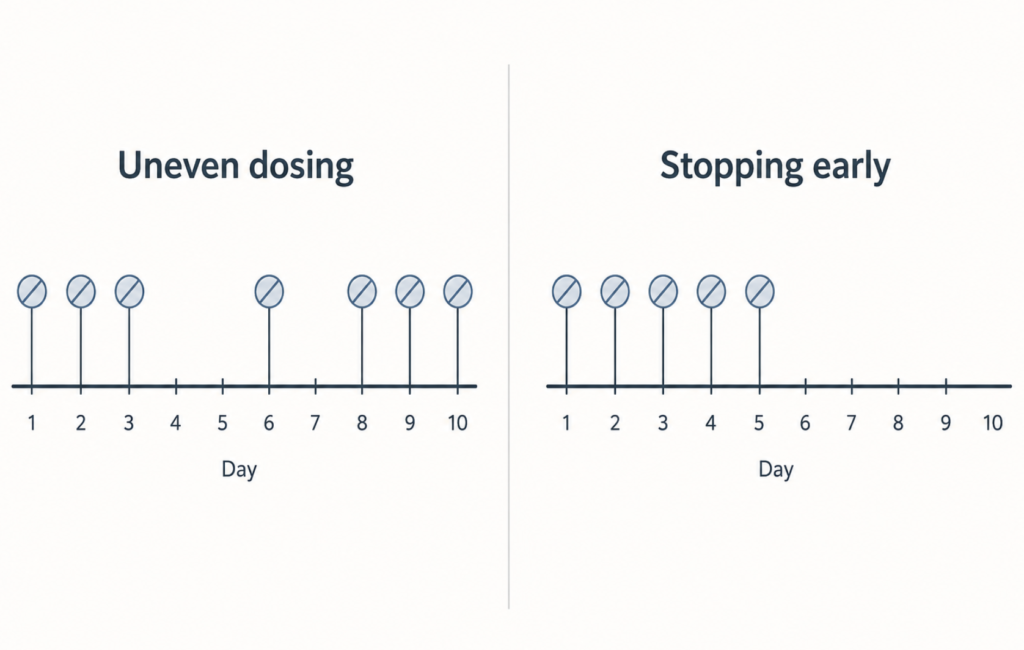
Public messaging has long collapsed these into one instruction. They deserve separating.
Uneven dosing is a pharmacological problem with a clear mechanism and no measured clinical consequence in upper respiratory infection.
Course duration is a genuinely contested question with a substantial evidence base, and the evidence largely favours shorter courses than tradition assumed.
For sinus infection the answer is settled. A meta-analysis of 12 randomised trials involving 4,430 adults with acute bacterial sinusitis found no difference in clinical success between short courses of three to seven days and longer courses of six to ten days (odds ratio 0.95, 95% confidence interval 0.81 to 1.12), so shorter worked as well as longer [Falagas, Short vs long duration antibiotic therapy for acute bacterial sinusitis, 2009].
Streptococcal throat infection is where the picture divides, and where two named authorities are easily confused.
The Infectious Diseases Society of America (IDSA) is a professional society of infectious disease physicians in the United States whose expert panels review evidence systematically and publish clinical practice guidelines. Its guidance recommends ten days of penicillin or amoxicillin for group A streptococcal pharyngitis, with azithromycin for five days among the alternatives for penicillin-allergic patients (IDSA guideline) [Shulman, IDSA guideline for GAS pharyngitis, 2012].
The BMJ is a peer-reviewed medical journal published in the United Kingdom. It publishes research and commentary; it does not issue guidelines. That distinction matters here because two very different items in that journal are routinely quoted as though they carried equal weight.
The first is a trial. A multicentre randomised non-inferiority study across 17 Swedish primary care centres assigned 433 patients with streptococcal pharyngotonsillitis to penicillin V four times daily for five days or three times daily for ten days. Clinical cure was 89.6% in the five-day group and 93.3% in the ten-day group (95% confidence interval -9.7 to 2.2), meeting the prespecified threshold for non-inferiority. Bacteriological eradication told a different story: 80.4% against 90.7% [Skoog Ståhlgren, Penicillin V four times daily for five days, 2019]. Cutting total exposure while increasing dosing frequency matched the standard regimen on symptoms and fell behind on clearing the organism.
A Cochrane review of 20 studies and 13,102 cases of streptococcal pharyngitis in children points the same way. Short courses produced fewer early clinical failures (odds ratio 0.80, 0.67 to 0.94) but more late bacteriological recurrence (1.31, 1.16 to 1.48), although that difference disappeared once trials of low-dose azithromycin were removed (1.06, 0.92 to 1.22). The review’s own authors noted that most included studies carried a high risk of bias, so the evidence points consistently in this direction without being settled [Altamimi, Short-term late-generation antibiotics vs longer term penicillin, 2012].
The second BMJ item is not a trial. In 2017, a group of infectious disease specialists published a commentary arguing that the public health message about completing every course is not supported by evidence and that longer-than-necessary treatment carries its own resistance cost [Llewelyn, The antibiotic course has had its day, 2017]. It is an argument rather than a finding, and it drew disagreement from other clinicians at the time. Quoting it as though a trial had overturned the ten-day recommendation misrepresents both documents.
None of these results contradict one another. A professional society recommends ten days; a trial reports that five days at higher frequency matched it on symptoms and trailed on eradication; a review finds shorter courses acceptable with a caveat about late recurrence. Reconciling them takes a judgement rather than a number, and that judgement rests on age, history of recurrence, the local burden of rheumatic heart disease, and whether a given patient can realistically take four doses a day.
Clinical Perspective: The useful question for a patient to leave with is what would change the answer in their own case, rather than how many days. Deciding duration is the prescriber’s work, informed by the guideline and by the trial evidence that complicates it. What patients can reasonably do is take doses at even intervals while the course is running, and ask before stopping rather than after.
Key Takeaways
Skipping doses and stopping a course early are separate behaviours with different risks, and collapsing them into one warning obscures both.
Beta-lactams such as amoxicillin work by holding drug concentrations above a threshold for a portion of each dosing interval, which is why the spacing of doses is built into the prescription.
The pharmacology of a missed dose is clear, but no study in upper respiratory infection has shown that missed doses lead to treatment failure.
The antibiotics guidelines most recommend for sinus infection are dosed two or three times daily, precisely the schedules patients keep worst.
A single course of a macrolide measurably shifts the bacteria in a healthy throat toward resistance, and the more convenient macrolide leaves the longer mark.
For sinus infection, shorter courses perform as well as longer ones. For streptococcal throat infection, the guideline and the trial evidence pull in different directions and the decision belongs with the treating clinician.
FAQ
Is it bad to skip one dose of an antibiotic? It depends on the drug. For a beta-lactam taken three times daily, a missed dose leaves a stretch of hours in which drug levels fall below the level that suppresses bacterial growth. For once-daily agents such as azithromycin, tissue levels persist long enough that a single missed dose changes less. No study in upper respiratory infection has measured whether either scenario changes the outcome.
Does skipping doses cause antibiotic resistance? Not in any way that has been demonstrated in an individual patient. What has been demonstrated is that taking a macrolide at all shifts throat bacteria toward resistance: in a placebo-controlled trial, the proportion of resistant streptococci rose by roughly half at peak [Malhotra-Kumar, Effect of azithromycin and clarithromycin on pharyngeal carriage, 2007]. Exposure drives resistance more reliably than uneven exposure does.
Is it worse to miss a once-daily antibiotic or a three-times-daily one? Missing a once-daily dose forfeits a full day of coverage rather than a third of one, but the long tissue persistence of most once-daily agents cushions the loss. The three-times-daily regimen is fragile in a different way: it is the schedule patients are least likely to keep at all, with adherence measured at 23.5% in one randomised outpatient study [Kardas, Patient adherence in respiratory tract infections, 2001].
Does a course still need to run ten days for strep throat? That is the standing recommendation from the Infectious Diseases Society of America. A Swedish randomised trial later found that five days of penicillin V given four times daily was non-inferior for clinical cure, though bacteriological eradication was lower [Skoog Ståhlgren, Penicillin V four times daily for five days, 2019]. Both findings are legitimate, and reconciling them for an individual patient is a clinical decision.
References
- Kardas P, Ratajczyk-Pakalska E. Patient adherence in respiratory tract infections: ceftibuten versus other antibiotics (PARTICULAR study). Pol Merkur Lekarski. 2001;10(60):445-449.
- Kardas P. Comparison of patient compliance with once-daily and twice-daily antibiotic regimens in respiratory tract infections: results of a randomized trial. J Antimicrob Chemother. 2007;59(3):531-536.
- Craig WA. Pharmacokinetic/pharmacodynamic parameters: rationale for antibacterial dosing of mice and men. Clin Infect Dis. 1998;26(1):1-10.
- Fallon RM, Kuti JL, Doern GV, Girotto JE, Nicolau DP. Pharmacodynamic target attainment of oral beta-lactams for the empiric treatment of acute otitis media in children. Paediatr Drugs. 2008;10(5):329-335.
- Ibar-Bariain M, Rodríguez-Gascón A, Isla A, Solinís MA, Canut-Blasco A. Application of pharmacokinetic/pharmacodynamic analysis to evaluate the adequacy of antimicrobial therapy for pediatric acute otitis media in Spain before and after the introduction of the PCV7 vaccine. Rev Esp Quimioter. 2019;32(2):121-129.
- World Health Organization. AWaRe classification of antibiotics for evaluation and monitoring of use, 2023. Geneva: WHO; 2023.
- Payne SC, McKenna M, Buckley J, et al. Executive summary of the clinical practice guideline on adult sinusitis update. Otolaryngol Head Neck Surg. 2025;173(2):299-316.
- Malhotra-Kumar S, Lammens C, Coenen S, Van Herck K, Goossens H. Effect of azithromycin and clarithromycin therapy on pharyngeal carriage of macrolide-resistant streptococci in healthy volunteers: a randomised, double-blind, placebo-controlled study. Lancet. 2007;369(9560):482-490.
- Falagas ME, Karageorgopoulos DE, Grammatikos AP, Matthaiou DK. Effectiveness and safety of short vs. long duration of antibiotic therapy for acute bacterial sinusitis: a meta-analysis of randomized trials. Br J Clin Pharmacol. 2009;67(2):161-171.
- Shulman ST, Bisno AL, Clegg HW, et al. Clinical practice guideline for the diagnosis and management of group A streptococcal pharyngitis: 2012 update by the Infectious Diseases Society of America. Clin Infect Dis. 2012;55(10):e86-e102.
- Skoog Ståhlgren G, Tyrstrup M, Edlund C, et al. Penicillin V four times daily for five days versus three times daily for 10 days in patients with pharyngotonsillitis caused by group A streptococci: randomised controlled, open label, non-inferiority study. BMJ. 2019;367:l5337.
- Altamimi S, Khalil A, Khalaiwi KA, Milner RA, Pusic MV, Al Othman MA. Short-term late-generation antibiotics versus longer term penicillin for acute streptococcal pharyngitis in children. Cochrane Database Syst Rev. 2012;8:CD004872.
- Llewelyn MJ, Fitzpatrick JM, Darwin E, et al. The antibiotic course has had its day. BMJ. 2017;358:j3418.
Joonpyo Hong, MD is a board-certified otolaryngologist practicing in Korea. This article reflects his clinical interpretation of published research and does not constitute individual medical advice.
This article is not intended to advertise or promote any specific company or product.
For more articles:
https://curiousmd.com/antibiotics-vs-antivirals-why-antivirals-are-rare/
https://curiousmd.com/antivirals-vs-antibiotics-why-so-few/
https://curiousmd.com/why-small-cap-biotech-investing-is-hard/
Link out to:
- WHO AWaRe classification of antibiotics, 2023
- IDSA clinical practice guideline for group A streptococcal pharyngitis
- Penicillin V five days versus ten days, randomised trial (BMJ, 2019)
- Macrolide therapy and pharyngeal carriage of resistant streptococci (Lancet, 2007)
- Short versus long antibiotic duration in acute bacterial sinusitis (meta-analysis)