
A clinician grabs a dizzy patient’s head, turns it about 15 degrees at high speed, and watches the eyes. That maneuver has been in the neuro-otology toolkit since 1988 [Halmagyi, A clinical sign of canal paresis, 1988] — and for two decades it missed deficits it should have caught, because the human eye cannot see the correction the brain makes mid-movement. The video head impulse test solved that problem with a camera. Here is what it measures, how it feels from the patient’s chair, and which diagnoses it changes.
What Is the Video Head Impulse Test?
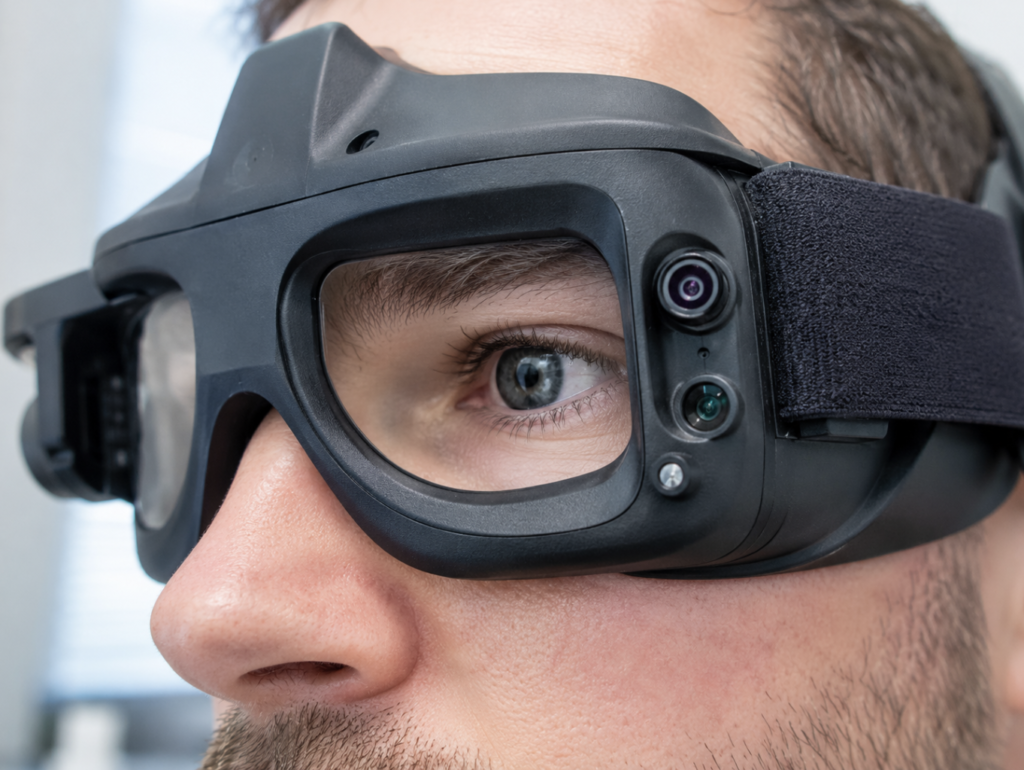
The video head impulse test (vHIT) is a quantitative measurement of the vestibulo-ocular reflex (VOR) — the reflex that holds your gaze steady on a target while your head moves. Lightweight goggles carry a high-speed infrared camera aimed at one eye and a motion sensor that tracks head velocity. Software compares the two signals and reports how faithfully the eyes compensated.
The original bedside version relied entirely on observation. When the reflex fails, the eyes drift off target and the brain fires a corrective saccade to snap them back — but only saccades occurring after the head stops are visible to an examiner. The camera records both kinds, and validation against the scleral search coil, the laboratory gold standard, showed the video version performs equivalently while being far easier to use in clinic [MacDougall, The video head impulse test: diagnostic accuracy in peripheral vestibulopathy, 2009].
| Bedside HIT | vHIT | |
|---|---|---|
| Equipment | None | Goggles, camera, sensor |
| Output | Yes/no impression | Numerical VOR gain |
| Covert saccades | Not detectable | Detected |
| Canals assessed | Horizontal (practically) | All six |
How Is vHIT Performed?
Before the test
You sit upright, facing a fixed target on the wall a meter or more away. Contact lenses and eye makeup come off — the camera tracks your pupil, and anything that blurs the image degrades the recording. A brief calibration step maps your eye movements to known target positions.
Neck comfort is not a minor detail here. The test depends on a sudden, rapid, unpredictable rotation of the head, and a neck that cannot tolerate that movement cannot produce a valid recording. Cervical discomfort from any cause — degenerative change, prior surgery, injury, or simply the reduced range that comes with age — may limit or prevent testing, so mention it before the goggles go on.
The head impulses
The examiner stands behind you, holds your head, and delivers small, abrupt, unpredictable rotations of roughly 10–20 degrees. Unpredictability is the point: if you can anticipate the direction, you will use vision and neck reflexes to cheat, and the measurement stops reflecting the vestibular reflex alone. Around fifteen to twenty usable impulses per direction are typical.
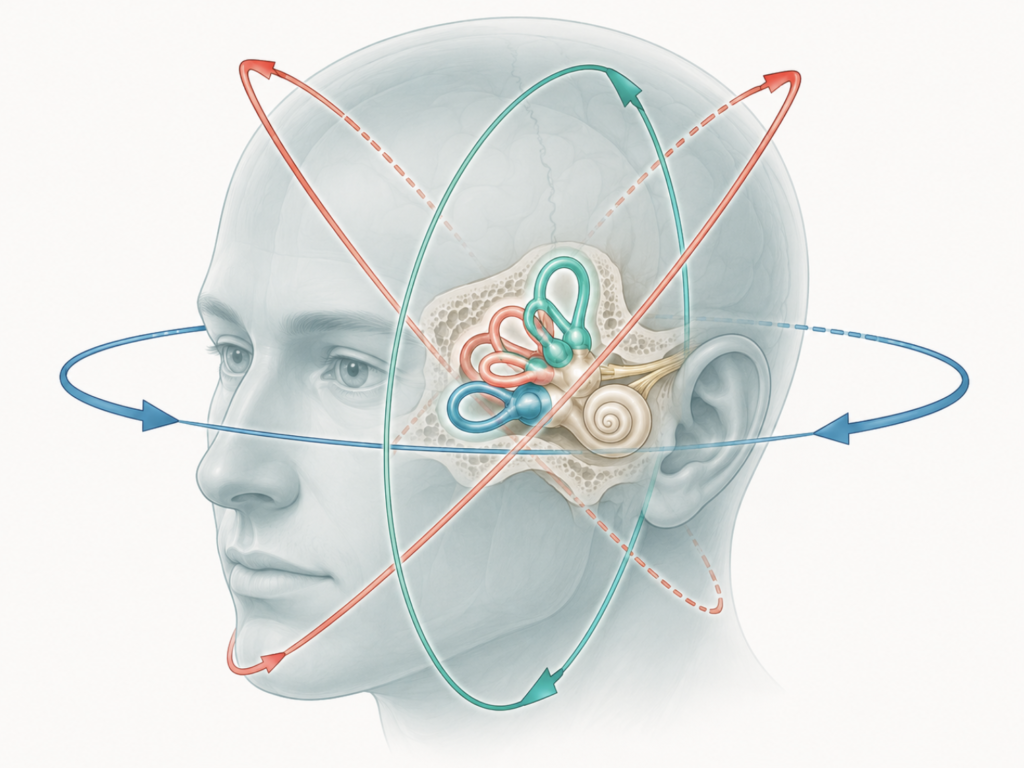
Three planes are tested. Horizontal rotations assess the lateral canals. Diagonal rotations along the LARP plane (left anterior, right posterior) and the RALP plane (right anterior, left posterior) assess the vertical canals — a capability confirmed against search-coil recordings in patients with known canal deficits [MacDougall, The video head impulse test (vHIT) detects vertical semicircular canal dysfunction, 2013]. Six canals, individually mapped.
Nothing is instilled in the ear, nothing spins, and most patients feel little or no vertigo.
Understanding Your Results: VOR Gain and Saccades
VOR gain
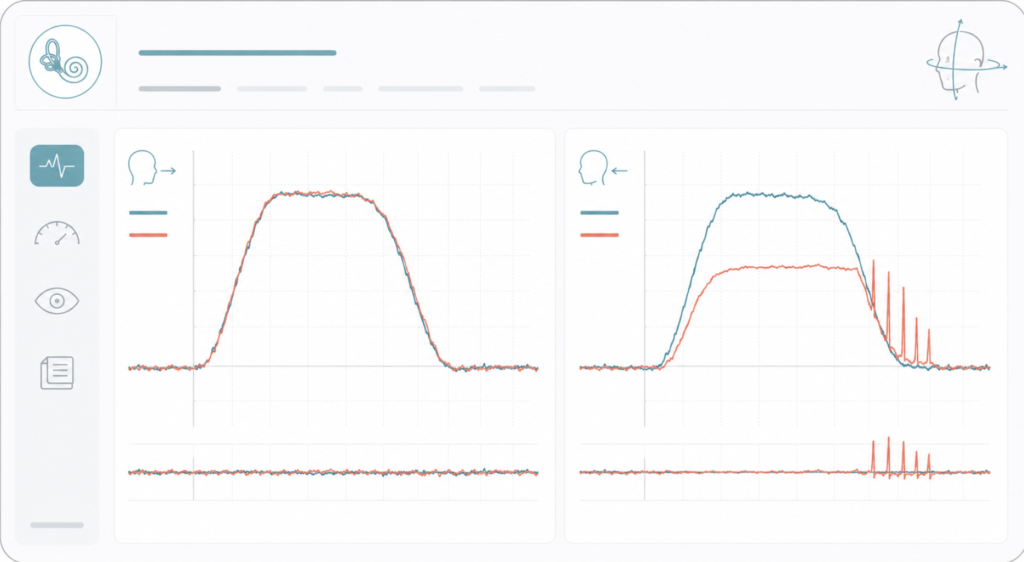
Gain is the ratio of eye velocity to head velocity. A perfect reflex moves the eyes exactly as fast as the head, in the opposite direction — a gain of 1.0. In clinical practice, horizontal canal gain above about 0.8 and vertical canal gain above about 0.7 are treated as normal. Normative work across age decades found gain drops modestly at very high head velocities but holds up well with age, even into the eighties [McGarvie, The video head impulse test (vHIT) of semicircular canal function – age-dependent normative values of VOR gain in healthy subjects, 2015].
Overt and covert saccades
Overt saccades happen after the head stops moving; covert saccades happen during it. Covert saccades are the reason bedside testing fails: a patient with genuine vestibular loss can look normal to an examiner because the eyes were dragged back on target before the head finished turning [Yip, Comparison of the bedside head-impulse test with the video head-impulse test in a clinical practice setting, 2016]. The camera catches them, and their presence — with or without a low gain — is a positive finding.
Gain asymmetry
The difference between right and left gain functions much like canal paresis on caloric testing. A single canal, one side, or a specific vertical pair can be isolated, which is why vHIT has become a mapping tool rather than a screening test [Halmagyi, The video head impulse test, 2017].
vHIT vs Caloric Testing: Not a Competition
Both examine the horizontal canal, but through different windows. Head impulses stimulate at high frequency, close to the range of natural head movement. Caloric irrigation stimulates at a very low frequency, far below anything the head does in daily life. The two can disagree, and the disagreement carries information.
In Ménière’s disease, the classic pattern is an abnormal caloric response alongside a normal vHIT — high-frequency function preserved while low-frequency function fails [McCaslin, The dissociation of vHIT and bithermal caloric test results provide topological localization of vestibular system impairment in patients with “definite” Ménière’s disease, 2015]. A normal vHIT in a patient with clear episodic vertigo is therefore not proof of a normal vestibular system. It is a clue.
Which Conditions Is vHIT Most Useful For?
- Vestibular neuritis and acute unilateral vestibulopathy. Gain drops on the affected side, often across multiple canals, and follow-up testing tracks recovery.
- Bilateral vestibulopathy. Low gain on both sides, often in patients exposed to aminoglycosides or presenting with unexplained imbalance and visual blurring while walking. Age-matched normative data make this detection possible [McGarvie, 2015].
- Ménière’s disease. The caloric–vHIT dissociation described above.
- Acute vestibular syndrome triage. A normal head impulse response in a patient with acute continuous vertigo and nystagmus raises concern for a central cause. Within the three-step HINTS examination, this pattern outperformed early diffusion-weighted MRI for identifying stroke [Kattah, HINTS to diagnose stroke in the acute vestibular syndrome, 2009].
- Vestibular schwannoma assessment and selection or monitoring of candidates for vestibular rehabilitation.
Where vHIT Falls Short
A normal vHIT does not rule out stroke on its own — the finding carries weight only inside the full clinical picture, in the right syndrome, interpreted by someone trained in it. Results also depend heavily on technique: goggle slippage, anticipated impulses, and poor pupil tracking all generate artifact that can mimic pathology. Patients who cannot cooperate may not be testable, and neither are many patients with cervical limitation — the impulse has to be fast and unanticipated to work at all, and a guarded neck removes exactly the property the test depends on.
Clinical Perspective The number on the report is the last thing to look at, not the first. What matters is the shape of the traces: whether the impulses were fast and consistent enough to be worth interpreting, whether the saccades cluster at a reproducible latency, and whether an “abnormal” gain came from ten clean impulses or from three good ones and seven where the goggles slid. A gain of 0.6 built on sloppy impulses means little. A gain of 0.85 with tightly clustered covert saccades often means quite a lot. This is also where automated artifact detection is starting to earn its place — not by reading the test, but by flagging which impulses should never have been counted.
Key Takeaways
- vHIT quantifies the vestibulo-ocular reflex and assesses all six semicircular canals individually.
- Horizontal VOR gain above roughly 0.8 and vertical gain above roughly 0.7 are the commonly used normal cutoffs.
- Detecting covert saccades is the decisive advantage of vHIT over the bedside head impulse test.
- vHIT tests high-frequency vestibular function while caloric testing tests low-frequency function; they are complementary, not interchangeable.
- A normal vHIT in acute continuous vertigo can point toward a central cause rather than reassure.
FAQ
Does the video head impulse test hurt? No. The head movements are small and fast but not forceful, and most patients find the test easier than caloric irrigation. Brief dizziness can occur but usually settles within seconds. Any neck discomfort should be reported beforehand — the test requires a rapid, unanticipated head rotation, and a neck that cannot tolerate it may make testing impractical.
How long does vHIT take? Most protocols run about 10 to 20 minutes, including goggle fitting and calibration. Testing all six canals takes longer than horizontal-only testing, and clinics often schedule vHIT alongside other vestibular tests in a single longer visit.
What is a normal VOR gain? A gain near 1.0 is ideal, and most laboratories treat above about 0.8 for horizontal canals and above about 0.7 for vertical canals as normal. Values are compared against age-matched normative data, and the presence of refixation saccades is weighed alongside the number.
Is vHIT better than a caloric test? Neither replaces the other. vHIT samples high-frequency function quickly and comfortably and covers all six canals; caloric testing samples low-frequency function of the horizontal canal only. Disagreement between them is diagnostically useful in its own right.
Can vHIT tell if my dizziness is caused by a stroke? Not by itself, but it contributes. In acute continuous vertigo with nystagmus, a normal head impulse response is one of three findings that together raise suspicion for a central cause. Interpretation requires the full examination and clinical context.
References
- Halmagyi GM, Curthoys IS. A clinical sign of canal paresis. Arch Neurol. 1988;45(7):737-739.
- MacDougall HG, Weber KP, McGarvie LA, Halmagyi GM, Curthoys IS. The video head impulse test: diagnostic accuracy in peripheral vestibulopathy. Neurology. 2009;73(14):1134-1141.
- Kattah JC, Talkad AV, Wang DZ, Hsieh YH, Newman-Toker DE. HINTS to diagnose stroke in the acute vestibular syndrome: three-step bedside oculomotor examination more sensitive than early MRI diffusion-weighted imaging. Stroke. 2009;40(11):3504-3510.
- MacDougall HG, McGarvie LA, Halmagyi GM, Curthoys IS, Weber KP. The video head impulse test (vHIT) detects vertical semicircular canal dysfunction. PLoS One. 2013;8(4):e61488.
- McCaslin DL, Rivas A, Jacobson GP, Bennett ML. The dissociation of video head impulse test (vHIT) and bithermal caloric test results provide topological localization of vestibular system impairment in patients with “definite” Ménière’s disease. Am J Audiol. 2015;24(1):1-10.
- McGarvie LA, MacDougall HG, Halmagyi GM, Burgess AM, Weber KP, Curthoys IS. The video head impulse test (vHIT) of semicircular canal function – age-dependent normative values of VOR gain in healthy subjects. Front Neurol. 2015;6:154.
- Halmagyi GM, Chen L, MacDougall HG, Weber KP, McGarvie LA, Curthoys IS. The video head impulse test. Front Neurol. 2017;8:258.
- Yip CW, Glaser M, Frenzel C, Bayer O, Strupp M. Comparison of the bedside head-impulse test with the video head-impulse test in a clinical practice setting: a prospective study of 500 outpatients. Front Neurol. 2016;7:58.
Joonpyo Hong, MD is a board-certified otolaryngologist practicing in Korea. This article reflects his clinical interpretation of published research and does not constitute individual medical advice.
For more interesting content:
https://curiousmd.com/does-ginkgo-biloba-work-tinnitus-memory/
https://curiousmd.com/menieres-disease-vs-syndrome/
https://curiousmd.com/can-you-train-your-vestibular-system/
https://curiousmd.com/vestibular-neuritis/
Link out to:
Patient-facing overview of the full vestibular test battery, including vHIT:
https://vestibular.org/article/diagnosis-treatment/diagnosis/
Explains one-sided vestibular loss and lists vHIT among the standard diagnostic tests:
https://vestibular.org/article/diagnosis-treatment/types-of-vestibular-disorders/unilateral-vestibular-hypofunction/
Government health authority page covering causes, types, and evaluation of balance disorders:
https://www.nidcd.nih.gov/health/balance-disorders
Academic medical center patient page on dizziness and vertigo from vestibular causes:
https://www.hopkinsmedicine.org/health/conditions-and-diseases/vestibular-balance-disorder