
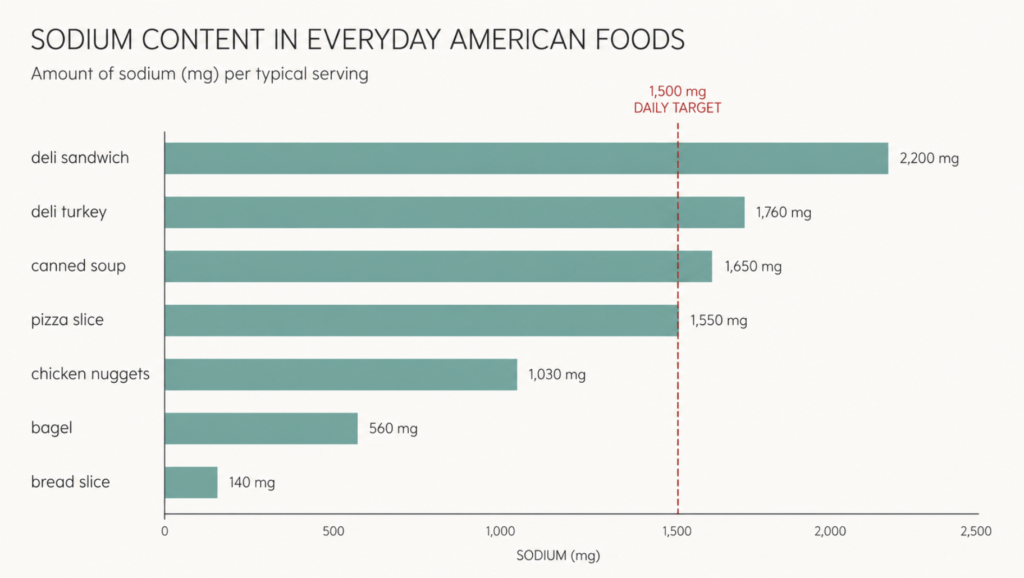
A single deli sandwich can carry more than 1,500 mg of sodium — an entire day’s target on a Ménière’s disease low-sodium diet, gone at lunch. Bread barely tastes salty, yet it is one of the largest sources of sodium in the American diet.
And here is the part that rarely gets said out loud: no randomized controlled trial has ever demonstrated that restricting sodium prevents vertigo attacks.
That is an uncomfortable opening for a treatment recommended in most clinics. It is also the accurate one. What follows is where the advice came from, what the numbers mean at an actual dinner table, and how long anyone should reasonably stay on it.
The Ménière’s disease low-sodium diet: what the evidence shows
The 2020 clinical practice guideline from the American Academy of Otolaryngology–Head and Neck Surgery states that clinicians should educate patients with Ménière’s disease about dietary and lifestyle changes that may reduce or prevent symptoms. That is a Recommendation-level statement — the second-strongest tier. For comparison, the same guideline places maintenance diuretics and betahistine one rung lower, at Option [Basura, Clinical Practice Guideline: Ménière’s Disease, 2020].
Then look at what sits underneath that recommendation.
A Cochrane systematic review searched for randomized trials of salt, caffeine, or alcohol restriction in Ménière’s disease and found none at all — zero eligible studies [Hussain, Restriction of Salt, Caffeine and Alcohol Intake for the Treatment of Ménière’s Disease or Syndrome, 2018]. A second Cochrane review five years later reached a similar place: the evidence for lifestyle and dietary interventions was rated very uncertain, with no placebo-controlled trials of salt restriction identified [Webster, Lifestyle and Dietary Interventions for Ménière’s Disease, 2023].
The most recent attempt used genetics instead of a trial. A bidirectional Mendelian randomization study drew on data from up to 941,280 people, using genetic variants as a natural randomization. Adding salt to food showed no significant association with Ménière’s disease (OR 0.719, 95% CI 0.429–1.206, p = 0.211), and neither did coffee or alcohol consumption. The authors concluded that the value of these restrictions deserves reconsideration [Gao, Restriction of Salt, Alcohol and Coffee Intake and Ménière’s Disease: Insight From Mendelian Randomization Study, 2024].
So a Recommendation-grade guideline statement rests on observation and physiological reasoning rather than trial data. Which raises the obvious question: where did this come from?
Where the advice came from: a 1929 hypothesis
The answer is a century old, and the sequence matters more than most people realize.
The oldest published recommendation for salt restriction in Ménière’s disease dates to 1929, from Dederding and her mentor Sydney Holger Mygind, who believed the condition stemmed from disordered water metabolism and proposed a reduced-salt, reduced-fluid diet.
Albert C. Furstenberg took up the idea, first in a series of 15 patients and then in a larger group of 150, producing the first results that appeared to support salt restriction as therapy. That framework went essentially unchallenged in print until 1980, when L. B. Jongkees published the first substantive criticism [Shim, Hold the Salt: History of Salt Restriction as a First-Line Therapy for Menière’s Disease, 2020].
Note the dates against this one: endolymphatic hydrops — the swelling of the inner ear’s fluid compartment that supposedly justifies restricting fluid-retaining sodium — was not demonstrated histologically until 1938, when Hallpike and Cairns examined temporal bones from patients with the syndrome [Hallpike, Observations on the Pathology of Ménière’s Syndrome, 1938].
The treatment came first. The mechanism arrived nine years later and was fitted to it.
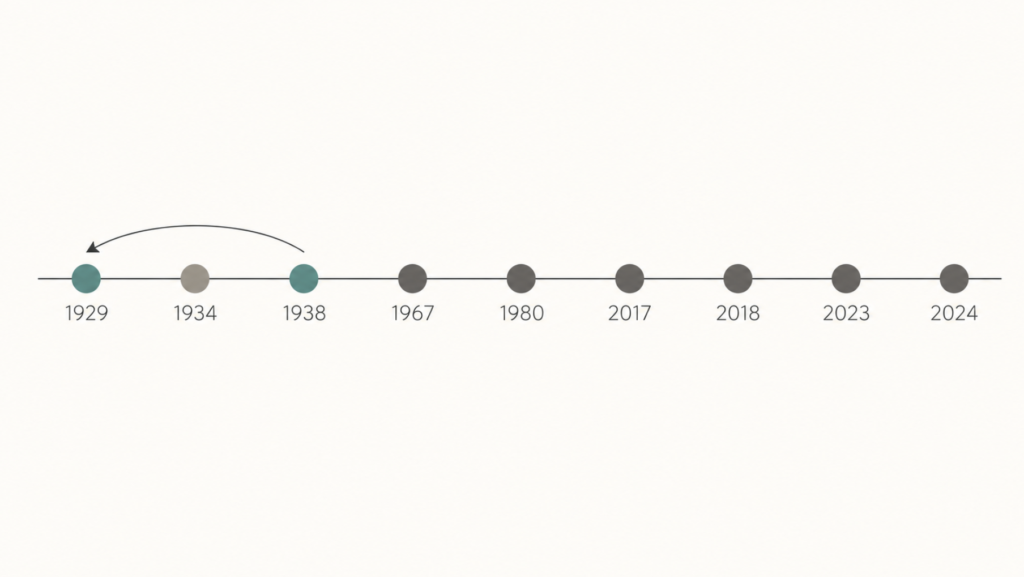
| Year | What happened |
|---|---|
| 1929 | Dederding and Mygind propose reduced salt and fluid intake based on a water-metabolism hypothesis |
| 1934 | Furstenberg reports on salt restriction plus ammonium chloride, first in 15 patients, later in 150 |
| 1938 | Hallpike and Cairns demonstrate endolymphatic hydrops on histology, supplying a mechanism after the fact |
| 1967 | Klockhoff and Lindblom test hydrochlorothiazide in 50 patients; salt restriction plus a diuretic becomes the familiar pairing |
| 1980 | Jongkees publishes the first substantive criticism of the diet |
| 2017 | A Japanese cohort measures urinary sodium and plasma hormones during two years of restriction |
| 2018 | Cochrane finds zero randomized trials |
| 2023 | Cochrane rates the evidence very uncertain |
| 2024 | Mendelian randomization finds no causal signal |
Worth reading the 1967 diuretic paper closely, because its authors were more careful than the practice that followed them. Klockhoff and Lindblom gave hydrochlorothiazide to 50 patients and saw no effect in late, stationary disease. In patients still in a fluctuating phase, symptoms improved — but the authors themselves called the results inconclusive, explicitly because the spontaneous course of the disease varies so greatly [Klockhoff, Menière’s Disease and Hydrochlorothiazide (Dichlotride) — A Critical Analysis of Symptoms and Therapeutic Effects, 1967].
That caveat turned out to be the central problem, and it returns later in this article.
The mechanism was probably wrong from the start
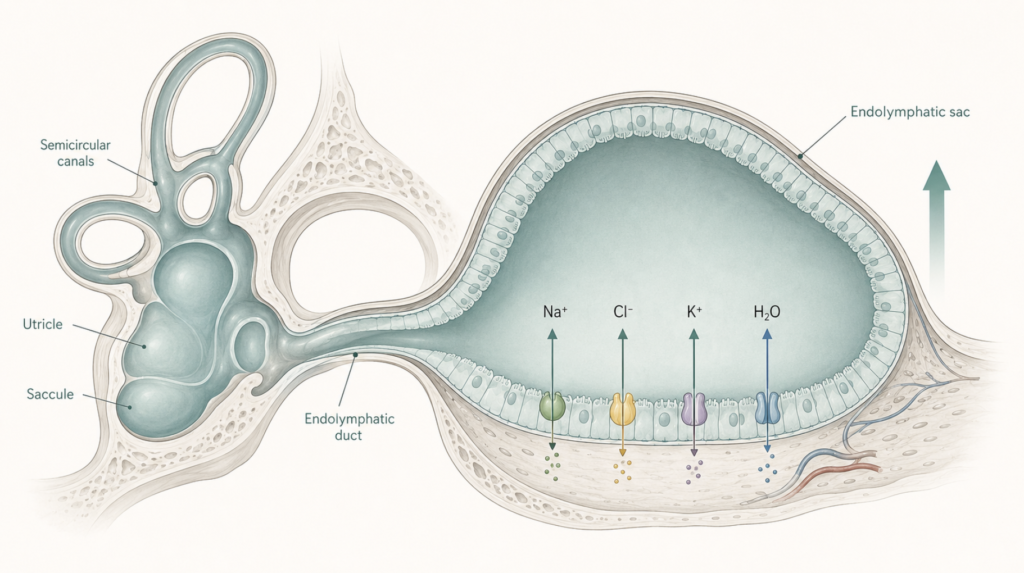
The original logic ran: more salt, more fluid retention, more endolymphatic pressure, more vertigo. Two observations undercut it.
First, a low-salt diet produces almost no change in plasma sodium levels. Second, sodium levels in the endolymph are essentially normal in histologically confirmed hydrops. Whatever a low-salt diet does in Ménière’s disease, simple sodium reduction in the inner ear does not appear to be it [Miyashita, Hormonal Changes Following a Low-Salt Diet in Patients With Meniere’s Disease, 2017].
An alternative hypothesis runs in the opposite direction. Reducing salt intake causes a physiological rise in plasma aldosterone. Mineralocorticoid receptors are expressed in the endolymphatic sac, along with aldosterone-responsive ion transporters, and experimental work suggests aldosterone may increase endolymph absorption there. On that model, the diet would work by raising a hormone rather than by lowering a mineral.
A Japanese group tested this directly. Thirteen patients with unilateral definite Ménière’s disease were prescribed a 2 g/day sodium diet with dietitian guidance, then followed for two years with serial 24-hour urine collections and hormone panels — the first study to verify adherence by measurement rather than self-report. Plasma aldosterone rose significantly across the two years. No other hormone measured, including antidiuretic hormone and cortisol, changed significantly [Miyashita, 2017].
The outcome data split by how well patients actually complied:
| Group | Mean urinary sodium | Complete vertigo control (Class A) |
|---|---|---|
| Group 1 (n = 7) | under 3 g/day | 7 of 7 (100%) |
| Group 2 (n = 6) | over 3 g/day | 4 of 6 (66%) |
Hearing outcomes at two years were also significantly better in the group with lower sodium excretion, and aldosterone levels tended to run higher in that group [Miyashita, 2017].
This is the most supportive evidence available, and it deserves to be read carefully rather than quoted as proof. Thirteen patients. No control group. The two groups were defined by adherence rather than randomization, so any trait that makes a patient comply well — health engagement, milder disease, more support at home — travels with the result. And the follow-up window is exactly the interval in which Ménière’s disease most often quiets down on its own, which the next section takes up. The authors themselves close by calling for larger randomized trials.
What it does offer is a testable idea: there may be a threshold below which restriction matters and above which it does not.
Why the Low-Sodium recommendation survives
Weak evidence and bad advice are not the same thing. Four reasons keep this on the first line.
The harm profile is close to zero. No side effects, no cost, no monitoring. Compare that to any pharmacologic or procedural option.
The collateral benefit is real. Sodium reduction has solid evidence for blood pressure and cardiovascular risk, whatever it does or does not do for the inner ear. A patient who fails to improve has still moved in a healthy direction.
Individual triggers exist even when group averages do not. A population-level null result does not rule out a subset of patients whose attacks genuinely follow salty meals. A symptom diary paired with a food log is the only way to find out which group someone belongs to.
The alternatives are not better evidenced. A Cochrane review of systemic drug treatments — betahistine, diuretics, antivirals, corticosteroids — found the evidence largely uncertain across the board [Webster, Systemic Pharmacological Interventions for Ménière’s Disease, 2023]. Salt restriction is not uniquely unsupported.
One caution belongs here, and the Mendelian randomization authors made it directly: relying solely on dietary restriction may delay more appropriate treatment, and carries real costs to social, work, and family life [Gao, 2024]. A patient whose attacks are frequent and disabling should not be left managing them with a saltshaker.
How much sodium is “low sodium”?
The usual target is 1,500 to 2,000 mg of sodium per day, with 2,300 mg as an outer limit.
The 2020 guideline does not set its own figure; it points to American Heart Association recommendations — an ideal of 1,500 mg daily and a ceiling of 2,300 mg [Basura, 2020]. The Japanese cohort described above used 2 g/day, which sits inside the same band. Converted into something usable at the table:
- 2,300 mg sodium ≈ 5.8 g of salt ≈ 1 teaspoon
- 1,500 mg sodium ≈ 3.8 g of salt ≈ 3/4 teaspoon
That is the total for an entire day, spread across every meal, snack, sauce, and beverage. Distribution matters more than most patients expect — roughly 500 mg per meal, not 1,400 mg at dinner and nothing else.
For scale: adults in the United States average about 3,400 mg of sodium daily, roughly 50% above the recommended limit, according to FDA figures. Reaching 1,500 mg means cutting current intake by more than half.
A caveat that gets skipped too often: patients with orthostatic hypotension, postural orthostatic tachycardia syndrome, or advanced age, and anyone already on a diuretic, can be harmed by aggressive sodium restriction. This target is not universal.
What 1,500 mg looks like on a real plate
Numbers in milligrams mean nothing until they become food.
Ordinary meals, extraordinary numbers
| Food | Serving | Sodium | Share of a 1,500 mg day |
|---|---|---|---|
| Deli sandwich with condiments | 1 sandwich | up to 1,500 mg | ~100% |
| Deli or prepackaged turkey | 1 serving | up to 1,050 mg | ~70% |
| Canned chicken noodle soup | 1 cup | up to 940 mg | ~63% |
| Pizza | 1 slice | up to 760 mg | ~51% |
| Frozen breaded chicken nuggets | 3 oz | ~600 mg | ~40% |
| Bagel | 1 | up to 500 mg | ~33% |
| Bread | 1 slice | up to 230 mg | ~15% |
Figures from American Heart Association “Salty Six” materials. Restaurant and chain values vary widely; check posted nutrition information.
Two slices of pizza can exhaust a day’s allowance. So can a sandwich. Neither registers as an indulgence.
The saltshaker is nearly irrelevant
This is the part that changes behavior, and it runs against intuition. More than 70% of sodium consumed in the United States comes from packaged, prepared, and restaurant foods — not from salt added while cooking or at the table, according to the FDA.
The distribution is concentrated. An analysis of 2017–2018 national nutrition survey data found that just fifteen food categories account for over half of all dietary sodium, led by pizza (5.3%), breads, rolls and buns (4.7%), cold cuts and cured meats (4.6%), soups (4.4%), and burritos and tacos (4.3%) [Ahmed, Top Sodium Food Sources in the American Diet—Using National Health and Nutrition Examination Survey, 2023].
Bread ranking that high surprises most people. It is not that bread is especially salty; it is that people eat it constantly, in small invisible doses, across every meal of the day.
The practical consequence: putting away the saltshaker addresses a small fraction of the problem. The changes that move the number are reading labels on packaged foods, reducing the frequency of restaurant and deli meals, and cooking from unprocessed ingredients — which lets a patient control the sodium that is otherwise added before food reaches them.
A day that lands near target
- Breakfast: eggs cooked without added salt, fresh fruit, unsalted oatmeal — under 200 mg
- Lunch: homemade sandwich on low-sodium bread with fresh roasted chicken rather than deli meat, no cheese, no condiments — roughly 400 mg
- Dinner: fresh fish or poultry, rice, vegetables seasoned with herbs, lemon, garlic, and pepper — roughly 300 mg
- Snacks: unsalted nuts, plain yogurt, fruit — under 150 mg
The pattern is unremarkable and that is the point. Nothing on that list requires specialty products. The sodium was never in the cooking; it was in the packaging and the takeout container.
How long, and what about diuretics?
There is no defined endpoint. This is chronic-condition management, not a course of treatment with a finish line.
But indefinite 1,500 mg is not the only option either. A workable approach: restrict strictly for three to six months, then reassess. If attacks have settled, ease toward 2,000–2,300 mg and hold there. If they return, tighten again. A symptom diary tracking vertigo, tinnitus, and aural fullness alongside food is what makes this loop informative rather than guesswork.
Now the trap — the same one Klockhoff flagged in 1967.
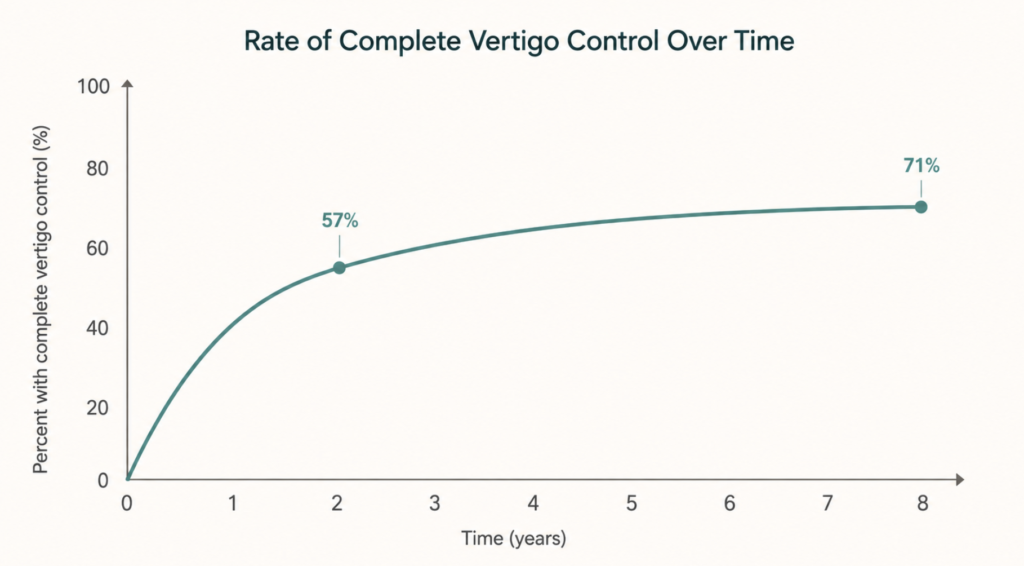
Ménière’s disease remits on its own at a high rate. In a study comparing patients who accepted surgery with 50 who were offered it and declined, 57% of the non-operated group had complete vertigo control at two years, and 71% had complete control after an average of 8.3 years [Silverstein, Natural History vs. Surgery for Menière’s Disease, 1989]. A large Finnish survey of 365 patients with definite disease found spontaneous remission of episodic vertigo in about 34%, with attacks growing shorter and less severe over time [Pyykkö, Changes in Symptom Pattern in Meniere’s Disease by Duration: The Need for Comprehensive Management, 2024].
Hold that 57% figure next to the Japanese cohort from earlier, where the poorly adherent group reached 66% complete control at two years. The two numbers are close enough that the comparison is worth noticing, though the studies differ too much in design and population for any firm conclusion.
That is the whole difficulty in a sentence. Improvement after starting a low-sodium diet is weak evidence that the diet caused the improvement — the same error that made the diet look effective in the uncontrolled series of the 1930s and 1970s, and the same error a patient makes reasoning about their own case.
The Finnish data carries a second warning: vertigo stopping does not mean the disease is over. Balance problems, drop attacks, and progressive hearing loss continued to evolve in that cohort [Pyykkö, 2024]. Attack-free is not cured.
On diuretics: the guideline rates them, with betahistine, as an Option for maintenance — a weaker recommendation than dietary education [Basura, 2020]. They are commonly combined with sodium restriction in practice, a pairing that traces directly to the 1960s thiazide work. What they are not is a substitute. A diuretic promotes sodium excretion; it does not license a high-sodium diet to be cancelled out pharmacologically. Combined use also requires attention to potassium, sodium, and volume status.
Caffeine and alcohol restriction rest on the same thin evidence base as salt [Hussain, 2018; Gao, 2024]. If a patient identifies either as a personal trigger, avoiding it is reasonable. Blanket prohibition is not well supported.
Clinical Perspective
Telling a patient the evidence is weak and telling them not to bother are different messages, and the distinction matters at the bedside.
A defensible approach is to resist prescribing a total dietary overhaul at the first visit. Most patients arrive assuming the problem is the saltshaker, and correcting that single misconception — that the sodium is already in the bread, the deli meat, and the takeout before anyone reaches for salt — does more than a printed restriction list.
Perfectionism is where this tends to fail. Moving from 3,400 mg to 2,500 mg is a substantial change even though it misses every published target, and framing that as failure often ends the effort entirely. The one study that measured adherence directly suggests any benefit may depend on reaching a threshold, which is an argument for sustainable partial progress over unsustainable strictness.
If the diet does not work, that is not a personal failing. It was never a treatment with established efficacy. Frequent, disabling attacks are a signal to discuss the next tier of treatment, not to restrict harder.
Key Takeaways
- No randomized controlled trial has ever shown that sodium restriction prevents vertigo attacks in Ménière’s disease; two Cochrane reviews found either zero eligible studies or very uncertain evidence.
- The recommendation originated in a 1929 water-metabolism hypothesis and was established through uncontrolled case series in the 1930s — before endolymphatic hydrops was demonstrated in 1938.
- A low-salt diet produces almost no change in plasma sodium, and endolymph sodium is essentially normal in confirmed hydrops, so the original “less salt, less fluid” rationale is unlikely to be correct.
- One two-year study of 13 patients that verified adherence by 24-hour urine collection found complete vertigo control in all 7 patients whose sodium excretion stayed under 3 g/day, versus 4 of 6 above it, alongside a significant rise in plasma aldosterone.
- The usual target is 1,500–2,000 mg of sodium daily, roughly three-quarters of a teaspoon of salt, distributed across all meals.
- More than 70% of sodium in the American diet comes from packaged, prepared, and restaurant foods rather than the saltshaker, with pizza, bread, cold cuts, soups, and burritos leading the list.
- 57% of untreated patients achieved complete vertigo control at two years and 71% at an average of 8.3 years, so improvement after starting any treatment is difficult to attribute to that treatment.
- Diuretics are an Option-level recommendation and do not substitute for dietary sodium reduction.
FAQ
Does a low-sodium diet actually work for Ménière’s disease? No randomized trial has shown that it does. Two Cochrane reviews and one large genetic analysis failed to find supporting evidence, though a small two-year study that verified adherence by urine testing reported better vertigo and hearing outcomes in patients who restricted most strictly. It remains widely recommended because the harm is minimal and some patients do appear to have salt-sensitive attacks.
If the evidence is weak, why do doctors still recommend it? Because the recommendation predates modern trial methodology and has never been convincingly replaced. It carries almost no risk, benefits blood pressure regardless, and the alternatives — betahistine, diuretics — have similarly uncertain evidence behind them.
How many milligrams per day is “low sodium”? Between 1,500 and 2,000 mg daily, with 2,300 mg as an upper limit. That is roughly three-quarters of a teaspoon of salt for the entire day, including all sauces, condiments, and packaged foods.
Will putting away the saltshaker be enough? No. More than 70% of dietary sodium in the United States is already present in packaged, prepared, and restaurant food before it reaches the table. Label reading and reducing restaurant meals move the number far more than cooking behavior does.
Which everyday foods are the worst offenders? Pizza, bread and rolls, cold cuts and cured meats, soups, and burritos and tacos are the five largest contributors to sodium intake. Bread ranks high not because it is especially salty but because it is eaten so frequently.
Can I stop the diet if I have had no attacks for years? A full return to previous intake is generally less advisable than easing to 2,000–2,300 mg and holding there, tightening again if symptoms recur. Bear in mind that spontaneous remission is common, so a long attack-free interval does not confirm the diet was responsible.
If I take a diuretic, can I skip the diet? No. A diuretic increases sodium excretion but does not neutralize a high-sodium intake, and the two are used together rather than interchangeably. Any change to diuretic therapy should be made with the prescribing physician.
I followed the diet strictly and nothing changed. What now? This is common and expected given the evidence base. Persistent, disabling attacks warrant a conversation about the next treatment tier rather than stricter restriction.
References
- Basura GJ, Adams ME, Monfared A, et al. Clinical practice guideline: Ménière’s disease. Otolaryngol Head Neck Surg. 2020;162(2 Suppl):S1-S55.
- Hussain K, Murdin L, Schilder AGM. Restriction of salt, caffeine and alcohol intake for the treatment of Ménière’s disease or syndrome. Cochrane Database Syst Rev. 2018;12:CD012173.
- Webster KE, George B, Lee A, et al. Lifestyle and dietary interventions for Ménière’s disease. Cochrane Database Syst Rev. 2023;2:CD015244.
- Webster KE, Galbraith K, Harrington-Benton NA, et al. Systemic pharmacological interventions for Ménière’s disease. Cochrane Database Syst Rev. 2023;2:CD015171.
- Gao W, Ma P, Wang Z, et al. Restriction of salt, alcohol and coffee intake and Ménière’s disease: insight from Mendelian randomization study. Front Nutr. 2024;11:1460864.
- Shim T, Strum DP, Mudry A, Monfared A. Hold the salt: history of salt restriction as a first-line therapy for Menière’s disease. Otol Neurotol. 2020;41(6):855-859.
- Hallpike CS, Cairns H. Observations on the pathology of Ménière’s syndrome: (section of otology). Proc R Soc Med. 1938;31(11):1317-1336.
- Klockhoff I, Lindblom U. Menière’s disease and hydrochlorothiazide (Dichlotride) — a critical analysis of symptoms and therapeutic effects. Acta Otolaryngol. 1967;63(4):347-365.
- Miyashita T, Inamoto R, Fukuda S, et al. Hormonal changes following a low-salt diet in patients with Meniere’s disease. Auris Nasus Larynx. 2017;44(1):52-57.
- Silverstein H, Smouha E, Jones R. Natural history vs. surgery for Menière’s disease. Otolaryngol Head Neck Surg. 1989;100(1):6-16.
- Pyykkö I, Zou J, Vetkas N. Changes in symptom pattern in Meniere’s disease by duration: the need for comprehensive management. Front Neurol. 2024;15:1496384.
- Ahmed M, Ng A, Christoforou A, Mulligan C, L’Abbé MR. Top sodium food sources in the American diet—using National Health and Nutrition Examination Survey. Nutrients. 2023;15(4):831.
Joonpyo Hong, MD is a board-certified otolaryngologist practicing in Korea. This article reflects his clinical interpretation of published research and does not constitute individual medical advice.
For more interesting content:
https://curiousmd.com/menieres-disease-vs-syndrome/
https://curiousmd.com/video-head-impulse-test-vhit/
https://curiousmd.com/vestibular-neuritis/
Link out to:
AAO-HNS Clinical Practice Guideline: Ménière’s Disease
Vestibular Disorders Association — Dietary Considerations
Restriction of salt, alcohol and coffee intake and Ménière’s disease (Frontiers in Nutrition, 2024)