
Wet earwax vs dry earwax, which is more frequent? In Korea, roughly one person in twenty has the sticky, brownish kind of earwax. Whether yours is wet or dry has nothing to do with hygiene or how often you clean. It comes down to a single letter of DNA, and the other nineteen people set the norm that all the local ear-care advice is written for.
That letter turns out to do more than one job, its distribution across the world is strangely uneven, and it predicts less about your ear health than most articles imply.
One Gene, Two Kinds of Earwax
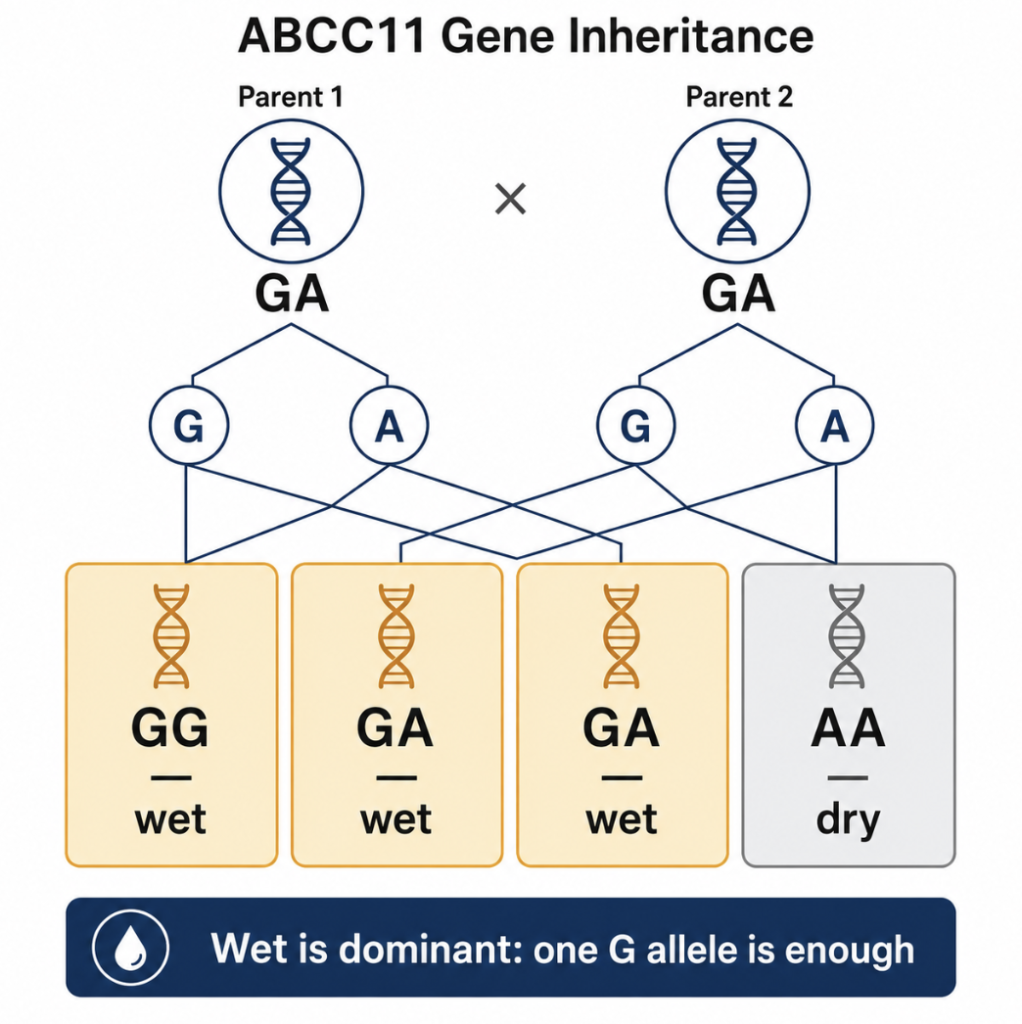
Earwax type is one of the few visible human traits controlled by a single genetic switch. A team led by Yoshiura pinpointed it in 2006: a single nucleotide polymorphism, rs17822931, in the ABCC11 gene. The AA genotype produces dry earwax; GA and GG produce the wet type [Yoshiura, A SNP in the ABCC11 gene is the determinant of human earwax type, 2006].
ABCC11 encodes a transporter protein that moves substances across cell membranes. In functional assays, cells carrying the A allele showed lower excretory activity than those carrying G [Yoshiura, 2006]. Cerumen itself is a mixture of sebum, modified apocrine sweat gland secretions, and shed epithelial cells [Schwartz, Clinical Practice Guideline (Update): Earwax (Cerumen Impaction), 2017]. Reduced transporter function tracks with far less of the glandular component, which leaves dry-type wax that is mostly skin.
Because wet is dominant, one G allele from either parent is enough. That is why mixed-ancestry families often see the wet type reappear in a child when both parents assumed dry was the family default.
Wet Earwax vs Dry Earwax by Ethnicity: The Actual Numbers
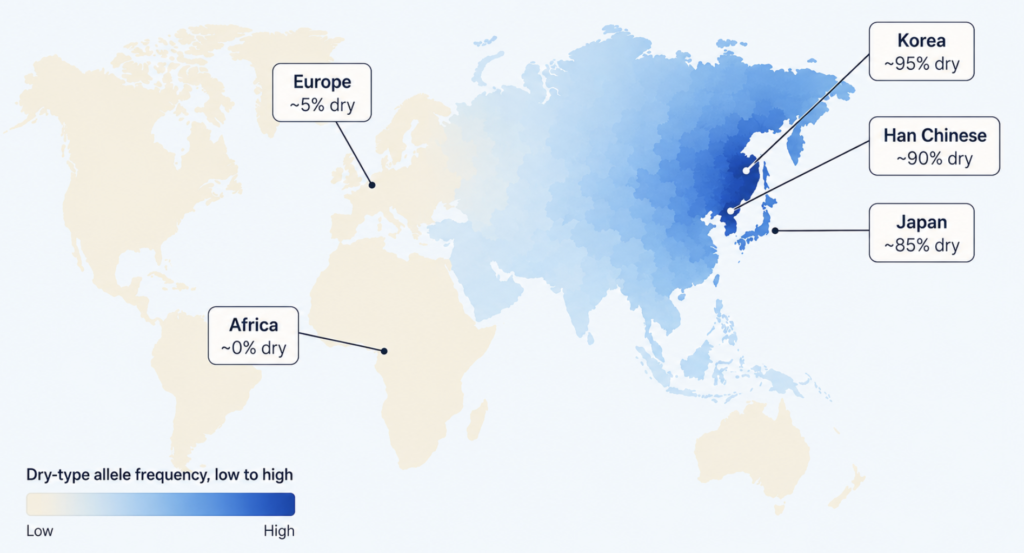
The geographic spread is unusually lopsided. Wet-type prevalence runs at approximately 95% in populations of European origin and close to 100% in populations of African origin. In East Asia the picture inverts: about 15% in Japan, about 10% among Han Chinese, and about 5% in Korea [Nakano, A strong association of axillary osmidrosis with the wet earwax type determined by genotyping of the ABCC11 gene, 2009].
| Population | Wet type (approx.) | Dry type (approx.) |
|---|---|---|
| African origin | ~100% | ~0% |
| European origin | ~95% | ~5% |
| Japanese | ~15% | ~85% |
| Han Chinese | ~10% | ~90% |
| Korean | ~5% | ~95% |
These numbers come with a caveat. The East Asian percentages are drawn from phenotype surveys reported alongside the original genotyping work, not from modern population-scale genomic databases, which have not published earwax-specific estimates for Korea. They are well-established approximations rather than precise measurements.
The dry allele frequency follows a north-south and east-west downward gradient from a peak in Chinese and Korean populations, which led the original authors to conclude that the A allele arose in northeast Asia and spread outward [Yoshiura, 2006].
Why it spread is a separate question, and only a partly answered one. Ohashi and colleagues estimated the selection coefficient for the A allele in East Asians at roughly 0.01 and dated the mutation to about 2,000 generations ago. They also found that absolute latitude correlates significantly with A allele frequency across Asian, Native American, and European populations, a pattern consistent with adaptation to cold climate [Ohashi, The impact of natural selection on an ABCC11 SNP determining earwax type, 2011]. Reduced apocrine secretion in a freezing environment is a plausible advantage, though the mechanism remains inferred rather than demonstrated.
The Body Odor Connection
The same gene also governs axillary apocrine secretion, which is the part that tends to surprise people.
In a Japanese study of 79 patients who had undergone surgery for axillary osmidrosis, 78 of them, or 98.7%, carried a wet-type genotype. In the general population sample used for comparison, those genotypes appeared in 35.4% of subjects [Nakano, 2009]. The authors drew a pointed practical conclusion: a patient with odor complaints who genotypes as dry type is unlikely to benefit from apocrine gland removal.
So wet earwax and noticeable underarm odor come from the same transporter rather than from two independent traits.
When Earwax Actually Becomes a Problem
Most consumer articles blur this line. Wet earwax is a normal variant; cerumen impaction is the actual condition.
The American Academy of Otolaryngology-Head and Neck Surgery defines impaction as an accumulation of cerumen that causes symptoms, prevents needed assessment of the ear, or both. The guideline explicitly recommends against routinely treating cerumen in patients who are asymptomatic and whose ears can be adequately examined [Schwartz, 2017]. Symptoms worth acting on include hearing loss, ear fullness, itching, pain, tinnitus, and, in hearing aid users, a change in device performance [Michaudet, Cerumen Impaction: Diagnosis and Management, 2018].
Impaction is present in roughly 10% of children and 5% of healthy adults, but in up to 57% of older people in nursing homes [Michaudet, 2018]. That jump with age is the number worth carrying away from this article.
Left in place, an impaction can do more than cause discomfort. Hearing loss from impacted cerumen can produce reversible cognitive impairment in older people [Michaudet, 2018]. In a study of 55 older adults with memory disorders, patients whose better-hearing ear was impacted gained an average of 4.6 dB after removal versus 0.9 dB in controls, and their MMSE scores improved significantly relative to controls after age adjustment. The unadjusted difference fell just short of significance [Sugiura, Effect of cerumen impaction on hearing and cognitive functions in Japanese older adults with cognitive impairment, 2014]. The sample is small, but the implication holds: a wax plug in an elderly patient can look like cognitive decline.
One gap deserves naming. However intuitive it sounds, there is no good comparative evidence that the wet phenotype itself produces more impactions than the dry phenotype. Reviews of impacted cerumen have long noted that the physiology and clinical significance of excessive wax remain poorly characterized, with no large placebo-controlled trials to anchor management decisions [Guest, Impacted cerumen: composition, production, epidemiology and management, 2004]. Anyone presenting wet earwax as inherently riskier is running ahead of the published data.
What Not to Do
The strongest evidence in this field concerns what makes things worse.
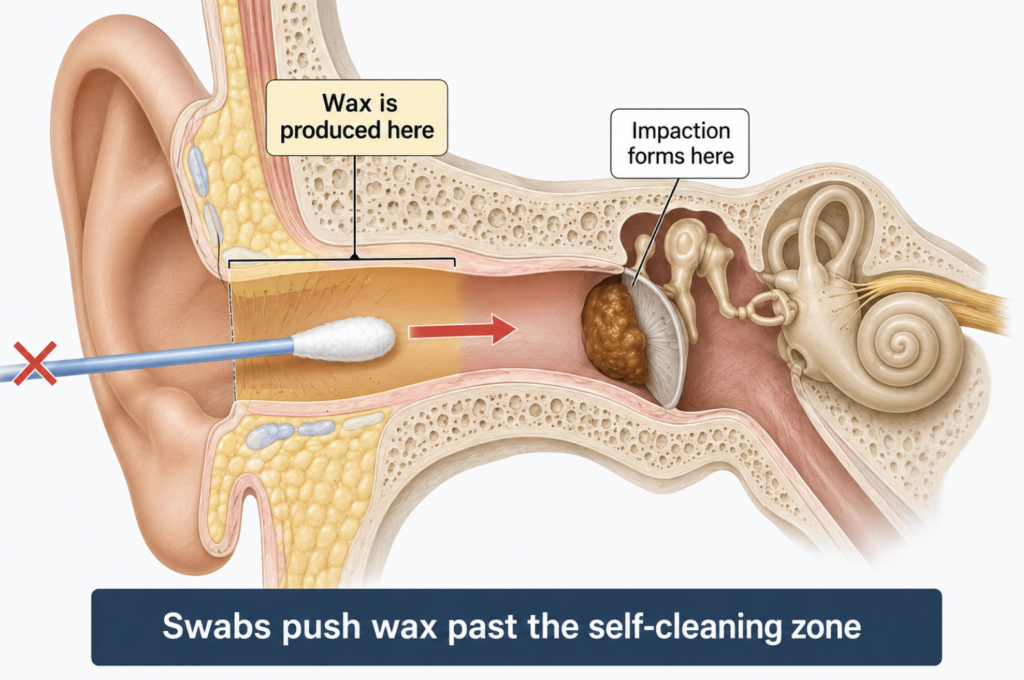
Cotton swabs are the clearest offender. In a case-control study of 87 children with otitis externa, 70.1% had used a cotton-tip applicator in the preceding ten days, compared with 34% of controls [Nussinovitch, Cotton-tip applicators as a leading cause of otitis externa, 2004]. Wax is produced in the outer cartilaginous canal, and a swab pushes it inward, past the point where it can migrate out on its own.
Ear candling has its own guideline statement, a direct recommendation against its use for treating or preventing impaction [Schwartz, 2017].
One widely repeated belief deserves a closer look, in both directions. A retrospective study of 164 patients at a single cerumen clinic found no association between hearing aid use and cerumen impaction [Manchaiah, Does hearing aid use increase the likelihood of cerumen impaction?, 2015]. That is one small retrospective sample, and it sits alongside clinical guidance that hearing aid users should have their canals checked every three to six months precisely because in-ear devices disrupt the outward migration of wax [Michaudet, 2018]. The fair summary is that in-ear devices plausibly contribute, the proposed mechanism is reasonable, and the direct evidence is thinner than the confidence with which the claim is usually repeated.
Clinical Perspective
The typical presentation in otolaryngology practice is not someone worried about earwax. It is someone who came in for hearing loss or a blocked-up sensation, and whose canal turns out to be packed with wet cerumen. Nobody arrives complaining about wax; it is only what caused the symptom.
Comparative data are absent, but a consistent clinical impression is that the discrete, rubbery plug capable of sealing a canal tends to be the wet type, while dry-type debris is more likely to flake and clear on its own. That is worth stating as an impression rather than a finding, and it is exactly the kind of question the literature has never properly asked.
Where it matters most is older patients. Reduced manual dexterity and declining vision make ear care harder at precisely the age when impaction becomes common. In that group, an impaction can present as hearing loss that resembles cognitive decline. The practical step is an unglamorous one: look in the ears.
Key Takeaways
- Earwax type is determined by a single SNP, rs17822931, in the ABCC11 gene, with wet dominant over dry.
- About 5% of Koreans have wet-type earwax, compared with roughly 95% of people of European origin and nearly 100% of people of African origin.
- The same gene drives apocrine secretion, which is why wet earwax and pronounced underarm odor travel together.
- Wet earwax is a normal variant, not a disorder, and guidelines advise against routinely removing asymptomatic cerumen.
- Cerumen impaction affects about 5% of healthy adults but up to 57% of nursing home residents, and can mimic cognitive decline.
FAQ
Is wet earwax a sign of a health problem?
No. It is a normal inherited variant carried by the large majority of the world’s population. It correlates with more noticeable underarm odor, since one gene controls both, but it is not a disease and does not require treatment on its own.
Why do most East Asians have dry earwax?
The dry-type allele appears to have arisen in northeast Asia and spread outward, reaching its highest frequency in Chinese and Korean populations. Latitude correlates with allele frequency, which suggests adaptation to cold climate, though the specific advantage has not been demonstrated directly.
Can earwax buildup cause hearing loss?
Yes, when it becomes impacted. Impaction can produce conductive hearing loss, fullness, itching, pain, and tinnitus. In older adults it can also cause reversible cognitive impairment, and removal has been shown to improve measured hearing thresholds.
How often should I clean my ears?
Guidelines do not recommend routine removal in people who are asymptomatic and whose ears can be examined normally. The canal clears itself under most circumstances, and inserting objects to speed that up tends to work against it.
References
- Yoshiura K, Kinoshita A, Ishida T, et al. A SNP in the ABCC11 gene is the determinant of human earwax type. Nat Genet. 2006;38(3):324-30.
- Ohashi J, Naka I, Tsuchiya N. The impact of natural selection on an ABCC11 SNP determining earwax type. Mol Biol Evol. 2011;28(1):849-57.
- Nakano M, Miwa N, Hirano A, Yoshiura K, Niikawa N. A strong association of axillary osmidrosis with the wet earwax type determined by genotyping of the ABCC11 gene. BMC Genet. 2009;10:42.
- Schwartz SR, Magit AE, Rosenfeld RM, et al. Clinical Practice Guideline (Update): Earwax (Cerumen Impaction). Otolaryngol Head Neck Surg. 2017;156(1 Suppl):S1-S29.
- Michaudet C, Malaty J. Cerumen Impaction: Diagnosis and Management. Am Fam Physician. 2018;98(8):525-529.
- Guest JF, Greener MJ, Robinson AC, Smith AF. Impacted cerumen: composition, production, epidemiology and management. QJM. 2004;97(8):477-88.
- Nussinovitch M, Rimon A, Volovitz B, Raveh E, Prais D, Amir J. Cotton-tip applicators as a leading cause of otitis externa. Int J Pediatr Otorhinolaryngol. 2004;68(4):433-5.
- Sugiura S, Yasue M, Sakurai T, et al. Effect of cerumen impaction on hearing and cognitive functions in Japanese older adults with cognitive impairment. Geriatr Gerontol Int. 2014;14 Suppl 2:56-61.
- Manchaiah V, Arthur J, Williams H. Does hearing aid use increase the likelihood of cerumen impaction? J Audiol Otol. 2015;19(3):168-71.
Joonpyo Hong, MD is a board-certified otolaryngologist practicing in Korea. This article reflects his clinical interpretation of published research and does not constitute individual medical advice.
For more articles:
https://curiousmd.com/cotton-swabs-in-your-ears/
https://curiousmd.com/otomycosis/
https://curiousmd.com/cholesteatoma-symptoms-diagnosis-surgery/
Link out to:
- AAO-HNS Clinical Practice Guideline: Earwax (Cerumen Impaction), Update — the full guideline hub, including patient handouts and the plain-language summary.
- American Family Physician: Cerumen Impaction — Diagnosis and Management — a practical review covering cerumenolytics, irrigation, and referral thresholds.
- ENT Health: Earwax (Cerumen Impaction) — the AAO-HNS Foundation’s patient-facing page on symptoms and safe home care.
- Yoshiura et al., Nature Genetics (2006) on PubMed — the original paper identifying rs17822931 as the earwax-type determinant.