
Consider a presentation that plays out in ENT clinics regularly. Someone loses weight successfully, then describes something that sounds implausible: her own breathing has become the loudest sound in her head. Her voice booms. She has started speaking quietly because she can no longer judge how loud she is. Her ear examination is normal, her hearing test is normal, and several previous clinicians have told her nothing is wrong.
Something is wrong. The diagnosis is usually straightforward once you know to look for it. Patulous eustachian tube treatment is the harder half of the problem, and it is the part most articles skip: once we name the condition, how much can we actually do about it?
What a Patulous Eustachian Tube Is
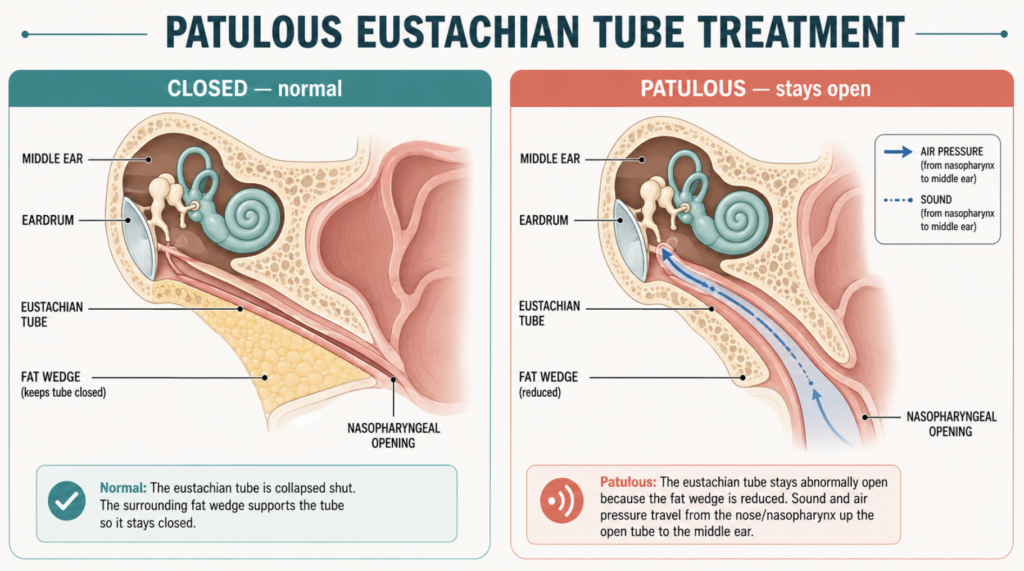
The eustachian tube connects the middle ear to the back of the nose. It is closed at rest and opens briefly when you swallow or yawn, equalizing pressure across the eardrum. In patulous eustachian tube (PET), that closure fails and the tube stays open. The middle ear ends up persistently connected to the nasopharynx, so pressure changes from breathing and speaking travel straight to the eardrum.
This is the mirror image of the condition it is most often confused with. Obstructive eustachian tube dysfunction is a tube that will not open; PET is a tube that will not close. The symptoms overlap enough — fullness, muffled hearing — that the wrong one gets treated routinely.
| Obstructive ETD | Patulous ETD | |
|---|---|---|
| Problem | Tube will not open | Tube will not close |
| Hallmark symptom | Fullness, muffled hearing, popping | Autophony — hearing your own voice and breath |
| Effect of lying down | Little change | Symptoms typically ease |
| Effect of a cold | Worse | May temporarily ease in some patients |
| Effect of exertion | Little change | Often worse |
| Typical trigger | Allergy, infection | Weight loss, pregnancy |
The anatomical explanation most often given involves Ostmann’s fat pad, a wedge of adipose tissue that presses the cartilaginous portion of the tube shut. When body fat is lost quickly, this pad shrinks along with everything else, and the tube loses its passive closing force. A separate proposed mechanism locates the problem in a concave defect of the tubal valve wall — plausible and widely repeated, though the primary evidence for it is thinner than its popularity suggests.
The Symptoms — and One Clue Worth Knowing
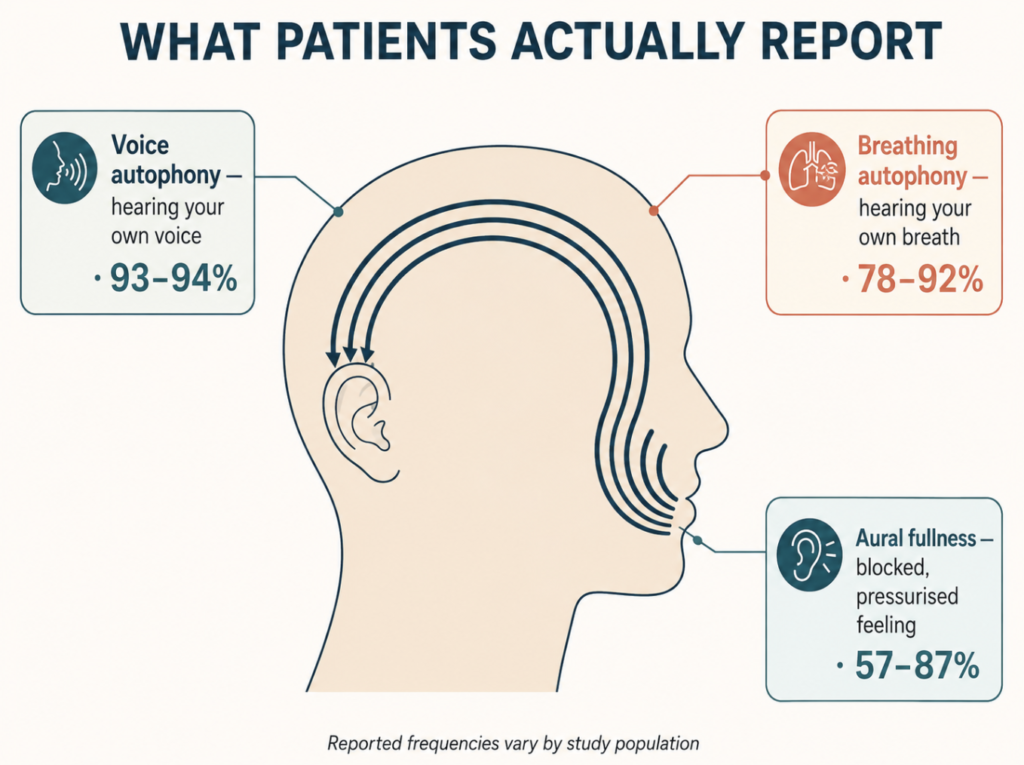
Voice autophony is the dominant complaint, reported by roughly nine in ten patients across series [Kawamura, The Characteristic of Patulous Eustachian Tube Patients Diagnosed by the JOS Diagnostic Criteria, 2019; Ward, Patulous Eustachian Tube Dysfunction: Patient Demographics and Comorbidities, 2017]. Hearing one’s own breathing follows closely. Aural fullness is common but far less consistent — one series put it at 87%, another at 57%, which says something about how differently these cohorts were assembled.
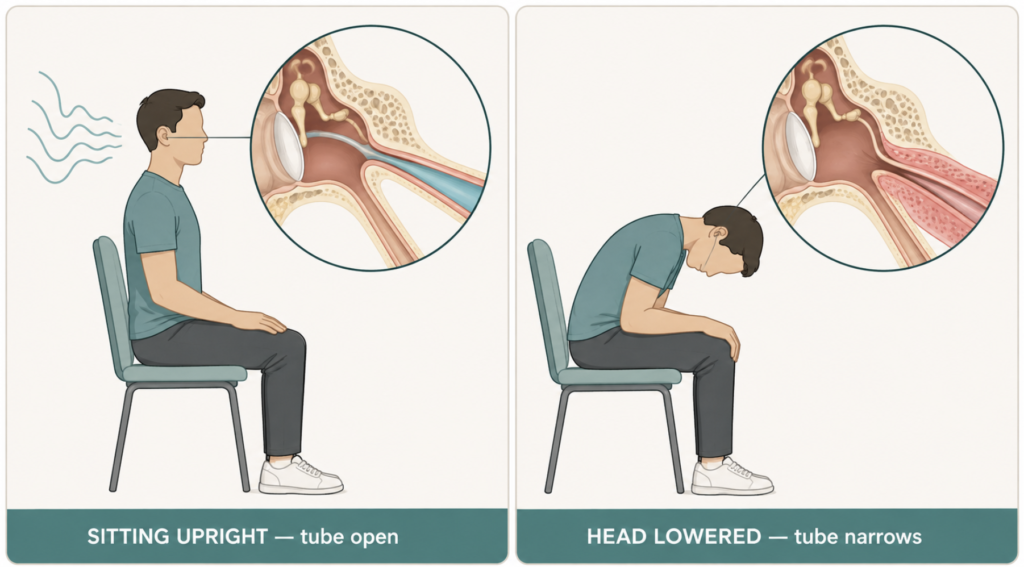
The clue clinicians rely on is positional. Between 65% and 91% of patients report that symptoms ease when they lie down or put their head between their knees, because venous engorgement of the tissue around the tube pushes it shut.
This is a characteristic symptom, not a diagnostic test. It runs in one direction only, and the reverse readings are both wrong. Symptoms that do not improve when lying down do not rule out a patulous tube — a substantial minority of confirmed cases fail this exact maneuver. And symptoms that do improve do not confirm one, since other conditions respond to postural change as well. The finding is worth mentioning to a clinician. It is not something to diagnose yourself with.
The same caution applies to the objective findings. Eardrum movement synchronized with breathing is among the most discriminating signs a clinician can see, yet it was present in only 69% of ears in one cohort of confirmed cases [Kawamura, The Characteristic of Patulous Eustachian Tube Patients Diagnosed by the JOS Diagnostic Criteria, 2019]. A normal-looking eardrum settles nothing.
How Common Is It?
Two numbers circulate, and they measure different things.
Reviews cite a prevalence of 0.3% to 7.0%, with female predominance and onset typically in adolescence or adulthood [Ikeda, Diagnosis and Treatment of Patulous Eustachian Tube, 2024]. That range is wide because the underlying studies defined the condition differently — treat it as an order of magnitude, not a figure.
Korean national health insurance claims tell a different story: a standardized prevalence of 7.2 per 100,000 in 2010, rising to 10.3 per 100,000 by 2016, with roughly 20,500 new patients recorded over that period [Choi, Prevalence and Incidence of Clinically Significant Patulous Eustachian Tube, 2018]. Women were affected about twice as often as men, peaking in their twenties.
These two figures are not in conflict, and they must not be stacked against each other. The first counts people with symptoms; the second counts people who sought care under a specific diagnostic code. The gap between them is the population that never gets diagnosed.
In high-risk groups the numbers are much less ambiguous. After bariatric surgery, independent studies converge on roughly 20–25%: 21% by clinical assessment in one series [Muñoz, Patulous Eustachian Tube in Bariatric Surgery Patients, 2010], and 25% by objective tympanometric testing six months post-operatively in a prospective cohort where nobody had PET beforehand [Erdemes, Objective Diagnosis of Patulous Eustachian Tube Following Bariatric Surgery Using Dynamic Tympanometry, 2025]. Among inpatients being treated for eating disorders, 42.6% reported autophony [Hollis, Autophony in Inpatients with Anorexia Nervosa or Avoidant Restrictive Food Intake Disorder, 2022].
That last population also delivers the most encouraging finding in this literature. In a prospective study of severe anorexia nervosa, 81.8% of symptomatic ears resolved within twelve days of nutritional rehabilitation [Mann, Transient Patulous Eustachian Tube in Severe Anorexia Nervosa, 2022]. When the underlying cause reverses, the tube often follows.
Causes, Including the New One
Weight loss is the best-known trigger, but the risk profile is broader. In the largest cohort assembled under standardized criteria — 1,009 patients — the strongest associations were habitual sniffing, low-dose estrogen-progestin use in women, and a history of weight loss, alongside lower body mass index and younger age [Oshima, Clinical Characteristics and Diagnostic Value of Symptoms and Objective Findings in Patulous Eustachian Tube, 2025]. Pregnancy, hemodialysis, nasopharyngeal scarring and neuromuscular disease all appear in the literature. A large share of cases have no identifiable cause at all.
Then there is the question everyone is now asking. A 2025 case series described seven adults who developed PET after four to ten months on semaglutide or tirzepatide, having lost between 8% and 19% of their body weight [Sudhoff, First Report on a Case Series of Patulous Eustachian Tube Following GLP-1 Receptor Agonist-Induced Weight Loss, 2025]. Mechanistically this is unsurprising — it is the same rapid fat loss that bariatric surgery produces, arriving by a different route.
The pharmacovigilance data points the other way, and the honest reading matters. Among 97,237 adverse events reported for GLP-1 receptor agonists, 958 were otologic, and the count for autophony was zero [Pak, GLP-1 Receptor Agonist Induced Eustachian Tube Dysfunction, 2025]. Either this is genuinely rare, or — more likely — patients and clinicians are not yet reporting it under a name that reaches the database. Seven cases do not establish a drug side effect. They establish that someone should be looking.
Patulous Eustachian Tube Treatment, Honestly
Start with the finding that shapes everything else. A systematic review of surgical treatment covering 510 ears found complete symptom relief ranging from 7% to 77%, improvement from 7% to 86%, and no response in 0% to 41% [Mousa, Surgical Treatment of Patulous Eustachian Tube — A Systematic Review, 2020]. Those are not confidence intervals around a stable estimate. That is a field without a settled answer. Separate systematic reviews reach the same conclusion: the evidence base is small case series, almost entirely uncontrolled [Luu, Treatment Effectiveness for Symptoms of Patulous Eustachian Tube, 2015].
Conservative measures first
Nasal instillation of saline is the standard opening move. In a retrospective series of 52 patients, 63.5% improved, rising to 80% among those with short symptom duration [Oshima, Nasal Instillation of Physiological Saline for Patulous Eustachian Tube, 2010]. With no control group, some of that is the natural course of a condition that often remits on its own — but it is cheap, harmless, and reasonable to try first.
Decongestants are the one thing to avoid. No trial has demonstrated harm, but the reasoning is sound enough that most clinicians act on it: a vasoconstrictor shrinks and dries the mucosa around the tubal opening, which is the opposite of what a tube that will not close needs.
The anticholinergic puzzle
Anticholinergic nasal sprays keep appearing in the literature as an option, and they present a genuinely unresolved problem that rarely gets discussed.
The reports go back to a 1988 study in which topical atropine applied to the tube improved both tubal function measures and symptoms [Morita, Effects of an Anti-Cholinergic on the Function of Patulous Eustachian Tube, 1988]. The largest series since — a Korean cohort in which roughly half of treated patients improved — appeared in a journal not indexed in MEDLINE, which is its own comment on how thin this evidence is. No randomized trial exists.
The pharmacology of the drug itself is not in doubt. Blocking muscarinic receptors reduces serous secretion from nasal glands, an effect confirmed at the highest evidence level for rhinorrhea [Pang, Intranasal Anticholinergics for Treatment of Chronic Rhinitis, 2023]. Why that would close a eustachian tube is where the reasoning becomes speculative.
The most plausible bridge runs through tube mechanics. In a primate model, washing out the normal mucous layer measurably altered the tube’s compliance and hysteresis, and surfactant instillation lowered its opening pressure [Ghadiali, Effect of Surface Tension and Surfactant Administration on Eustachian Tube Mechanics, 2002]. The surface film is mechanically real. Shifting it from watery toward viscous might raise the pressure needed to force the tube open, keeping it shut.
Might. That chain has never been tested in patulous eustachian tube, and it collides with the rest of the treatment logic. Anticholinergics dry the mucosa, saline wets it, and decongestants are discouraged precisely because they dry it. Three interventions pull in three directions — a reliable sign that the mechanism is not understood, only that some patients improve on some of them.
Surgery, and what each procedure buys
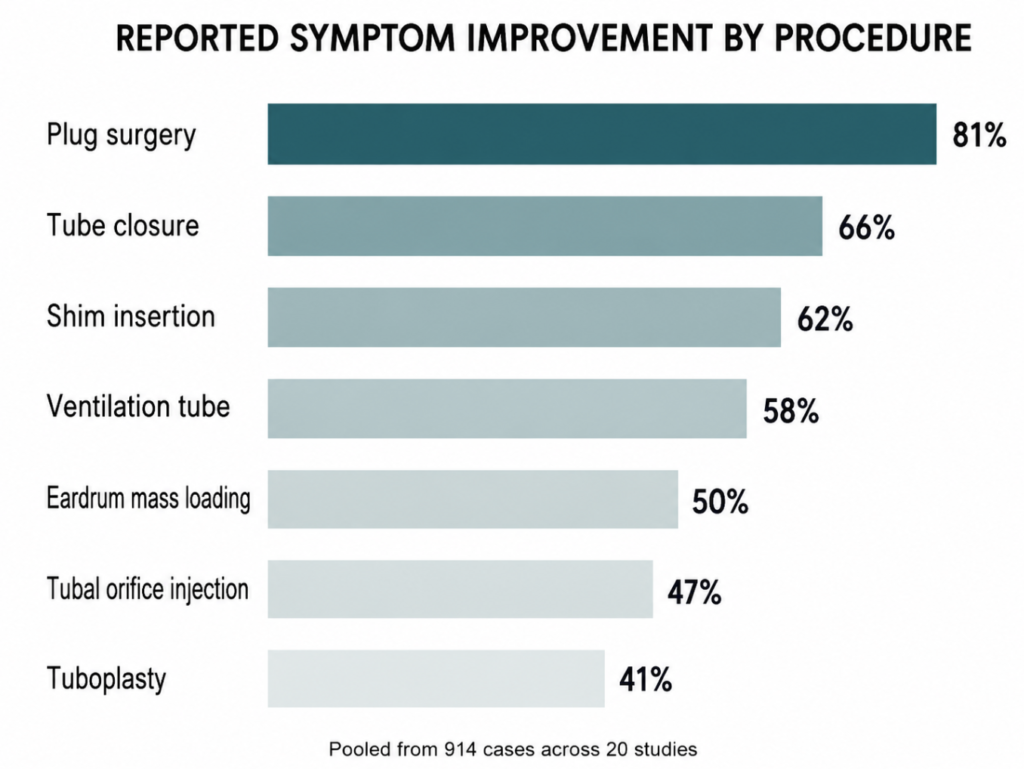
Pooling 914 cases, reported symptom improvement varied sharply by technique: plug surgery 81% (95% CI 77–85), tube closure 66%, shim insertion 62%, ventilation tube insertion 58%, mass loading of the eardrum 50%, injection into the tubal orifice 47%, and tuboplasty 41% [Ikeda, Systematic Review of Surgical Outcomes Following Repair of Patulous Eustachian Tube, 2020].
The best-designed study is a prospective multicenter trial of transtympanic silicone plug insertion in patients who had failed six months of conservative treatment. Handicap scores fell from 34.4 to 5.7 at six months, with 82.1% judged successful (95% CI 63.1–93.9). Middle ear effusion occurred in 17.2% and eardrum perforation in 13.8% [Ikeda, Efficacy of a Silicone Plug for Patulous Eustachian Tube, 2020]. Roughly one patient in five had a complication.
Two further findings deserve more attention than they get. First, results decay: in a series of 83 patients, success fell from 74.0% at one month to 65.2% at twelve [Shibasaki, Postoperative Course of Eustachian Tube Plug Surgery with Kobayashi Plug, 2025].
Second, when 241 procedures were tracked at a single center, the median duration of symptom relief was five months, with an interquartile range of 1.1 to 15.5 months. Hydroxyapatite injection performed worst at three months, against 20.6 months for obliteration of the tube [Ward, Twelve-Month Outcomes of Eustachian Tube Procedures, 2019]. Anyone considering surgery should be told the relief may be measured in months.
Why ventilation tubes help at all
A ventilation tube does nothing to the eustachian tube, which makes its 58% improvement rate look paradoxical until you consider where the symptom actually comes from. Autophony in PET is generated at the eardrum: pressure swings from breathing and speaking travel up the open tube and set the membrane moving. A ventilation tube opens a second pathway between the middle ear and the ear canal, equalizing those swings across the drum and damping its excursion.
This remains a proposed explanation rather than a proven one, but two observations support it. Loading the eardrum with added mass — which does nothing except restrict its movement — relieves symptoms in about half of cases. And after a tuboplasty technique that reshaped the tube, abnormal eardrum excursions disappeared in 10 of 11 patients alongside their symptoms [Yáñez, Curvature Inversion Technique, 2011]. Stop the drum from moving and much of the noise stops with it.
There is a second, entirely separate reason. Some patients sniff habitually to generate negative middle ear pressure and pull the tube shut, at the cost of progressive eardrum retraction. A ventilation tube prevents that negative pressure from building, which breaks the cycle. In this subgroup, ventilation tubes improved 90.9% of patients [Endo, The Effect of Ventilation Tube Insertion or Trans-Tympanic Silicone Plug Insertion on a Patulous Eustachian Tube, 2016].
Clinical Perspective
The most useful thing to understand about this condition is that its treatments sit on a spectrum from reversible to irreversible, and the evidence gets weaker as you move along it.
There is also a paradox worth sitting with. In a recent series, complete remission was achieved in 70% of cases — and obstructive eustachian tube dysfunction developed in 14.6% of ears, occurring exclusively in the ears that had achieved complete remission [Bae, Optimal Eustachian Tube Plugging Method for Patulous Eustachian Tube Disorder, 2025]. This is a single small study, so nothing is settled.
But it captures the problem precisely. The goal is not a maximally closed tube; it is a tube that closes normally. Overshooting simply trades one disease for its opposite. That is why the first question in the clinic is rarely which operation to choose — it is whether the trigger can be reversed at all, because when it can, the tube usually recovers on its own.
Key Takeaways
- Patulous eustachian tube is a tube that will not close, the opposite of the far more common eustachian tube dysfunction in which the tube will not open.
- Autophony — hearing your own voice and breathing — is reported by roughly nine in ten patients and is the symptom that most reliably points to this diagnosis.
- Rapid weight loss is the best-documented trigger, affecting 20–25% of patients after bariatric surgery, and early reports now describe the same pattern with GLP-1 receptor agonists.
- When the underlying cause reverses, the condition often reverses with it: 81.8% of symptomatic ears resolved within twelve days of nutritional rehabilitation in severe anorexia nervosa.
- Surgical success rates range from 7% to 86% across studies, and in one center the median duration of symptom relief after a procedure was five months.
FAQ
Why do I hear my own breathing in my ear? Because the eustachian tube may be staying open when it should be closed. Normally the tube seals the middle ear off from the back of the nose between swallows. When it stays open, pressure changes generated by breathing and speaking travel directly to the eardrum instead of being blocked. The result is called autophony, and patients often describe it as talking into a seashell.
Does a patulous eustachian tube go away on its own? Often, yes — particularly when it has an identifiable, reversible trigger. Cases arising in pregnancy commonly resolve after delivery, and cases caused by weight loss frequently resolve as weight is regained. In severe anorexia nervosa, most symptomatic ears cleared within about two weeks of nutritional rehabilitation. Cases without an identifiable cause are the ones most likely to persist.
Can GLP-1 medications like semaglutide cause ear problems? There are early reports, but nothing established. A 2025 case series described seven patients who developed a patulous eustachian tube during GLP-1 therapy after substantial weight loss, which is mechanistically what rapid fat loss does. However, a review of nearly 100,000 adverse event reports for these drugs found no reports of autophony at all. Anyone with new ear symptoms should be evaluated rather than stopping medication independently.
Is surgery worth it? It depends heavily on how disabling the symptoms are and how long conservative treatment has been tried. The best-designed study reported 82% success with plug insertion, but roughly one in five patients had a complication, and success rates decline over the following year. In one center the median duration of relief was five months. Surgery is generally reserved for severe cases that have not improved after about six months of conservative management.
How is it different from regular eustachian tube dysfunction? They are opposites. Ordinary eustachian tube dysfunction means the tube will not open, so pressure cannot equalize — typically worse with colds and during air travel. A patulous tube will not close, so there is too much connection: often worse with exertion, and typically relieved by lying down. Treating one as the other is a common source of delay.
References
- Ikeda R. Diagnosis and treatment of patulous Eustachian tube. Auris Nasus Larynx. 2024.
- Choi SW, et al. Prevalence and incidence of clinically significant patulous Eustachian tube: a population-based study using the Korean National Health Insurance Claims Database. Am J Otolaryngol. 2018.
- Kawamura Y, et al. The characteristic of patulous eustachian tube patients diagnosed by the JOS diagnostic criteria. PLoS One. 2019.
- Ward BK, Ashry Y, Poe DS. Patulous Eustachian tube dysfunction: patient demographics and comorbidities. Otol Neurotol. 2017;38(9):1362-1369.
- Oshima H, et al. Clinical characteristics and diagnostic value of symptoms and objective findings in patulous eustachian tube: a large-scale study based on the Japan Otological Society criteria. Auris Nasus Larynx. 2025.
- Muñoz D, et al. Patulous eustachian tube in bariatric surgery patients. Otolaryngol Head Neck Surg. 2010.
- Erdemes S, et al. Objective diagnosis of patulous Eustachian tube following bariatric surgery using dynamic tympanometry. Am J Otolaryngol. 2025.
- Mann SE, et al. Transient patulous eustachian tube in severe anorexia nervosa: a prospective observational study. Laryngoscope Investig Otolaryngol. 2022.
- Hollis J, et al. Autophony in inpatients with anorexia nervosa or avoidant restrictive food intake disorder. Int J Eat Disord. 2022.
- Sudhoff H. First report on a case series of patulous Eustachian tube following GLP-1 receptor agonist-induced weight loss. Eur Arch Otorhinolaryngol. 2025.
- Pak KY, et al. GLP-1 receptor agonist induced eustachian tube dysfunction: database and systematic review of otolaryngologic adverse events. Otol Neurotol. 2025.
- Oshima T, et al. Nasal instillation of physiological saline for patulous eustachian tube. Acta Otolaryngol. 2010.
- Morita M, et al. Effects of an anti-cholinergic on the function of patulous eustachian tube. Acta Otolaryngol Suppl. 1988.
- Ghadiali S, et al. Effect of surface tension and surfactant administration on Eustachian tube mechanics. J Appl Physiol. 2002.
- Pang JC, et al. Intranasal anticholinergics for treatment of chronic rhinitis: systematic review and meta-analysis. Laryngoscope. 2023;133(4):722-731.
- Luu K, et al. Treatment effectiveness for symptoms of patulous Eustachian tube: a systematic review. Otol Neurotol. 2015.
- Mousa Z, Faber C, Rosenberg T. Surgical treatment of patulous Eustachian tube – a systematic review. Dan Med J. 2020;67(10):A02200068.
- Ikeda R, et al. Systematic review of surgical outcomes following repair of patulous Eustachian tube. Otol Neurotol. 2020;41(8):1012-1020.
- Ikeda R, et al. Efficacy of a silicone plug for patulous eustachian tube: a prospective, multicenter case series. Laryngoscope. 2020;130(5):1304-1309.
- Shibasaki T, et al. Postoperative course of Eustachian tube plug surgery with Kobayashi plug. Auris Nasus Larynx. 2025.
- Ward BK, Ashry Y, Poe DS. Twelve-month outcomes of Eustachian tube procedures for management of patulous Eustachian tube dysfunction. Laryngoscope. 2019;129(1):222-228.
- Endo S, et al. The effect of ventilation tube insertion or trans-tympanic silicone plug insertion on a patulous Eustachian tube. Acta Otolaryngol. 2016.
- Bae SH, et al. Optimal Eustachian tube plugging method for patulous Eustachian tube disorder. Clin Otolaryngol. 2025.
- Yáñez C, et al. Curvature inversion technique: a novel tuboplastic technique for patulous Eustachian tube. Otolaryngol Head Neck Surg. 2011.
Joonpyo Hong, MD is a board-certified otolaryngologist practicing in Korea. This article reflects his clinical interpretation of published research and does not constitute individual medical advice.
For more articles:
https://curiousmd.com/eustachian-tube-function-testing-training/
https://curiousmd.com/ear-and-sinus-barotrauma-decongestant-guide/
https://curiousmd.com/ozempic-ear-side-effect-weight-loss-clogged-ears/
Link out to:
- Kawamura et al., The characteristic of patulous eustachian tube patients diagnosed by the JOS diagnostic criteria, PLoS ONE (full text)
- Mousa et al., Surgical treatment of patulous Eustachian tube — a systematic review, Danish Medical Journal (PubMed)
- Sudhoff, First report on a case series of patulous Eustachian tube following GLP-1 receptor agonist-induced weight loss, European Archives of Oto-Rhino-Laryngology