
In one published study, taping the mouth shut cut snoring events almost in half — from 304 per hour to 121. That number is real, peer-reviewed, and almost never quoted with its fine print: every participant had been screened first to confirm their nose was clear.
That gap between the number and its conditions is the whole story. So, does mouth taping help snoring? The evidence gives three different answers — yes for a narrow group, nothing for another, and worse for a third — and most people cannot tell which group they are in.
Why anyone thought this would work
Breathing through the mouth genuinely is harder on the airway. When healthy volunteers were forced to breathe orally instead of nasally during sleep, total upper airway resistance was 2.5 times higher, and the apnea-hypopnea index rose from 1.5 to 43 events per hour [Fitzpatrick, Effect of Nasal or Oral Breathing Route on Upper Airway Resistance During Sleep, 2003].
That finding is solid, and it is the engine behind the entire trend. But notice what it shows: nasal breathing is better in people whose nasal route is open. It does not show that forcing the mouth closed produces the same benefit, and those are different claims requiring different evidence.
A strip of tape does not widen anything. It changes which route the air takes — and only if the other route is available.
Where does mouth taping help snoring — and who was in those studies?
The most-cited result comes from 20 patients with mild sleep apnea who were confirmed mouth breathers. After taping, 13 of 20 (65%) responded well. Median apnea-hypopnea index fell from 8.3 to 4.7 events per hour, snoring index fell from 304 to 121 events per hour, and the lowest oxygen saturation improved from 82.5% to 87% [Lee, The Impact of Mouth-Taping in Mouth-Breathers with Mild Obstructive Sleep Apnea, 2022].
Now the entry criteria: age 20 to 60, body mass index under 30, apnea-hypopnea index under 15, witnessed mouth breathing during sleep — and no nasal obstruction. There was no control group.
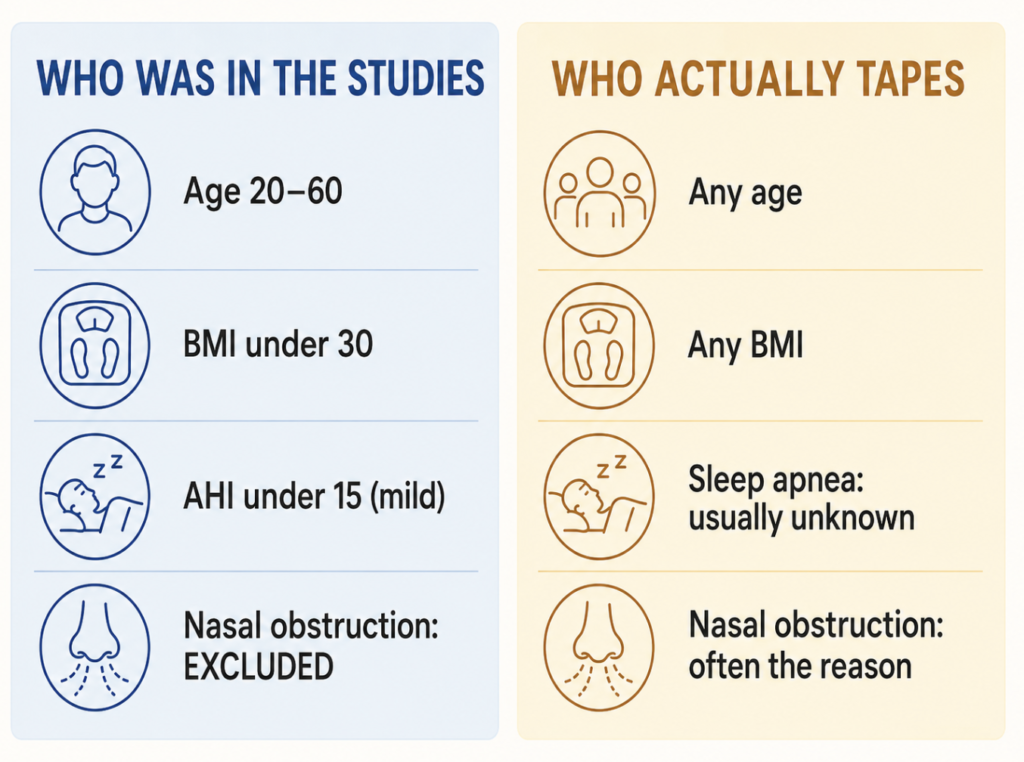
A second study using a porous oral patch found a similar pattern, with median apnea-hypopnea index falling from 12 to 7.8 and improvements in daytime sleepiness and snoring scores [Huang, Novel Porous Oral Patches for Patients with Mild Obstructive Sleep Apnea and Mouth Breathing, 2015]. Same shape of study: small, uncontrolled, mild disease, nasal obstruction excluded.
These are real signals. They are also the ceiling of the positive evidence.
The result that rarely gets quoted
A larger crossover study tested tape against a mandibular advancement device and against baseline. Tape alone produced no significant change in apnea-hypopnea index compared with baseline. The significant finding was for the combination — adding mouth closure to the oral appliance dropped median apnea-hypopnea index from 10.5 to 5.6 events per hour [Labarca, Mouth Closing to Improve the Efficacy of Mandibular Advancement Devices in Sleep Apnea, 2022].
That result is frequently cited as proof that taping works. It is proof that taping adds something to a device the person is already wearing under supervision. Those are not the same recommendation.
A chinstrap trial found no significant change in apnea-hypopnea index, no improvement in lowest oxygen saturation, and a lower percentage of REM sleep than on the diagnostic study [Bhat, The Efficacy of a Chinstrap in Treating Sleep Disordered Breathing and Snoring, 2014].
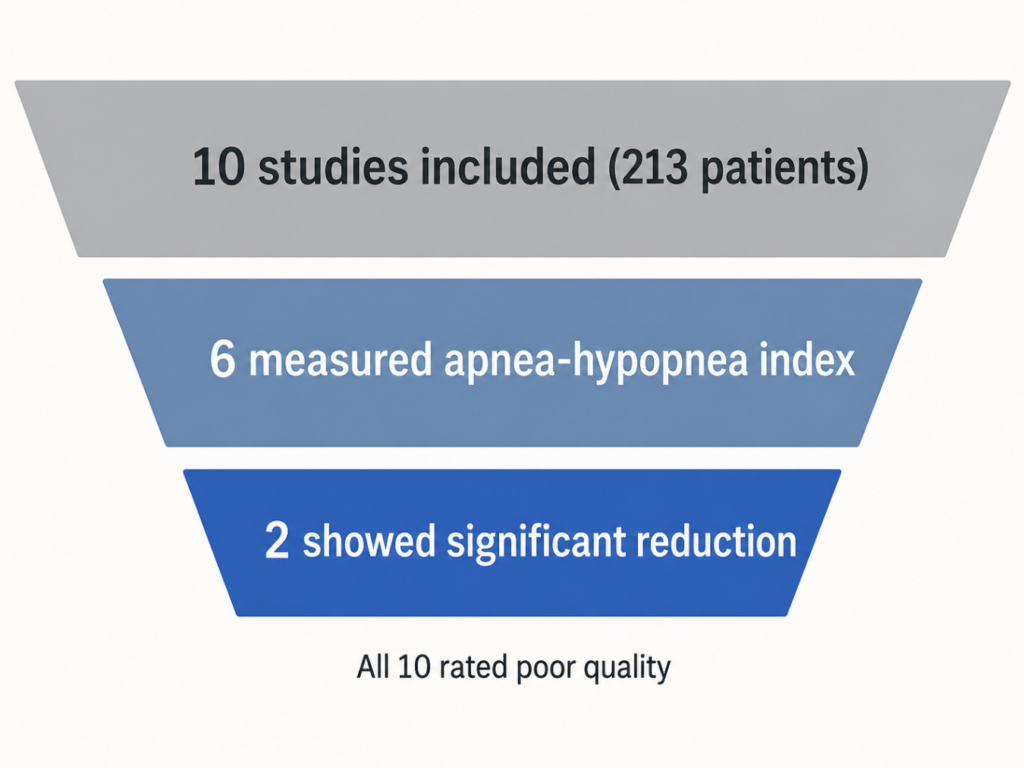
Pulled together: a 2025 systematic review found 10 eligible studies covering 213 patients. Six measured apnea-hypopnea index and only two showed a significant reduction — the two above, both restricted to mild disease, both excluding anyone with a blocked nose. All 10 studies were rated poor quality [Rhee, Breaking Social Media Fads and Uncovering the Safety and Efficacy of Mouth Taping, 2025].
Closing the mouth is not universally good
The most informative study on this question did not use tape at all.
Investigators measured nasal and oral airflow separately during drug-induced sleep endoscopy in 54 patients with sleep apnea, closing the mouth manually on alternating breaths. On average, the maneuver helped: total inspiratory airflow rose by 27.8 percentage points measured against each patient’s own resting breathing level — roughly a 25% improvement [Yang, Mouth Closure and Airflow in Patients with Obstructive Sleep Apnea, 2024].
Then the average broke apart. In 12 of 54 patients — 22% — airflow got worse when the mouth was closed.
The split tracked how much the person was already breathing through their mouth. Patients with near-zero oral airflow showed no meaningful change. Patients with moderate oral airflow improved by 2.0 L/min, a gain of about 53% against their resting level. Patients with the highest oral airflow lost 1.86 L/min — a drop of about 40%.
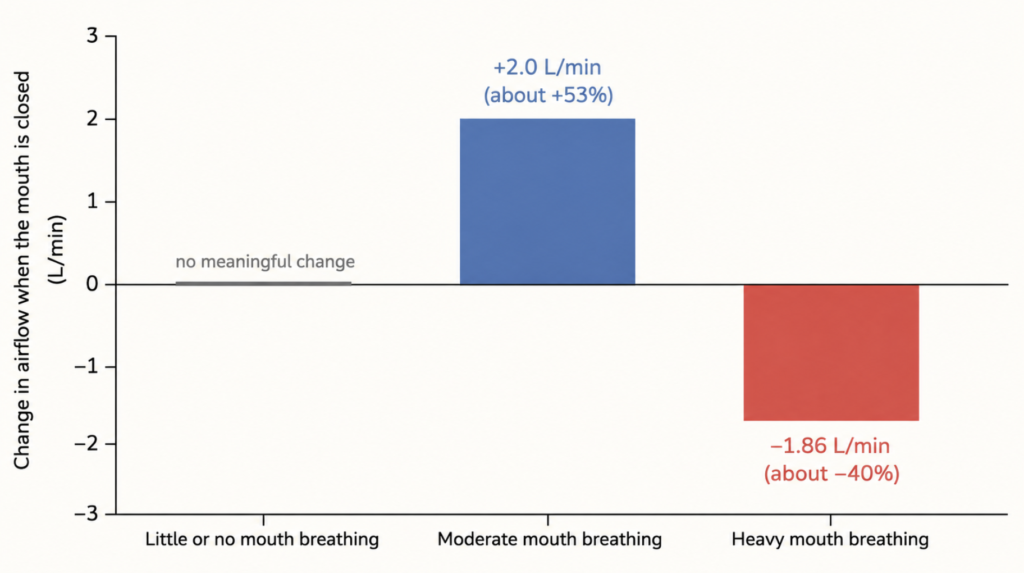
The mechanism is the part worth sitting with. Some people breathe through the mouth because the route above it, at the soft palate, is obstructed. For them the mouth is not a bad habit — it is the working airway. Obstruction at that level predicted a negative response with 77% accuracy, and the direction is not uniform either: one obstruction pattern responded favorably, with airflow improving on closure. What determines the outcome is airway anatomy, and that is not something anyone can read off their own face.
Two caveats belong with these numbers. This was an acute, single-breath maneuver under propofol sedation, not a night of taped sleep. And 12 additional patients were excluded for insufficient baseline airflow — a design choice that, by the authors’ own description, meant deterioration could not be observed in that group.
Tape may not even stop mouth breathing
There is a further wrinkle. When patients are taped, many keep attempting to breathe orally anyway — air escapes around the seal and the cheeks puff. Patients with no puffing had significantly lower apnea-hypopnea index than those with partial or complete puffing, and intermittent puffing carried the highest index of all [Jau, Mouth Puffing Phenomenon and Upper Airway Features May Be Used to Predict the Severity of Obstructive Sleep Apnea, 2023].
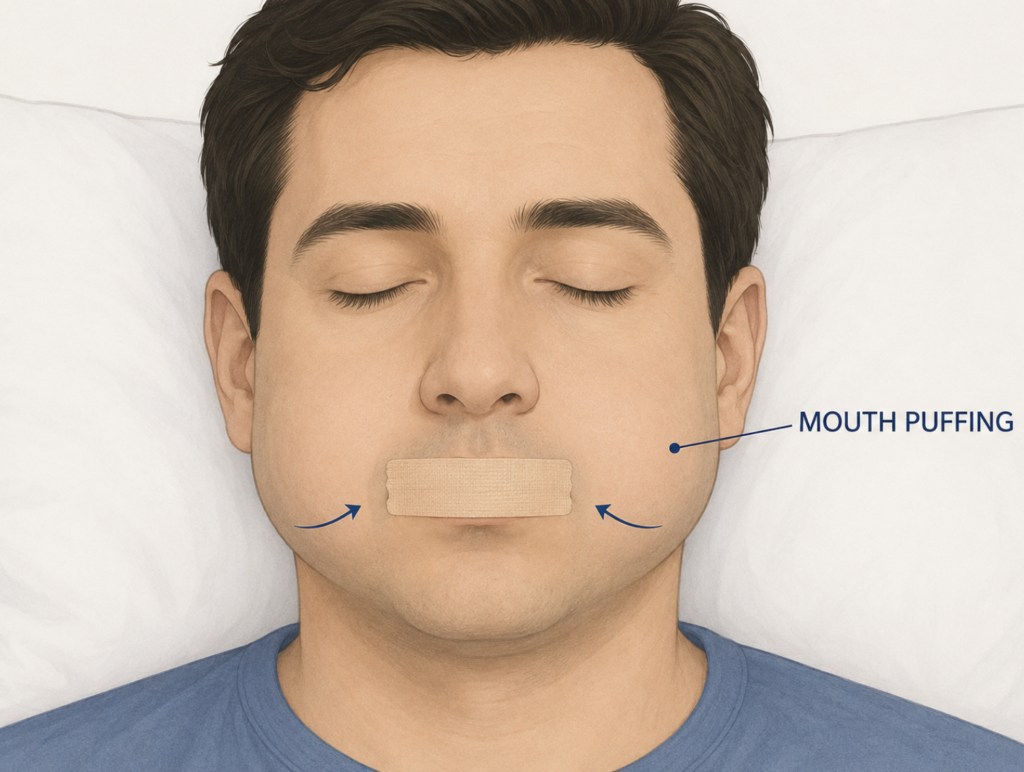
Tape may therefore obscure mouth breathing rather than eliminate it.
One application does have steadier support: reducing mouth leak in patients already using nasal CPAP, where a mouth-closing device significantly reduced leak [Bachour, Mouth Closing Device (Chinstrap) Reduces Mouth Leak During Nasal CPAP, 2004] — but that is a supervised, already-diagnosed population.
So which group am I in?
Start from the cause. Mouth breathing during sleep is usually downstream of something — allergic rhinitis, adenotonsillar hypertrophy, a deviated septum or some other reasons. Which means the typical person reaching for tape is, by definition, the person every positive study excluded.
This is also where the safety concern sits. Four of the 10 reviewed studies explicitly discussed a risk of asphyxiation when nasal obstruction or regurgitation is present, and the authors of the most favorable study stated that taping is not recommended in moderate to severe sleep apnea [Rhee, Breaking Social Media Fads and Uncovering the Safety and Efficacy of Mouth Taping, 2025]. The American Academy of Sleep Medicine called mouth taping dangerous in a 2023 public statement — not a clinical guideline, but a clear position — alongside a commissioned survey in which 12% of 2,005 U.S. adults reported having tried it.
An ENT visit can settle a good part of this. Whether your nose is actually obstructed, and why, is information available in a clinic. Where your throat narrows during sleep is not — that needs a sleep study or endoscopy.
Clinical Perspective
The people for whom taping is safe are largely the people who need it least: clear nose, mild disease, no significant apnea. The people drawn to it are usually the opposite. Before anything gets taped, the question worth answering is not “how do I keep my mouth shut” but “why does it open in the first place.” That answer often changes the plan entirely — and sometimes it removes the need for tape altogether.
Key Takeaways
- Mouth taping reduced snoring and apnea severity in two small uncontrolled studies, both limited to mild sleep apnea in people confirmed to have a clear nasal airway.
- Six studies measured apnea-hypopnea index and only two found a significant reduction; all 10 studies in the 2025 systematic review were rated poor quality.
- Mouth taping alone showed no significant benefit over baseline in the one crossover study that tested it directly against a mandibular advancement device.
- Closing the mouth worsened airflow in 22% of patients studied under sleep endoscopy — a drop of about 40% in that group — specifically those who relied on the oral route to bypass obstruction above it.
- Nasal obstruction is the most common reason people breathe through their mouths at night, and it is the exact condition that every favorable study excluded.
FAQ
Is mouth taping safe if I have sleep apnea? Not without evaluation. The favorable evidence covers mild sleep apnea only, and the authors of that work advised against taping in moderate to severe disease. Closing the mouth removes a compensatory airflow route in some patients, and airflow measurably worsened in about one in five people tested under sleep endoscopy. Since sleep apnea is diagnosed by sleep testing rather than by symptoms alone, the practical risk is not knowing which group you are in.
How do I know if I can breathe through my nose while asleep? You cannot reliably tell on your own, because nasal patency shifts overnight with position and congestion cycles. Daytime difficulty breathing through the nose is a useful warning sign, but its absence does not confirm a clear airway at 3 a.m. A clinical examination identifies most structural and inflammatory causes of nasal obstruction.
Does mouth taping actually reduce snoring? It did in specific studies, substantially — snoring index fell by roughly half in one group of mild-apnea mouth breathers with clear nasal airways. Whether that transfers to snorers in general is unproven, since those participants were selected for exactly the conditions most snorers do not meet. No large randomized trial has tested this.
What should I do instead? Identify why the mouth opens. Nasal obstruction from rhinitis, septal deviation, or tonsillar enlargement has established treatments, and options such as positional therapy, oral appliances, and CPAP are established parts of standard care for sleep-disordered breathing. If you snore loudly, gasp or choke at night, or feel persistently sleepy during the day, a sleep evaluation comes before any home remedy.
References
- Fitzpatrick MF, McLean H, Urton AM, Tan A, O’Donnell D, Driver HS. Effect of nasal or oral breathing route on upper airway resistance during sleep. Eur Respir J. 2003;22(5):827-832.
- Bachour A, Hurmerinta K, Maasilta P. Mouth closing device (chinstrap) reduces mouth leak during nasal CPAP. Sleep Med. 2004;5(3):261-267.
- Bhat S, Gushway-Henry N, Polos PG, DeBari VA, Riar S, Gupta D, et al. The efficacy of a chinstrap in treating sleep disordered breathing and snoring. J Clin Sleep Med. 2014;10(8):887-892.
- Huang TW, Young TH. Novel porous oral patches for patients with mild obstructive sleep apnea and mouth breathing: a pilot study. Otolaryngol Head Neck Surg. 2015;152(2):369-373.
- Labarca G, Sands SA, Cohn V, Demko G, Vena D, Messineo L, et al. Mouth closing to improve the efficacy of mandibular advancement devices in sleep apnea. Ann Am Thorac Soc. 2022;19(7):1185-1192.
- Lee YC, Lu CT, Cheng WN, Li HY. The impact of mouth-taping in mouth-breathers with mild obstructive sleep apnea: a preliminary study. Healthcare (Basel). 2022;10(9):1755.
- Jau JY, Kuo TBJ, Li LPH, Chen TY, Hsu YS, Lai CT, et al. Mouth puffing phenomenon and upper airway features may be used to predict the severity of obstructive sleep apnea. Nat Sci Sleep. 2023;15:165-174.
- Yang H, Huyett P, Wang TY, Sumner J, Azarbarzin A, Labarca GPT, et al. Mouth closure and airflow in patients with obstructive sleep apnea: a nonrandomized clinical trial. JAMA Otolaryngol Head Neck Surg. 2024;150(11):1012-1019.
- Rhee J, Iansavitchene A, Mannala S, Graham ME, Rotenberg B. Breaking social media fads and uncovering the safety and efficacy of mouth taping in patients with mouth breathing, sleep disordered breathing, or obstructive sleep apnea: a systematic review. PLoS One. 2025;20(5):e0323643.
Joonpyo Hong, MD is a board-certified otolaryngologist practicing in Korea. This article reflects his clinical interpretation of published research and does not constitute individual medical advice.
For more interesting content:
https://curiousmd.com/child-snoring-not-normal-by-age/
https://curiousmd.com/apple-watch-sleep-apnea-accuracy/
https://curiousmd.com/wearable-ai-for-sleep-apnea-2026/
Link out to:
- Mouth Closure and Airflow in Patients With Obstructive Sleep Apnea (JAMA Otolaryngology–Head & Neck Surgery) — the sleep endoscopy trial showing airflow worsened in 22% of patients.
- Breaking social media fads: a systematic review of mouth taping (PLOS One) — full open-access review of all 10 studies.
- The Impact of Mouth-Taping in Mouth-Breathers with Mild Obstructive Sleep Apnea (PubMed) — abstract of the study reporting the 47% snoring reduction.
- Viral TikTok trends are not the answer for better sleep (American Academy of Sleep Medicine) — the AASM statement and survey referenced above.