
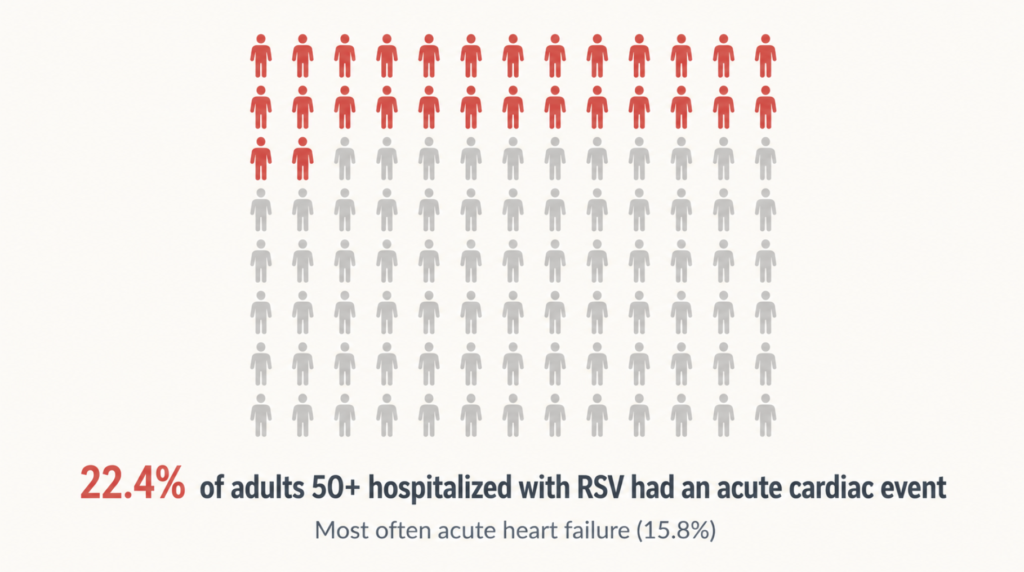
Among 6,248 adults aged 50 or older hospitalized with respiratory syncytial virus(RSV) across five surveillance seasons, 22.4% had an acute cardiac event during the admission — most often acute heart failure [Woodruff, Acute Cardiac Events in Hospitalized Older Adults With Respiratory Syncytial Virus Infection, 2024]. These were patients admitted for a respiratory infection. Numbers like that are why RSV vaccine effectiveness has become a practical question rather than an academic one.
A virus most people file under “bad cold in babies” now has three licensed vaccines and two monoclonal antibodies aimed at it. The question patients ask is simple: does it work, and for how long? Answering it means holding three axes at once — age group, outcome measured, and time since the dose. Change any one and the number moves substantially.
One Virus, Two Different Diseases
In infants, RSV is a lower airway disease of small tubes. It causes bronchiolitis and pneumonia, and it is the leading cause of infant hospitalization in the United States [Suh, Respiratory Syncytial Virus Is the Leading Cause of United States Infant Hospitalizations, 2022].
In older adults, RSV behaves less like a lung infection and more like a systemic stressor on an already-loaded system. Surveillance data show acute heart failure in 15.8% of hospitalized adults aged 50 and older, and acute cardiac events in 8.5% of those with no documented cardiovascular disease [Woodruff, 2024]. These events were observed alongside RSV admission rather than proven to be caused by it, but the pattern mirrors what is already accepted for influenza and SARS-CoV-2.
| Infants and young children | Adults 50+ | |
|---|---|---|
| Typical syndrome | Bronchiolitis, pneumonia | Lower respiratory tract disease, chronic disease exacerbation |
| Driver of admission | Airway obstruction, feeding difficulty, hypoxia | Respiratory failure plus cardiac decompensation |
| Prevention tool | Monoclonal antibody, or maternal vaccination | Active vaccination |
| Dosing | Single dose per season of risk | Single dose, not annual |
Vaccines for Adults, Antibodies for Infants
News coverage collapses this distinction constantly, and it matters clinically.
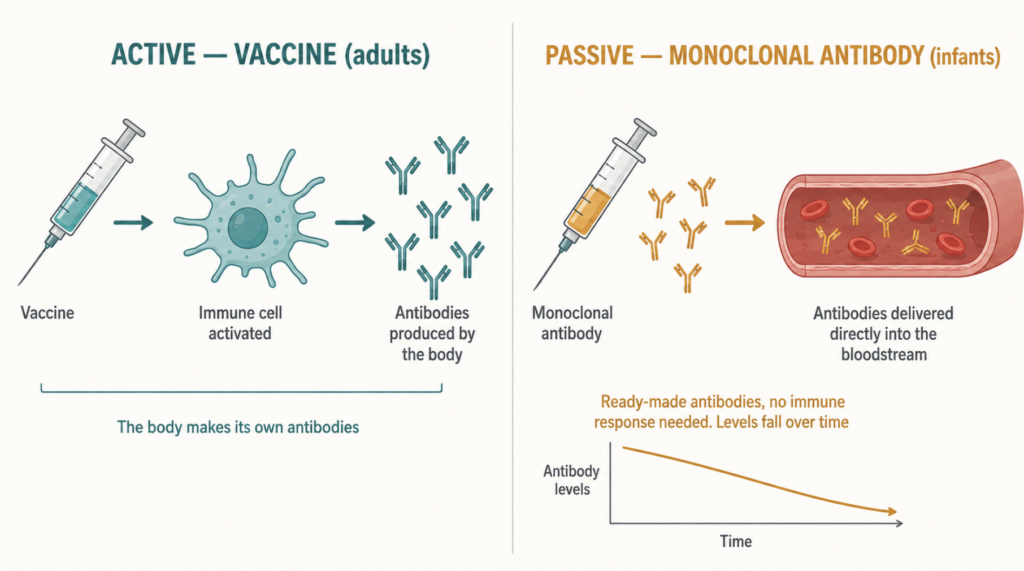
Adults receive an active vaccine — Arexvy, Abrysvo, or mResvia — which asks the immune system to build its own antibodies. Infants receive nirsevimab or clesrovimab, monoclonal antibodies that hand over pre-made protection directly, with no immune response required. That is why protection is expected to fade as the antibody clears. Maternal vaccination in pregnancy is the third route, transferring antibody across the placenta; it was effective against medically attended severe RSV lower respiratory illness in infants in its pivotal trial [Kampmann, Bivalent Prefusion F Vaccine in Pregnancy to Prevent RSV Illness in Infants, 2023]. Either maternal vaccination or infant antibody is used — not both.
The First-Season Numbers Are Strong
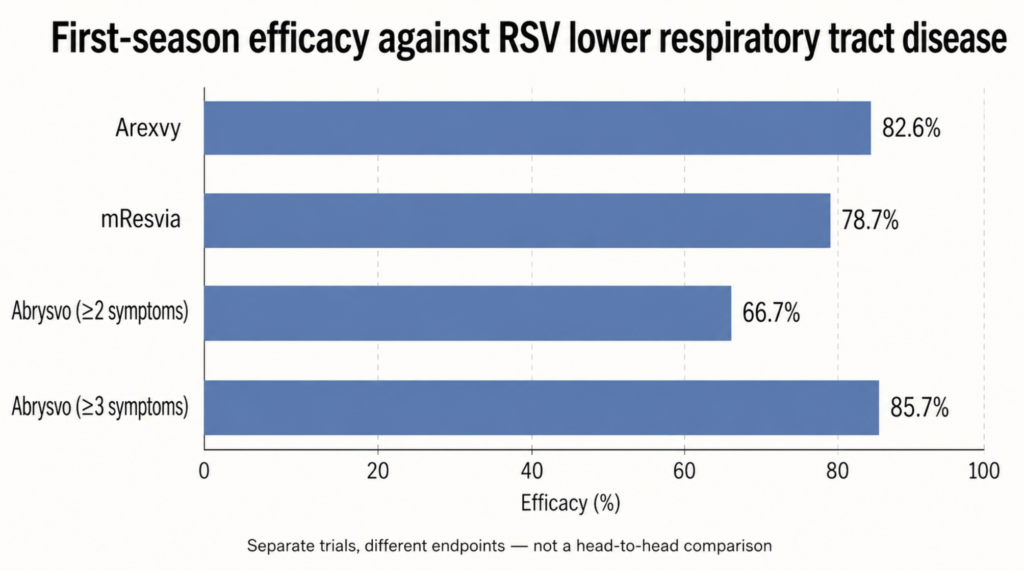
All three adult vaccines cleared their pivotal trials convincingly. Over the first season, efficacy against RSV-associated lower respiratory tract disease was 82.6% for Arexvy in adults 60 and older [Papi, Respiratory Syncytial Virus Prefusion F Protein Vaccine in Older Adults, 2023]; 66.7% for Abrysvo against illness with at least two symptoms and 85.7% with at least three [Walsh, Efficacy and Safety of a Bivalent RSV Prefusion F Vaccine in Older Adults, 2023]; and 78.7% for mResvia against illness with at least two symptoms [Wilson, Efficacy and Safety of an mRNA-Based RSV PreF Vaccine in Older Adults, 2023].
Real-world data agreed. Among US veterans aged 60 and older during 2023–24, effectiveness against documented RSV infection was 78.1% [Bajema, Respiratory Syncytial Virus Vaccine Effectiveness Among US Veterans, 2025].
RSV Vaccine Effectiveness in Season Two and Three
Most articles stop at the paragraph above. The durability data are more useful.
In the three-season analysis of the Arexvy pivotal trial, cumulative efficacy of a single dose against RSV lower respiratory tract disease was 62.9%, and 51.1% against RSV-associated acute respiratory illness. Protection declined across seasons, with the steeper drop between seasons one and two, and a second dose given a year later added little [Ison, Efficacy, Safety, and Immunogenicity of RSVPreF3 OA in Older Adults Over Three RSV Seasons, 2025]. Two-season efficacy in the same trial was 67.2% [Ison, RSVPreF3 OA in Older Adults Over 2 RSV Seasons, 2024]. Abrysvo’s two-season follow-up shows the same directional decline [Walsh, Efficacy, Immunogenicity, and Safety of the Bivalent RSVpreF Vaccine Over 2 RSV Seasons, 2026].
The largest real-world durability study followed 288,111 vaccinated US veterans for a median of 15.8 months. Effectiveness against documented RSV infection fell from 82.5% at 0–1 month to 59.4% over 0–18 months; against hospitalization, from 88.9% to 57.3%. Declines were most pronounced among immunocompromised patients [Bajema, Durability of Respiratory Syncytial Virus Vaccine Effectiveness Among US Veterans, 2026].
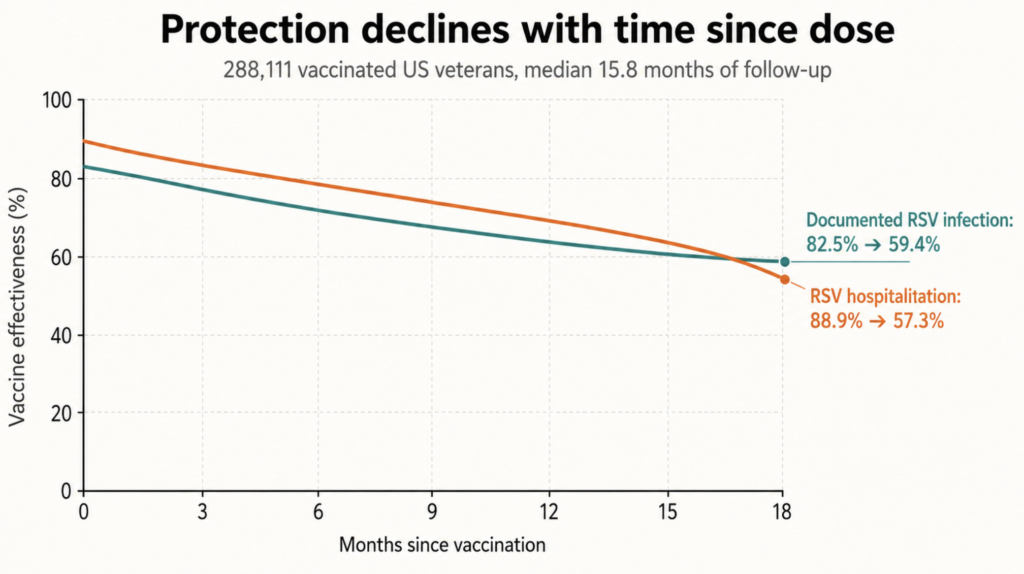
Two things follow. This is not an annual vaccine. And the field has not settled whether or when a later booster is warranted — the current single-dose recommendation reflects that unresolved question rather than a confident answer.
Infants: Strong Signal, Short Observation Window
In the HARMONIE randomized trial, nirsevimab reduced hospitalization for RSV lower respiratory tract infection by 83.2% and very severe RSV infection by 75.7% [Drysdale, Nirsevimab for Prevention of Hospitalizations Due to RSV in Infants, 2023].
Real-world estimates cluster in a compatible range. Across published studies, effectiveness runs roughly 70% to 90% against RSV-associated hospitalization and 55% to 88% against emergency department encounters — in line with the trial. The highest single estimate, 98% against hospitalization in the US VISION network, comes from a window with a median of only 48 to 52 days since the dose; because nirsevimab is passive immunization, its concentration falls with time. The same analysis put effectiveness against emergency department encounters at 77% [Payne, Effectiveness of Nirsevimab Among Infants in Their First RSV Season in the United States, 2025].
That 98% is not a wrong number. It measures protection during the well-covered early window, which is a different quantity from season-long protection — the same axis problem that runs through the adult data.
The Guillain-Barré Question, Answered With Numbers
Regulators added a Guillain-Barré syndrome warning to the adult RSV vaccine labels in early 2025, and patients ask about it.
England’s national analysis of its programme for 75–79-year-olds, covering 1,483,800 doses, found a relative incidence of GBS of 3.34 (95% CI 2.12–5.28) in the 42 days after vaccination — an attributable risk of 23 cases per million doses (95% CI 17–26). US estimates differ by method: an electronic-health-record analysis reported 18.2 cases per million doses for Abrysvo and 5.2 for Arexvy, while the FDA’s chart-confirmed Medicare analysis estimated about 9 per million [Stowe, Assessing the Risk of Guillain-Barré Syndrome in Older Adults After Bivalent RSV Pre-F Vaccination in England, 2025; Fry, Effectiveness and Safety of Respiratory Syncytial Virus Vaccine for US Adults Aged 60 Years or Older, 2025].
The benefit side has both observed and modelled components. Observed: in the US test-negative network during 2023–24, vaccination was 80% effective (95% CI 71–85) against RSV-associated hospitalization in adults 60 and older without immunocompromise, and 73% (48–85) in those with immunocompromising conditions [Payne, RSV Vaccine Effectiveness Against RSV-Associated Hospitalisations and Emergency Department Encounters Among Adults Aged 60 Years and Older in the USA, 2024]. At programme level, England recorded a 30% reduction in RSV hospital admissions (95% CI 18–40) among eligible 75–79-year-olds at roughly 42% coverage, with similar early findings reported from Scotland [Mensah, Early Impact of RSV Vaccination in Older Adults in England, 2025; Hameed, Early Evidence of RSV Vaccination Impact on Hospitalisation Rates of Older People in Scotland, 2025].
Converting that into a per-million figure requires modelling. Estimates presented to the UK’s vaccine committee, cited by the England safety analysis, put the benefit at 1,128 hospital admissions and 86 deaths prevented per million doses — roughly 50 times the GBS estimate for admissions, and about four times for deaths [Stowe, 2025].
The asymmetry is worth naming: observed harm against partly modelled benefit. That is not a rhetorical trick but a property of how the evidence is generated. A rare adverse event can only be counted after licensure, while the admissions a programme prevented never happened and must be inferred. The observed effectiveness and programme-level reductions above are what keep the modelled side anchored to something real.
Most GBS cases clustered on days 8 to 21, which is worth telling patients so they seek assessment early.
Clinical Perspective
Two points deserve emphasis, offered as clinical interpretation rather than trial evidence.
RSV is systematically under-tested in adults. An older patient with a cough who never receives a multiplex respiratory panel becomes an invisible case, and invisible cases make a disease look smaller than it is. The case counts and hospitalization totals above are likely floors. Proportions behave differently: when testing follows clinician suspicion, sicker patients are tested preferentially, so a within-hospitalization figure such as the 22.4% cardiac-event estimate may run high rather than low.
The single-dose schedule may also carry a communication cost. “You don’t need this every year” is easily heard as “this isn’t important” — a framing worth correcting deliberately at the point of counselling.
The Asthma Question Nobody Has Answered
Severe RSV bronchiolitis in infancy is associated with recurrent wheeze and later asthma. Whether preventing the bronchiolitis prevents the asthma is a different claim, and the evidence does not yet support it: monoclonal antibody prophylaxis trials with long-term follow-up have produced conflicting results, and a systematic review of causal strength concluded the association falls short of established causation [Quinn, Respiratory Syncytial Virus Prophylaxis for Prevention of Recurrent Childhood Wheeze and Asthma, 2020; Brunwasser, Assessing the Strength of Evidence for a Causal Effect of RSV Lower Respiratory Tract Infections on Subsequent Wheezing Illness, 2020]. The large nirsevimab cohorts now accumulating are, in effect, the natural experiment that could settle it.
Key Takeaways
- A single RSV vaccine dose is not an annual vaccine; revaccination one year later added little efficacy in the pivotal trial.
- First-season efficacy against lower respiratory tract disease ranged from 66.7% to 82.6%, falling to 62.9% cumulatively over three seasons.
- In 288,111 vaccinated veterans, effectiveness against RSV hospitalization fell from 88.9% at one month to 57.3% over 18 months.
- Infants receive a monoclonal antibody, not a vaccine; nirsevimab cut RSV hospitalization by 83.2% in a randomized trial.
- The Guillain-Barré signal is real and small — roughly 9 to 23 excess cases per million doses depending on country and method.
FAQ
Do I need an RSV vaccine every year?
No. Current recommendations call for a single dose. In the three-season trial, a second dose one year later added little additional efficacy. Whether a booster at a longer interval will eventually be recommended remains under evaluation.
Is the RSV shot given to babies a vaccine?
No. Nirsevimab and clesrovimab are monoclonal antibodies — ready-made protection given directly, rather than something that trains the infant’s immune system. Protection declines as the antibody clears.
Should a healthy 55-year-old get it?
Not under current recommendations, which target all adults 75 and older plus adults 50 to 74 with conditions raising the risk of severe RSV — chronic lung or cardiovascular disease, diabetes with complications, end-stage kidney disease, and moderate to severe immunocompromise, among others. The decision belongs with their own physician.
How serious is the Guillain-Barré risk?
Small, and quantified. National analyses estimate roughly 9 to 23 excess cases per million doses in the six weeks after vaccination, clustering on days 8 to 21. US and UK regulators concluded the benefits continue to outweigh this risk; UK guidance asks that vaccinees be told to seek assessment promptly for new weakness or numbness.
Maternal vaccination in pregnancy, or nirsevimab for the baby?
One or the other, not both, for most infants. Maternal vaccination protects from birth, which matters for babies born during the season; infant antibody can be given at the birth hospital or a well-child visit. The choice usually turns on delivery timing relative to the RSV season and on local availability.
References
Bajema KL, Bui DP, Yan L, et al. Durability of respiratory syncytial virus vaccine effectiveness among US veterans. JAMA Intern Med. 2026;186(1):78-88.
Bajema KL, Yan L, Li Y, et al. Respiratory syncytial virus vaccine effectiveness among US veterans, September, 2023 to March, 2024: a target trial emulation study. Lancet Infect Dis. 2025;25(6):625-633.
Brunwasser SM, Snyder BM, Driscoll AJ, et al. Assessing the strength of evidence for a causal effect of respiratory syncytial virus lower respiratory tract infections on subsequent wheezing illness: a systematic review and meta-analysis. Lancet Respir Med. 2020;8(8):795-806.
Drysdale SB, Cathie K, Flamein F, et al. Nirsevimab for prevention of hospitalizations due to RSV in infants. N Engl J Med. 2023;389(26):2425-2435.
Fry SE, Terebuh P, Kaelber DC, Xu R, Davis PB. Effectiveness and safety of respiratory syncytial virus vaccine for US adults aged 60 years or older. JAMA Netw Open. 2025;8:e258322.
Ison MG, Papi A, Athan E, et al. Efficacy, safety, and immunogenicity of the AS01E-adjuvanted respiratory syncytial virus prefusion F protein vaccine (RSVPreF3 OA) in older adults over three respiratory syncytial virus seasons (AReSVi-006): a multicentre, randomised, observer-blinded, placebo-controlled, phase 3 trial. Lancet Respir Med. 2025;13(6):517-529.
Ison MG, Papi A, Athan E, et al. Efficacy and safety of respiratory syncytial virus (RSV) prefusion F protein vaccine (RSVPreF3 OA) in older adults over 2 RSV seasons. Clin Infect Dis. 2024;78(6):1732-1744.
Hameed SS, Robertson C, Morrison K, et al. Early evidence of RSV vaccination impact on hospitalisation rates of older people in Scotland. Lancet Infect Dis. 2025;25(3):256-258.
Kampmann B, Madhi SA, Munjal I, et al. Bivalent prefusion F vaccine in pregnancy to prevent RSV illness in infants. N Engl J Med. 2023;388(16):1451-1464.
Mensah AA, Whitaker H, Andrews NJ, Watson CH. Early impact of RSV vaccination in older adults in England. Lancet. 2025;405(10485):1139-1140.
Papi A, Ison MG, Langley JM, et al. Respiratory syncytial virus prefusion F protein vaccine in older adults. N Engl J Med. 2023;388(7):595-608.
Payne AB, Watts JA, Mitchell PK, et al. Respiratory syncytial virus (RSV) vaccine effectiveness against RSV-associated hospitalisations and emergency department encounters among adults aged 60 years and older in the USA, October, 2023, to March, 2024: a test-negative design analysis. Lancet. 2024;404(10462):1547-1559.
Payne AB, Battan-Wraith S, Rowley EAK, et al. Effectiveness of nirsevimab among infants in their first RSV season in the United States, October 2023-March 2024: a test-negative design analysis. Lancet Reg Health Am. 2025;49:101196.
Quinn LA, Shields MD, Sinha I, Groves HE. Respiratory syncytial virus prophylaxis for prevention of recurrent childhood wheeze and asthma: a systematic review. Syst Rev. 2020;9(1):269.
Stowe J, Watson CH, Ramsay ME, Andrews NJ. Assessing the risk of Guillain-Barré syndrome in older adults after bivalent RSV pre-F vaccination in England. Nat Commun. 2025;16:11496.
Suh M, Movva N, Jiang X, et al. Respiratory syncytial virus is the leading cause of United States infant hospitalizations, 2009-2019: a study of the national (nationwide) inpatient sample. J Infect Dis. 2022;226(Suppl 2):S154-S163.
Walsh EE, Eiras D, Woodside J, et al. Efficacy, immunogenicity, and safety of the bivalent respiratory syncytial virus (RSV) prefusion F vaccine in older adults over 2 RSV seasons. Clin Infect Dis. 2026;81(6):e680-e689.
Walsh EE, Pérez Marc G, Zareba AM, et al. Efficacy and safety of a bivalent RSV prefusion F vaccine in older adults. N Engl J Med. 2023;388(16):1465-1477.
Wilson E, Goswami J, Baqui AH, et al. Efficacy and safety of an mRNA-based RSV PreF vaccine in older adults. N Engl J Med. 2023;389(24):2233-2244.
Woodruff RC, Melgar M, et al. Acute cardiac events in hospitalized older adults with respiratory syncytial virus infection. JAMA Intern Med. 2024;184(6):602-611.
Guidance and regulatory documents
Centers for Disease Control and Prevention. RSV vaccine guidance for adults. Atlanta, GA: US Department of Health and Human Services, CDC.
Centers for Disease Control and Prevention, Advisory Committee on Immunization Practices. ACIP recommendations: respiratory syncytial virus. Atlanta, GA: US Department of Health and Human Services, CDC.
US Food and Drug Administration. FDA requires Guillain-Barré syndrome (GBS) warning in the prescribing information for RSV vaccines Abrysvo and Arexvy. Silver Spring, MD: FDA; January 2025.
Joonpyo Hong, MD is a board-certified otolaryngologist practicing in Korea. This article reflects his clinical interpretation of published research and does not constitute individual medical advice.
For more articles:
https://curiousmd.com/hpv-vaccine-and-throat-cancer/
https://curiousmd.com/japanese-encephalitis-vaccine/
https://curiousmd.com/shingles-vaccine-and-hearing-loss/
Link out to:
- CDC — RSV Vaccine Guidance for Adults: current US recommendations, eligibility conditions, and vaccine-by-vaccine effectiveness summaries.
- Nature Communications — Guillain-Barré syndrome after bivalent RSV pre-F vaccination in England: the full national safety analysis behind the 23-per-million figure.
- CDC — ACIP Vaccine Recommendations: the committee record for adult RSV vaccination and infant immunization.
- PubMed — Durability of RSV Vaccine Effectiveness Among US Veterans (JAMA Intern Med, 2026): the 288,111-veteran durability study.
- PubMed — RSV vaccine effectiveness against hospitalisations in US adults 60+ (Lancet, 2024): the test-negative analysis behind the 80% figure.
Pingback: Flu Vaccine Mismatch: Does the Shot Still Work?