
Search for baby hoarse voice from crying and you get dozens of articles listing possible causes. None of them gives a number. Nobody says how many days it takes for the voice to come back.
That is not an oversight. The study that would answer the question has not been done. No one has followed a group of hoarse infants and recorded when their voices returned.
So rather than inventing a timeline, this article sets out what is actually known: what happens in an infant’s larynx during prolonged crying, what the trajectory looks like even without a recovery study, what the evidence does and does not say about long-term effects, and which signs mean the hoarseness was never about crying at all.
Baby Hoarse Voice From Crying: What Actually Happens in the Larynx
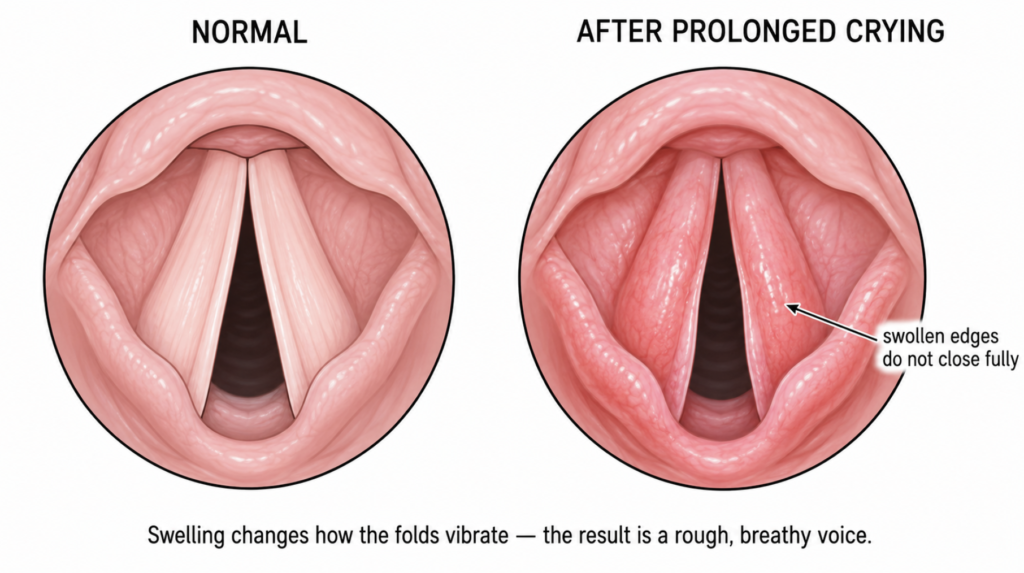
The mechanism is the same one behind a hoarse adult voice after a loud concert. Vocal folds produce sound by vibrating rapidly against each other. Sustained, forceful, high-pressure phonation, which is exactly what crying is, drives repeated mechanical impact between the two vibrating surfaces, and the tissue responds the way any tissue responds to repeated impact. It swells.
Swollen folds are heavier and stiffer. They stop closing cleanly along their full length, and the sound that comes out is rough, breathy, or lower in pitch. That is hoarseness, and it is standard laryngeal physiology rather than a contested claim [Stachler, Clinical Practice Guideline: Hoarseness (Dysphonia) (Update), 2018].
There is a caveat here that most parenting articles skip. That model was built from adult and school-age larynges. No published series has examined otherwise healthy infants after a long crying night to confirm the same process is occurring in them. An infant larynx is not simply a smaller adult larynx: the vocal ligament is not yet fully differentiated, and the layered structure that governs adult vibration is still developing through the early years. The explanation is sound and widely accepted, but it has not been verified directly in babies.
Why No One Can Give a Number of Days
There is no study of how long crying-related hoarseness lasts in infants under one year, of any size or vintage. The literature on infant voice is substantial, but it is built around structural problems: congenital lesions, vocal fold immobility, injury after intubation. The ordinary baby who cried for six hours and woke up raspy has never been the subject of a follow-up study.
Knowing that is more useful than a confident “two to three days” that traces back to nothing. What can be offered instead is the shape of the thing, which is arguably more informative anyway.
The Load Comes Down, Even If the Recovery Can’t Be Timed
How fast an infant’s voice recovers cannot be measured from existing data. How much vocal load an infant is under can be, and that curve is one of the best described trajectories in all of infant research.
A meta-analysis of 28 diary studies covering 8,690 infants found that average fussing and crying held steady at 117 to 133 minutes per day (SD 66 to 70) through the first six weeks, then dropped to a mean of 68 minutes (SD 46.2) by 10 to 12 weeks [Wolke, Systematic Review and Meta-Analysis: Fussing and Crying Durations and Prevalence of Colic in Infants, 2017]. Colic by modified Wessel criteria followed the same descent: 17% to 25% in the first six weeks, 11% at 8 to 9 weeks, and 0.6% by 10 to 12 weeks.
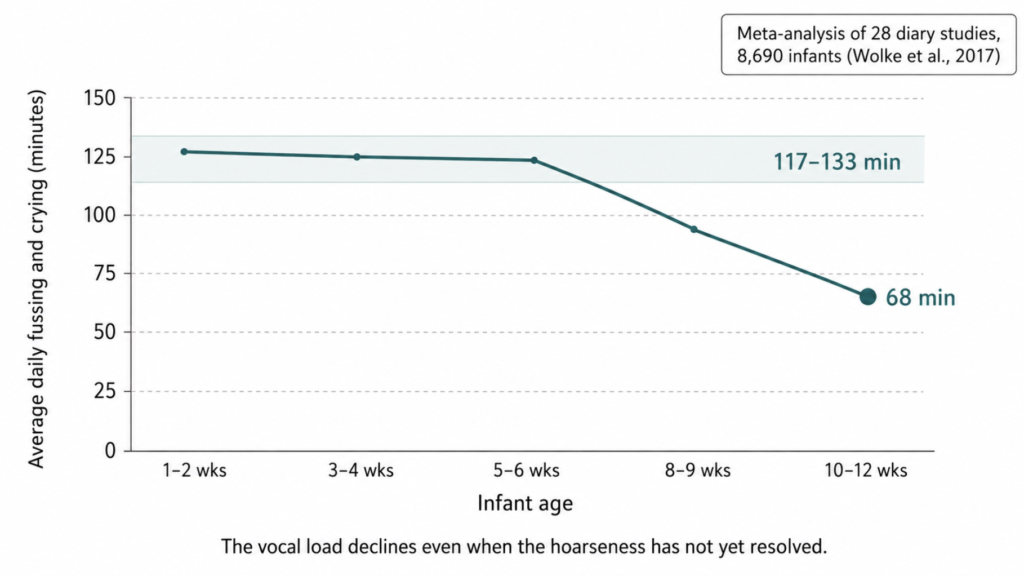
That last figure is worth reading twice. The pattern consuming a household right now becomes statistically rare within a matter of weeks.
Two qualifications belong here. A separate meta-analysis pooling 57 studies across 17 countries and 7,580 infants found 126 minutes (SD 61) of crying and fussing at the traditional five to six week “peak,” but with high heterogeneity between studies, and its modeling suggested that crying remains substantial across the first year after the initial decline [Vermillet, Crying in the First 12 Months of Life, 2022]. The Wolke analysis, meanwhile, found no statistical support for a universal peak at six weeks at all. The familiar curve reproduced across parenting sites, peaking at six weeks and resolved by twelve, is tidier than the data.
What both analyses agree on is direction. The load comes down. Whatever is happening to those vocal folds is happening under a burden that is decreasing rather than accumulating.
Will This Affect the Child’s Voice as an Adult?
This is usually the real worry, and it deserves careful handling rather than brisk reassurance.
No one has followed these children into later childhood to check. There is no cohort of “infants who were hoarse from crying” with voice outcomes at age ten, so there is no evidence showing they turn out fine. That evidence has simply never been gathered.
What exists instead is a clinical observation, and it should be read as exactly that. When children present to voice clinics with a persistent voice problem, the recognized causes form a fairly stable list: vocal fold nodules in school-age children, congenital structural lesions, and vocal fold immobility following cardiac surgery or difficult intubation. Having cried a great deal as an infant does not appear on it. Crying is a universal exposure, every infant does it, and a substantial fraction become hoarse from it, so if that exposure produced meaningful long-term voice damage at any appreciable rate, it would probably have surfaced as a recognized category by now. It has not. That is an absence of findings rather than a finding, which is weaker than proof, though in a reasonably well observed field an absence carries some weight.
One correction is worth making. Several parenting articles raise vocal fold nodules as a consequence of infant crying. The research on pediatric nodules is real, but it studies school-age children. How often nodules occur in infants under one year, and what becomes of them, has not been studied. Applying school-age findings to a four-month-old is an extrapolation rather than a fact, and it manufactures a worry the evidence does not support.
When Hoarseness Was Never About the Crying
Some infant hoarseness has nothing to do with vocal use, and the features that distinguish it are usually available to a parent without any equipment. This is the part that changes decisions.
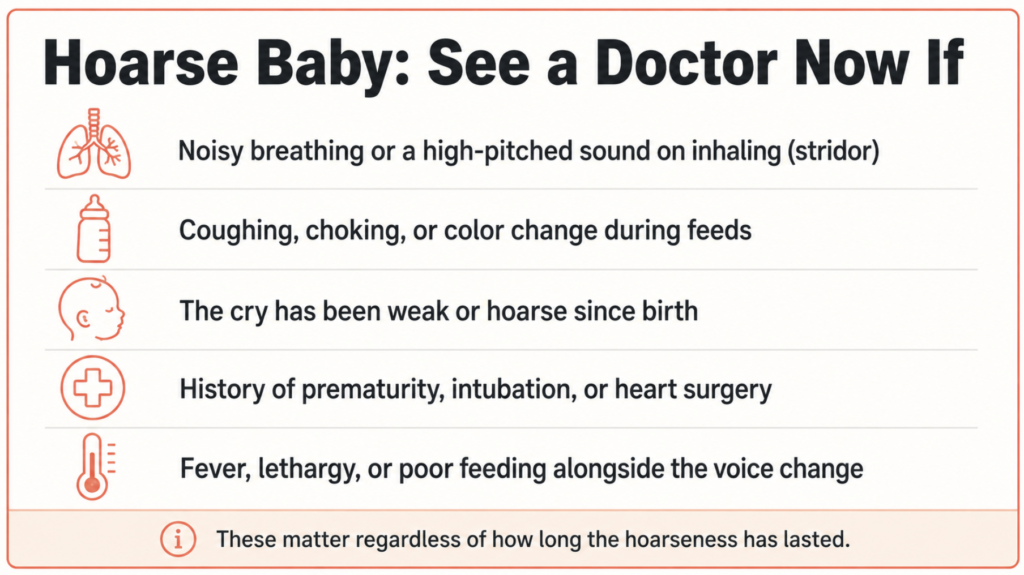
Signs that warrant evaluation now, however long the hoarseness has lasted:
- Noisy breathing, particularly a high-pitched sound on inhaling (stridor), or visible effort to breathe. Voice and airway share the same structure, so a problem affecting both is a different category of problem.
- Coughing, choking, or color change during feeds, which raises the question of whether the larynx is protecting the airway properly.
- A weak, hoarse, or abnormal cry present since birth or the first days of life. Hoarseness that appeared after a long crying night is a different story from hoarseness that was always there.
- A history of prematurity, neonatal intubation, or cardiac surgery. These belong in a separate pathway, discussed below.
- Fever, lethargy, poor feeding, or any systemic illness alongside the voice change.
History matters more than most parents realize. When vocal fold paralysis is identified in infants under twelve months, the causes cluster into a small number of categories: injury to the nerve during prior thoracic or cardiac surgery, central nervous system pathology, and a substantial idiopathic group with no identifiable cause [Zbar, Vocal Fold Paralysis in Infants Twelve Months of Age and Younger, 1996]. The practical implication for a parent is that surgical history is the first question rather than a footnote.
Prematurity carries its own signal. Among 843 very low birth weight infants screened, 18 had persistent dysphonia at one year of corrected age, and every one of them had a birth weight under 1,000 g. The rate among previously ventilated extremely low birth weight infants was 6.6%. Duration of ventilation and number of intubations did not separate cases from controls, but a documented difficult intubation did [Garten, Dysphonia at 12 Months Corrected Age in Very Low-Birth-Weight-Born Children, 2011]. This is single-center retrospective work. Even so, a baby born very early who had a difficult intubation belongs in a different conversation than a full-term baby who cried through the night.
The Four-Week Rule, and Who It Was Written For
Professional guidelines recommend laryngeal examination when dysphonia fails to resolve or improve within four weeks, or at any point irrespective of duration when a serious cause is suspected. Recent intubation, recent neck or chest surgery, and accompanying respiratory distress or stridor are named explicitly as reasons to move immediately [Stachler, Clinical Practice Guideline: Hoarseness (Dysphonia) (Update), 2018].
That four-week threshold applies to all age groups, which is another way of saying it was not derived from infants. No dedicated guideline exists for hoarseness in children under one year. Four weeks of continuous hoarseness in an infant has already left the territory of ordinary crying, so the threshold works better as a ceiling than as something to wait for. The symptom list above is the more practical trigger.
The Vocal Rest Problem
Every treatment framework for phonotrauma begins with voice rest. Reduce the load, the swelling settles, the tissue recovers.
None of that can be done with a baby. An infant cannot understand the instruction, and crying is not a behavior to be corrected; it is the only signaling system the child currently has. This is the trap that leaves parents feeling they are watching damage accumulate with no way to intervene.
What is actually available is everything upstream of voice rest: responding to the crying, working out what is driving it, and addressing whatever underlies it, whether that is hunger, discomfort, illness, or overstimulation. Reducing the reason to cry is the only version of voice rest that exists at this age, and it is also just ordinary care. Crying that is severe, persistent, or unlike a baby’s usual pattern is worth raising with a clinician in its own right, not because of the voice but because of what might sit behind it.
Clinical Perspective
Assessing a hoarse infant is less a matter of grading how injured the vocal folds are than of working out which of two stories is being told.
The first story has a beginning. The voice was normal, then there was a long night or a difficult week, and then it was rough. It fluctuates, worse after a hard stretch and better after a calm one. Breathing is quiet and feeding is unremarkable. This story tends to resolve on its own.
The second story has no beginning, or the wrong kind of beginning. The cry was never quite right. Or the voice changed and stayed changed, indifferent to how much the baby actually cried. Or something else travels with it: a noise on inhaling, a cough at the breast or bottle, a surgical history. This story needs a look at the larynx, and how long the hoarseness has lasted barely enters that decision.
One further observation belongs in any article on this subject. Parents arriving with this question are frequently running on weeks of broken sleep and a growing conviction that they are damaging their child. At three in the morning, the more vulnerable system in the house is probably not the baby’s larynx, and asking for help with the crying is not a lesser problem than asking about the voice.
Key Takeaways
- No study has measured how long crying-related hoarseness lasts in infants under one year, so any specific recovery timeline offered elsewhere is not evidence-based.
- Average infant fussing and crying falls from 117 to 133 minutes daily in the first six weeks to 68 minutes by 10 to 12 weeks, so the load on the vocal folds declines even while hoarseness persists.
- Colic by modified Wessel criteria drops from 17% to 25% in the first six weeks down to 0.6% by 10 to 12 weeks.
- Research on pediatric vocal fold nodules comes from school-age children, and applying it to infants under one year is an extrapolation rather than a finding.
- Stridor, choking during feeds, hoarseness present since birth, or a history of prematurity, intubation, or cardiac surgery warrant evaluation regardless of how long the hoarseness has lasted.
FAQ
How long does a baby hoarse voice from crying last? No one knows, because the study has never been done in infants under one year. What is well documented is that crying itself declines sharply over the first three months, so the strain producing the hoarseness is decreasing across that period. If hoarseness persists without improving, the more useful question is whether crying was ever the real cause.
Can crying permanently damage a baby’s voice? There is no long-term follow-up of infants who became hoarse from crying, so this cannot be answered from published data. Clinically, “cried a lot as a baby” does not appear among the recognized causes of persistent childhood voice disorders, which are dominated by school-age nodules, congenital lesions, and vocal fold immobility after surgery or intubation. That is a clinical observation rather than proof.
Do babies get vocal nodules from crying? The research on pediatric vocal fold nodules is drawn from school-age children. There is no data on how often nodules occur in infants under one year or what happens to them over time. Warnings about nodules aimed at parents of babies are extrapolated from an older age group.
When should a hoarse baby see a doctor? Immediately if there is stridor, breathing difficulty, choking during feeds, fever or lethargy, hoarseness present since birth, or a history of prematurity, intubation, or cardiac surgery. Without those, general guidelines suggest laryngeal examination if dysphonia does not improve within four weeks, but that threshold was written for all ages rather than for infants, and four weeks of continuous hoarseness in a baby is already beyond ordinary crying.
References
- Garten L, Salm A, Rosenfeld J, Walch E, Bührer C, Hüseman D. Dysphonia at 12 months corrected age in very low-birth-weight-born children. Eur J Pediatr. 2011;170(4):469-475.
- Stachler RJ, Francis DO, Schwartz SR, Damask CC, Digoy GP, Krouse HJ, et al. Clinical practice guideline: hoarseness (dysphonia) (update). Otolaryngol Head Neck Surg. 2018;158(1_suppl):S1-S42.
- Vermillet AQ, Tølbøll K, Litsis Mizan S, Skewes JC, Parsons CE. Crying in the first 12 months of life: a systematic review and meta-analysis of cross-country parent-reported data and modeling of the “cry curve”. Child Dev. 2022;93(4):1201-1222.
- Wolke D, Bilgin A, Samara M. Systematic review and meta-analysis: fussing and crying durations and prevalence of colic in infants. J Pediatr. 2017;185:55-61.e4.
- Zbar RI, Smith RJ. Vocal fold paralysis in infants twelve months of age and younger. Otolaryngol Head Neck Surg. 1996;114(1):18-21.
Joonpyo Hong, MD is a board-certified otolaryngologist practicing in Korea. This article reflects his clinical interpretation of published research and does not constitute individual medical advice.
For more articles:
https://curiousmd.com/vocal-nodule-vs-polyp-vs-cyst/
https://curiousmd.com/laryngomalacia-in-infants-symptoms-causes-treatment/
https://curiousmd.com/mdvp-voice-analysis-interpretation/
Link out to:
- AAO-HNS Clinical Practice Guideline: Hoarseness (Dysphonia) — Update — the full guideline, plus plain-language and patient-facing summaries.
- Wolke et al., Fussing and Crying Durations and Prevalence of Colic in Infants (PubMed) — the meta-analysis behind the crying-duration figures cited above.
- Vermillet et al., Crying in the First 12 Months of Life (open access) — free full text of the cross-country cry-curve analysis.
- Zbar & Smith, Vocal Fold Paralysis in Infants Twelve Months of Age and Younger (PubMed) — the infant-specific series on causes of vocal fold paralysis.
- ENThealth: Hoarseness — AAO-HNS patient education page.