
A patient lies draped under four thin metal arms. The surgeon is not standing over the table. In robotic surgery, the surgeon sits several meters away at a console, head lowered into a viewer, fingers inside two ring-shaped controllers. From the gallery it looks like a machine operating on a human being.
That is not what is happening. Every millimeter those arms travel was commanded by the surgeon’s hands a moment earlier and sent down a cable. The machine makes no decisions of its own. It cannot tell where the artery runs or identify the gallbladder. Switch off the console and the arms stop where they are, still holding whatever they were holding.
The gap between that impression and the machine’s actual role can be measured. A systematic review of every surgical robot cleared by the United States Food and Drug Administration between 2015 and 2023 screened nearly 38,000 device records and identified 49 surgical robots. Of those, 86% sat at the lowest working rung of machine autonomy, called robot assistance, meaning the device helps but never decides. Only 6% reached a level where the system can plan and adjust part of a task on its own [Lee, Levels of Autonomy in FDA-Cleared Surgical Robots, 2024].
Twenty years of robotic surgery changed how the surgeon’s hands move. Artificial intelligence is aimed at something different and much harder to hand over, which is the surgeon’s judgment.
What robotic surgery actually is
The formal name for the current arrangement is teleoperation. A surgeon manipulates controls at one end; motors reproduce those movements at the other. Between the two sits software that translates, scales, and smooths, but does not originate. No part of that loop generates an intention.
Engineers describe this with a ladder borrowed almost directly from self-driving cars. A widely adopted framework sorts medical robots into six rungs, from Level 0, where the machine has no autonomy at all, up to Level 5, a system that could carry out an entire operation with no human present [Yang, Medical Robotics: Levels of Autonomy, 2017]. The rungs in between describe machines that can perform a single defined task, then a task they can adapt mid-execution, then a sequence of tasks under supervision.
Almost everything in clinical use today sits near the bottom of that ladder. But “no autonomy at all” overstates the case, and the overstatement matters. Some cleared systems, such as orthopedic platforms that cut bone along a plan built from the patient’s own imaging, genuinely hold a plan and correct against it. Most surgical robots are not incapable of holding a plan. They are simply not permitted to make decisions, because they were designed to improve movement rather than to contribute judgment.
The case for the console
Surgeons who work robotically are not confused about what the machine does. They value it for narrow, physical reasons.
Human hands always tremble slightly, and the software filters that tremor out. Human wrists cannot rotate freely at the end of a long rigid rod pushed through a small incision, so robotic instruments carry joints near the tip that restore rotation deep inside a body cavity. And the surgeon looks into a magnified stereoscopic view rather than a flat monitor across the room [Chatterjee, Advancements in Robotic Surgery, 2024].
All three are real, and all three are about movement. Enthusiastic accounts of robotic surgery tend to slide from there into a claim they have not earned, because better movement is not the same thing as a better outcome. A steadier hand deep in the pelvis is mechanically advantageous. Whether that advantage survives all the way out to the patient, in the form of fewer complications, better function a year later, or longer survival, is a separate question answered by different evidence, and the answer has been repeatedly disappointing.
Clinical Perspective. The strongest defensible claim for the console is about access rather than quality. It lets a difficult approach be attempted through small incisions by more surgeons than could otherwise manage it. That is worth something, but it is not the same as making the operation better, and treating the two claims as one has been the central rhetorical error of the last two decades.
The case against: expensive, and not clearly better
The skeptical position is blunt. Robotic surgery, the argument runs, is a costly way to do what competent humans already did. It deserves a fair hearing, because the trial evidence is largely on its side.
Consider three of the largest randomized comparisons.
| Trial | Comparison | Primary result |
|---|---|---|
| ROLARR (rectal cancer, 471 patients, 29 sites, 10 countries) | Robotic vs conventional laparoscopic resection | Conversion to open surgery 8.1% robotic vs 12.2% laparoscopic, not a statistically meaningful difference. Complications, 30-day mortality, and margin positivity (5.1% vs 6.3%) were also similar [Jayne, ROLARR Randomized Clinical Trial, 2017] |
| Yaxley et al. (prostate cancer, 326 patients) | Robotic vs open radical prostatectomy | Urinary and sexual function scores at 12 weeks were effectively identical (urinary 83.8 vs 82.5) [Yaxley, Robot-assisted vs Open Radical Prostatectomy, 2016] |
| ORATOR (oropharyngeal cancer, 68 patients) | Transoral robotic surgery vs radiotherapy | Swallowing-related quality of life at one year slightly favored radiotherapy (86.9 vs 80.1), a difference too small to be clinically meaningful. Side-effect profiles differed [Nichols, ORATOR Randomised Trial, 2019] |
In rectal cancer, roughly one operation in ten had to be converted to open surgery regardless of which technology was used. In prostate cancer, patients three months out could not be distinguished by which machine had been in the room. In throat cancer, a small trial found no swallowing advantage for the robot at all.
These findings carry different weights. ROLARR was large, international, and its direction has held up in later analyses, so it can be stated flatly. The prostate trial was smaller, ran at a single center with one surgeon per arm, and reported only early outcomes, so it points a direction rather than settling one. ORATOR enrolled 68 patients in total, enough to notice a large effect but not enough to rule out a modest one.
Then there is money. An independent analysis of the primary manufacturer’s audited financial filings estimated that in 2017, United States hospitals paid that company more than $3 billion, which worked out to roughly $3,568 per robotic procedure: about $1,866 for instruments and accessories, $1,038 toward the systems themselves, and $663 for service contracts [Childers, Acquisition and Operating Costs for Robotic Surgery, 2018]. Part of that instrument cost is structural rather than physical, since instruments are specified not to be used beyond ten procedures. Those are American figures from 2017 and they do not translate directly to other health systems, but the direction is not ambiguous.
The technology also spreads on its own momentum. A study of 73 hospitals and 169,404 patients in one American state found robotic use rising from 1.8% of these operations in 2012 to 15.1% in 2018. For inguinal hernia repair, a routine operation with a well-established laparoscopic approach, robotic use went from 0.7% to 28.8%. The more revealing finding is what happened to the alternative: before adopting a robot, hospitals were steadily increasing their laparoscopic surgery, and afterward laparoscopic use began to fall [Sheetz, Trends in the Adoption of Robotic Surgery, 2020]. Buying the equipment changed practice more reliably than the trial evidence did.
Where the skeptics overreach
The strongest version of the criticism, that humans can already do all of this, leaves out the question of which humans.
A study of 20 bariatric surgeons submitted operative videos for blinded peer rating, then linked those skill ratings to outcomes in 10,343 of their patients. Ratings ranged from 2.6 to 4.8 on a five-point scale. Surgeons in the bottom quarter of technical skill had complication rates of 14.5%, against 5.2% for the top quarter. Mortality was 0.26% against 0.05%, and their operations took 137 minutes against 98 [Birkmeyer, Surgical Skill and Complication Rates, 2013]. Roughly one patient in seven had a complication with the least skilled surgeons, against one in twenty with the most skilled, in the same operation, the same registry, and the same state.
That study examined conventional hand technique rather than robots, and it does not show that robots close the gap. No trial does. But it undercuts the premise the criticism rests on, because “a human can do this” is only reassuring if the human in question is one of the good ones, and skill is not distributed evenly. The trials asked whether the robot outperforms the surgeon, not whether it reduces the variation between surgeons.
Clinical Perspective. The ROLARR investigators noted their result applied to surgeons with varying robotic experience, which is the realistic condition rather than a flaw. The more interesting gap in the last twenty years is the question nobody asked. The field spent two decades testing whether the robot beats the surgeon and almost never tested whether it narrows the distance between surgeons, which is the question a machine that does not decide could plausibly have answered.
Where robots actually operate today
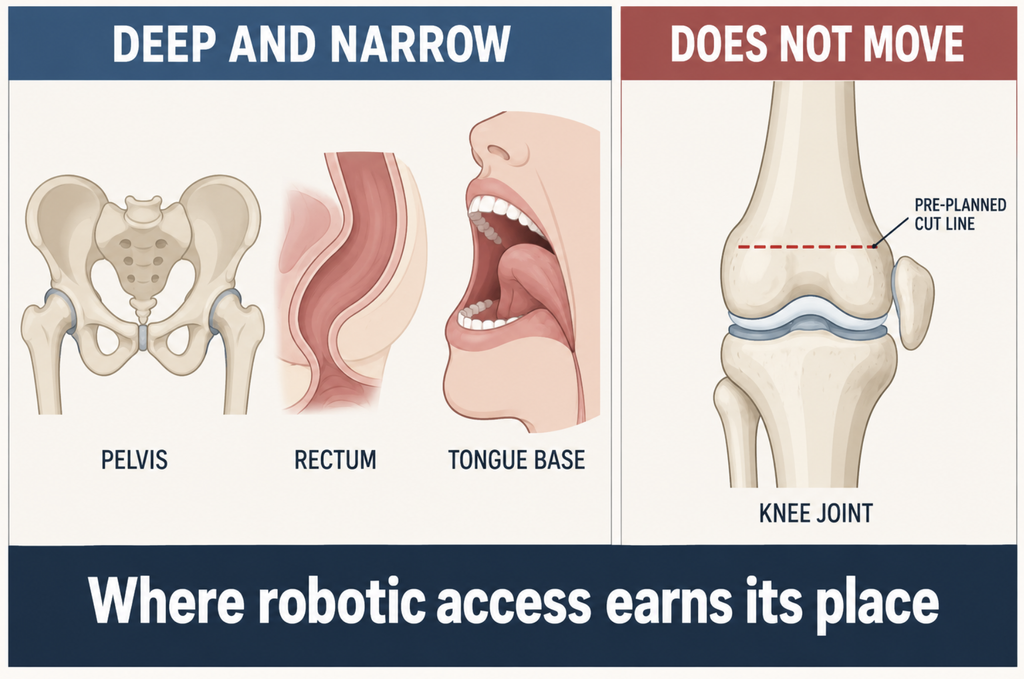
Robotic surgery concentrated where anatomy is unfriendly to human wrists. Urology and gynecology came first, because the pelvis is deep, narrow, and bony, and the instruments that reach it are long. Colorectal surgery followed. Head and neck surgery adopted a transoral approach, reaching tumors at the base of the tongue through the open mouth rather than by splitting the jaw. Orthopedic surgery took a different path, using robotic arms to execute bone cuts planned in advance from imaging.
Two conditions recur. Either the target sits somewhere deep and narrow where human dexterity fails first, or the target is rigid enough to be planned in advance and does not move once the operation begins. Bone belongs to the second group. This matters more than it appears, because it is exactly the boundary that machine autonomy has not yet crossed.
Diffusion has also run well ahead of that logic. The rise in robotic hernia repair, a comfortable and high-volume laparoscopic operation, was one of the steepest increases recorded, and it is difficult to argue that inguinal anatomy is deep, narrow, or unreachable by hand. Where the anatomy is genuinely difficult, the case for the robot is clinical. Where it is not, what remains is mostly commercial.
Using a robot versus trusting an algorithm
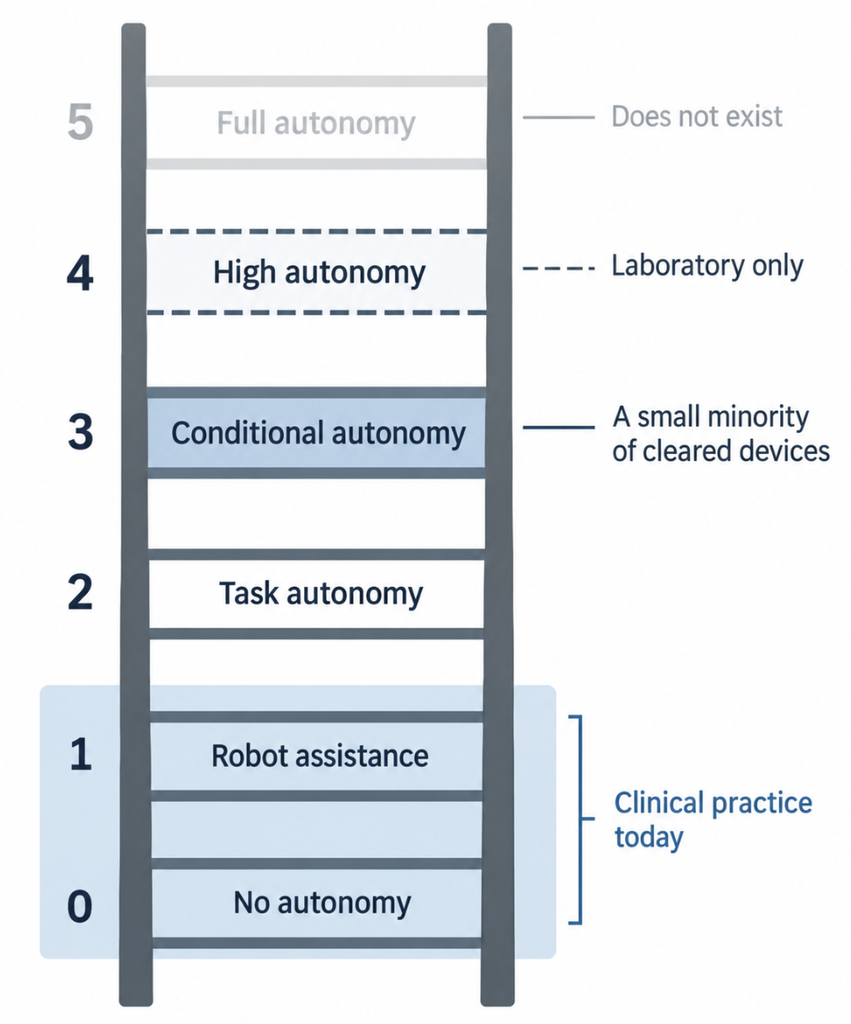
Public discussion tends to collapse two different things. A robot changes who moves the instruments, while artificial intelligence changes who decides where they go.
| Level | What the machine does | Status |
|---|---|---|
| 0 | Nothing autonomously; pure teleoperation | Standard for most systems in clinical use |
| 1 | Assists the surgeon, physically or cognitively | The great majority of cleared surgical robots |
| 2 | Performs a defined task on command | Present in some planning-based systems |
| 3 | Plans a task and adjusts during execution | Reached by a small minority of cleared devices |
| 4 | Plans and executes a sequence, under supervision | Laboratory only |
| 5 | Performs an entire operation unsupervised | Does not exist |
Levels adapted from [Yang, Medical Robotics: Levels of Autonomy, 2017]; distribution among cleared devices from [Lee, Levels of Autonomy in FDA-Cleared Surgical Robots, 2024].
Artificial intelligence has already entered the operating room, but at the bottom of this ladder, as perception rather than action. In one study, deep learning models were trained on 2,627 frames drawn from 290 gallbladder operations contributed by 153 surgeons across 37 countries, and asked to mark which regions of the surgical field were safe to cut and which were not. The models were reasonably good at flagging the dangerous zones and less good at the safe ones, and their performance varied sharply by structure: they outlined the liver well, the gallbladder less well, and the small triangle of tissue containing the critical duct and artery least well of all [Madani, AI for Intraoperative Guidance, 2022].
That last result matters more than the headline accuracy. The structure the model handled worst is the one surgeons actually injure, so the model was weakest exactly where guidance would be most useful.
Two laboratory demonstrations show what the next rungs look like. In one, an autonomous system sutured bowel in living pigs, with animals followed for a week afterward; on measures of stitch spacing and consistency, the machine was more uniform than expert human hands [Saeidi, Autonomous Robotic Laparoscopic Surgery for Intestinal Anastomosis, 2022]. In the other, a system trained on video of surgeons performing gallbladder removal completed a step of that operation on eight previously unseen cadaveric specimens, all eight times, with no human intervention [Kim, SRT-H: Hierarchical Framework for Autonomous Surgery, 2025].
Both results are genuine and both are early. One was in pigs. The other was in dead tissue, on one step of one operation, without a control group. Neither has been performed on a living patient, and the authors of the second described their own result as step-level autonomy and cautioned against the headlines that followed.
Clinical Perspective. Most of a surgeon’s working time is not manual. It is a running series of small decisions: this plane or that one, this is scar tissue rather than duct, stop and reassess. Robots left that layer untouched, which is part of why the trials found so little. AI works on it directly, so both the possible gains and the possible failures are of a different kind than anything teleoperation produced.
Four walls between here and full autonomy
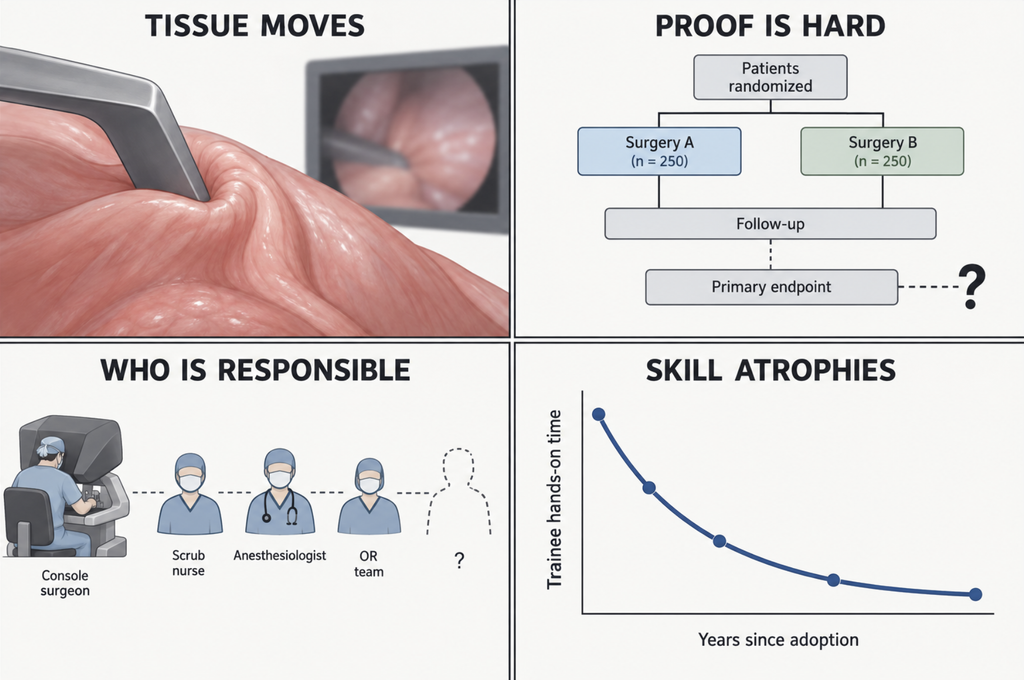
Tissue moves and a road does not. Soft tissue stretches under traction, shifts when the patient is repositioned, and changes shape the moment it is cut. Blood obscures the camera at exactly the moment precision matters most. The teams working on autonomous systems name these as the central technical obstacles in their own papers rather than as afterthoughts [Saeidi, 2022; Kim, 2025]. Bone was automated first partly because it holds still.
Proof is hard to obtain, because surgery resists clean trials. Blinding is close to impossible, techniques improve mid-study, and outcomes depend on the operator as much as the method, which is why so many robotic comparisons produced ambiguous results even after decades and thousands of patients. A system that learns and changes between versions is harder to evaluate still. What exactly gets approved, if the thing approved keeps updating?
Nobody has settled who is responsible either. When a teleoperated instrument injures a duct, the line of accountability runs to the surgeon holding the controls. When a system plans and executes, that line frays. The regulatory frameworks were not written for devices that decide. This gap was flagged by the people building these machines, in the same paper that defined the autonomy ladder [Yang, 2017], and it has not closed. One telling detail from the FDA review: only two cleared surgical robots were formally recognized as having machine-learning capability, while more were described that way in marketing materials [Lee, 2024]. Regulation is behind the technology, and further behind the way the technology is advertised.
Skill also atrophies. If a machine reliably performs a step, trainees stop learning it, and the humans who must take over when the machine fails are the least prepared to do so. Autonomy depends on human rescue for its failure cases while eroding the expertise that rescue requires.
The self-driving comparison breaks down at the obvious point. A car in trouble can pull over, and an open abdomen cannot wait by the roadside while the system reboots.
Clinical Perspective. The likeliest near-term version of this is not an autonomous surgeon but an attentive one: software that watches the field and flags a wrong plane while a human holds the instruments. That is smaller than the headlines suggest and larger than what the current robot delivers, because it would be the first time the machine contributes judgment rather than motion. Whether patients end up better off depends on trials that have not yet been run.
Key Takeaways
- Robotic surgery as practiced today is teleoperation. The machine reproduces the surgeon’s movements and originates none of its own.
- Randomized trials have repeatedly failed to show that robotic approaches beat conventional ones on the outcomes patients care about, while costing substantially more.
- Adoption has tracked equipment purchases more closely than evidence. Hospitals that bought robots changed their surgical practice, and their laparoscopic volume fell.
- The “humans can already do this” objection depends on which human, since measured differences in surgical skill correspond to nearly threefold differences in complication rates.
- Artificial intelligence targets the decision layer that robots left untouched, which is why its potential and its risks are both larger.
- Autonomous surgery has been demonstrated in animals and cadaveric tissue on single steps of single operations, and never in a living patient.
FAQ
Does a robot perform the surgery? No. In clinical practice the robot reproduces the surgeon’s hand movements in real time and makes no decisions of its own. A systematic review of surgical robots cleared by the FDA between 2015 and 2023 found 86% at the lowest working level of autonomy, where the device assists but never decides [Lee, 2024].
Is robotic surgery better than conventional surgery? Generally not, on the outcomes measured so far. The largest randomized trial in rectal cancer found no meaningful difference in conversion to open surgery, complications, or mortality against standard laparoscopic surgery [Jayne, 2017]. Robotic approaches remain valuable where anatomy is deep and narrow, but different access and better result are separate claims.
Has a robot ever operated on a person by itself? No. The most advanced demonstrations completed one step of gallbladder removal on eight cadaveric specimens with no human intervention, and sutured bowel in living pigs [Kim, 2025; Saeidi, 2022]. Neither has been attempted in a living human patient.
Will AI replace surgeons? It depends on what the question means. Nothing on the horizon replaces a surgeon’s full role, and the unresolved obstacles are as much regulatory and legal as technical. What is plausible sooner is software that watches an operation and warns before an error, which is assistance with judgment rather than substitution for it.
References
- Lee A, Baker TS, Bederson JB, Rapoport BI. Levels of autonomy in FDA-cleared surgical robots: a systematic review. NPJ Digit Med. 2024;7(1):103.
- Yang GZ, Cambias J, Cleary K, et al. Medical robotics—regulatory, ethical, and legal considerations for increasing levels of autonomy. Sci Robot. 2017;2(4):eaam8638.
- Chatterjee S, Das S, Ganguly K, Mandal D. Advancements in robotic surgery: innovations, challenges and future prospects. J Robot Surg. 2024;18(1):28.
- Jayne D, Pigazzi A, Marshall H, et al. Effect of robotic-assisted vs conventional laparoscopic surgery on risk of conversion to open laparotomy among patients undergoing resection for rectal cancer: the ROLARR randomized clinical trial. JAMA. 2017;318(16):1569-1580.
- Yaxley JW, Coughlin GD, Chambers SK, et al. Robot-assisted laparoscopic prostatectomy versus open radical retropubic prostatectomy: early outcomes from a randomised controlled phase 3 study. Lancet. 2016;388(10049):1057-1066.
- Nichols AC, Theurer J, Prisman E, et al. Radiotherapy versus transoral robotic surgery and neck dissection for oropharyngeal squamous cell carcinoma (ORATOR): an open-label, phase 2, randomised trial. Lancet Oncol. 2019;20(10):1349-1359.
- Childers CP, Maggard-Gibbons M. Estimation of the acquisition and operating costs for robotic surgery. JAMA. 2018;320(8):835-836.
- Sheetz KH, Claflin J, Dimick JB. Trends in the adoption of robotic surgery for common surgical procedures. JAMA Netw Open. 2020;3(1):e1918911.
- Birkmeyer JD, Finks JF, O’Reilly A, et al. Surgical skill and complication rates after bariatric surgery. N Engl J Med. 2013;369(15):1434-1442.
- Madani A, Namazi B, Altieri MS, et al. Artificial intelligence for intraoperative guidance: using semantic segmentation to identify surgical anatomy during laparoscopic cholecystectomy. Ann Surg. 2022;276(2):363-369.
- Saeidi H, Opfermann JD, Kam M, et al. Autonomous robotic laparoscopic surgery for intestinal anastomosis. Sci Robot. 2022;7(62):eabj2908.
- Kim JWB, Chen JT, Hansen P, et al. SRT-H: a hierarchical framework for autonomous surgery via language-conditioned imitation learning. Sci Robot. 2025;10(104):eadt5254.
Joonpyo Hong, MD is a board-certified otolaryngologist practicing in Korea. This article reflects his clinical interpretation of published research and does not constitute individual medical advice.
This article is not intended to advertise or promote any specific company or product.
For more articles:
https://curiousmd.com/neuralink-voice-speech-first/
https://curiousmd.com/ai-speech-clarification-hearing-loss/
https://curiousmd.com/convolutional-neural-networks-in-medicine/
https://curiousmd.com/anti-tslp-antibody-nasal-polyps/
Link out to:
ROLARR randomized trial, JAMA (2017)
Levels of autonomy in FDA-cleared surgical robots, npj Digital Medicine (2024)
Levels of autonomy for medical robotics, Science Robotics (2017)
Estimating the cost of robotic surgery, JAMA (2018)
Autonomous cholecystectomy step via imitation learning, Science Robotics (2025)