
Researchers tracked 9,801 children from two British birth cohorts from age 1 to age 11, looking for the classic allergic march: eczema first, then wheeze, then hay fever. They found that sequence in 3.1% of them [Belgrave, Developmental profiles of eczema, wheeze, and rhinitis: two population-based birth cohort studies, 2014].
That number surprises most parents. The allergic march is one of the most repeated ideas in pediatric allergy, and it is not wrong. But the tidy staircase drawn in patient handouts describes what happens across a population, not what will happen to any one child. The cohort data has more to say about timing, about how often the full sequence actually occurs, about how much parental allergy adds, and about the question parents of infants ask most: can moisturizer prevent any of this?
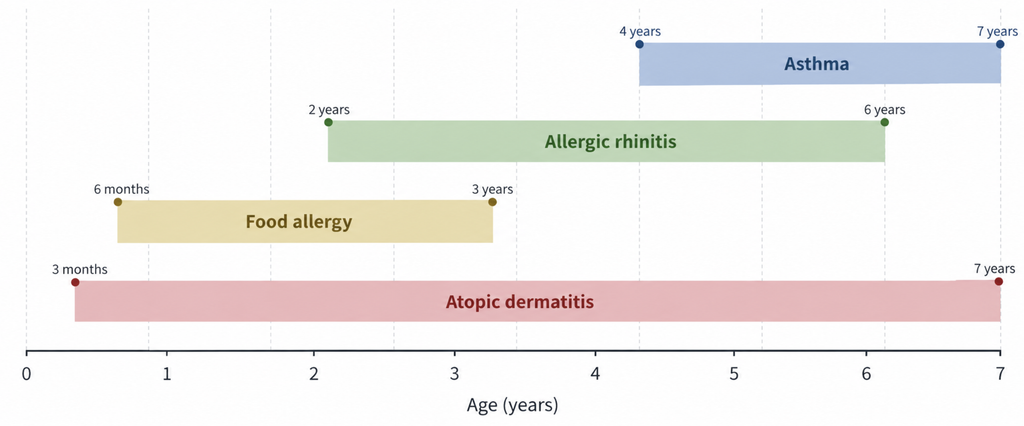
What the allergic march is, and when each stage appears
The allergic march, or atopic march, is the tendency for allergic conditions to appear in a characteristic order during childhood. It usually starts with a disrupted skin barrier and moves toward the airway [Zheng, The atopic march: progression from atopic dermatitis to allergic rhinitis and asthma, 2011].
| Stage | Typical onset | Notes |
|---|---|---|
| Atopic dermatitis | 3 to 6 months | 48% of affected children by 6 months; 89% by age 5 |
| Food allergy | Late infancy to age 3 | Prevalence peaks near 10% at age 1 |
| Allergic rhinitis | Preschool to early school age | Prevalence keeps rising with age |
| Asthma | School age | Often the last to appear |
Atopic dermatitis affects roughly 17% to 24% of children, and food allergy is about six times more common in children who have it [Tsuge, Current insights into atopic march, 2021]. The airway symptoms come later. Across the two UK cohorts, rhinitis became steadily more common as children aged while eczema and wheeze became less common [Belgrave, 2014].
The proposed mechanism is epicutaneous sensitization. A leaky skin barrier lets allergens reach immune cells under conditions that favor a type 2 response, and the sensitization that follows surfaces later in the nose and airway instead of the skin [Zheng, 2011].
How often do all three actually happen?
This is where the staircase breaks down. Belgrave and colleagues applied Bayesian machine learning to individual-level data from the ALSPAC and MAAS cohorts, 9,801 children assessed at ages 1, 3, 5, 8 and 11, and asked whether individual children follow the march. Eight distinct profiles came out [Belgrave, 2014]:
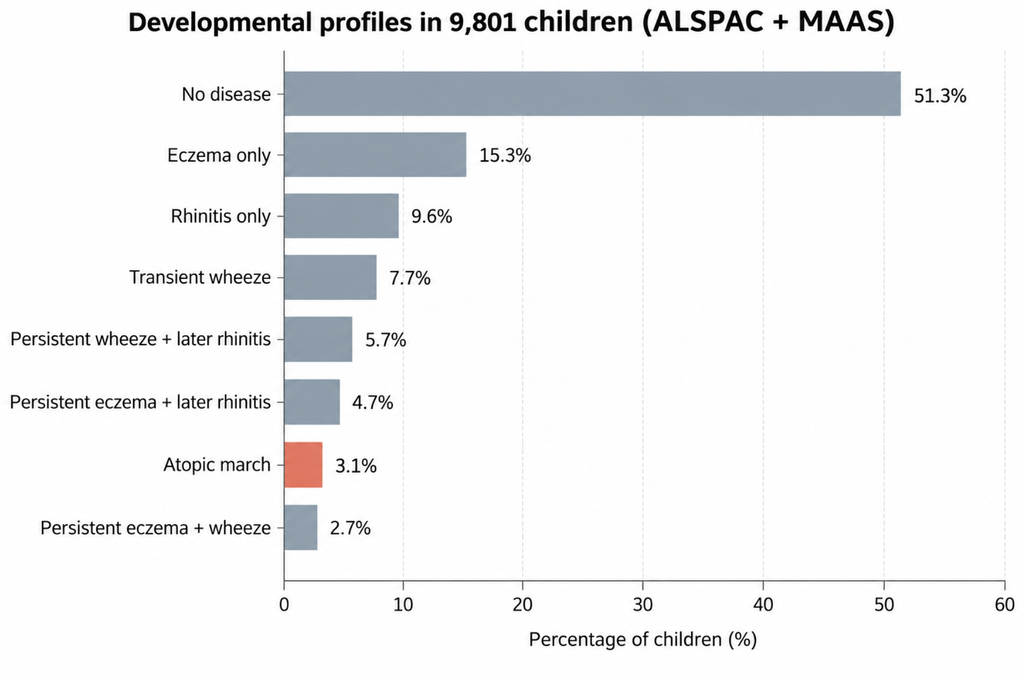
- No disease: 51.3%
- Eczema only: 15.3%
- Rhinitis only: 9.6%
- Transient wheeze: 7.7%
- Persistent wheeze with later-onset rhinitis: 5.7%
- Persistent eczema with later-onset rhinitis: 4.7%
- Atopic march (all three, in sequence): 3.1%
- Persistent eczema and wheeze: 2.7%
Among children with any symptoms at all, only about 7% followed a march-like trajectory. When the authors compared statistical models, the model that treated transitions between eczema, wheeze and rhinitis as independent fit the data better than the model that built in march-style transitions [Belgrave, 2014].
Their explanation is an ecological fallacy. Plot eczema, wheeze and rhinitis prevalence by age across a whole population and the curves crest in march order. Disaggregate to individual children and that single path splits into eight.
These are UK cohorts, and directly comparable analyses across other countries and ethnic groups are still sparse. Korean data points to similar heterogeneity with different weighting. In the Panel Study on Korean Children, which followed 1,579 children to school age, asthma and allergic rhinitis at ages 6 to 8 clustered specifically with the early-onset persistent eczema phenotype, not with eczema in general, and children who had both eczema and food allergy early carried a higher risk of recent wheezing at age 8 (adjusted OR 8.09; 95% CI 2.54 to 25.76) [Jung, Atopic dermatitis with coexisting food allergy in early life is associated with childhood asthma, 2022]. That confidence interval is wide, covering anything from a 2.5-fold to a 26-fold difference, which reflects how few children were in the subgroup. The direction of the association matches other cohorts, but the magnitude is imprecise and should not be quoted as a firm estimate.
Does the march mean a child is “highly allergic”?
Partly. But the sequence itself is a weaker signal than early onset, severity and IgE sensitization.
Children whose eczema comes with specific IgE to environmental allergens by 2 to 4 years progress to rhinitis and asthma more often than children without IgE sensitization, and those three features are the main determinants of progression [Zheng, 2011]. The Korean cohort points the same way: phenotype mattered more than the diagnosis label [Jung, 2022].
The march may also not be causal. A major review argues that shared genetic loci, shared environmental triggers and microbiome differences could account for much of it, with the sequence tracking when each organ typically becomes symptomatic. On that reading it is a clustering of disorders rather than a march [Paller, The atopic march and atopic multimorbidity: many trajectories, many pathways, 2019].
Clinical Perspective The march is a statement about risk, not a schedule. A toddler with severe, early, IgE-sensitized eczema is worth watching more closely for breathing symptoms, because that phenotype carries elevated risk. A child whose mild eczema cleared at 18 months sits in the far larger group whose trajectory is simply “eczema only.” Those two families need different conversations.
If parents have allergies, is the march more likely?
Yes, and the effect size is now reasonably well quantified. A systematic review and meta-analysis covering 149 studies found that a parental history of atopic disease raised the odds of atopic dermatitis in the child (OR 1.81; 95% CI 1.65 to 1.99) [Ravn, How does parental history of atopic disease predict the risk of atopic dermatitis in a child? A systematic review and meta-analysis, 2020].
Three details in that analysis are more useful than the headline number. What the parent has matters: parental atopic dermatitis carried a much stronger association (OR 3.30) than parental asthma (OR 1.56) or allergic rhinitis (OR 1.68). Which parent has it does not, since maternal and paternal history had comparable effects across all the atopic diseases. And the load adds up. Two atopic parents (OR 2.08) beat one (OR 1.30), and a parent with several atopic diseases (OR 2.32) beat a parent with one (OR 1.49).
Much older percentage estimates still circulate widely in patient-facing material. They predate this meta-analysis and are not well anchored in current evidence, so the odds ratios above are the better guide. What is inherited is a tendency toward atopy, not a specific allergy.
What the evidence supports at each stage
In infancy, once atopic dermatitis is present, controlling it well is the priority. Severity and persistence drive downstream risk, not the diagnosis on its own [Zheng, 2011].
At 4 to 6 months, food introduction becomes the decision point. The LEAP trial randomized 640 infants with severe eczema, egg allergy or both to consume or avoid peanut. Among those with negative skin-prick tests at baseline, peanut allergy at 60 months was 13.7% with avoidance versus 1.9% with consumption; among those already sensitized, 35.3% versus 10.6% [Du Toit, Randomized trial of peanut consumption in infants at risk for peanut allergy, 2015]. Early introduction, clinician-guided for high-risk infants, is the strongest actionable evidence in the entire march.
At preschool and school age, persistent nasal symptoms are worth identifying instead of writing off as one cold after another. Night cough, or play cut short by exertion, in a child with early-onset persistent eczema warrants evaluation and not just reassurance.
Can moisturizer prevent eczema in the first place?
This is the question most parents of infants ask, and the field reversed itself on it. Early small studies were encouraging enough that daily emollient from birth became common advice. Then the large trials reported.
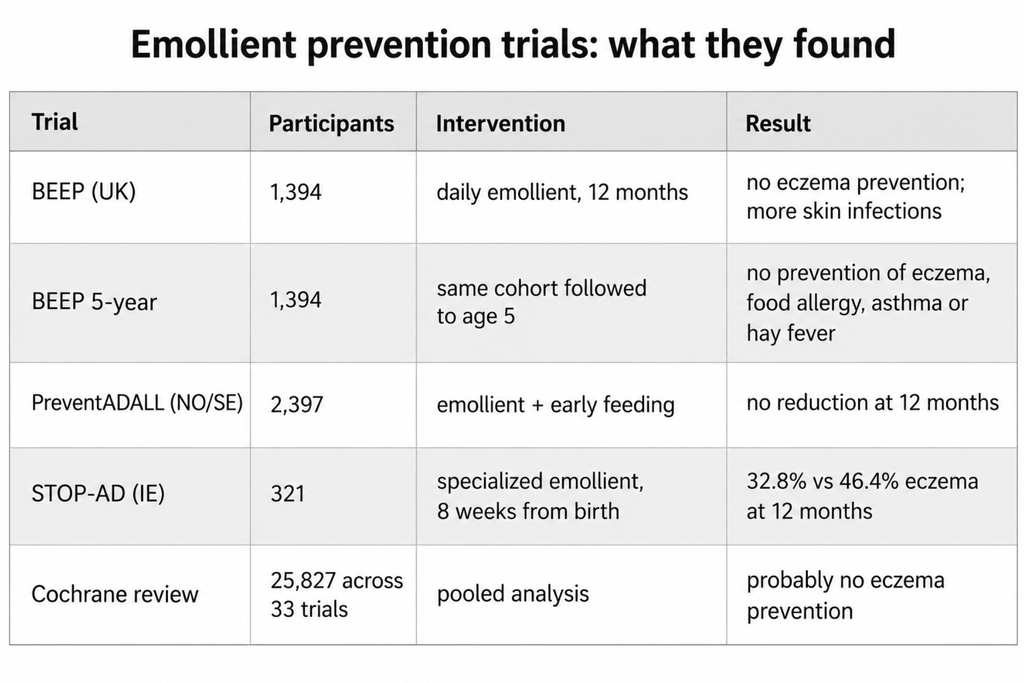
BEEP randomized 1,394 high-risk UK newborns to daily emollient for the first year plus standard advice, or to standard advice alone. At age 2, eczema was present in 23% of the emollient group and 25% of controls (adjusted RR 0.95; 95% CI 0.78 to 1.16), and skin infections were more common with emollient (adjusted incidence rate ratio 1.55; 95% CI 1.15 to 2.09) [Chalmers, Daily emollient during infancy for prevention of eczema: the BEEP randomised controlled trial, 2020]. Follow-up to age 5 found no protection against atopic dermatitis, food allergy, asthma or hay fever [Bradshaw, Emollients for prevention of atopic dermatitis: 5-year findings from the BEEP randomized trial, 2023].
PreventADALL, a Norwegian and Swedish trial in 2,397 infants from the general population, tested emollients and early complementary feeding in a factorial design. Neither reduced atopic dermatitis by 12 months. The risk difference for the skin intervention was 3.1% (95% CI -0.3 to 6.5) in favor of control [Skjerven, Skin emollient and early complementary feeding to prevent infant atopic dermatitis (PreventADALL): a factorial, multicentre, cluster-randomised trial, 2020].
The Cochrane review pooled 33 randomized trials and 25,827 participants. Skin care interventions in the first year probably do not change eczema risk (RR 1.03; 95% CI 0.81 to 1.31), probably increase skin infection risk (RR 1.33), and may increase IgE-mediated food allergy risk (RR 2.53; 95% CI 0.99 to 6.49, low-certainty evidence from a single trial) [Kelleher, Skin care interventions in infants for preventing eczema and food allergy, 2022].
One smaller trial reported a different result. STOP-AD randomized 321 high-risk infants at a single center in Ireland to an emollient formulated for very dry, eczema-prone skin, started within the first days of life and continued for 8 weeks. Cumulative atopic dermatitis at 12 months was 32.8% versus 46.4% in controls (RR 0.71; 95% CI 0.52 to 0.97; p = 0.036), with no significant difference in skin infections [Ní Chaoimh, Early initiation of short-term emollient use for the prevention of atopic dermatitis in high-risk infants: the STOP-AD randomised controlled trial, 2023].
These results are not directly comparable. STOP-AD differed from the larger trials in duration, timing, emollient formulation and population, and it ran at one center with about a quarter of BEEP’s sample size and no replication to date. The Cochrane review, pooling the larger body of evidence, concluded that emollients in the first year probably do not prevent eczema [Kelleher, 2022]. None of this is in dispute for treatment, where emollients remain standard care for eczema that already exists. The trials tested something narrower: daily emollient applied to healthy newborns to stop eczema from ever appearing. The largest of them did not find that it worked.
Key Takeaways
- Only 3.1% of children in two UK birth cohorts followed the full sequence of eczema, then wheeze, then rhinitis. About 7% of symptomatic children did.
- Eczema alone (15.3%) was roughly five times more common than the complete allergic march.
- Early onset, severity and IgE sensitization predict progression better than the presence of eczema itself.
- Parental atopic dermatitis raises a child’s eczema odds more than parental asthma or rhinitis does, and two atopic parents roughly double the odds.
- Early peanut introduction cut peanut allergy from 13.7% to 1.9% in high-risk infants, while daily emollient from birth did not prevent eczema in the two largest trials.
FAQ
Does every child with eczema develop asthma? No. In pooled data from 9,801 children, “eczema only” was the largest symptomatic profile at 15.3%, while the full march reached 3.1% [Belgrave, 2014]. Early-onset, persistent, IgE-sensitized eczema does carry meaningfully higher risk.
At what age does allergic rhinitis usually appear? Typically in the preschool to early school years, later than eczema and food allergy. Across childhood, rhinitis prevalence rises with age while eczema and wheeze prevalence falls [Belgrave, 2014].
If both parents have allergies, what is my child’s risk? Higher, and quantifiably so. Two atopic parents carried roughly double the odds of atopic dermatitis compared with none (OR 2.08), and parental atopic dermatitis specifically carried an OR of 3.30 [Ravn, 2020]. Higher odds are not a diagnosis.
Can the allergic march be prevented? Partly. The best-supported intervention is early introduction of allergenic foods in high-risk infants [Du Toit, 2015]. Prophylactic daily emollient from birth did not prevent eczema, food allergy, asthma or hay fever through age 5 [Bradshaw, 2023].
Should I moisturize my newborn every day to prevent eczema? Current evidence does not support daily emollient purely for prevention. Large trials found no protective effect and some increase in skin infections [Chalmers, 2020; Kelleher, 2022]. Moisturizing remains essential once eczema is present, and one trial of a short, specialized regimen begun in the first days of life did show benefit [Ní Chaoimh, 2023]. That one is worth raising with your pediatrician rather than deciding alone.
Joonpyo Hong, MD is a board-certified otolaryngologist practicing in Korea. This article reflects his clinical interpretation of published research and does not constitute individual medical advice.
For more articles:
https://curiousmd.com/ai-allergy-forecast-personalized-prediction/
https://curiousmd.com/when-to-take-allergic-rhinitis-medication/
https://curiousmd.com/allergen-immunotherapy-for-allergic-rhinitis/
Link out to:
American Academy of Pediatrics — Allergic March · https://www.aap.org/en/patient-care/allergic-march/ — A clinician-facing overview of the allergic march, including sequence, risk factors, and prevention.
HealthyChildren.org — From Eczema to Allergies to Asthma · https://www.healthychildren.org/English/health-issues/conditions/allergies-asthma/Pages/from-eczema-to-allergies-to-asthma-understanding-the-allergic-march.aspx — The AAP’s parent-facing explainer, written by a pediatric allergist.
Asthma and Allergy Foundation of America — The Allergic or Atopic March · https://aafa.org/allergies/prevent-allergies/allergic-march/ — A patient-organization summary of the march and what prevention evidence currently supports.
Cochrane — Does moisturising baby skin prevent eczema or food allergies? · https://www.cochrane.org/about-us/news/does-moisturising-baby-skin-prevent-eczema-or-food-allergies — Plain-language summary of the emollient evidence, written for non-specialists.