
Every other treatment for allergic rhinitis stops working the day it stops. This one does not — which is exactly why it is so hard to deliver.
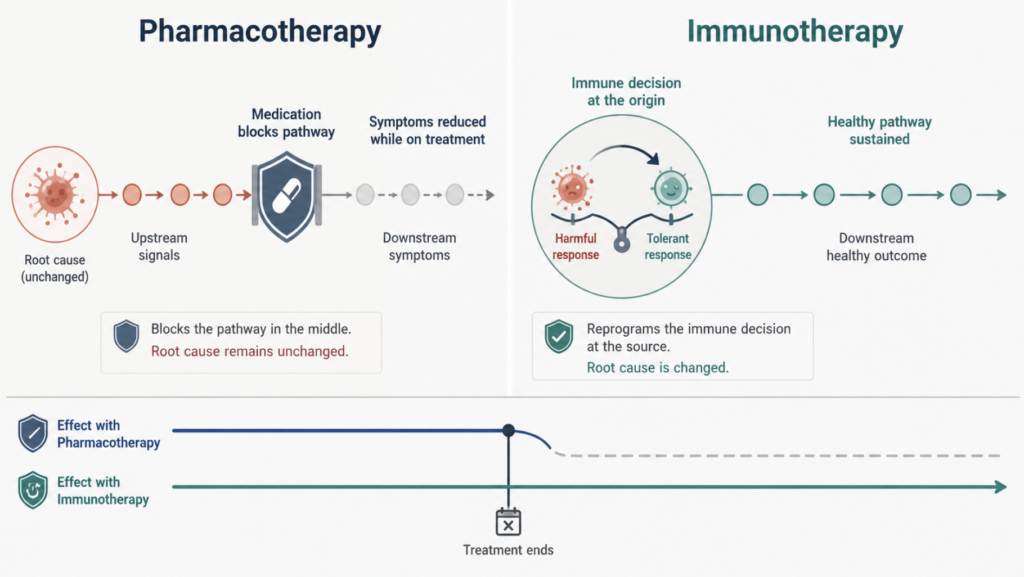
Allergen immunotherapy for allergic rhinitis occupies a strange position in respiratory medicine. It is the only available treatment that alters the underlying disease process rather than intercepting its output. It has more than a century of clinical use and a substantial randomized evidence base. And fewer than one in ten patients with allergic rhinitis or asthma worldwide ever receives it.
The usual explanations — limited awareness, limited access, limited specialist supply — are all true and all incomplete. A more exact account sits inside three numbers: a relative symptom reduction of roughly 30% over placebo, a minimum treatment course of three years, and a real-world three-year completion rate of 7% for the sublingual route.
Those three figures, read together, explain nearly every controversy in this field. The argument about immunotherapy has never really been about whether it works. It has been about what it should be compared against, how long it must be sustained, and who actually finishes.
What Immunotherapy Does, and Where the Map Ends
Pharmacotherapy argues with the symptom. Immunotherapy argues with the premise.
Antihistamines block a mediator from reaching its receptor. Intranasal corticosteroids suppress the inflammatory cascade downstream of that mediator. Both act on the consequences of a decision the immune system has already made. Allergen immunotherapy attempts to revise the decision itself.
That revision proceeds on three distinct timescales. Within hours to days, mast cells and basophils become less responsive — early desensitization, occurring before antibody composition has meaningfully shifted. Over weeks to months, regulatory T and B cells are induced, and the interleukin-10 and transforming growth factor-beta they release suppress allergen-specific type 2 helper T cell responses. Over months to years, blocking antibodies — IgG4, IgG1, IgA — accumulate and intercept allergen before it can engage IgE. These antibodies inhibit IgE-dependent activation at both the high-affinity receptor on mast cells and basophils and the low-affinity receptor on B cells [Shamji, Mechanisms of allergen immunotherapy, 2017].
That much is established. The interesting part is what follows it.
Knowing the sequence does not confer the ability to predict who will respond. No pretreatment test identifies likely responders. No validated laboratory measure tracks success during treatment. And the most commonly invoked marker turns out to behave in a way that undermines its own use.
In a cohort followed for three years of treatment and two years afterward, allergen-specific IgG4 rose through the first two years, plateaued in the third, and declined once treatment ended. Over that same post-treatment period, IgE-blocking activity remained suppressed in 83% of patients, a regulatory T cell response persisted in roughly two-thirds, and reductions in specific IgE and interleukin-4-producing cells held [Carrera Boada, Persistent regulatory T-cell response, 2018]. This observation comes from a single study of thirty patients and should be interpreted with corresponding caution.
Small as that cohort is, an independent line of reasoning arrives at the same place. The European Academy of Allergy and Clinical Immunology biomarker task force reviewed candidate markers across seven domains and recommended exploring allergen-specific IgG4 as a marker of adherence rather than efficacy. The ratio of specific to total IgE and IgE-facilitated antigen presentation inhibition were retained as candidate surrogates. No validated biomarker of clinical response exists [Shamji, Biomarkers for monitoring clinical efficacy of AIT, 2017].
A rising IgG4 shows that a patient is taking the medication. It does not show that the medication is working.
Clinical Perspective. The distinction between a plausible mechanism and a demonstrated effect is where overstatement enters this field, and it enters almost nowhere else. A clinician who cites an IgG4 titer as evidence of therapeutic success has crossed a bridge that the evidence does not support — and, more practically, has substituted a number that falls after treatment for an outcome that persists.
Why Allergen Immunotherapy for Allergic Rhinitis Is Not First-Line
No head-to-head trial compares immunotherapy with pharmacotherapy. An indirect comparison, placing relative effect over placebo side by side across large placebo-controlled trials, produces the following [Devillier, A meta-analysis of SLIT and pharmacotherapy, 2014]:
| Treatment | Relative symptom reduction vs placebo |
|---|---|
| Five-grass pollen SLIT tablet | 29.6% |
| Intranasal corticosteroid | 23.5% |
| Timothy grass SLIT tablet | 19.2% |
| Azelastine–fluticasone combination spray | 17.1% |
| Second-generation H1-antihistamine | 15.0% |
| Montelukast | 6.5% |
Read carefully, the table says this: sublingual tablets clearly outperform antihistamines and montelukast, and sit in roughly the same band as an intranasal steroid. Heterogeneity between placebo arms and differences in allergen exposure across trials mean the ranking cannot be taken literally. The order of magnitude can.
The implication is uncomfortable and clarifying at once. Three years of daily therapy and periodic clinical review purchase short-term symptom control comparable to a spray used each morning. Whatever justifies immunotherapy, it is not the symptom score during treatment.
What justifies it is what remains afterward — and that is the entire argument.
This is why the indication is written as it is. Immunotherapy is reserved for moderate-to-severe disease inadequately controlled by pharmacotherapy, not because of regulatory conservatism but because the effect size during treatment does not justify a three-year commitment in patients whose symptoms already respond to a spray.
A counterargument exists. Earlier intervention might prevent progression to asthma. The evidence for that proposition, however, is weaker than it is usually presented to be — a point taken up below. Prevention of new sensitizations rests on thinner ground still, largely retrospective and observational.
Three Years, and the Problem of Knowing When to Stop
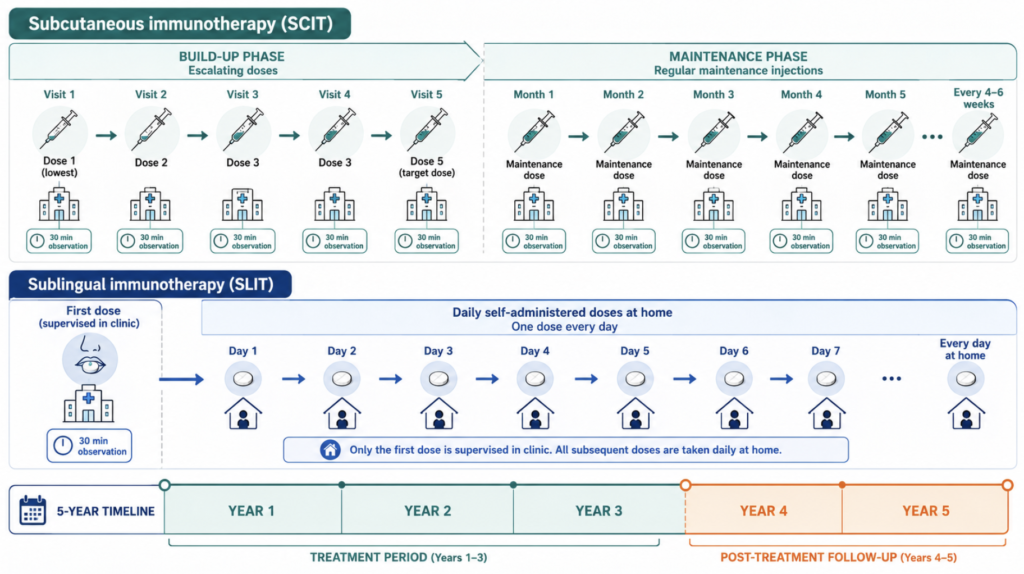
Nearly every guideline specifies a minimum of three years. The evidence behind that number is thinner than its ubiquity implies.
Comparisons of three versus five years consistently find no advantage to the longer course. In ninety children with house dust mite–driven asthma, outcomes three years after cessation did not differ between those treated for three years and those treated for five [Stelmach, Comparison of 3- and 5-year HDM immunotherapy, 2012]. A randomized three-versus-five-year comparison in adults reached the same conclusion. Multiple small studies point the same direction, but no large randomized comparison exists. Three years is closer to convention than to a derived optimum.
What is well established is that the benefit outlasts the treatment. The strongest demonstration comes from a five-year placebo-controlled trial of a grass pollen tablet in which three years of treatment were followed by two years of blinded observation. Reductions in symptoms and medication use persisted two years after the last dose, accompanied by sustained immunological change [Durham, SQ-standardized sublingual grass immunotherapy, 2012]. Maintaining blinding through the follow-up period is rare in this literature, and it is what makes the result difficult to attribute to expectation.
The pediatric evidence is more complicated than commonly reported. In 812 children aged 5 to 12 without asthma, three years of treatment followed by two years of observation produced no difference in time to asthma onset — the primary endpoint. Secondary endpoints did move: asthma symptoms and asthma medication use decreased, and reductions in rhinoconjunctivitis symptoms persisted through follow-up [Valovirta, GAP trial, 2018]. A considerable secondary literature cites this trial as establishing asthma prevention. That characterization is not accurate.
An older study followed children for ten years after three years of subcutaneous treatment and found significantly less asthma in the treated group [Jacobsen, 10-year follow-up on the PAT study, 2007]. It was open-label without a placebo arm, and attrition was substantial, but it remains the longest follow-up available.
Relapse after cessation appears to vary by allergen in a way that suggests exposure matters. Reviews summarizing the available follow-up studies describe relapse as uncommon after seasonal pollen courses and considerably more frequent after house dust mite courses. Because these figures come from studies of differing design placed side by side, the specific numbers should not be read literally. Continuous versus seasonal exposure is the obvious candidate explanation, though it has not been tested directly.
Which leaves the question clinicians actually face: when should treatment stop?
The honest answer is that no validated marker exists to tell them. IgG4 falls after cessation and therefore cannot serve. Skin test wheal size and specific IgE do not track clinical response reliably. What remains is symptom burden and rescue medication use — clinical judgment, unassisted.
Two practical conventions fill the gap. Reassess continuation if no clear response has emerged by one year. If there is a response, complete three years. Beyond that, the decision is individual.
Clinical Perspective. Explaining the basis of the three-year rule changes the conversation with a patient who feels well at year two. It is not a studied optimum but a bracket: below it, benefit does not persist; above it, additional benefit has not been demonstrated. Stopping early forfeits the only property that distinguishes this treatment from a spray.
Boundaries: Who Cannot Start, Who Cannot Escalate, and What Can Be Treated
Contraindications divide into two categories with different evidentiary weight behind them.
Barriers to initiation. Product labeling for the US sublingual tablets shares a common set: severe, unstable, or uncontrolled asthma; a history of any severe systemic or severe local reaction to sublingual immunotherapy; a history of eosinophilic esophagitis; and hypersensitivity to excipients. These are regulatory documents and function as firm limits.
Society-issued contraindications behave differently. The EAACI position paper classifies active malignancy as an absolute contraindication to aeroallergen immunotherapy and active autoimmune disease as absolute, with disease in remission relative. The same document states plainly that evidence for these designations is limited and that most conclusions rest on case reports [Pitsios, Clinical contraindications to AIT, 2015]. These are strongly recommended positions with limited supporting evidence — a distinction worth preserving, because it means a patient in autoimmune remission who needs treatment presents a risk-benefit calculation rather than a closed door.
Guidance on beta-blockers and ACE inhibitors has softened. At maintenance dosing the incremental risk appears minimal, and substitution is preferred only where a safe and effective alternative exists.
Barriers to escalation. Dose advancement is withheld during asthma exacerbation, acute infection or gastroenteritis, and — specific to the sublingual route — oral mucosal disruption from dental extraction, stomatitis, ulceration, or recent oral surgery. A prior systemic reaction warrants dose reduction rather than continued escalation. For subcutaneous treatment, peak pollen season for a highly sensitizing allergen is a further adjustment point.
Widely used schedules govern dose adjustment after interruptions: during maintenance, repeat the last dose if under five weeks have elapsed, reduce 25% at five to seven weeks, step back one dose or reduce 45% at seven to eleven weeks, step back two doses or reduce 55% at eleven to fifteen weeks, and restart from the first vial beyond three to four months [Larenas-Linnemann, Gaps in allergen immunotherapy administration, 2020].
These figures look authoritative. A surveillance analysis covering 84.1 million injection visits states otherwise: protocols for dose adjustment after gaps, and optimal maintenance intervals, rest on expert opinion alone [Epstein, North American Immunotherapy Surveillance Study, 2025]. Schedules differ between institutions and no prospective validation exists. They are convention, not evidence.
The same dataset produced one new signal. Across 2021 to 2022, practices using maintenance intervals longer than four weeks recorded significantly higher rates of total, moderate, and severe systemic reactions. This is a first observation from surveillance data and is not settled. Given how routinely maintenance intervals are extended for patient convenience, it deserves attention.
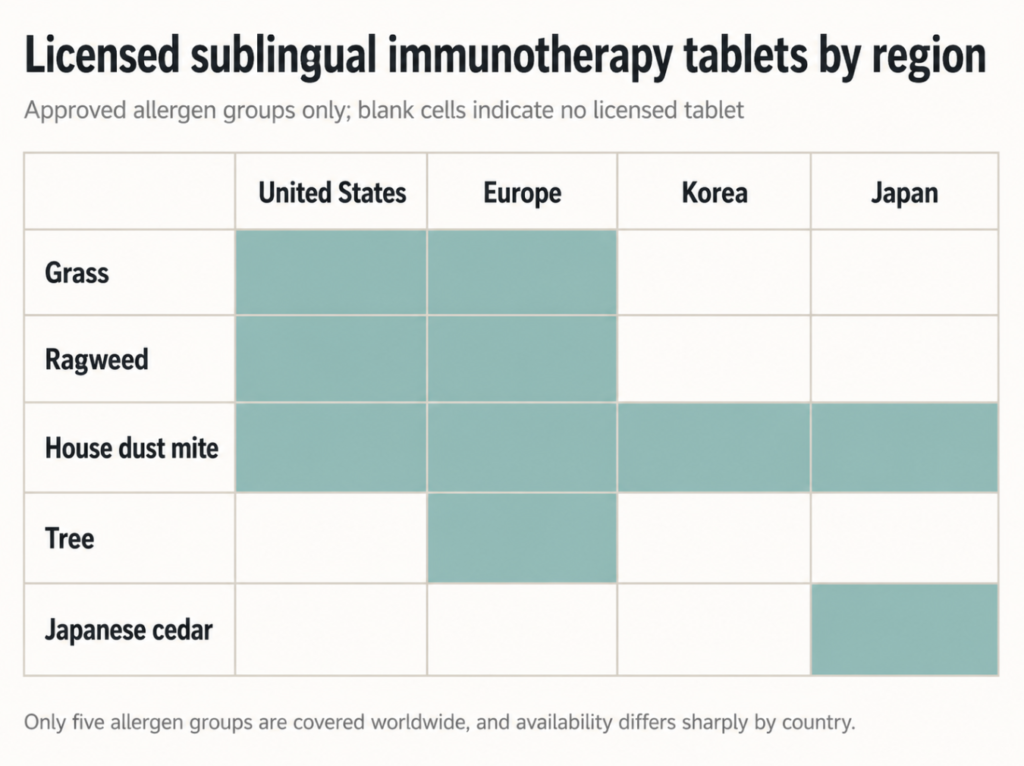
What can actually be treated. The scope of immunotherapy is set not by immunology but by the list of licensed products, and that list is short.
| United States | Europe | Korea | Japan | |
|---|---|---|---|---|
| Grass | Oralair, Grastek | Oralair, Grazax | — | — |
| Ragweed | Ragwitek | Ragwizax | — | — |
| House dust mite | Odactra | Acarizax, Actair | Acarizax, Actair | Miticure, Actair |
| Tree (birch homologous group) | — | Itulazax | — | — |
| Japanese cedar | — | — | — | Cedarcure |
| Liquid drops | Off-label | Varies by country | Staloral 300 | — |
The blank cells carry the message. Worldwide, sublingual tablets cover five allergen groups: grass, ragweed, house dust mite, the birch homologous group, and Japanese cedar. Molds, cockroach, dog, mugwort, and most weeds have no tablet product or no evidence at tablet standard. Not every patient with allergic rhinitis is a candidate, regardless of how well the indication otherwise fits.
Regional asymmetry is substantial. The United States has no tree tablet; Itulazax, licensed across 22 European countries for adults since 2019, was extended to children aged 5 to 17 in 2025 and recommended by the UK National Institute for Health and Care Excellence the same year for an estimated 27,000 patients in England. Japan runs the opposite pattern — only two allergens available, both reimbursed, both restricted to physicians who have completed manufacturer certification.
Polysensitization complicates selection further. Between 50% and 80% of patients seeking treatment for moderate-to-severe respiratory allergy are polysensitized. North American practice combines all clinically relevant extracts; European practice selects the one or two most clinically troublesome. Subgroup analyses of large grass tablet trials found polysensitized patients benefited as much as monosensitized ones, though these were not prespecified analyses [Calderón, Multiple-allergen and single-allergen immunotherapy strategies, 2012]. Both sides largely agree that evidence for multiallergen mixtures is weak.
Safety Is Not Adherence
North American surveillance from 2008 to 2023 covers 84.1 million injection visits across 4.9 million patients — the largest safety dataset in the field.
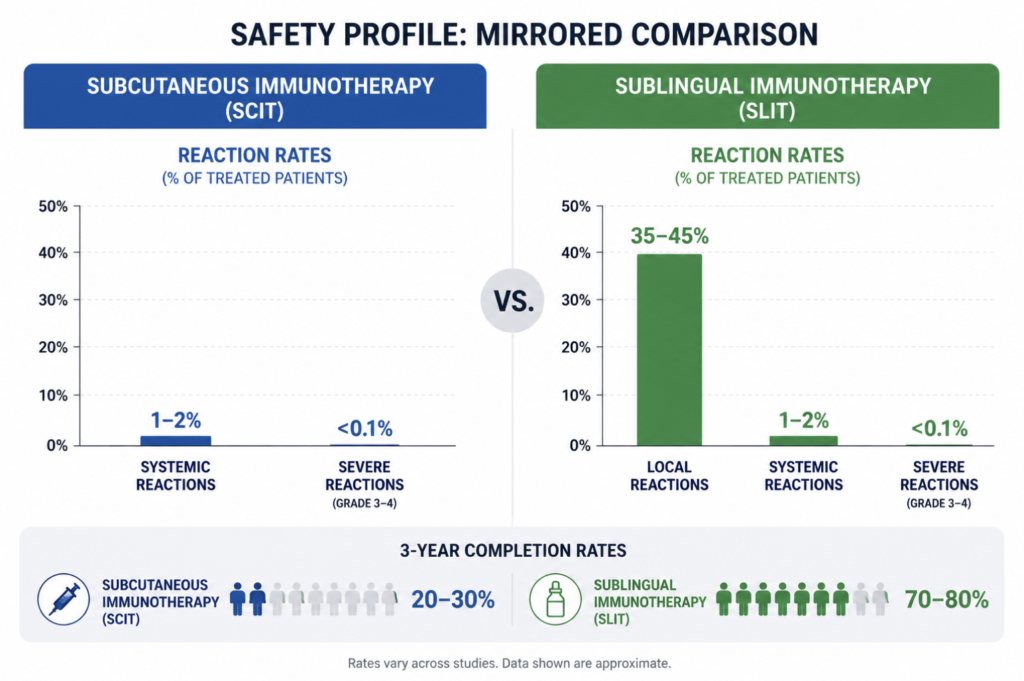
Systemic reactions occur at 0.1% of injection visits, a rate stable across fifteen years, and the most severe grade occurs at roughly one per million injections [Epstein, AAAAI/ACAAI Subcutaneous Immunotherapy Surveillance Study, 2019]. Ninety-six fatal reactions were confirmed between 1973 and 2023, four of them newly identified between 2018 and 2023 [Epstein, North American Immunotherapy Surveillance Study, 2025]. An earlier survey covering 1990 to 2001 estimated 3.4 deaths per year, or one per 2.5 million injections [Bernstein, Twelve-year survey of fatal reactions, 2004]. Survey methodology differs between the two eras, which limits direct comparison, and voluntary reporting likely understates true incidence in both.
Two findings have direct operational consequences. Fifteen percent of systemic reactions begin more than thirty minutes after injection. And practices prescribing epinephrine autoinjectors to more than 90% of patients did not experience fewer delayed severe reactions, because self-administration rates were low. Prescribing a device and having it used in an emergency are separate events.
Sublingual immunotherapy inverts the profile. A meta-analysis of 26 studies covering 7,827 patients and more than 2.7 million doses found local reactions in 40.8%, systemic reactions in 1.09%, anaphylaxis in 0.13%, and discontinuation due to side effects in 4.32% [Janz, Exploring side effects of sublingual immunotherapy, 2024]. A pooled analysis of 48 tablet trials reported treatment-related anaphylaxis at 0.02% versus 0.01% on placebo — a sixfold discrepancy driven by case definition, since the tablet analysis excluded clusters of local reactions such as simultaneous throat tightness and lip swelling. Neither figure is wrong; the definitions differ, and citations should say which is being used.
The temporal pattern of local reactions is well characterized. Pooling 923 children on grass tablet against 895 on placebo, treatment-related adverse events occurred in 59% versus 23%, with 98% mild to moderate. Oral pruritus (33%) and throat irritation (19%) both had a median onset on day one, recurred for a median of 14.5 and 5 days respectively, and individual episodes resolved within 30 to 60 minutes.
Those numbers translate directly into patient counseling, and counseling is where the real problem lies.
Sublingual therapy is safer, self-administered, and free of clinic visits. It is also abandoned far more often. In Dutch pharmacy claims data, 18% of all immunotherapy users reached the minimum three years — 23% for subcutaneous, 7% for sublingual — with median durations of 1.7 and 0.6 years [Kiel, Real-life compliance and persistence, 2013]. German prescription data showed twelve-month persistence of 22% to 27% for sublingual against 38% to 64% for subcutaneous. Absolute values differ considerably across datasets; the direction does not. These are European health systems, and reimbursement structure plausibly affects the figures.
The result runs against intuition. The easier, safer route is completed less often. Removing the clinic visit removed something along with the inconvenience.
This closes the loop on effect size. When a therapy designed around three years of adherence is completed by roughly one patient in ten, trial efficacy is not what the population receives.
Clinical Perspective. The decisive intervention in sublingual immunotherapy is not the prescription but the first two weeks. A patient told that oral itching will begin on day one, resolve within the hour, and largely disappear inside a fortnight behaves differently from a patient who discovers this alone on day three. Safety arrives automatically. Completion does not.
Reading the Evidence
The standard endpoint is settled. An EAACI task force reviewing nine outcome domains recommended a combined symptom and medication score, weighting symptoms and rescue medication equally, as the primary endpoint for immunotherapy trials [Pfaar, Recommendations for the standardization of clinical outcomes, 2014].
What that score has to show is not settled at all.
The most frequently quoted threshold is a 20% effect over placebo, proposed by a World Allergy Organization task force. European regulators do not accept it as a general criterion, on arithmetic grounds: converting a percentage into an absolute difference depends entirely on what the placebo arm scored. Twenty percent against a low placebo score is a small absolute change; twenty percent against a high one is not.
The US Center for Biologics Evaluation and Research requires two conditions simultaneously — a relative difference in total combined score of −15% or better, and an upper 95% confidence bound of 10% or less. Effect size and precision, together.
Anchor-based work put the question to patients. Surveying 1,071 grass-allergic individuals and using phase 3 data as an anchor produced a minimal clinically important difference of −0.22 points on the combined score, approximately −16%. Notably, 69% of respondents were satisfied by a one-point improvement in their single worst symptom; only 14.8% required two points or more. These values were derived in grass allergy and may differ by allergen.
Two further factors distort trial-to-trial comparison. A post-hoc analysis of seven timothy grass tablet trials found the observed treatment effect correlated strongly with cumulative pollen counts in the first twenty days of the season, with a coefficient of determination of 0.803. Same product, same protocol, different weather, different result.
Placebo response varies too. Across placebo arms from six controlled trials, the subcutaneous placebo effect ranged from 24% to 41%, reaching 51.8% in a season of low pollen exposure. The sublingual figure was far lower, but only one sublingual trial was included, so this is not settled — though the direction is consistent with other reports.
Together these explain why the long-running dispute over whether subcutaneous outperforms sublingual for grass pollen has not resolved. The meta-analytic indirect comparisons that started it were promptly challenged on methodological grounds, and no large head-to-head trial exists to settle the matter.
Clinical Perspective. Three things determine whether an immunotherapy trial result means anything: the placebo arm’s absolute score, the season’s allergen exposure, and the width of the confidence interval. Statistical significance without those three is close to uninformative.
A Century In, and What Is Actually Coming
Market sizing turns out to be surprisingly unreliable. Published estimates for the global allergy immunotherapy market around 2025 range from roughly two to four billion US dollars, with projected annual growth rates spanning 3.5% to above 12%. A twofold spread in the base figure means quoting any single number manufactures precision that does not exist.
The structural claims are more consistent. Subcutaneous treatment still generates roughly two-thirds of revenue. Within the sublingual segment, tablets have overtaken liquid drops. Allergic rhinitis dominates by indication, Europe is the largest market, and the Asia-Pacific region is growing fastest.
The pipeline warrants sober reading. Recombinant allergens, hypoallergenic variants, peptide vaccines, and nucleic acid platforms have been in development for more than two decades, and none has reached regulatory approval for inhalant allergy. Omalizumab combined with immunotherapy reduces systemic adverse events without improving efficacy. Intralymphatic administration showed no difference from placebo in the year following treatment in a randomized birch and grass trial; differences observed two years later, after unblinding, are hypothesis-generating at best. Toll-like receptor agonists used as adjuvants may permit shorter courses, but confirmation is pending.
More than a century after the first pollen injections, the standard of care remains natural allergen extract. The next generation has been announced repeatedly and has not arrived.
Clinical Perspective. Allergen immunotherapy is neither the breakthrough its advocates describe nor the marginal intervention its critics suggest. On symptom control it competes with a bottle of nasal spray; on disease course it has no competitor at all. The clinical question therefore never changes: does this patient have enough years ahead to make three of them worth spending, and can this patient sustain three years at all?
Key Takeaways
- During treatment, immunotherapy delivers symptom control in roughly the same band as an intranasal corticosteroid; its distinguishing property is that the benefit persists after treatment ends.
- The three-year minimum is a bracket rather than an optimum — below it benefit does not persist, above it no additional benefit has been demonstrated.
- No validated biomarker indicates when to stop; IgG4 declines after cessation and is recommended for monitoring adherence rather than efficacy.
- Licensed sublingual tablets cover five allergen groups worldwide, and availability differs sharply between the United States, Europe, Korea, and Japan.
- Dose-adjustment schedules after treatment gaps rest on expert opinion alone, with no prospective validation.
- The safer route is the less completed one: roughly 7% of sublingual patients reach three years, against 23% for subcutaneous.
FAQ
Is sublingual immunotherapy less effective than subcutaneous?
Unresolved. Meta-analytic indirect comparisons suggesting subcutaneous superiority for grass pollen were challenged on methodological grounds, and the dispute has not been settled. Placebo response appears to differ between the two routes, which makes cross-trial comparison unreliable. No large head-to-head trial exists.
Can a blood test confirm that immunotherapy is working?
No. The EAACI biomarker task force concluded that no validated marker predicts clinical response, and recommended allergen-specific IgG4 be explored as a marker of adherence rather than efficacy [Shamji, Biomarkers for monitoring clinical efficacy of AIT, 2017].
Does one year of treatment produce lasting benefit?
No. Every trial demonstrating persistence after cessation used a three-year course. Studies consistently indicate that shorter courses do not produce durable benefit, while three and five years have not been distinguished [Stelmach, Comparison of 3- and 5-year HDM immunotherapy, 2012].
Can every patient with allergic rhinitis receive immunotherapy?
No. Two constraints apply. The indication is limited to moderate-to-severe disease inadequately controlled by pharmacotherapy, and licensed tablet products exist for only five allergen groups. Common allergens including molds and cockroach have no tablet product or insufficient evidence.
References
- Durham SR, Emminger W, Kapp A, et al. SQ-standardized sublingual grass immunotherapy: confirmation of disease modification 2 years after 3 years of treatment in a randomized trial. J Allergy Clin Immunol. 2012;129(3):717-725.e5.
- Valovirta E, Petersen TH, Piotrowska T, et al. Results from the 5-year SQ grass sublingual immunotherapy tablet asthma prevention (GAP) trial in children with grass pollen allergy. J Allergy Clin Immunol. 2018;141(2):529-538.e13.
- Jacobsen L, Niggemann B, Dreborg S, et al. Specific immunotherapy has long-term preventive effect of seasonal and perennial asthma: 10-year follow-up on the PAT study. Allergy. 2007;62(8):943-948.
- Devillier P, Dreyfus JF, Demoly P, Calderón MA. A meta-analysis of sublingual allergen immunotherapy and pharmacotherapy in pollen-induced seasonal allergic rhinoconjunctivitis. BMC Med. 2014;12:71.
- Shamji MH, Durham SR. Mechanisms of allergen immunotherapy for inhaled allergens and predictive biomarkers. J Allergy Clin Immunol. 2017;140(6):1485-1498.
- Shamji MH, Kappen JH, Akdis M, et al. Biomarkers for monitoring clinical efficacy of allergen immunotherapy for allergic rhinoconjunctivitis and allergic asthma: an EAACI Position Paper. Allergy. 2017;72(8):1156-1173.
- Carrera Boada C, Jimeno L, Galán A, et al. Persistent regulatory T-cell response 2 years after 3 years of grass tablet SLIT: links to reduced eosinophil counts, sIgE levels, and clinical benefit. Allergy. 2018;73(10):1980-1988.
- Pitsios C, Demoly P, Bilò MB, et al. Clinical contraindications to allergen immunotherapy: an EAACI position paper. Allergy. 2015;70(8):897-909.
- Roberts G, Pfaar O, Akdis CA, et al. EAACI Guidelines on Allergen Immunotherapy: allergic rhinoconjunctivitis. Allergy. 2018;73(4):765-798.
- Pfaar O, Demoly P, Gerth van Wijk R, et al. Recommendations for the standardization of clinical outcomes used in allergen immunotherapy trials for allergic rhinoconjunctivitis: an EAACI Position Paper. Allergy. 2014;69(7):854-867.
- Kiel MA, Röder E, Gerth van Wijk R, et al. Real-life compliance and persistence among users of subcutaneous and sublingual allergen immunotherapy. J Allergy Clin Immunol. 2013;132(2):353-360.e2.
- Janz TA, Jimoh RO, Nguyen SA, et al. Exploring side effects of sublingual immunotherapy: a systematic review and meta-analysis. Ear Nose Throat J. 2024.
- Epstein TG, Liss GM, Berendts K, Bernstein DI. AAAAI/ACAAI Subcutaneous Immunotherapy Surveillance Study (2013-2017): fatalities, infections, delayed reactions, and use of epinephrine autoinjectors. J Allergy Clin Immunol Pract. 2019;7(6):1996-2003.e1.
- Epstein TG, Berendts K, Bernstein DI. Impact of dose adjustment after gaps in subcutaneous immunotherapy: update from the North American Immunotherapy Surveillance Study (2008-2023). J Allergy Clin Immunol Pract. 2025.
- Larenas-Linnemann DE, Epstein T, Ponda P, et al. Gaps in allergen immunotherapy administration and subcutaneous allergen immunotherapy dose adjustment schedules. Ann Allergy Asthma Immunol. 2020;125(5):505-506.e2.
- Stelmach I, Sobocińska A, Majak P, et al. Comparison of the long-term efficacy of 3- and 5-year house dust mite allergen immunotherapy. Ann Allergy Asthma Immunol. 2012;109(4):274-278.
- Calderón MA, Cox L, Casale TB, Moingeon P, Demoly P. Multiple-allergen and single-allergen immunotherapy strategies in polysensitized patients: looking at the published evidence. J Allergy Clin Immunol. 2012;129(4):929-934.
- Nolte H, Casale TB, Lockey RF, et al. A practical guide to the sublingual immunotherapy tablet adverse event profile: implications for clinical practice. Postgrad Med. 2017;129(6):590-597.
- Min JY, Jee HM, Lee HY, et al. The KAAACI Guidelines for Sublingual Immunotherapy. Allergy Asthma Immunol Res. 2024;16(1):9-21.
Joonpyo Hong, MD is a board-certified otolaryngologist practicing in Korea. This article reflects his clinical interpretation of published research and does not constitute individual medical advice.
This article is not intended to advertise or promote any specific company or product.
For more interesting content:
https://curiousmd.com/summer-allergic-rhinitis/
https://curiousmd.com/allergic-vs-nonallergic-rhinitis/
https://curiousmd.com/korea-2026-pollen-allergies/
Link out to:
- EAACI Guidelines on Allergen Immunotherapy: https://eaaci.org/guidelines-position-papers/eaaci-guidelines-on-allergen-immunotherapy-allergic-rhinoconjunctivitis/
- FDA licensed allergen extract sublingual tablets: https://www.fda.gov/vaccines-blood-biologics/allergenics/allergen-extract-sublingual-tablets
- AAAAI/ACAAI Joint Task Force practice parameters: https://www.allergyparameters.org/
- NICE guidance on Betula verrucosa sublingual immunotherapy: https://www.nice.org.uk/guidance
Pingback: Insect Bite Anaphylaxis: Which Bugs, How Fast, What to Do