
Two patients leave the clinic with the same prescription. A month later, one says spring finally felt normal. The other says the medication did nothing. Often the difference is not the molecule or the dose. It is the clock. With allergic rhinitis medication, when you take it can matter as much as which one you take. So, it’s important to answer the question of when to take allergic rhinitis medication.
Rhinitis drugs are usually taught by mechanism: antihistamines, corticosteroids, leukotriene receptor antagonists, decongestants. That grouping is useful for exams. At the bathroom cabinet it tells you almost nothing. What matters in daily use is when a drug needs to be in the body relative to the allergen, and how long it should stay there.
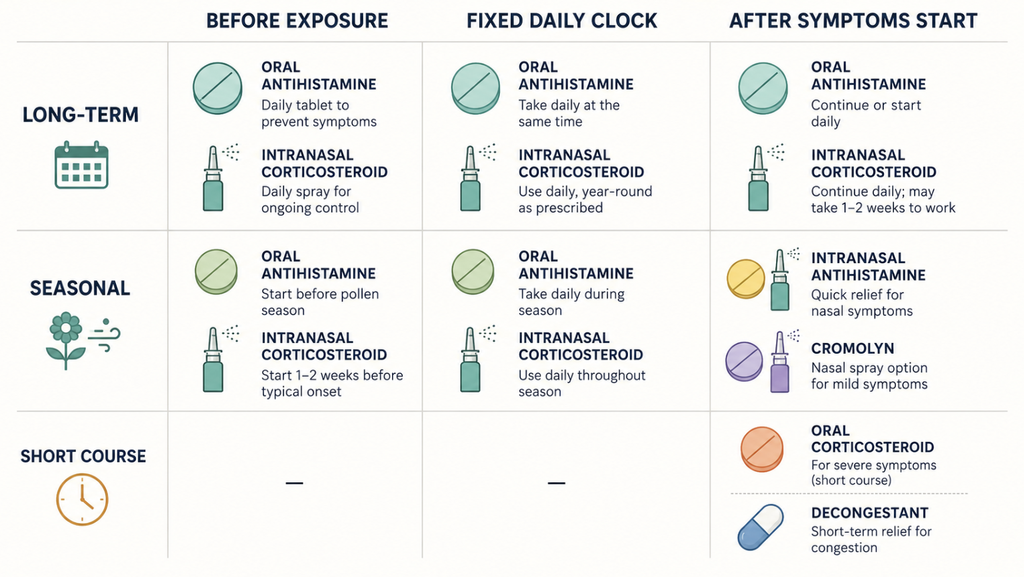
Two axes decide the timing
Every rhinitis medication sits on two axes. The first is its relationship to allergen exposure. Some drugs work best when they are already on board before pollen arrives. Others work regardless of exposure timing, provided the schedule is consistent. A few act fast enough to help after symptoms have started. The second axis is duration: daily and indefinite, seasonal, or a short course with a built-in stop date.
| Best taken before exposure | Fixed daily schedule | Effective after symptoms start | |
|---|---|---|---|
| Long-term maintenance | Oral antihistamine | Intranasal corticosteroid, LTRA | |
| Seasonal or perennial | Cromolyn | Intranasal antihistamine, ipratropium | |
| Short course (days) | Oral corticosteroid (morning) | Pseudoephedrine, oxymetazoline |
Many treatment failures come from putting a drug in the wrong cell of that table.
Group 1: drugs that work best taken first
Oral second-generation antihistamines reach peak plasma concentration roughly one to three hours after a dose. Histamine released from mast cells binds H1 receptors within seconds. These agents still help once symptoms have begun, but there is an unavoidable lag between swallowing the tablet and meaningful receptor blockade. A dose 30 to 60 minutes ahead of a known exposure, whether that is a friend’s cat, a hike, or a drive with the windows down, closes the gap.
Cromolyn shows the principle more sharply. It stabilizes the mast cell membrane and prevents degranulation, so it cannot reverse mediator release that has already happened. It is a prophylactic agent by design. That is why it requires frequent daily dosing, and why it disappoints patients who reach for it mid-attack.
Group 2: drugs that run on a schedule, not on a trigger
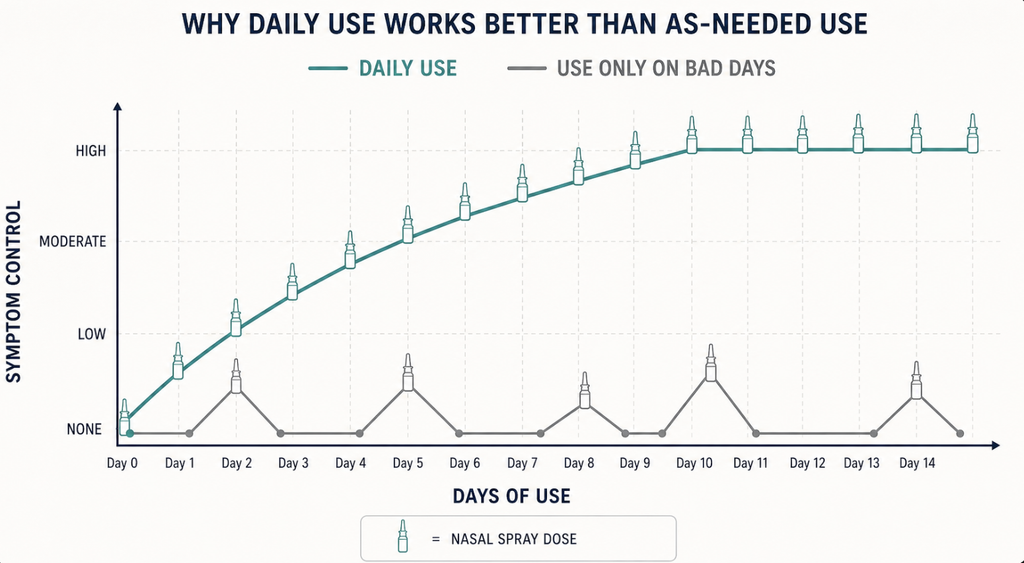
Intranasal corticosteroids are recommended as first-line therapy for allergic rhinitis when symptoms affect quality of life [Seidman, Clinical practice guideline: allergic rhinitis executive summary, 2015]. They are also among the most commonly misused, because patients tend to treat them like a decongestant spray: a puff when the nose blocks, nothing when it does not.
The mechanism explains the failure. Glucocorticoids act through nuclear receptor binding and altered gene transcription, which suppresses the cytokines and eosinophil recruitment behind late-phase inflammation. That process takes hours to begin, and product labeling puts full effect at days to weeks of regular use. Intermittent dosing never lets the mucosa get there.
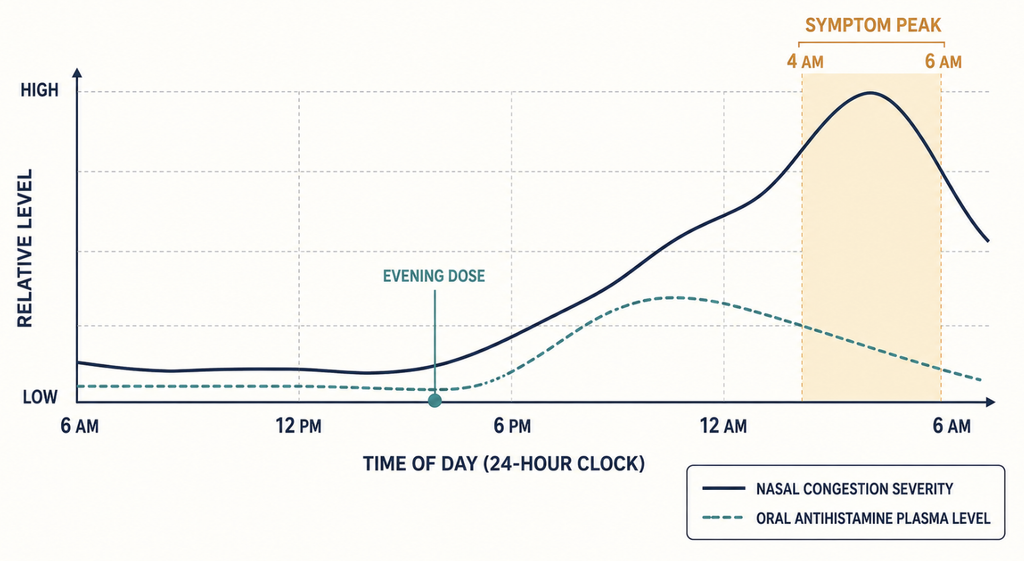
Congestion severity follows a circadian rhythm, worst overnight and in the early morning, which is the rationale for chronotherapy in this disease [Storms, Pharmacologic approaches to daytime and nighttime symptoms of allergic rhinitis, 2004]. The same review reports improved efficacy with evening dosing for one antihistamine but notes that this has not been established as a class effect. It also observes that intranasal corticosteroids dosed in the morning improve nighttime symptoms, while whether evening dosing would do better remains untested.
Leukotriene receptor antagonists deserve a closer reading than they usually get. Montelukast is widely described as a bedtime drug, and evening administration is the labeled convention [Storms, 2004]. The convention has a basis: a pooled analysis of four phase III seasonal rhinitis trials, all using evening dosing, found symptom improvement by the second day of treatment [Weinstein, Onset of efficacy of montelukast in seasonal allergic rhinitis, 2005].
What does not exist is a head-to-head comparison. No published trial appears to have tested morning against evening dosing for rhinitis outcomes, and morning dosing has performed well where it was used. In a randomized two-week ragweed study, montelukast taken each morning significantly improved rhinitis symptoms and every quality-of-life domain from baseline [Mucha, Comparison of montelukast and pseudoephedrine in the treatment of allergic rhinitis, 2006]. Prescribing information reflects that gap, stating that efficacy for seasonal allergic rhinitis was shown with morning or evening administration and that timing may be individualized.
So the defensible position is narrower than the usual advice. Evening dosing is well supported, morning dosing is permitted and has supporting data, and neither has been shown superior for rhinitis. Where asthma coexists, labeling directs a single evening dose. Montelukast also carries a boxed warning for serious neuropsychiatric effects, and regulators advise reserving it for allergic rhinitis patients who cannot tolerate or have not responded to alternatives. That context belongs in any discussion of the drug, whatever the timing question.
Group 3: drugs with an expiration date
Intranasal antihistamines behave differently from their oral counterparts. In an environmental exposure chamber study, azelastine nasal spray significantly improved nasal symptom scores within 15 minutes and outperformed mometasone at every measured point across eight hours [Patel, Onset of action of azelastine nasal spray compared with mometasone nasal spray and placebo in subjects with seasonal allergic rhinitis evaluated in an environmental exposure chamber, 2007]. That is a rescue profile, which makes as-needed use a strategy worth studying formally rather than a compromise. The ARIA group has argued exactly that [Bousquet, The Allergic Rhinitis and Its Impact on Asthma (ARIA) Approach of Value-Added Medicines: As-Needed Treatment in Allergic Rhinitis, 2022].
Topical decongestants are the opposite case. They work fast, and they have to be stopped. Prolonged use produces rhinitis medicamentosa, with histologic changes including ciliary loss, squamous metaplasia, epithelial edema and goblet cell hyperplasia. No threshold dose or duration has been established, which is why the recommendation is simply the shortest period necessary. Stopping the drug is first-line treatment, and an intranasal corticosteroid can speed recovery [Ramey, Rhinitis medicamentosa, 2006].
Oral pseudoephedrine targets congestion alone through alpha-adrenergic vasoconstriction. Its stimulant profile argues against late-day dosing, and its cardiovascular and urinary effects make it unsuitable for some patients, which is a conversation for a prescriber rather than a pharmacy shelf.
Short courses of oral corticosteroid follow a rule that is pure chronopharmacology. Once-daily morning administration produces little adrenocortical suppression, while the same total dose split across the day produces significant hypothalamic-pituitary-adrenal suppression [Ohdo, Changes in toxicity and effectiveness with timing of drug administration: implications for drug safety, 2003]. The milligrams are identical, so the entire difference comes from the schedule.
Building the calendar
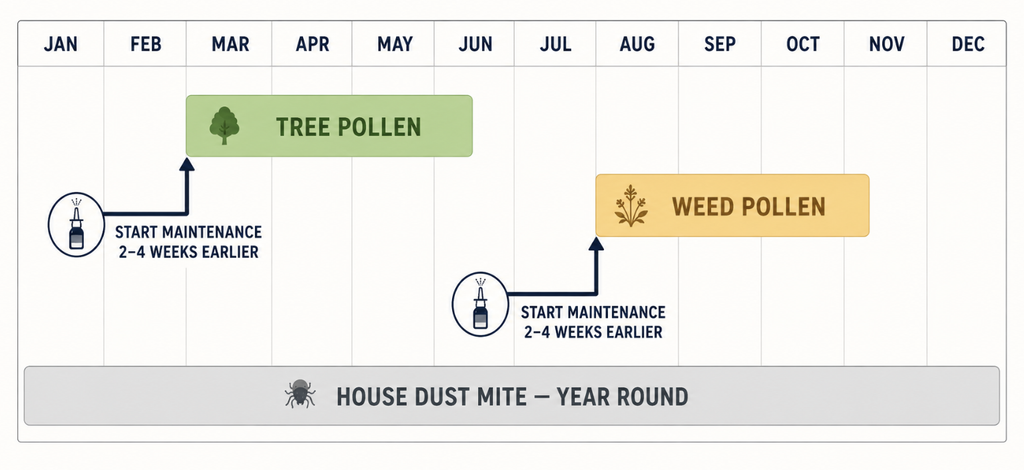
The Korea Meteorological Administration publishes a pollen concentration risk index twice daily during spring tree pollen season and again for weed season, roughly August through October. Pre-seasonal timing is calculated backwards from those windows, since the widely cited interval for starting maintenance treatment is two to four weeks before a season begins. House dust mite allergy has no season, so maintenance runs year-round.
Apps that help with the schedule
Timing only helps if it is executed, and real-world adherence to rhinitis treatment is poor. Patients self-medicate according to how they feel on a given day [Bousquet, 2022]. Three kinds of tool address different parts of that gap.
The first is a symptom and treatment diary. MASK-air, developed within the ARIA network, records daily visual analogue scores for nasal symptoms, eye symptoms, work and sleep, alongside the medication actually taken. Its value is retrospective: it shows whether a maintenance drug was taken every day or only on bad days.
The second is a pollen forecast. The KMA index is freely available, and its practical use is less the daily number than the seasonal onset, which anchors the start date for pre-seasonal treatment.
The third is a generic medication reminder. Any reliable reminder app handles fixed-schedule drugs. The setting worth adding is a stop alarm for short-course agents. A timer that ends a decongestant course does more good than any amount of dosing advice.
Quality varies enormously. In one Australian evaluation, 418 candidate apps were retrieved and only 16 met the criteria for full assessment against self-management principles and usability [Tan, Identifying an effective mobile health application for the self-management of allergic rhinitis and asthma in Australia, 2020]. Store ratings are not a proxy for clinical usefulness.
Clinical perspective
A recurring pattern in practice is not the wrong drug but the wrong schedule, typically an intranasal corticosteroid used as a rescue spray. Patients who report that it does not work are often describing their experience accurately: used three days out of ten, it does not work. The practical implication is that when to start and when to stop deserves as much consultation time as the choice of product. This is a clinical interpretation rather than a guideline recommendation.
Key takeaways
- Oral antihistamines reach peak concentration one to three hours after dosing, so timing relative to exposure matters as much as dose.
- Intranasal corticosteroids need days to weeks of regular use to reach full effect and underperform when used only on symptomatic days.
- No trial has compared morning with evening montelukast dosing for allergic rhinitis, and labeling permits either.
- Topical nasal decongestants have no established safe duration and are recommended for the shortest course possible.
- Once-daily morning dosing of oral corticosteroids produces less adrenal suppression than the same dose divided across the day.
FAQ
Can allergy medicine be taken only when symptoms appear? For some drugs yes, for others no. Intranasal antihistamines act within 15 minutes and suit as-needed use, while oral antihistamines take one to three hours, which leaves a symptomatic gap. Intranasal corticosteroids and cromolyn are poorly suited to this pattern. The first depends on days of regular use; the second prevents a step that has already occurred once symptoms begin.
How far in advance is a steroid nasal spray usually started? Commonly two to four weeks before the season begins. The aim is a mucosa that is already treated when the first pollen arrives rather than one playing catch-up. Local pollen calendars determine the actual date, which is worth confirming with a clinician for an individual allergen profile.
Is it better to take antihistamines in the morning or at night? It depends on the symptom pattern. Congestion is typically worst overnight and in the early morning, so evening dosing can line peak drug levels up with peak symptoms. Chronotherapy data support this for at least one antihistamine but have not confirmed it as a class effect. However, one should keep in mind that antihistamines work low at nasal congestion. Daytime-dominant symptoms, or drowsiness from the drug, point the other way.
Why is nasal decongestant spray limited to a few days? Because prolonged use causes rhinitis medicamentosa, meaning rebound congestion with structural change in the nasal lining, including ciliary loss and squamous metaplasia. No safe cumulative dose has been defined, so the conservative rule is the shortest course possible. Treatment is stopping the spray, sometimes with an intranasal corticosteroid to speed recovery.
References
- Seidman MD, Gurgel RK, Lin SY, et al. Clinical practice guideline: allergic rhinitis executive summary. Otolaryngol Head Neck Surg. 2015;152(2):197-206.
- Storms WW. Pharmacologic approaches to daytime and nighttime symptoms of allergic rhinitis. J Allergy Clin Immunol. 2004;114(5 Suppl):S146-53.
- Patel P, D’Andrea C, Sacks HJ. Onset of action of azelastine nasal spray compared with mometasone nasal spray and placebo in subjects with seasonal allergic rhinitis evaluated in an environmental exposure chamber. Am J Rhinol. 2007;21(4):499-503.
- Ramey JT, Bailen E, Lockey RF. Rhinitis medicamentosa. J Investig Allergol Clin Immunol. 2006;16(3):148-55.
- Ohdo S. Changes in toxicity and effectiveness with timing of drug administration: implications for drug safety. Drug Saf. 2003;26(14):999-1010.
- Bousquet J, Toumi M, Sousa-Pinto B, et al. The Allergic Rhinitis and Its Impact on Asthma (ARIA) Approach of Value-Added Medicines: As-Needed Treatment in Allergic Rhinitis. J Allergy Clin Immunol Pract. 2022;10(11):2878-2888.
- Tan R, Cvetkovski B, Kritikos V, et al. Identifying an effective mobile health application for the self-management of allergic rhinitis and asthma in Australia. J Asthma. 2020;57(10):1128-1139.
- Weinstein SF, Philip G, Hampel FC, et al. Onset of efficacy of montelukast in seasonal allergic rhinitis. Allergy Asthma Proc. 2005;26(1):41-6.
- Mucha SM, deTineo M, Naclerio RM, Baroody FM. Comparison of montelukast and pseudoephedrine in the treatment of allergic rhinitis. Arch Otolaryngol Head Neck Surg. 2006;132(2):164-72.
Joonpyo Hong, MD is a board-certified otolaryngologist practicing in Korea. This article reflects his clinical interpretation of published research and does not constitute individual medical advice.
For more articles:
https://curiousmd.com/allergen-immunotherapy-for-allergic-rhinitis/
https://curiousmd.com/summer-allergic-rhinitis/
https://curiousmd.com/allergic-vs-nonallergic-rhinitis/
Link out to:
- AAO-HNSF Clinical Practice Guideline: Allergic Rhinitis — https://www.entnet.org/quality-practice/quality-products/clinical-practice-guidelines/allergic-rhinitis/
- MASK-air (ARIA symptom diary app) — https://www.mask-air.com/en
- FDA prescribing information — montelukast (Singulair) — https://www.accessdata.fda.gov/drugsatfda_docs/label/2012/021409s036lbl.pdf