
Ask people to answer the risk of steroids vs NSAIDs and the answer arrives as a feeling rather than a fact: one is dangerous, the other is not. The same person swallows ibuprofen without hesitating and then balks at a short course of prednisolone. The asymmetry is measurable. In a randomized trial of 275 dermatology patients, mean scores on the validated TOPICOP steroid-phobia scale sat near 42 out of 100 before any intervention, and targeted education moved the knowledge domain while leaving the fear domain essentially untouched [Choi, Efficacy of targeted education in reducing topical steroid phobia: A randomized clinical trial, 2020].
Both drugs suppress inflammation. Only one of them carries the other’s name inside its own: non-steroidal anti-inflammatory drug. The reason for that is a piece of twentieth-century drug history, and it explains most of what patients get wrong about steroids.
What “steroid” actually means
The first misunderstanding is grammatical. “Steroid” does not name a drug. It names a shape: a four-ring carbon skeleton, seventeen carbon atoms arranged in three six-sided rings and one five-sided ring, all of it derived from cholesterol. Whatever hangs off that skeleton determines what the molecule does.
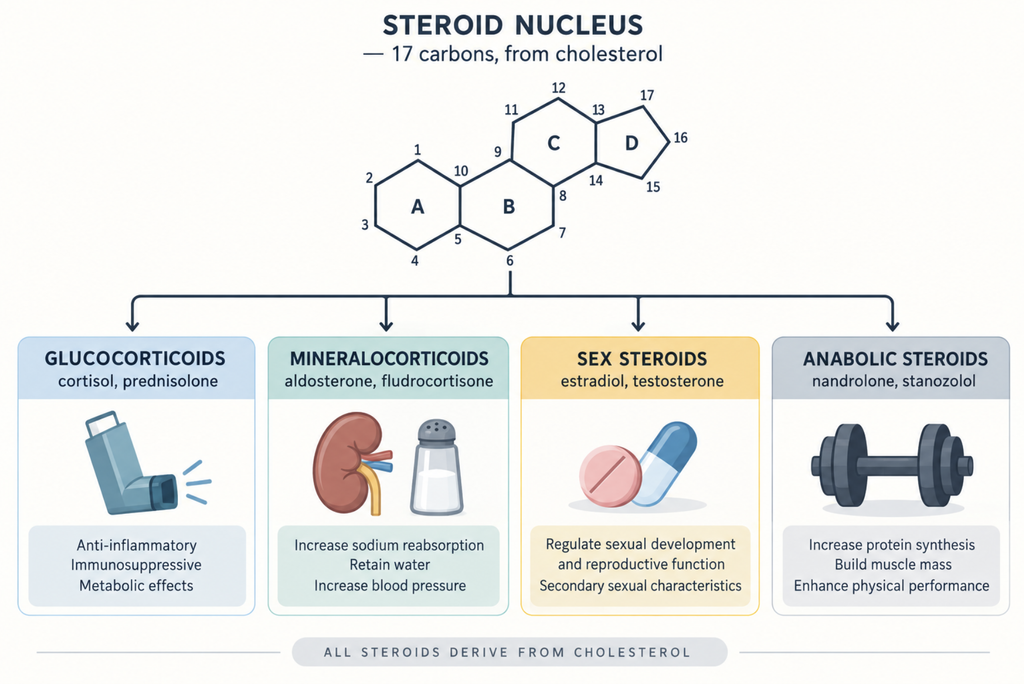
So the word covers molecules with almost nothing in common functionally:
| Family | Representative molecules | What it does | Where you meet it |
|---|---|---|---|
| Glucocorticoids | Cortisol, prednisolone, dexamethasone, triamcinolone | Suppresses inflammation and immune response; raises blood glucose | The “steroid shot,” the asthma inhaler, the eczema cream |
| Mineralocorticoids | Aldosterone, fludrocortisone | Regulates sodium, potassium, and blood pressure | Adrenal insufficiency, orthostatic hypotension |
| Sex steroids | Estradiol, progesterone, testosterone | Reproductive development and function | Oral contraceptives, hormone therapy |
| Anabolic steroids | Nandrolone, stanozolol | Synthetic testosterone derivatives that promote muscle mass | Athletic doping, gym culture |
The first two are both made in the adrenal cortex, which is why they share the prefix cortico-. But a glucocorticoid and an anabolic steroid are about as similar as a violin and a chainsaw: both are shaped from wood, and the resemblance stops there.
When a physician prescribes “a steroid” for a sinus infection, an ear condition, or a rash, the drug is almost always a glucocorticoid. It shares a carbon skeleton with the compounds athletes are banned for, and nothing else of clinical relevance.
1948: Compound E and a case considered hopeless
Philip Hench had spent two decades at the Mayo Clinic puzzling over a clinical observation nobody could explain: patients with rheumatoid arthritis sometimes improved dramatically during pregnancy or during an episode of jaundice. He suspected some circulating substance was responsible and called it Substance X.
Edward Kendall, a biochemist down the hall, had been isolating compounds from adrenal cortex extract and labeling them alphabetically. Compound E was scarce, expensive, and of unproven use.
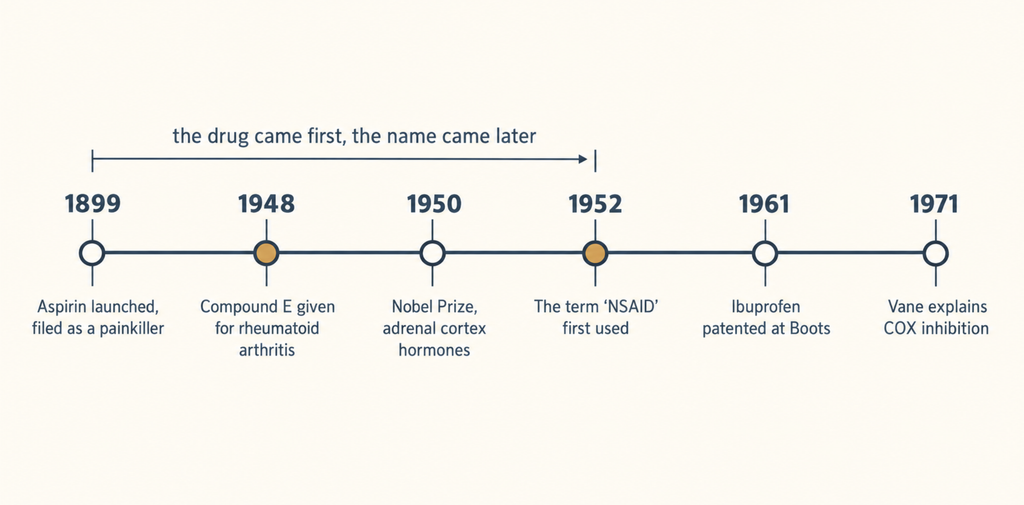
In September 1948, Hench administered Compound E to a patient whose rheumatoid arthritis had been considered beyond treatment. The response was rapid and unambiguous. A series of further patients followed, and Hench and Kendall published the results in April 1949 [Hench, The effect of a hormone of the adrenal cortex (17-hydroxy-11-dehydrocorticosterone; compound E) and of pituitary adrenocorticotropic hormone on rheumatoid arthritis, 1949]. Compound E was renamed cortisone.
The Nobel Prize in Physiology or Medicine followed in 1950, awarded to Kendall, Hench, and Tadeus Reichstein barely a year after publication. That is among the fastest turnarounds in the prize’s history. Newspapers called cortisone a miracle. Within a few years, the same medical community that had celebrated it was cataloguing what long-term use did to bone, glucose control, skin, and the adrenal glands’ own ability to function.
The anti-inflammatory steroid is a glucocorticoid
When people say “steroids reduce inflammation,” they are describing one branch of that family tree. Cortisone is a glucocorticoid, and so is every anti-inflammatory steroid descended from it: prednisolone, methylprednisolone, dexamethasone, betamethasone, triamcinolone, budesonide, mometasone.
Mineralocorticoids do something different. Fludrocortisone is prescribed to hold sodium and support blood pressure, not to calm a swollen joint. Endocrinology treats the two as separate tools despite the shared origin.
What glucocorticoids actually do is broader than the word “anti-inflammatory” suggests. They bind an intracellular receptor that travels to the nucleus and alters the transcription of a wide set of genes, damping multiple arms of the immune response at once rather than blocking one enzyme [Rhen, Antiinflammatory action of glucocorticoids, new mechanisms for old drugs, 2005]. That breadth explains both the effect and the cost. Turning down the whole immune response also turns down the parts that were doing useful work.
Steroids vs NSAIDs: why the name came second
The chronology here runs backwards from what most people assume, including many clinicians.
Aspirin reached the market in 1899, half a century before cortisone. But it was not marketed or understood as an anti-inflammatory drug. It was a pain reliever and a fever reducer, and that is how the profession filed it.
Cortisone changed the filing system. Its 1949 debut showed so dramatically that a drug could suppress inflammation that “anti-inflammatory” became a category worth naming. Once steroids defined that category, the field needed a term for everything else in it. The phrase non-steroidal anti-inflammatory drug was first used in 1952, when phenylbutazone was introduced [Hart, Non-steroidal anti-inflammatory drugs. Current status and rational therapeutic use, 1984].
So the answer to “were NSAIDs discovered after steroids?” is: no, but the name was. Aspirin is the older drug by fifty years. It was retroactively assigned to a category that had not existed when it was invented, and defined by what it is not.
The negation shaped what came next. In 1953, a pharmacologist at the Boots Pure Drug Company named Stewart Adams set out to find a drug effective in rheumatoid arthritis on the explicit condition that it not be a corticosteroid. Eight years and roughly six hundred compounds later, Adams and the chemist John Nicholson filed a patent on 2-(4-isobutylphenyl)propionic acid [Halford, 50th anniversary of the discovery of ibuprofen: an interview with Dr Stewart Adams, 2012]. The world now knows it as ibuprofen. It exists because its inventors were deliberately searching the space defined by what steroids were not.
The mechanism took another two decades. In 1971 John Vane showed that aspirin-like drugs work by inhibiting prostaglandin synthesis through the cyclooxygenase pathway [Vane, Inhibition of prostaglandin synthesis as a mechanism of action for aspirin-like drugs, 1971]. Only then did the class have a definition of its own instead of one borrowed by negation.
The difference between the two classes is not a matter of strength. A glucocorticoid changes which genes a cell transcribes; an NSAID blocks one enzyme. The scale is different, and so is the footprint.
Key takeaways
- “Steroid” describes a four-ring carbon structure derived from cholesterol, not a single drug or drug class.
- The anti-inflammatory steroids used in clinical practice are glucocorticoids, a distinct family from mineralocorticoids and from anabolic steroids.
- Cortisone was first given to a rheumatoid arthritis patient in September 1948 and earned a Nobel Prize in 1950.
- Aspirin was introduced in 1899, fifty years before cortisone, but the term “non-steroidal anti-inflammatory drug” was not coined until 1952.
- Ibuprofen originated from a research program begun in 1953 with the explicit goal of finding an anti-arthritic drug that was not a corticosteroid.
- Glucocorticoids alter gene transcription across the immune system; NSAIDs inhibit a single enzyme pathway.
FAQ
Are the steroids doctors prescribe the same as bodybuilding steroids? No. Prescribed anti-inflammatory steroids are glucocorticoids; the steroids associated with athletic doping are anabolic steroids, synthetic derivatives of testosterone. They share a carbon skeleton and nothing else clinically relevant. A prednisolone course does not build muscle, and anabolic steroids do not treat inflammation.
Which came first, aspirin or cortisone? Aspirin, by about fifty years. It was introduced in 1899, while cortisone was first administered therapeutically in 1948. The term “non-steroidal” was applied to aspirin’s class retroactively in 1952, after steroids had established what an anti-inflammatory drug was.
Is acetaminophen an NSAID? No, despite frequently being grouped with them. Acetaminophen relieves pain and reduces fever but has little meaningful anti-inflammatory effect at standard doses, which places it outside the NSAID class. How the three drug categories interact when combined is a separate question, covered in a follow-up article.
What’s the difference between prednisolone and dexamethasone? Both are glucocorticoids, but they differ substantially in potency and duration. Relative to hydrocortisone, prednisolone carries about four times the glucocorticoid activity and acts for 12 to 36 hours, while dexamethasone carries roughly thirty times the activity, acts for 36 to 72 hours, and has minimal mineralocorticoid effect [Liu, A practical guide to the monitoring and management of the complications of systemic corticosteroid therapy, 2013]. Approximate equivalent doses are 5 mg of prednisolone to 0.75 mg of dexamethasone, which is why the two are never interchangeable milligram for milligram.
References
- Hench PS, Kendall EC. The effect of a hormone of the adrenal cortex (17-hydroxy-11-dehydrocorticosterone; compound E) and of pituitary adrenocorticotropic hormone on rheumatoid arthritis. Proc Staff Meet Mayo Clin. 1949 Apr 13;24(8):181-97.
- Hart FD, Huskisson EC. Non-steroidal anti-inflammatory drugs. Current status and rational therapeutic use. Drugs. 1984 Mar;27(3):232-55.
- Vane JR. Inhibition of prostaglandin synthesis as a mechanism of action for aspirin-like drugs. Nat New Biol. 1971 Jun 23;231(25):232-5.
- Rhen T, Cidlowski JA. Antiinflammatory action of glucocorticoids—new mechanisms for old drugs. N Engl J Med. 2005 Oct 20;353(16):1711-23.
- Choi E, Tan KW, Tang F, Tan C, Chandran NS. Efficacy of targeted education in reducing topical steroid phobia: A randomized clinical trial. J Am Acad Dermatol. 2020;83(6):1681-1687.
- Halford GM, Lordkipanidzé M, Watson SP. 50th anniversary of the discovery of ibuprofen: an interview with Dr Stewart Adams. Platelets. 2012;23(6):415-22.
- Liu D, Ahmet A, Ward L, Krishnamoorthy P, Mandelcorn ED, Leigh R, Brown JP, Cohen A, Kim H. A practical guide to the monitoring and management of the complications of systemic corticosteroid therapy. Allergy Asthma Clin Immunol. 2013;9(1):30.
- Daley-Yates PT, Larenas-Linnemann D, Bhargave C, Verma M. Intranasal corticosteroids: topical potency, systemic activity and therapeutic index. J Asthma Allergy. 2021;14:1093-1104.
Joonpyo Hong, MD is a board-certified otolaryngologist practicing in Korea. This article reflects his clinical interpretation of published research and does not constitute individual medical advice.
For more articles:
https://curiousmd.com/injectable-analgesics/
https://curiousmd.com/nose-to-brain-drug-delivery/
https://curiousmd.com/nsaid-induced-gastric-ulcers/
https://curiousmd.com/acetaminophen-vs-nsaids-evidence/
Link out to:
https://www.nobelprize.org/prizes/medicine/1950/summary/ — The official Nobel Foundation record of the 1950 prize to Kendall, Reichstein and Hench, with each laureate’s Nobel lecture and biography.
https://www.sciencehistory.org/education/scientific-biographies/percy-lavon-julian/ — Science History Institute biography of Percy Lavon Julian, the chemist whose synthesis route made cortisone and hydrocortisone affordable to mass-produce.
https://www.nhs.uk/medicines/steroids/ — NHS patient-facing overview of steroid medicines by route of administration, including an explicit note that these are not anabolic steroids.
https://www.rsc.org/news/2013/november/chemical-landmark-plaque-honours-scientific-discovery-past-and-future — Royal Society of Chemistry announcement of the Chemical Landmark plaques marking the discovery of ibuprofen at Boots in Nottingham.