
A migraine spray can begin relieving pain well before a swallowed tablet has finished dissolving, and a diazepam spray can stop a cluster of seizures without an injection. Both rely on nose to brain drug delivery — a route that uses anatomy, not just chemistry. The roof of the nasal cavity sits only millimeters from the brain, and a drug delivered there can take a shortcut that oral and even intravenous drugs cannot. This article explains how that route works, which therapies already use it, which are still being tested, and why the physical condition of the nose decides whether the route is open or closed.
Why the Brain Is So Hard to Reach
Most of the difficulty in treating brain disease is a delivery problem, not a discovery problem. The obstacle is the blood-brain barrier (BBB), a tightly sealed lining of the brain’s capillaries that controls what passes from the bloodstream into brain tissue. Its cells are joined by tight junctions, and it actively pumps many foreign molecules back out.
The scale of the problem is easy to underestimate. The barrier excludes close to 100% of large-molecule drugs and more than 98% of all small-molecule drugs from the brain (Pardridge, The blood-brain barrier: bottleneck in brain drug development, 2005). A compound can be potent in a test tube and useless in a patient simply because it never reaches its target.
For years, the reliable ways around the barrier were invasive. Delivering a drug straight into the cerebrospinal fluid requires an intrathecal injection into the spinal canal, an intracerebroventricular injection, or a surgically placed implant. These carry real risks of infection and are impractical for conditions a patient needs to treat quickly or repeatedly at home. That gap is what makes the nose to brain drug delivery route interesting.
How Nose to Brain Drug Delivery Works: Two Nerve Pathways
The nose is not an obvious doorway to the brain, but anatomically it is a direct one. High in the nasal cavity, at the skull base, sits the olfactory mucosa — the tissue responsible for smell. Its nerve fibers pass through tiny perforations in the skull directly into the brain. A drug deposited in this region can travel along these olfactory pathways, and along branches of the trigeminal nerve that also innervate the nasal lining, to reach the central nervous system while largely bypassing the blood-brain barrier (Drath, Nose-to-brain drug delivery: from bench to bedside, 2025).
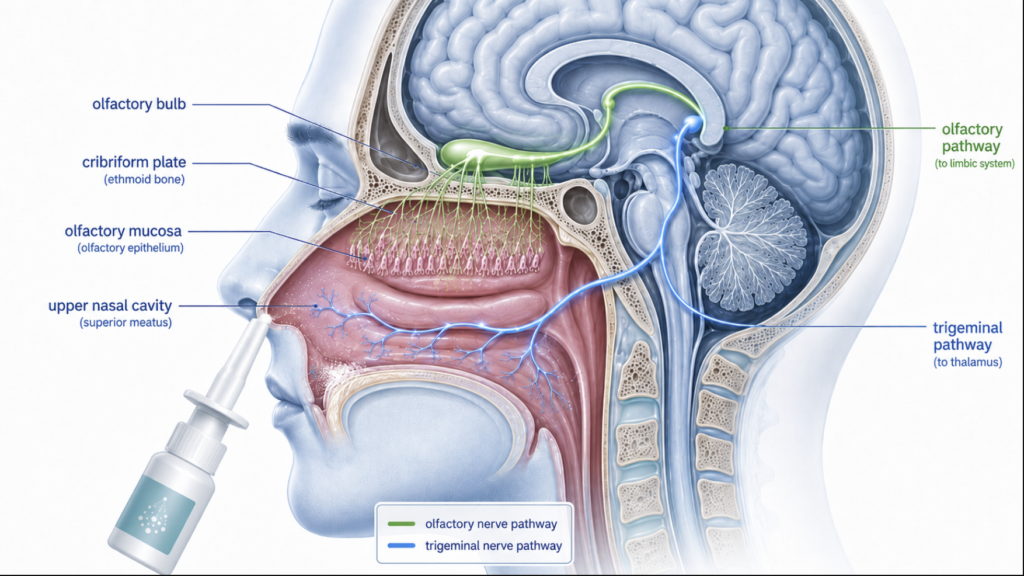
This transport is thought to occur mainly along the outside of the nerves rather than requiring the drug to be taken up inside nerve cells, which is part of why molecules of very different sizes — from small drugs to peptides and proteins — can use it (Drath, Nose-to-brain drug delivery: from bench to bedside, 2025).
There is a second, separate advantage that applies even to the fraction of drug absorbed into the bloodstream through the nose. Oral drugs are absorbed through the gut and travel first through the liver, where much of the dose is metabolized before reaching the circulation — the “first-pass” effect. Nasal delivery skips both the gut and this hepatic first pass, which is one reason nasal formulations can act quickly and at lower doses, and why they suit peptides and proteins that would be destroyed in the stomach (Drath, Nose-to-brain drug delivery: from bench to bedside, 2025).
One detail matters for everything that follows: the benefit depends on where in the nose the drug lands. The nerve pathways are in the upper and posterior regions. A drug that deposits only in the front of the nose — as much of a conventional spray does — is far less likely to reach them.
Already Approved: Migraine and Seizures
This is no longer a laboratory idea. Two drug classes have reached the clinic through the nose, and they show what the route can do.
Zavegepant is a small-molecule CGRP receptor antagonist delivered as a nasal spray, approved by the FDA in 2023 as the first nasal spray in its class for acute migraine. In its pivotal phase 3 trial of 1,405 adults, more patients treated with zavegepant were pain-free at two hours than those given placebo (24% vs 15%), and more were free of their most bothersome symptom (40% vs 31%) (Lipton, Safety, tolerability, and efficacy of zavegepant 10 mg nasal spray for the acute treatment of migraine in the USA, 2023).
Rapid onset has been a central claim for the nasal formulation, and relief within the first 15 minutes has been widely reported for zavegepant in secondary endpoints and manufacturer materials; the two-hour outcomes above, however, are the trial’s confirmed coprimary results and the most reliable figures to cite. The most common side effect was an altered sense of taste, a direct consequence of the delivery route.
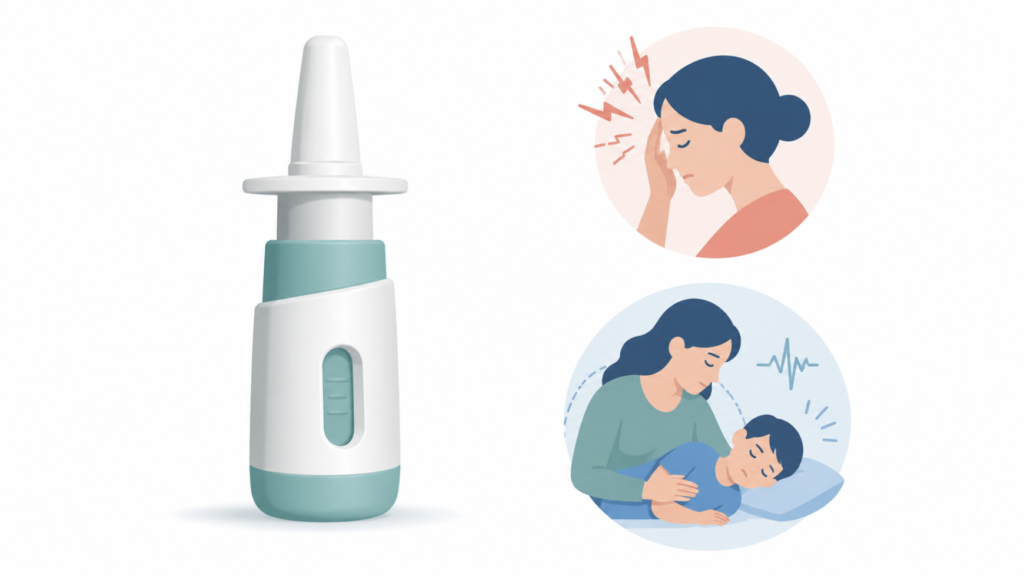
The clinical logic is straightforward. Migraine frequently comes with nausea and vomiting, which makes swallowing and keeping down an oral tablet unreliable exactly when a patient needs it. A spray sidesteps that problem entirely.
Seizure care makes the same point from a different angle. Diazepam nasal spray (marketed as Valtoco) is FDA-approved for the short-term treatment of seizure clusters — bouts of frequent seizures distinct from a person’s usual pattern — and in 2025 its approval was expanded to children as young as two. The alternative rescue formulation for this situation has long been a rectal gel, which is difficult and distressing to administer to a seizing child in public. An intranasal option that can be given quickly, in almost any setting, addresses a concrete and long-standing need.
The Next Frontier: Concussion and Traumatic Brain Injury
Concussion and mild traumatic brain injury are among the most common neurological conditions with no FDA-approved drug treatment. The damage is driven in large part by neuroinflammation, and the nose-to-brain route is now being explored as a way to reach that inflammation directly. It bears emphasis that this work is early — the examples below are investigational and not available to patients.
One approach uses an intranasal anti-CD3 antibody. In a mouse model of contusional traumatic brain injury, nasal administration reduced central nervous system damage and improved behavioral outcomes. The mechanism was indirect and instructive: the nasal antibody prompted a population of interleukin-10-producing regulatory T cells to migrate to the brain, where they contacted microglia — the brain’s resident immune cells — and calmed their chronic inflammatory activity while improving their ability to clear debris (Izzy, Nasal anti-CD3 monoclonal antibody ameliorates traumatic brain injury, enhances microglial phagocytosis and reduces neuroinflammation via IL-10-dependent T-microglia crosstalk, 2025).
When the researchers blocked the interleukin-10 signal, the benefit disappeared, which strengthens the case that this pathway is doing the work. This is a preclinical, animal-model finding; the widely discussed idea of a “spray on the sideline” for injured athletes is a hypothesis it raises, not a treatment it delivers.
A separate intranasal neurosteroid candidate has entered early-phase human testing for concussion, aiming to reduce neuroinflammation and oxidative stress after injury. It, too, remains in trials, with efficacy in patients not yet established. Both programs illustrate the direction of travel more than any settled result.
When the Door Is Blocked: Why Nasal Patency Matters
Here is the part usually left out of the enthusiasm for nose-to-brain delivery, and it is the part where an ear, nose, and throat specialist becomes directly relevant. The route only works if the drug physically reaches the upper and posterior nasal regions where nerve transport occurs. If the nasal airway is obstructed or distorted, the drug lands in the wrong place — or does not get past the entrance at all — and the elegant pathway described above never comes into play.
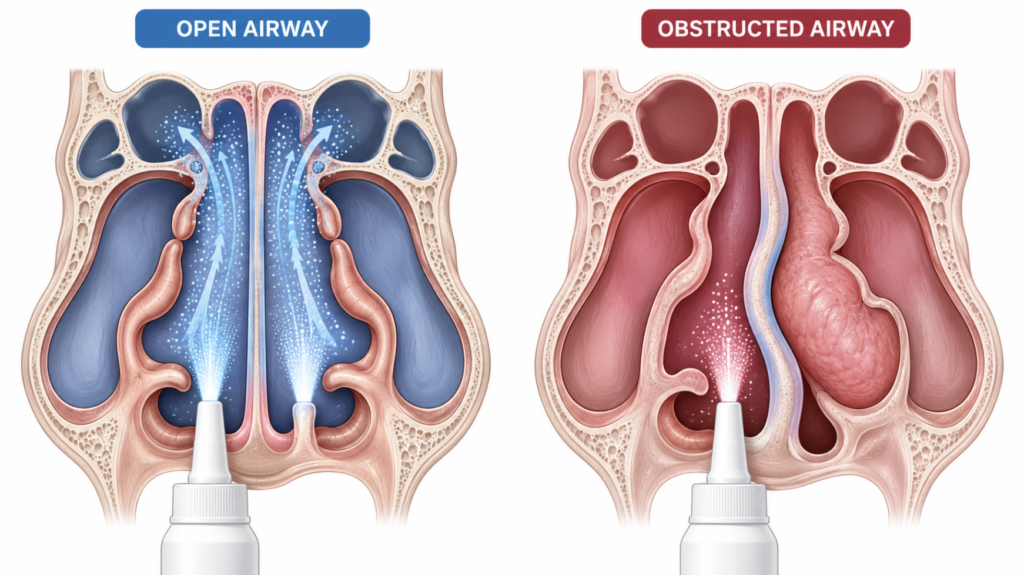
The evidence for this is concrete, not hypothetical. In a computational fluid dynamics simulation built from the CT scan of a nose with a deviated septum and an enlarged turbinate, posterior drug deposition on the obstructed side was roughly four times lower than on the open side (Frank, Deviated nasal septum hinders intranasal sprays, 2012). A patient with a significant deviation may effectively be treating only one side of their nose.
Obstruction is not only a matter of gross anatomy. The nose has a natural nasal cycle — a normal, alternating pattern of congestion and decongestion that shifts airflow between the two nostrils over hours. Controlled deposition experiments show that this cycle measurably changes where a spray settles, with a congested passage confining the drug and a decongested one allowing broader spread toward the posterior turbinate (Seifelnasr, Assessing nasal epithelial dynamics: impact of the natural nasal cycle on intranasal spray deposition, 2024). Head position during dosing matters as well. In other words, even a structurally normal nose is a moving target, and a diseased one can be a closed door.
The device itself is part of the equation. The nasal valve is the narrowest point of the airway and, together with the convoluted internal geometry, it exists precisely to filter and condition inhaled air — not to admit medication.
Conventional spray pumps tend to deposit much of their dose in the front of the nose, and newer delivery technologies have been developed specifically to push more drug into the upper and posterior regions where it can be absorbed or transported (Djupesland, Nasal drug delivery devices: characteristics and performance in a clinical perspective, 2013). That review was authored by a developer of one such device, so its device comparisons are best read alongside the independent deposition studies cited above. Even the best device, however, cannot compensate for an airway that is physically blocked.
Clinical Perspective
This is where the otolaryngologist’s role comes into focus, and it is frequently overlooked in discussions dominated by pharmacology. Nasal obstruction is conventionally divided into two categories. Structural causes include a deviated septum and other anatomical distortions of the airway. Mucosal causes include nasal polyps and chronic hypertrophic rhinitis, in which swollen or overgrown tissue narrows the passage.
An ENT physician is the clinician equipped to identify and correct these problems — reducing hypertrophied turbinates, treating or removing polyps, managing chronic rhinitis, or surgically straightening a deviated septum. As intranasal drugs expand from migraine and seizures toward brain injury and, potentially, neurodegenerative disease, keeping this pathway open becomes a therapeutic act in its own right. A patient with untreated obstruction may be absorbing far less of a prescribed dose than either they or their prescriber assumes, and the fix for that is not a different drug but an evaluation of the nose itself. The nose is the door to the brain, and someone has to make sure it opens.
Key Takeaways
- Drugs deposited high in the nasal cavity can travel along the olfactory and trigeminal nerve pathways into the brain, bypassing the blood-brain barrier, which otherwise blocks more than 98% of small-molecule drugs.
- Nasal delivery also avoids the liver’s first-pass metabolism, allowing faster onset and lower doses, and it suits peptides and proteins that would be destroyed if swallowed.
- Zavegepant is the first FDA-approved CGRP nasal spray for acute migraine, with more patients pain-free at two hours than on placebo (24% vs 15%).
- Diazepam nasal spray is approved for seizure clusters, including in children as young as two, replacing a difficult rectal alternative.
- No FDA-approved drug exists for concussion; intranasal candidates are in preclinical and early clinical testing and are not yet available to patients.
- Nasal obstruction from a deviated septum, polyps, or chronic rhinitis can cut drug deposition on the affected side several-fold, making nasal patency a genuine and correctable clinical factor.
FAQ
How do nasal sprays reach the brain?
Drugs deposited high in the nasal cavity travel along the olfactory and trigeminal nerve pathways directly into the central nervous system. This route bypasses the blood-brain barrier, the lining that normally blocks the great majority of drugs from entering the brain. The drug has to reach the upper and posterior nose for this to happen, which is why deposition matters.
Why do nasal migraine sprays work faster than pills?
Nasal delivery skips the gut and the liver, so the drug is not broken down before reaching the bloodstream and nerve pathways. In trials, nasal zavegepant produced pain freedom at two hours in significantly more patients than placebo, and rapid onset is a key reason the route is useful when nausea makes swallowing pills unreliable.
Is there a nasal spray for concussion yet?
No. Concussion currently has no FDA-approved drug treatment. Several intranasal candidates are being studied, including an anti-CD3 antibody tested in mice and a neurosteroid in early human trials, but none is approved or available for patient use.
Can nasal congestion or a deviated septum affect how well a nasal spray works?
Yes. Obstruction from a deviated septum, nasal polyps, or chronic rhinitis can substantially reduce how much drug reaches the target region of the nose — in one simulation, roughly fourfold on the blocked side. This is one reason an ENT evaluation can matter for patients who rely on intranasal medication.
References
- Pardridge WM. The blood-brain barrier: bottleneck in brain drug development. NeuroRx. 2005;2(1):3-14.
- Drath I, Richter F, Feja M. Nose-to-brain drug delivery: from bench to bedside. Transl Neurodegener. 2025;14(1):23.
- Lipton RB, Croop R, Stock DA, Madonia J, Forshaw M, Lovegren M, Mosher L, Coric V, Goadsby PJ. Safety, tolerability, and efficacy of zavegepant 10 mg nasal spray for the acute treatment of migraine in the USA: a phase 3, double-blind, randomised, placebo-controlled multicentre trial. Lancet Neurol. 2023;22(3):209-217.
- Frank DO, Kimbell JS, Cannon D, Pawar SS, Rhee JS. Deviated nasal septum hinders intranasal sprays: a computer simulation study. Rhinology. 2012;50(3):311-318.
- Seifelnasr A, Si X, Xi J. Assessing nasal epithelial dynamics: impact of the natural nasal cycle on intranasal spray deposition. Pharmaceuticals (Basel). 2024;17(1):73.
- Djupesland PG. Nasal drug delivery devices: characteristics and performance in a clinical perspective—a review. Drug Deliv Transl Res. 2013;3(1):42-62.
- Izzy S, Yahya T, Albastaki O, et al. Nasal anti-CD3 monoclonal antibody ameliorates traumatic brain injury, enhances microglial phagocytosis and reduces neuroinflammation via IL-10-dependent T-microglia crosstalk. Nat Neurosci. 2025;28(3):499-516.
Joonpyo Hong, MD is a board-certified otolaryngologist practicing in Korea. This article reflects his clinical interpretation of published research and does not constitute individual medical advice.
For more interesting content:
https://curiousmd.com/depression-nasal-spray-esketamine/
https://curiousmd.com/ear-and-sinus-barotrauma-decongestant-guide/
https://curiousmd.com/ozempic-ear-side-effect-weight-loss-clogged-ears/
Pingback: Steroids vs NSAIDs: The History Behind the Names