
Every strain in this winter’s flu vaccine is new. The World Health Organization (WHO) resets the lineup each year to limit flu vaccine mismatch. When it announced its picks for the 2026-27 Northern Hemisphere season in February 2026, it replaced all three strains used the year before. In Korea, the free national flu vaccination program starts rolling out on September 21, and this year it covers children up to age 14.
If the virus changes often enough that the vaccine has to be rebuilt every year, it is fair to ask what happens when the virus changes again after the shot is made. This article covers how the strains are chosen, how a chicken egg can undermine a well-chosen strain, and what the vaccine still does when the match is poor.
How WHO picks the strains
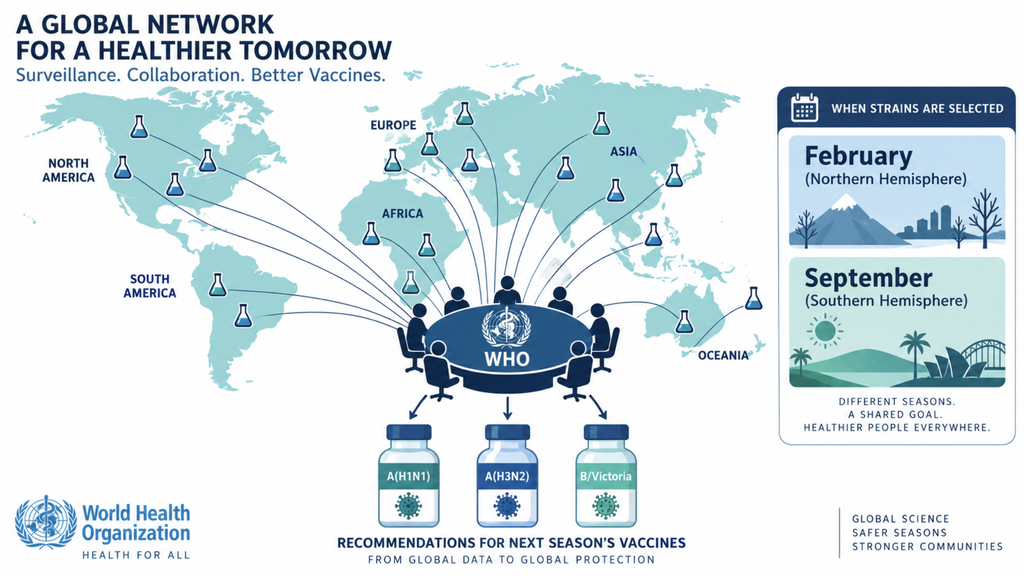
WHO convenes experts twice a year: in February to recommend strains for the Northern Hemisphere, and in September for the Southern Hemisphere. They work from year-round data collected by the Global Influenza Surveillance and Response System (GISRS). This laboratory network sequences circulating viruses and tests how well antibodies neutralize them, including antibodies from recently vaccinated people.
The 2026-27 vaccine contains three strains: one influenza A(H1N1), one A(H3N2), and one influenza B virus of the Victoria lineage. Each is a representative rather than a full catalogue. The vaccine targets viruses “like” the chosen strain and counts on antibodies cross-reacting with its close relatives.
Korea’s national program used a four-strain vaccine until the 2024-25 season. It dropped to three because the fourth strain, B/Yamagata, has not been detected anywhere in the world for a long time. According to the Korea Disease Control and Prevention Agency (KDCA), the three-strain vaccine is equivalent to the four-strain version in effectiveness and safety.
Timing is where the system is weakest. Strains are fixed in February for a season that peaks months later, and the virus keeps evolving in between. The 2025-26 season showed how wide that gap can get. Among genetically characterized H3N2 samples in the United States, 93% belonged to subclade K. This antigenically drifted variant was first identified by the CDC in June 2025, after that season’s strains had already been chosen [Maloney, Interim Estimates of 2025–26 Seasonal Influenza Vaccine Effectiveness — United States, September 2025–February 2026, 2026].
The egg problem
The 2026-27 recommendation names two H3N2 strains. A/Darwin/1454/2025 is for egg-based vaccines. A/Darwin/1415/2025 is for vaccines made in cell culture or with recombinant protein or nucleic acid (mRNA) platforms. The B component is split the same way.
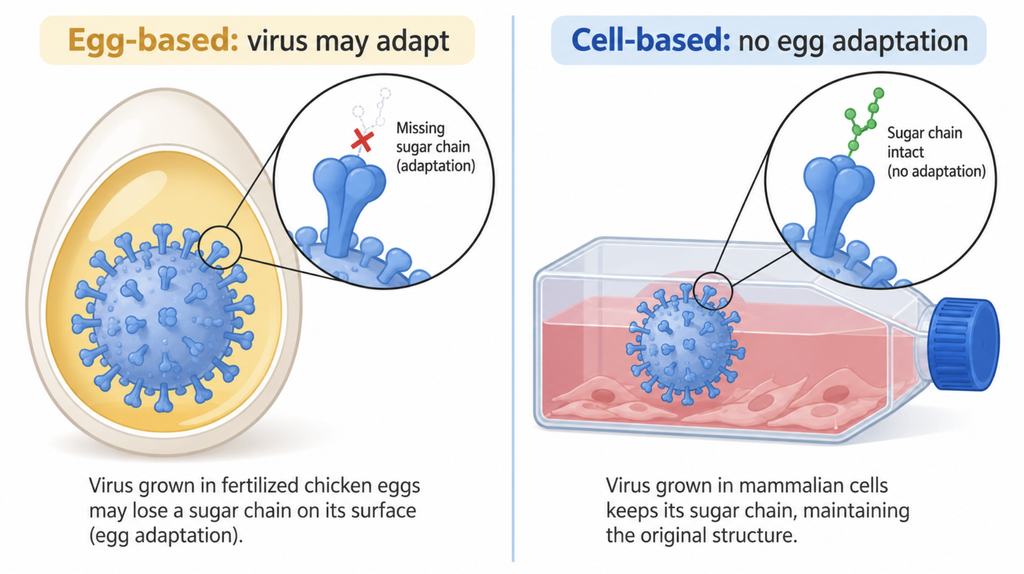
The reason has to do with how many flu vaccines are made. The virus is grown inside fertilized chicken eggs, and a human virus replicating in a bird environment can pick up mutations that help it grow there. Some of those mutations land on hemagglutinin, the surface protein the vaccine is supposed to teach the immune system to recognize.
The 2016-17 season is a well-documented example. That year’s H3N2 strain matched circulating viruses on paper, but protection was lower than expected. Circulating H3N2 viruses carried a sugar chain (a glycosylation site) on a key antibody target, and the egg-adapted vaccine strain had lost it. Antibodies from ferrets and people exposed to the egg-adapted strain neutralized the circulating virus poorly. Antibodies raised against antigens that kept the glycosylation site recognized it well, and that included a vaccine made without eggs [Zost, Contemporary H3N2 influenza viruses have a glycosylation site that alters binding of antibodies elicited by egg-adapted vaccine strains, 2017]. That work was a laboratory analysis, though, and it does not by itself show that non-egg vaccines protect better in every season.
So a mismatch can come from two places: a prediction that missed, or a production step that altered a correct prediction. WHO’s separate egg and non-egg strains appear aimed at the second problem, though this is an inference rather than a documented statement.
Drift vs. shift: two kinds of “new variant”
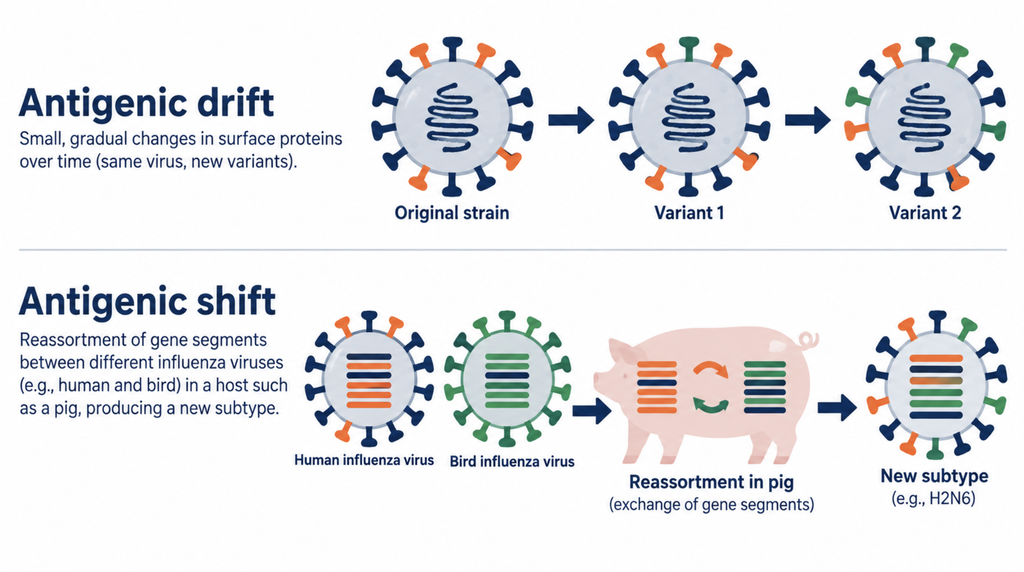
“New variant” can mean two different things. Antigenic drift is the steady build-up of small mutations within a subtype. H3N2, for example, changes a little every year. Antigenic shift is the arrival of an antigenically novel subtype through gene swapping with animal influenza viruses, and it can trigger pandemics [Kilbourne, The total influenza vaccine failure of 1947 revisited, 2002].
The distinction matters for vaccines. Viruses within a subtype usually cross-react, so an older vaccine typically keeps partial protection against a drifted strain. Before a 2002 re-analysis, complete loss of cross-protection had been documented only with shift. That re-analysis looked at the exception. In 1947, a vaccine that had worked in the 1943-44 and 1944-45 seasons failed entirely against a heavily drifted virus [Kilbourne, The total influenza vaccine failure of 1947 revisited, 2002].
For the seasonal vaccine, the realistic “new variant” is a drifted one.
Flu vaccine mismatch: what the shot still does
In a mismatched season the vaccine still prevents illness, only less of it. The 2025-26 subclade K season was a real-world test. In the United States, interim vaccine effectiveness against flu-related hospitalization was 41% in children and adolescents and 30% in adults [Maloney, Interim Estimates of 2025–26 Seasonal Influenza Vaccine Effectiveness — United States, September 2025–February 2026, 2026]. In Canada, vaccination lowered the risk of medically attended H3N2 illness, including subclade K, by about 40% [Separovic, Interim 2025/26 influenza vaccine effectiveness estimates with immuno-epidemiological considerations for A(H3N2) subclade K protection, Canada, January 2026, 2026]. Those numbers are lower than in recent seasons, but they are well above zero.
When infection breaks through, it tends to be milder. A review that pooled results from multiple studies looked at adults hospitalized with influenza. Vaccinated patients had 26% lower odds of ICU admission and 31% lower odds of death than unvaccinated patients [Ferdinands, Does influenza vaccination attenuate the severity of breakthrough infections? A narrative review and recommendations for further research, 2021]. The effect shows up in milder cases too. Across nine seasons, vaccinated outpatients with confirmed flu reported feeling better when they came in for care [Chung, Vaccine-associated attenuation of subjective severity among outpatients with influenza, 2022].
Vaccination may also shorten hospital stays, with a caveat. In the 2013-14 season, it was linked to lower odds of in-hospital death across adult age groups. It was also linked to shorter hospital and ICU stays in adults aged 50 and older [Arriola, Influenza Vaccination Modifies Disease Severity Among Community-dwelling Adults Hospitalized With Influenza, 2017]. That season was well matched, however. For people who stay home with mild illness, data on recovery time are still thin, especially in mismatched seasons.
Myth check: “Vaccinated people don’t spread flu”
This claim mixes two questions, and the evidence for each is very different.
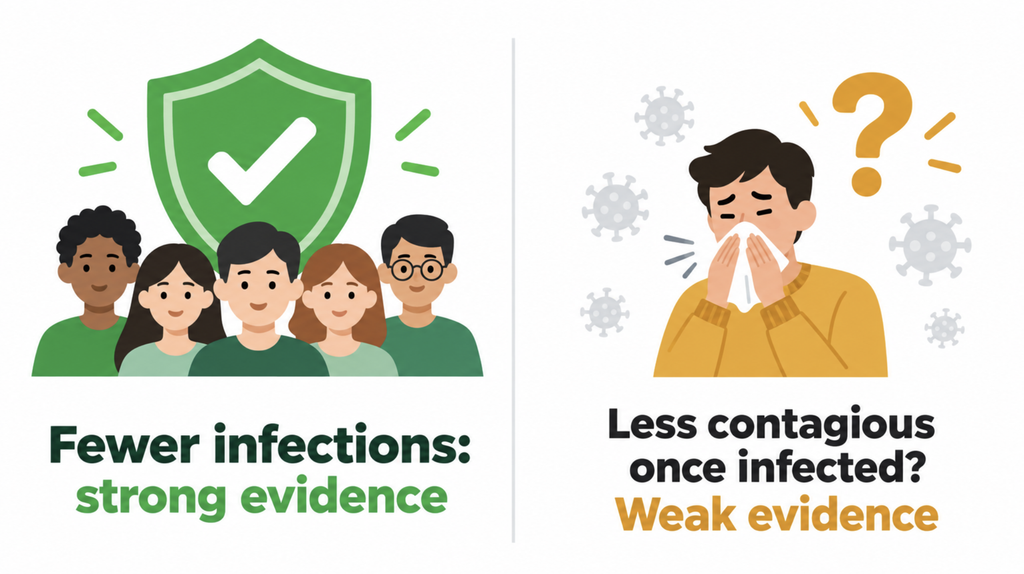
The first question is whether vaccinated people catch flu less often. They do, and fewer infections mean fewer people passing the virus on. A cluster randomized trial in Canadian Hutterite communities showed how far this can reach. In communities where children were vaccinated, unvaccinated community members were 61% less likely to get confirmed influenza than in communities where children received a control vaccine [Loeb, Effect of influenza vaccination of children on infection rates in Hutterite communities: a randomized trial, 2010].
The second question is whether vaccinated people are less contagious once infected, and here the evidence is weak. In an Italian study, vaccinated outpatients with flu had a slightly lower viral load than unvaccinated ones. The difference was not statistically significant, though, and came mainly from H1N1 [Domnich, Effect of Influenza Vaccination on the Disease Severity and Viral Load Among Adult Outpatients and Inpatients, 2025]. A lower viral load also doesn’t automatically mean less transmission.
In practice, the vaccine reduces spread mainly by preventing infections in the first place. A vaccinated person who does get sick should assume they can still infect others. That means taking the same precautions around older family members, infants, and anyone with chronic illness.
Clinical perspective
Every flu season brings some version of the question “I got the shot, so why did I still get the flu?” The data above suggest it is more useful to think of the vaccine as something that shifts the odds. It is not a wall. A vaccine effectiveness of 40% does not mean the vaccine works in only 40% of people. It means vaccinated people had roughly 40% lower odds of the measured outcome than unvaccinated people. When infection does break through, the evidence points toward a milder course, including in people sick enough to be hospitalized. A partially matched vaccine is still worth getting. It just won’t make anyone untouchable, and it won’t make them non-contagious.
Key takeaways
- WHO selects flu vaccine strains twice a year using global surveillance data. The 2026-27 Northern Hemisphere vaccine contains three strains.
- Vaccine mismatch can come from viral evolution after strain selection, or from mutations introduced while the virus grows in chicken eggs.
- In the mismatched 2025-26 season, interim U.S. vaccine effectiveness against flu hospitalization was 41% in children and 30% in adults.
- Among adults hospitalized with influenza, vaccination has been associated with lower odds of ICU admission and death.
- Vaccination reduces flu spread mainly by preventing infection. Evidence that infected vaccinated people are less contagious is weak.
FAQ
How are flu vaccine strains chosen each year? WHO experts choose them twice a year, in February for the Northern Hemisphere and in September for the Southern Hemisphere, based on year-round global surveillance data. They recommend one representative strain for each influenza group in the vaccine.
Why are flu vaccines made in eggs, and does it matter? Eggs are a long-established way to grow flu virus at scale. It matters because the virus can mutate as it adapts to them. In 2016-17, an egg-adapted H3N2 strain lost a feature found on circulating viruses, which likely reduced protection. WHO now recommends separate strains for egg-based and non-egg vaccines.
Is the flu shot worth it if the strain doesn’t match? Current evidence says yes. In the mismatched 2025-26 season, the vaccine still reduced flu-related hospitalizations by 41% in U.S. children and 30% in adults, and breakthrough infections tend to be milder.
Do vaccinated people spread flu less? Partly. Vaccinated people are less likely to get infected, which reduces spread. Once they are infected, there is little evidence that they are less contagious, so anyone with flu symptoms should take precautions.
References
- Ferdinands JM, Thompson MG, Blanton L, Spencer S, Grant L, Fry AM. Does influenza vaccination attenuate the severity of breakthrough infections? A narrative review and recommendations for further research. Vaccine. 2021;39(28):3678-95.
- Arriola C, Garg S, Anderson EJ, Ryan PA, George A, Zansky SM, et al. Influenza vaccination modifies disease severity among community-dwelling adults hospitalized with influenza. Clin Infect Dis. 2017;65(8):1289-97.
- Zost SJ, Parkhouse K, Gumina ME, Kim K, Diaz Perez S, Wilson PC, et al. Contemporary H3N2 influenza viruses have a glycosylation site that alters binding of antibodies elicited by egg-adapted vaccine strains. Proc Natl Acad Sci U S A. 2017;114(47):12578-83.
- Chung JR, Kim SS, Flannery B, Smith ME, Dunnigan K, Raiyani C, et al. Vaccine-associated attenuation of subjective severity among outpatients with influenza. Vaccine. 2022;40(32):4322-7.
- Kilbourne ED, Smith C, Brett I, Pokorny BA, Johansson B, Cox N. The total influenza vaccine failure of 1947 revisited: major intrasubtypic antigenic change can explain failure of vaccine in a post-World War II epidemic. Proc Natl Acad Sci U S A. 2002;99(16):10748-52.
- Loeb M, Russell ML, Moss L, Fonseca K, Fox J, Earn DJ, et al. Effect of influenza vaccination of children on infection rates in Hutterite communities: a randomized trial. JAMA. 2010;303(10):943-50.
- Maloney P, Reeves EL, Wielgosz K, Price AM, Natarajan K, DeSilva MB, et al. Interim estimates of 2025-26 seasonal influenza vaccine effectiveness – United States, September 2025-February 2026. MMWR Morb Mortal Wkly Rep. 2026;75(9):116-23.
- Separovic L, Sabaiduc S, Zhan Y, Kaweski SE, Olsha R, Hasso M, et al. Interim 2025/26 influenza vaccine effectiveness estimates with immuno-epidemiological considerations for A(H3N2) subclade K protection, Canada, January 2026. Euro Surveill. 2026;31(5):2600068.
- Domnich A, Paolozzi V, Garzillo G, Orsi A, Icardi G. Effect of influenza vaccination on the disease severity and viral load among adult outpatients and inpatients. Vaccines (Basel). 2025;13(10):1046.
Joonpyo Hong, MD is a board-certified otolaryngologist practicing in Korea. This article reflects his clinical interpretation of published research and does not constitute individual medical advice.
For more articles:
https://curiousmd.com/chickenpox-vaccine-for-adults/
https://curiousmd.com/rsv-vaccine-effectiveness-adults-infants/
https://curiousmd.com/hpv-vaccine-and-throat-cancer/
https://curiousmd.com/shingles-vaccine-and-hearing-loss/
Link out to:
https://www.who.int/news/item/27-02-2026-recommendations-for-influenza-vaccine-composition-for-the-2026-2027-northern-hemisphere-season : WHO’s announcement of the 2026–27 Northern Hemisphere vaccine strains, including the separate egg-based and non-egg recommendations.
https://www.cidrap.umn.edu/influenza-vaccines/news-scan-nov-08-2017 : CIDRAP’s news brief on the 2017 study linking an egg-adapted H3N2 mutation to lower vaccine effectiveness.
https://www.kdca.go.kr/bbs/kdca/42/312308/artclView.do – KDCA press release (Korean) on the 2026–27 national influenza vaccination schedule and expansion to age 14.