
Among 66 adults admitted with deep neck space infections at a Rwandan teaching hospital, the average duration of symptoms before presentation was 11 days [Ncogoza I, Clinical Presentation and Factors Leading to Complications of Deep Neck Space Infections at CHUK, 2021]. Search tooth infection spread to neck online and you will mostly get “days to weeks,” which is accurate and not much help. Nobody has cleanly measured the interval people actually want to know, and the reason why says something useful about what to watch for instead.
What a deep neck infection is
The neck is not solid tissue. It is organized into potential spaces separated by sheets of fascia, and those sheets run vertically, from the floor of the mouth, past the pharynx, down behind the esophagus, and into the chest. A deep neck infection has left its original site and entered these spaces.
That anatomy explains most of what follows. An abscess at a lower molar and an abscess in the mediastinum are the same infection at two points along one corridor, not two different diseases. Ludwig’s angina, the bilateral swelling of the floor of the mouth that can push the tongue backward into the airway, is what this looks like when it moves early and fast.
Where it starts
Two sources dominate. Among 226 patients at a Thai referral hospital, odontogenic infections accounted for 54.9% of cases [Pinsai S, Factors associated with complications among deep neck infections in a community-based hospital in Thailand, 2026]. In a Taiwanese series of 185 patients, odontogenic infections made up 53.2% and upper airway infections 30.5% of cases with an identified cause [Huang TT, Deep neck infection: analysis of 185 cases, 2004].
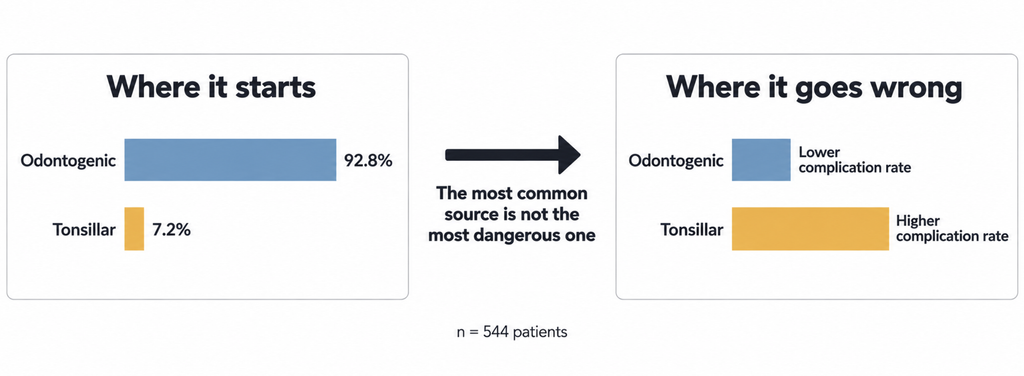
A Czech multicenter study of 544 patients is harder to square with intuition. It found 92.8% with an odontogenic origin and only 7.2% with a tonsillar one, yet complications occurred significantly more often in the tonsillar group (P < 0.001) [Matoušek P, Tonsillar origin of deep neck infection as a negative prognostic factor for developing complications, 2022].
So a neglected tooth is the likeliest starting point by a wide margin, while the much smaller tonsillar group is where complications concentrate.
Who is most at risk
Risk has been quantified reasonably well here, because several large national databases have been analyzed.
| Condition | Adjusted hazard ratio for developing a deep neck infection |
|---|---|
| Type 1 diabetes | 10.71 (95% CI 6.02 to 19.05) |
| Decompensated liver cirrhosis | 4.11 (95% CI 3.16 to 5.35) |
The diabetes signal is the strongest. In a Taiwanese cohort of 5,741 patients with type 1 diabetes matched against 22,964 controls, the adjusted hazard ratio was 10.71, and those patients also stayed in hospital longer when infection occurred, 9.0 days against 4.1 [Chang GH, High Risk of Deep Neck Infection in Patients with Type 1 Diabetes Mellitus, 2018]. Decompensated cirrhosis carried an adjusted hazard ratio of 4.11 [Tsai MS, The Association Between Decompensated Liver Cirrhosis and Deep Neck Infection, 2019].
Age compounds this. Comparing 113 patients over 65 with 285 younger adults, the elderly group had longer stays, higher C-reactive protein, higher blood sugar, and higher rates of both intubation and surgical drainage [Hsiao FY, Assessment of the Elderly Adult Patients with Deep Neck Infection, 2026]. In the 185-case Taiwanese series, all three deaths were in patients over 72 with underlying systemic disease [Huang TT, 2004].
The timeline question, and why nobody has a clean answer
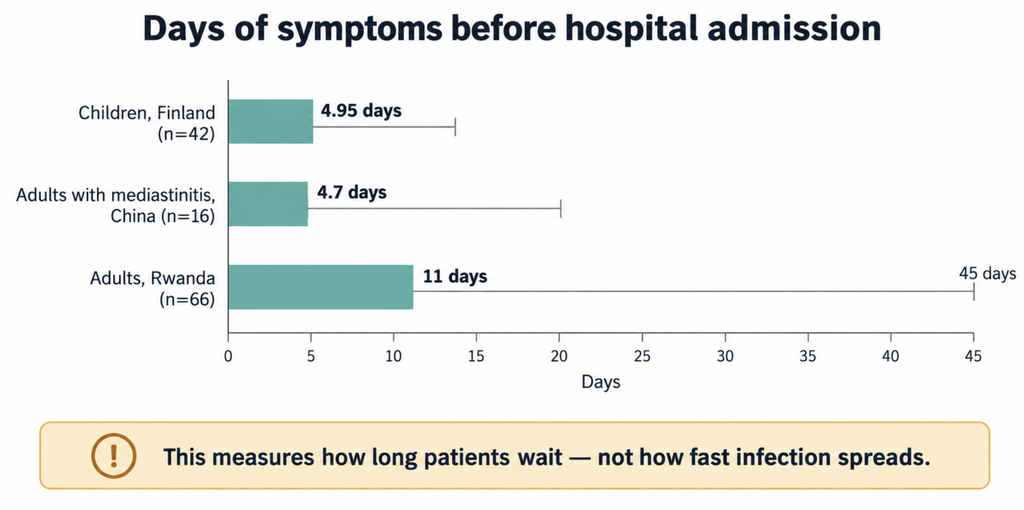
The measurement problem is simple once you see it. No study measures the interval between a primary infection and the moment it crosses into the deep neck, because that moment is invisible. It happens inside tissue, with no symptom to mark it. What studies measure instead is the interval from symptom onset to hospital arrival.
| Population | Mean symptom duration before admission |
|---|---|
| Children, median age 4.9 years (n=42, Finland) | 4.95 days |
| Adults with mediastinitis (n=16, China) | 4.7 days (range 2 to 10) |
| Adults at a teaching hospital (n=66, Rwanda) | 11 days (range 2 to 45) |
The pediatric figure is 4.95 days [Velhonoja J, Early surgical intervention enhances recovery of severe pediatric deep neck infection patients, 2021]. Among 16 patients who developed descending necrotizing mediastinitis, the delay between onset of the primary infection and admission averaged 4.7 days, ranging from 2 to 10 [Ma C, Multidisciplinary treatment of deep neck infection associated with descending necrotizing mediastinitis, 2019]. Adults in Kigali averaged 11 days, and both delayed consultation and age over 40 were associated with complications and longer hospital stay [Ncogoza I, 2021].
None of this is a countdown clock. These numbers describe how long people tolerate symptoms before seeking help, and in one series a patient waited 45 days while another arrived in 2. They track human behavior more closely than they track bacterial speed. The question that can actually be answered is whether anything has changed to suggest the infection is no longer local.
How dangerous it is
The best contemporary figures come from 12,063 adult cases across an 18-year Taiwanese multicenter cohort. In-hospital mortality fell from 7.7% to 6.4% between the 2006 to 2014 and 2015 to 2023 periods, and descending necrotizing mediastinitis dropped from 2.7% to 0.7% [Liu FC, Temporal Trends in Pathogens and Clinical Outcomes of Adult Deep Neck Infections, 2026].
Smaller single-center series report lower overall mortality, 1.6% in the 185-case Taiwanese review [Huang TT, 2004], which reflects case mix rather than contradiction. The average is less informative than whether complications develop.
Independent predictors of complications, from the Thai cohort: parapharyngeal space involvement (OR 43.3; 95% CI 3.0 to 628.0), multiple space involvement (OR 7.98; 95% CI 2.7 to 23.9), and submental space involvement (OR 5.5; 95% CI 1.4 to 22.0) [Pinsai S, 2026]. Airway obstruction occurred in 7.1% of that cohort and sepsis in 4.9%.
Neck pain and swelling were inversely associated with complications (OR 0.2; 95% CI 0.04 to 0.9) [Pinsai S, 2026]. Obvious symptoms bring people in early, and the quieter presentations are the ones that arrive late.
Clinical Perspective
Severe pain is not the presentation that deserves the most caution. Pain that has become oddly bearable while the swelling stays unchanged is worse: a toothache that goes quiet while the jaw is still swollen can mean the abscess has found somewhere else to drain.
Partial self-treatment produces a similar picture. An incomplete course of antibiotics can suppress fever, fluctuance, and general malaise while the underlying process continues, so the examination looks more reassuring than the anatomy warrants.
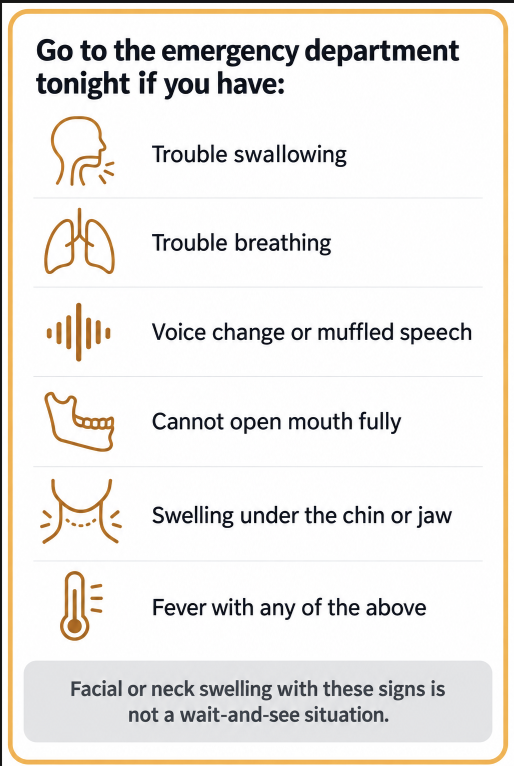
A change in swallowing, a change in voice, or a jaw that will not open as far as it did the day before puts the problem outside the scope of routine dental care. That is a clinical interpretation rather than a validated triage rule, though the anatomy behind it is not in dispute.
Key takeaways
- Deep neck infections most often begin with a dental infection, 54.9% of cases in one 226-patient cohort, but tonsillar-origin infections carry a significantly higher complication rate despite being far less common.
- Published “timelines” measure how long patients wait before seeking care, 4.7 to 11 days on average, not how quickly infection spreads. There is no reliable countdown.
- In-hospital mortality across 12,063 adult cases was 6.4% in the most recent period studied.
- Type 1 diabetes raises deep neck infection risk roughly tenfold (adjusted HR 10.71), and decompensated cirrhosis roughly fourfold (adjusted HR 4.11).
- Difficulty swallowing, limited mouth opening, voice change, or breathing difficulty alongside facial or neck swelling warrant emergency evaluation, not observation.
FAQ
How long does it take for a tooth infection to reach the neck?
There is no measurable average, because the crossing point produces no symptom. What research records is the time patients spend symptomatic before hospital admission, which averaged 4.7 days in one mediastinitis series and 11 days in an adult African cohort. The range in published series spans 2 to 45 days, so the interval reflects when people seek care more than how fast bacteria move.
Can a sore throat become a deep neck infection?
Yes, and the tonsillar route carries more risk than the dental one. Tonsillar-origin infections represented only 7.2% of 544 cases but had significantly higher complication rates than odontogenic ones.
Does diabetes really change the risk that much?
Yes. Type 1 diabetes carried an adjusted hazard ratio of 10.71 for developing a deep neck infection in a Taiwanese national cohort, and those patients required more than twice the hospital stay when infection did occur.
What symptoms mean I should go to an emergency department tonight?
Trouble swallowing, trouble breathing, voice change, inability to open the mouth fully, or swelling under the chin or jaw, particularly with fever. These suggest the infection has moved beyond its original site, and infections at this stage often require hospital-level treatment rather than outpatient management.
References
- Huang TT, Liu TC, Chen PR, Tseng FY, Yeh TH, Chen YS. Deep neck infection: analysis of 185 cases. Head Neck. 2004;26(10):854-60.
- Matoušek P, Čábalová L, Formánková D, Staníková L, Čelakovský P, Mejzlík J, Chrobok V, Komínek P. Tonsillar origin of deep neck infection as a negative prognostic factor for developing complications. Otolaryngol Pol. 2022;76(2):42-45.
- Ma C, Zhou L, Zhao JZ, Lin RT, Zhang T, Yu LJ, Shi TY, Wang M. Multidisciplinary treatment of deep neck infection associated with descending necrotizing mediastinitis: a single-centre experience. J Int Med Res. 2019;47(12):6027-6040.
- Velhonoja J, Lääveri M, Soukka T, Hirvonen J, Kinnunen I, Irjala H. Early surgical intervention enhances recovery of severe pediatric deep neck infection patients. Int J Pediatr Otorhinolaryngol. 2021;144:110694.
- Ncogoza I, Munezero E, Mvukiyehe JP, Shaye D. Clinical Presentation and Factors Leading to Complications of Deep Neck Space Infections at CHUK. Rwanda J Med Health Sci. 2021;4(1):8-19.
- Pinsai S, Keeratitadapong W, Trakarnchansiri J. Factors associated with complications among deep neck infections in a community-based hospital in Thailand. BMC Infect Dis. 2026;26(1).
- Liu FC, Lu A, Yang PR, Tsai YT, Yang YH, Liu CY, Chang GH. Temporal Trends in Pathogens and Clinical Outcomes of Adult Deep Neck Infections: An 18-Year Multicenter Cohort Study of 12,063 Cases. Microorganisms. 2026;14(8).
- Chang GH, Ding MC, Yang YH, Lin YH, Liu CY, Lin MH, Wu CY, Hsu CM, Tsai MS. High Risk of Deep Neck Infection in Patients with Type 1 Diabetes Mellitus: A Nationwide Population-Based Cohort Study. J Clin Med. 2018;7(11).
- Tsai MS, Chang GH, Chen WM, Liu CY, Lin MH, Chang PJ, Huang TY, Tsai YT, Wu CY, Hsu CM, Yang YH. The Association Between Decompensated Liver Cirrhosis and Deep Neck Infection: Real-World Evidence. Int J Environ Res Public Health. 2019;16(20).
- Hsiao FY, Ho CY, Chan KC, Wang YC, Chin SC, Chen SL. Assessment of the Elderly Adult Patients with Deep Neck Infection: A Retrospective Study. Ear Nose Throat J. 2026;105(1):47-54.
Joonpyo Hong, MD is a board-certified otolaryngologist practicing in Korea. This article reflects his clinical interpretation of published research and does not constitute individual medical advic
For more articles:
https://curiousmd.com/sore-throat-on-one-side-peritonsillar-abscess/
https://curiousmd.com/injectable-analgesics/
https://curiousmd.com/aphthous-ulcer-treatment-ent-guide/
Link out to:
MSD Manual Professional — Parapharyngeal Abscess
https://www.msdmanuals.com/professional/ear-nose-and-throat-disorders/oral-and-pharyngeal-disorders/parapharyngeal-abscess Clinician-level reference on the parapharyngeal space, the compartment most strongly associated with complications in the data above. Notes that this space connects to every other major fascial neck space.
MSD Manual Professional — Submandibular Space Infection (Ludwig Angina)
https://www.msdmanuals.com/professional/ear-nose-and-throat-disorders/oral-and-pharyngeal-disorders/submandibular-space-infection Covers the odontogenic origin of Ludwig angina, usually the second and third mandibular molars, and notes that airway obstruction can occur within hours.
Cleveland Clinic — Ludwig’s Angina
https://my.clevelandclinic.org/health/diseases/23457-ludwigs-angina Patient-facing overview with a clear emergency-symptom list, useful for readers who want plain-language guidance on when to call for help.
StatPearls (NCBI Bookshelf) — Ludwig Angina
https://www.ncbi.nlm.nih.gov/books/NBK482354/ Open-access clinical review covering epidemiology, airway management, and outcomes.