
A CT scan shows a nasal passage that looks almost hollow, yet the person attached to it says every breath feels like suffocating. Most empty nose syndrome symptoms come out of that mismatch between what the scan shows and what the patient feels. The condition is rare and usually follows nasal surgery, and much of what circulates about it online is more alarming than the published evidence supports.
What is empty nose syndrome?
Empty nose syndrome (ENS) is a condition in which the nose feels blocked, dry, or suffocating even though the airway is objectively wide open, most often after surgery that removed or shrank the turbinates [Kanjanawasee, Empty Nose Syndrome Pathophysiology: A Systematic Review, 2022]. The name goes back to 1994, when surgeons described marked tissue loss inside noses after turbinate removal [Park, Development of a New Swine Model Resembling Human Empty Nose Syndrome, 2024]. The ENT specialty society calls it rare and notes that most of the research is case series and expert opinion [AAO-HNS, Empty Nose Syndrome, 2024].
What the turbinates do
The inferior turbinates are ridges of mucosa on each side wall of the nose. They work a bit like the fins of a car radiator. Air passing over their large, moist surface comes out warmer and more humid, and it slows down slightly on the way. That small amount of resistance is part of what makes breathing feel normal. Take away too much of the surface and the air rushes straight through an open channel.
Empty nose syndrome symptoms: what patients feel
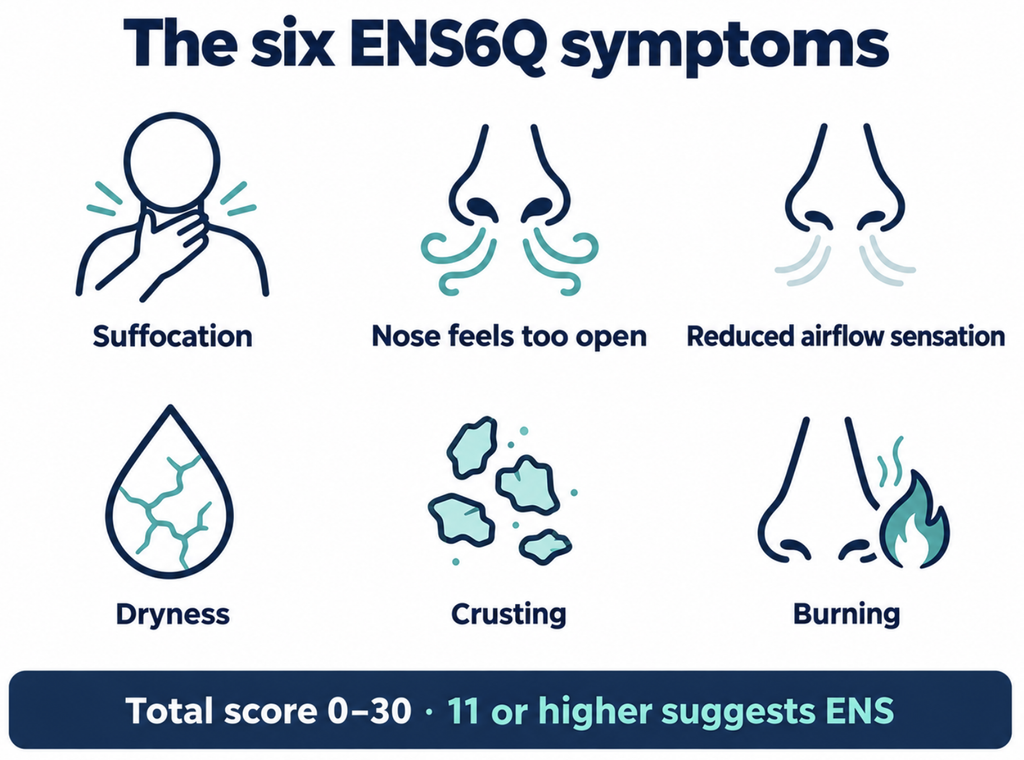
The validated Empty Nose Syndrome 6-Item Questionnaire (ENS6Q) asks about six symptoms that separate ENS from ordinary congestion [Velasquez, The Empty Nose Syndrome 6-Item Questionnaire (ENS6Q): a validated 6-item questionnaire as a diagnostic aid for empty nose syndrome patients, 2017].
| Symptom | How patients often describe it |
|---|---|
| Suffocation | Not getting enough air despite breathing |
| Nose feels too open | Air rushes through with no resistance |
| Reduced airflow sensation | Cannot feel the air passing |
| Dryness | A parched, irritated lining |
| Crusting | Hard crusts that keep coming back |
| Burning | Air that stings or hurts |
Scores run from 0 to 30 [Almansour, Medial Flap Turbinoplasty is Unlikely to Cause Empty Nose Syndrome, 2025]. For many patients the problem goes well beyond the nose: a systematic review found anxiety and depression in more than 50% of ENS patients, and the mood symptoms tracked how severe the nasal symptoms were [Kanjanawasee, Empty Nose Syndrome Pathophysiology: A Systematic Review, 2022]. If symptoms like these have ever pushed you toward thoughts of self-harm, contact a local crisis line or emergency services right away.
Why does an open nose feel blocked?
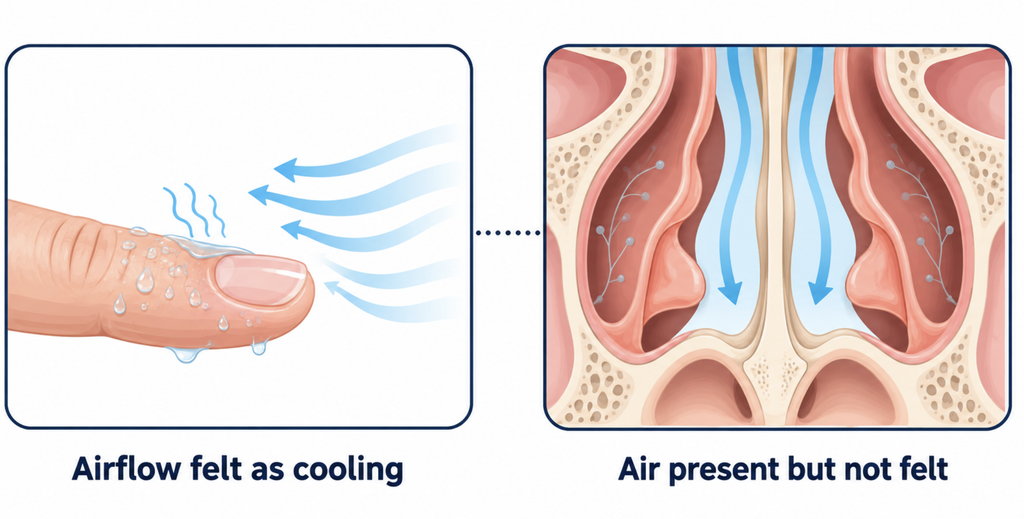
Hold a wet fingertip in a breeze and you mostly feel the wind as cooling. The nose senses airflow the same way, through cold-sensitive nerve endings in its lining. Studies suggest this system is weaker in ENS. Patients’ tissue has shown fewer TRPM8 cold receptors [Wu, Distinct Histopathology Characteristics in Empty Nose Syndrome, 2021], and patients are less able to detect menthol, which activates those receptors [Kanjanawasee, Empty Nose Syndrome Pathophysiology: A Systematic Review, 2022]. If the brain gets only a faint “cool air” signal, it may decide that little air is coming in, even when plenty is.
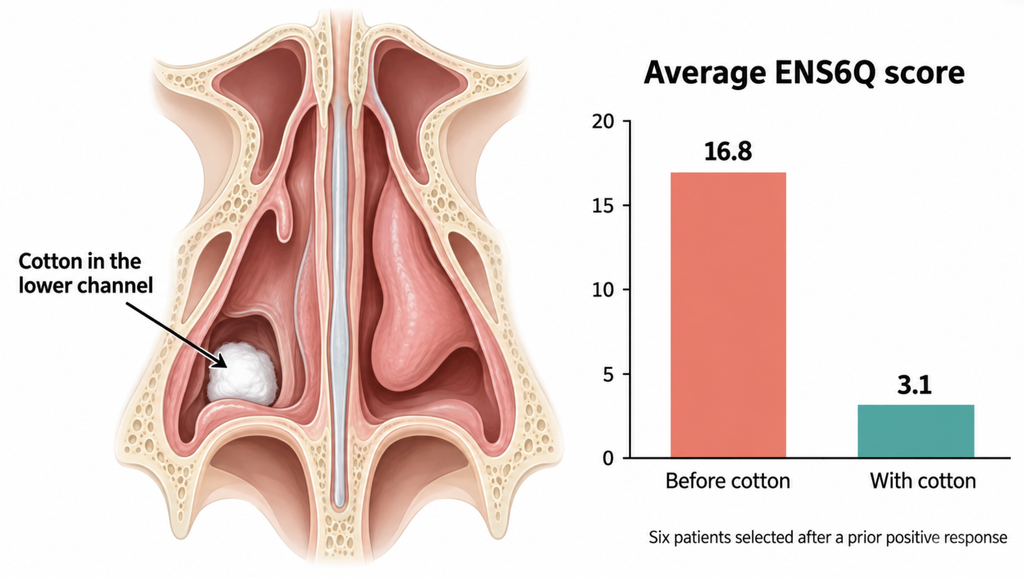
Airflow direction matters too. In a small computer-modeling study of six patients, placing cotton where tissue was missing raised nasal resistance by 21% and pushed airflow back toward its usual lower channel [Malik, The cotton test redistributes nasal airflow in patients with empty nose syndrome, 2020].
Surgery doesn’t explain everything, though. People who have similar operations don’t all develop ENS, and a Korean study found higher autonomic symptom scores in ENS patients than in controls, which suggests individual differences play a part [Ryu, Assessment of Autonomic Dysfunction in Patients With Empty Nose Syndrome Using the Composite Autonomic Symptom Scale-31, 2025]. The Kanjanawasee review cited above concluded that surgery’s causal role is still unclear.
How is empty nose syndrome diagnosed?
No single test confirms ENS. Doctors put together a history of turbinate surgery, endoscopy or CT showing lost tissue, and the ENS6Q, where a score of 11 or higher suggests the condition [Almansour, Medial Flap Turbinoplasty is Unlikely to Cause Empty Nose Syndrome, 2025]. Other causes of a dry, uncomfortable nose have to be ruled out first [Coste, Empty nose syndrome, 2012].
The cotton test works like trying on a temporary turbinate. A cotton plug moistened with saline goes where tissue is missing, and the patient fills out the ENS6Q again. A drop of 7 points counts as a meaningful change [Thamboo, Defining surgical criteria for empty nose syndrome: Validation of the office-based cotton test and clinical interpretability of the validated Empty Nose Syndrome 6-Item Questionnaire, 2017]. In the six-patient modeling study, whose patients were chosen because they had already responded, average scores fell from 16.8 to 3.1 with the cotton in place.
Because a placebo effect is possible, some centers now use a blinded, stepwise version [Gao, Empty Nose Syndrome: An Update on Pathophysiology, Diagnosis, and Treatment, 2026]. A strong response supports the diagnosis and helps identify who might benefit from volume-restoring surgery.
Can empty nose syndrome be treated?
Yes, although “treated” is a more accurate word than “cured.” Conservative care comes first: humidification, saline, moisturizing gels, patient education, and treatment of any depression or anxiety that comes with it [Gill, Update on empty nose syndrome: disease mechanisms, diagnostic tools, and treatment strategies, 2019]. The Gao review cited above also includes cognitive behavioral therapy with antidepressants as part of comprehensive care.
If symptoms persist, surgeons can rebuild lost volume by placing implants along the side wall of the nose, a procedure called inferior meatus augmentation. In one Korean series of 20 patients who received rib cartilage implants, average ENS6Q scores fell from 17.5 to 9.1 over a mean follow-up of about five years, but about a third of operated patients developed nasal obstruction after surgery [Gwak, Treatment Outcomes of the Inferior Meatus Augmentation Procedure With Autologous Costal Cartilage for Empty Nose Syndrome, 2026]. Regenerative treatments that aim to restore the mucosa itself are still early, but promising [Kim, Surgical and Regenerative Treatment Options for Empty Nose Syndrome: A Systematic Review, 2024].
The weak point in all of this is the quality of the evidence. A recent meta-analysis pooled 35 studies with 957 patients, and while every study reported improvement, none was a randomized controlled trial [Hussain, A Systematic Review and Meta-Analysis of Management Options for Empty Nose Syndrome: A Proposed Management Algorithm, 2025].
Should you worry about turbinate surgery?
How common is empty nose syndrome?
Nobody knows. Trying to chart ENS rates is like drawing a temperature graph for a city with no thermometers: no large study has measured how often ENS follows turbinate surgery overall, so there is no way to tell whether it is rising or falling [AAO-HNS, Empty Nose Syndrome, 2024]. A figure of about 20% after inferior turbinate resection gets repeated widely, but it is an expert’s estimate for aggressive tissue removal, not a rate counted in a cohort [Coste, Empty nose syndrome, 2012].
The few cohorts that do exist each looked at a single tissue-sparing technique, and their results point the other way. Of 100 patients followed for at least 12 months after medial flap turbinoplasty, none ended up with an ENS6Q score of 11 or higher [Almansour, Medial Flap Turbinoplasty is Unlikely to Cause Empty Nose Syndrome, 2025]. A multicenter study of 110 patients after partial middle turbinate removal found the same thing [Eide, Subtotal Middle Turbinate Resection in Patients with Chronic Rhinosinusitis with Nasal Polyps is Unlikely to Cause Empty Nose Syndrome: A Multi-Institutional Prospective Study, 2025]. These studies are too small to rule ENS out, but they back the long-standing advice to use the most conservative technique that works [Coste, Empty nose syndrome, 2012].
Before turbinate surgery, it’s worth asking whether medical treatment has been tried for long enough, and how much of the lining the planned technique will preserve.
Clinical Perspective. Turbinate surgery should trim the turbinate, not erase it. Keeping the lining and its contour intact preserves the nose’s built-in air conditioner along with its airflow sensors. When someone says they are suffocating through an open nose, they need a careful workup, even if the scan looks fine.
Key Takeaways
- Empty nose syndrome is a rare condition, usually after turbinate surgery, in which a wide-open nose feels blocked or suffocating.
- The problem seems to lie more in sensation than in space: the nose may lose its ability to feel cool airflow.
- Diagnosis combines surgical history, imaging, an ENS6Q score of 11 or higher, and an in-office cotton test.
- Treatments range from humidification to volume-restoring surgery, but no randomized trials exist yet.
- No reliable data exist on how often ENS occurs or whether that is changing; the widely quoted 20% is an expert estimate tied to aggressive tissue removal.
FAQ
What does empty nose syndrome feel like?
Usually like suffocating through a nose that is clearly open, often with dryness, crusting, and burning.
How is empty nose syndrome diagnosed?
There’s no single test. Doctors rely on surgical history, imaging, an ENS6Q score of 11 or higher, and improvement with the cotton test.
Can empty nose syndrome be cured?
Not reliably, but symptoms can improve with humidification, mental health support, or volume-restoring surgery.
How common is empty nose syndrome?
Unknown. The often-cited 20% figure is an expert estimate for aggressive turbinate removal, not a measured rate.
Does turbinate reduction surgery always cause empty nose syndrome?
No. In one study of a tissue-sparing technique, none of 100 patients developed ENS-range scores.
References
- Almansour YM, Alani A, Wilson CP, Eide JG, Craig JR. Medial Flap Turbinoplasty is Unlikely to Cause Empty Nose Syndrome. Laryngoscope. 2025;135(5):1622-1627.
- AAO-HNS. Empty Nose Syndrome. American Academy of Otolaryngology-Head and Neck Surgery; 2024 Dec 9.
- Coste A, Dessi P, Serrano E. Empty nose syndrome. Eur Ann Otorhinolaryngol Head Neck Dis. 2012;129(2):93-7.
- Eide JG, Kuan EC, Adappa ND, et al. Subtotal Middle Turbinate Resection in Patients with Chronic Rhinosinusitis with Nasal Polyps is Unlikely to Cause Empty Nose Syndrome: A Multi-Institutional Prospective Study. Laryngoscope. 2025;135(1):59-65.
- Gao Z, Jang YJ. Empty Nose Syndrome: An Update on Pathophysiology, Diagnosis, and Treatment. Clin Exp Otorhinolaryngol. 2026 Jun 1. Epub ahead of print.
- Gill AS, Said M, Tollefson TT, Steele TO. Update on empty nose syndrome: disease mechanisms, diagnostic tools, and treatment strategies. Curr Opin Otolaryngol Head Neck Surg. 2019;27(4):237-242.
- Gwak JW, Jang YJ. Treatment Outcomes of the Inferior Meatus Augmentation Procedure With Autologous Costal Cartilage for Empty Nose Syndrome. Clin Exp Otorhinolaryngol. 2026;19(1):79-85.
- Hussain S, Hayat J, Almhanedi H, et al. A Systematic Review and Meta-Analysis of Management Options for Empty Nose Syndrome: A Proposed Management Algorithm. Otolaryngol Head Neck Surg. 2025;172(1):1-12.
- Kanjanawasee D, Campbell RG, Rimmer J, et al. Empty Nose Syndrome Pathophysiology: A Systematic Review. Otolaryngol Head Neck Surg. 2022;167(3):434-451.
- Kim DH, Basurrah MA, Kim SW, Kim SW. Surgical and Regenerative Treatment Options for Empty Nose Syndrome: A Systematic Review. Clin Exp Otorhinolaryngol. 2024;17(3):241-252.
- Malik J, Thamboo A, Dholakia S, et al. The cotton test redistributes nasal airflow in patients with empty nose syndrome. Int Forum Allergy Rhinol. 2020;10(4):539-545.
- Park DB, Jang DW, Kim DH, Kim SW. Development of a New Swine Model Resembling Human Empty Nose Syndrome. Medicina (Kaunas). 2024;60(10):1559.
- Ryu SS, Kim DY, Jang YJ. Assessment of Autonomic Dysfunction in Patients With Empty Nose Syndrome Using the Composite Autonomic Symptom Scale-31. J Rhinol. 2025;32(3):162-168.
- Thamboo A, Velasquez N, Habib AR, Zarabanda D, Paknezhad H, Nayak JV. Defining surgical criteria for empty nose syndrome: Validation of the office-based cotton test and clinical interpretability of the validated Empty Nose Syndrome 6-Item Questionnaire. Laryngoscope. 2017;127(8):1746-1752.
- Velasquez N, Thamboo A, Habib AR, Huang Z, Nayak JV. The Empty Nose Syndrome 6-Item Questionnaire (ENS6Q): a validated 6-item questionnaire as a diagnostic aid for empty nose syndrome patients. Int Forum Allergy Rhinol. 2017;7(1):64-71.
- Wu CL, Fu CH, Lee TJ. Distinct Histopathology Characteristics in Empty Nose Syndrome. Laryngoscope. 2021;131(1):E14-E18.
Joonpyo Hong, MD is a board-certified otolaryngologist practicing in Korea. This article reflects his clinical interpretation of published research and does not constitute individual medical advice.
For more articles:
https://curiousmd.com/nose-to-brain-drug-delivery/
https://curiousmd.com/deviated-septum-diagnosis-ai/
https://curiousmd.com/when-to-fix-a-broken-nose/
Link out to:
https://www.entnet.org/resource/empty-nose-syndrome/ — The American Academy of Otolaryngology–Head and Neck Surgery’s summary of ENS, its diagnosis, and the limits of current evidence.
https://rarediseases.org/rare-diseases/empty-nose-syndrome/ — NORD’s patient-facing rare disease report on ENS symptoms, diagnosis, and treatment options.
https://www.enttoday.org/article/empty-nose-syndrome-physiological-psychological-or-perhaps-a-little-of-both/ — Leading rhinologists discuss the physical and psychological sides of ENS and how to prevent it.
https://my.clevelandclinic.org/health/treatments/22805-turbinate-reduction — A plain-language guide to turbinate reduction techniques, recovery, and risks, including ENS.