
Tactile feedback in robotic surgery can look like a solved problem now that the newest robots let surgeons feel resistance. But resistance is only part of what surgeons mean when they talk about touch. In the neck, touch works alongside sight to tell two vessels apart: one pushes back firm and springy, the other flattens under light pressure.
Dexterity, Force, and Touch: Three Things Surgeons Mean by “Feel”
Engineers break touch into layers, and most commercial systems deliver only one of them [Okamura, Haptic feedback in robot-assisted surgery, 2009]. Everyday comparisons make the layers easier to picture.
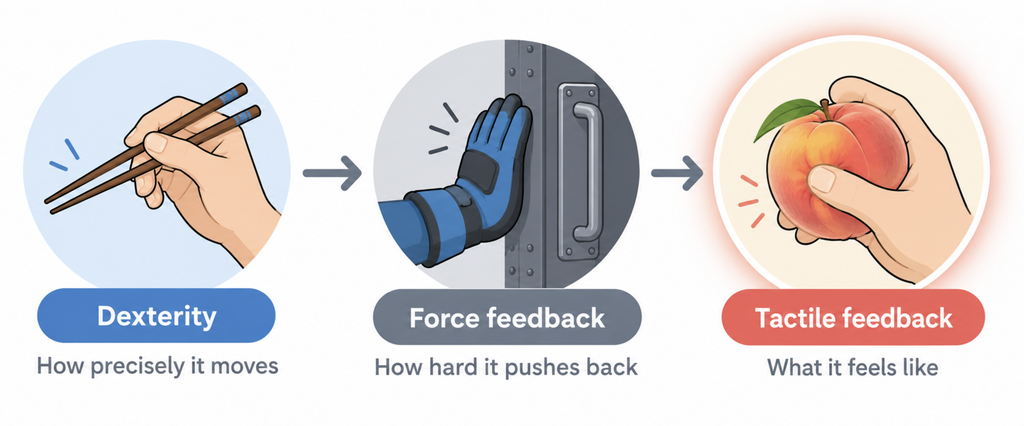
- Dexterity is how freely and precisely an instrument moves, the way a practiced hand handles chopsticks.
- Force (kinesthetic) feedback is the push-back you feel when an instrument meets resistance. Push a heavy door while wearing thick gloves and you know it is heavy, but not what it is made of.
- Tactile (cutaneous) feedback is the pattern of pressure across the skin of a fingertip. It is how a bare hand tells a ripe peach from an unripe one.
Robots already do the first well; the da Vinci 5 is designed to filter tremor and vibration [Hammerand, Da Vinci 5 design changes, 2024]. The gap is in the other two, mostly the third. Sensing and displaying pressure spread across a surface has long been called the hardest part [Okamura, Haptic feedback in robot-assisted surgery, 2009].
What Artery, Vein, Tumor, and Necrosis Feel Like in a Machine’s Language
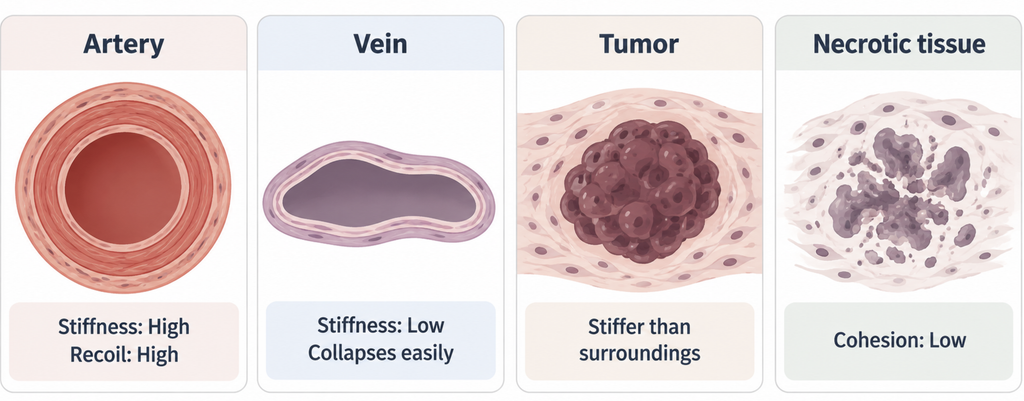
A machine reads tissue as something between springs and clay. It tracks how far the tissue gives (stiffness), how quickly it springs back (recoil), and how well it holds together before tearing (cohesion). Each texture a surgeon describes is a different mix of these.
| Tissue | What surgeons describe | What a sensor would need to measure | Hard part |
|---|---|---|---|
| Artery | Firm, springy, pulsing | High stiffness, fast recoil, rhythmic motion | Separating the pulse from probe pressure |
| Vein | Soft, thin, collapses easily | Low stiffness, easy collapse | Very small forces |
| Tumor | Hard, distinct from surroundings | Stiffness higher than neighboring tissue | Finding depth, not just presence |
| Necrotic tissue | Mushy, falls apart | Low cohesion, friability | No single stiffness value captures it |
Tumor firmness has the best numbers behind it. In 169 fresh breast tissue samples, malignant tumors were 3 to 6 times stiffer than normal fibroglandular tissue, and high-grade invasive ductal carcinoma was up to 13 times stiffer [Samani, Elastic moduli of breast tissues, 2007]. Those were ex vivo breast measurements, so other organs may not follow the same pattern.
Necrotic tissue is harder to put a number on. Clinicians recognize it less by stiffness than by how loosely it holds together, and no single sensor reading captures that yet.
Can Surgeons See What They Can’t Feel?
A meta-analysis of 56 studies compared robotic systems with and without haptic feedback. With feedback, surgeons applied less force, finished tasks faster, and were more accurate, though the benefit tended to be smaller in more experienced surgeons [Bergholz, Benefits of haptic feedback, 2023]. One possibility is that experts learn to read tissue deformation on the screen. Intuitive’s then-chief executive expected veterans to say, “I can see forces, I can use visual haptics” [Hammerand, Da Vinci 5 design changes, 2024].
Clinical Perspective. In neck dissection, the carotid artery and internal jugular vein are identified by sight, and touch adds a second check: one rebounds, the other flattens. Transoral robotic surgery is different. In open surgery a finger would trace the edge of a base-of-tongue tumor; through the robot, that edge has to be inferred from the screen and preoperative imaging. That is where tactile sensing would matter most.
Who Is Building Tactile Feedback in Robotic Surgery?
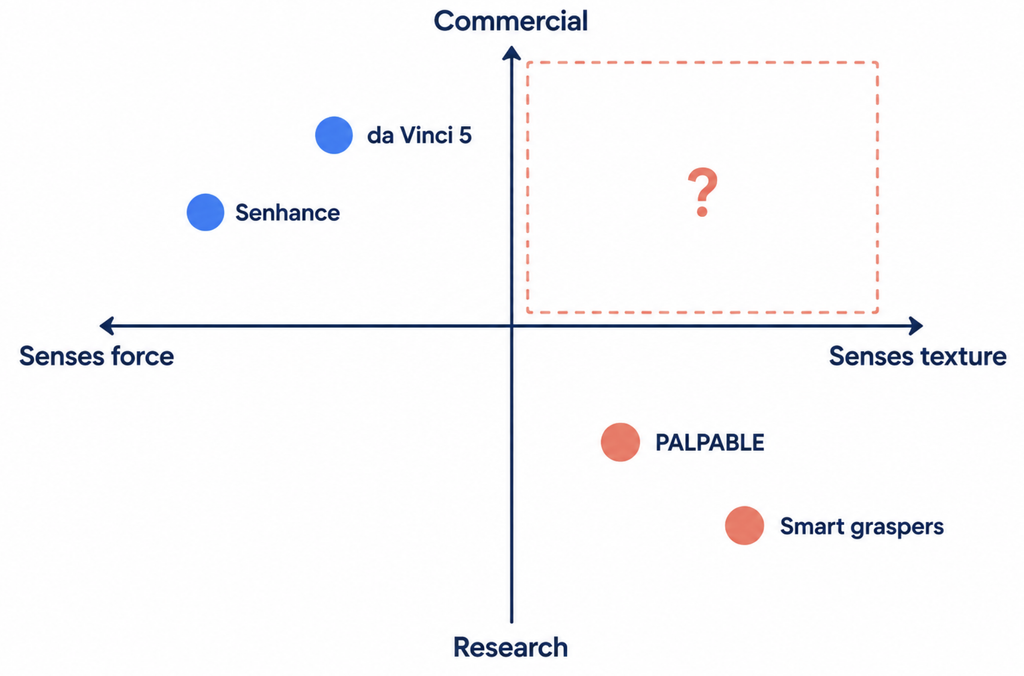
Several groups are working on it, but what has reached operating rooms senses force, not texture.
| System | What it senses | Stage |
|---|---|---|
| Senhance (TransEnterix, now Asensus Surgical) | Force at the instruments, fed back to the handles | FDA-cleared in 2017 |
| da Vinci 5 (Intuitive) | Push-pull force at instrument tips | Commercial, launched in 2024 |
| PALPABLE (EU consortium) | Stiffness map from a soft optical fingertip | Prototype; research runs through 2026 |
| Academic smart graspers | Stiffness and hidden lumps | Bench testing |
Senhance was marketed as the first robotic platform with haptic feedback [TransEnterix, Senhance FDA clearance, 2017], which its maker describes as real-time force feedback [Asensus, Senhance program announcement, 2021]. The da Vinci 5 measures push and pull at the instrument tips and relays it to the hand controllers [Kneuertz, Force in robotic thoracic surgery, 2025].
Across 444 thoracic procedures by 73 surgeons, median force fell from 1.79 N with feedback off to 1.32 N at the highest setting, about a quarter less. Several authors work for the manufacturer, and the study did not assess clinical outcomes [Kneuertz, Force in robotic thoracic surgery, 2025]. In a simulated transoral tumor resection, 15 head and neck surgeons applied a mean contact force of 1.59 N with feedback on and 2.11 N with it off, and they made smaller margin errors and caused less charring [Mukaigawa, Force feedback in transoral robotic surgery, 2026]. A small pilot, though, found no significant difference in overall trainee scores [Emerson, Force feedback and trainee performance, 2026].
True tactile sensing is still at the prototype stage. The EU-funded PALPABLE project is building a soft fingertip with hair-thin optical fibers that turns pressure into an on-screen stiffness map [King, Robotic fingertips, 2026]. In bench tests, a laparoscopic grasper fitted with sensors estimated stiffness, flagged hidden lumps, and helped surgeons sort samples more accurately [Othman, Smart laparoscopic forceps, 2022].
Why Machines Still Can’t Feel What Hands Know
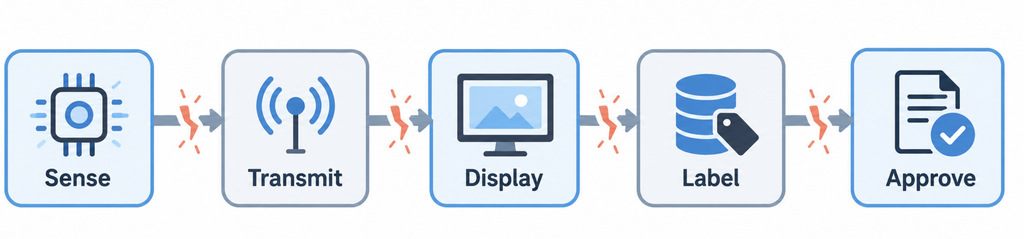
The first obstacle is sensing at the tip. Force sensing was long the major hurdle [Okamura, Haptic feedback in robot-assisted surgery, 2009] and reached commercial instruments only recently. Sensing distributed pressure at a slender tip is harder still.
The second is showing it. A hand controller can push back, but it cannot easily recreate pressure across a fingertip, which is why PALPABLE displays stiffness visually [King, Robotic fingertips, 2026].
Then the benefit has to be proven. The cost-benefit of haptics has not been established [Okamura, Haptic feedback in robot-assisted surgery, 2009], and recent force studies still call for outcome research [Kneuertz, Force in robotic thoracic surgery, 2025]. U.S. labeling still contraindicates the da Vinci 5 Force Feedback needle driver in hysterectomy and myomectomy [Jeong, Force feedback in hysterectomy, 2026].
Finally, someone has to label the data. AI learns from examples with the answers attached. Turning “mushy” or “springy” into numbers, and matching them to what the tissue turned out to be, takes datasets that barely exist yet.
Think of building a mechanical sommelier: an electronic tongue covers half the job, and someone still has to record which taste goes with which wine. Early work suggests this is feasible. One lab system estimated elasticity without a force sensor and statistically separated lab samples with similar mechanics [Gutierrez-Giles, Sensorless tissue classification, 2022].
The Surgeon’s Hands as Tacit Knowledge
What we call a surgeon’s experience includes a skill nobody fully writes down: knowing by touch when tissue is right. Japanese surgeons reporting their first da Vinci 5 case argued that force readings synced with video may turn this tacit skill into numbers that can be taught [Iwami, First Japanese da Vinci 5 resection, 2026]. The system records interaction forces during each case [Hammerand, Da Vinci 5 design changes, 2024], so every operation now leaves a record of how hard the surgeon pressed.
Getting the rest of the way will take sensors that measure texture, displays that can show it, and AI trained on expert data. Force has made it into the machine. The texture that tells artery from vein, and tumor from healthy tissue, is still something only a surgeon’s hands can read.
Key Takeaways
- Most surgical robots described as “haptic” relay force. They do not relay the texture that distinguishes one tissue from another.
- The da Vinci 5, launched in 2024, measures push-pull force at the instrument tips. True tactile sensing is still in prototypes.
- Artery, vein, tumor, and necrotic tissue differ in stiffness, recoil, and cohesion, and a machine has to measure each one separately.
- Haptic feedback tends to help less experienced surgeons more, which suggests experts already read force visually.
- For AI, sensors are only part of the bottleneck. The other part is labeled data linking touch to tissue.
FAQ
Can surgical robots feel tissue?
Only partly. Systems such as the da Vinci 5 sense instrument force [Kneuertz, Force in robotic thoracic surgery, 2025], while probes that map texture and stiffness are still prototypes [King, Robotic fingertips, 2026].
What is the difference between haptic and tactile feedback?
Haptic is the broader term. It covers force feedback, the push-back felt through the hand, and tactile feedback, the pressure pattern on the skin that conveys texture and firmness [Okamura, Haptic feedback in robot-assisted surgery, 2009].
Does the da Vinci 5 have haptic feedback?
Yes, in the form of force feedback. Sensors at the instrument tips measure push and pull and relay it to the hand controllers [Kneuertz, Force in robotic thoracic surgery, 2025]. It does not convey surface texture.
Can AI learn a surgeon’s sense of touch?
Not yet. Lab systems can classify tissue samples by their mechanics [Gutierrez-Giles, Sensorless tissue classification, 2022], and force data recorded during surgery may make tacit skill measurable [Iwami, First Japanese da Vinci 5 resection, 2026].
References
- Okamura AM. Haptic feedback in robot-assisted minimally invasive surgery. Curr Opin Urol. 2009;19(1):102-7.
- Hammerand J. The Intuitive da Vinci 5’s top design changes: ‘This is groundbreaking for robotic surgery’. Medical Design & Outsourcing [Internet]. 2024 Mar 18 [cited 2026 Oct 2]. Available from: https://www.medicaldesignandoutsourcing.com/intuitive-da-vinci-5-design-changes-force-feedback-haptic/
- Samani A, Zubovits J, Plewes D. Elastic moduli of normal and pathological human breast tissues: an inversion-technique-based investigation of 169 samples. Phys Med Biol. 2007;52(6):1565-76.
- Bergholz M, Ferle M, Weber BM. The benefits of haptic feedback in robot assisted surgery and their moderators: a meta-analysis. Sci Rep. 2023;13(1):19215.
- TransEnterix, Inc. TransEnterix announces US 510(k) FDA clearance for Senhance Surgical Robotic System [Internet]. 2017 Oct 13 [cited 2026 Oct 2]. Available from: https://www.sec.gov/Archives/edgar/data/876378/000129993317001044/exhibit2.htm
- Asensus Surgical, Inc. Asensus Surgical announces St. Bernhard Hospital in Germany to initiate Senhance surgery program [Internet]. 2021 [cited 2026 Oct 2]. Available from: https://ir.asensus.com/node/14296
- Kneuertz PJ, Mostellar R, Merritt RE, Servais EL, Mitzman B, Villamizar NR, et al. Force in robotic thoracic surgery – a one year analysis of DaVinci 5 force feedback. J Robot Surg. 2025;19(1):632.
- Mukaigawa T, Goto S, Sakamoto K, Sakuma N, Kitani T, Mitani S. Impact of the force feedback feature on transoral robotic surgery. J Robot Surg. 2026;20(1).
- Emerson AE, Gleason LT, Gleason F, Stahl RD, Rose JB, Baker S, et al. Effects of force feedback on trainee performance: a pilot study of the dV5 surgical robot. J Surg Educ. 2026;83(9):104038.
- King A. Restoring surgeons’ sense of touch with robotic fingertips. Horizon Magazine [Internet]. 2026 Jan 20 [cited 2026 Oct 2]. Available from: https://projects.research-and-innovation.ec.europa.eu/en/horizon-magazine/restoring-surgeons-sense-touch-robotic-fingertips
- Othman W, Vandyck KE, Abril C, Barajas-Gamboa JS, Pantoja JP, Kroh M, et al. Stiffness assessment and lump detection in minimally invasive surgery using in-house developed smart laparoscopic forceps. IEEE J Transl Eng Health Med. 2022;10:2500410.
- Jeong IY, Lee S, Park H, Song JY, Kim S. Safety of continuous force feedback in robotic hysterectomy and myomectomy. JSLS. 2026;30(3).
- Gutierrez-Giles A, Padilla-Castañeda MA, Alvarez-Icaza L, Gutierrez-Herrera E. Force-sensorless identification and classification of tissue biomechanical parameters for robot-assisted palpation. Sensors (Basel). 2022;22(22):8670.
- Iwami Y, Takahashi H, Kobayashi K, Paku M, Ishikawa S, Iwamoto K, et al. First Japanese experience of robotic-assisted low anterior resection using the da Vinci 5: incorporating force feedback and case insights in rectal cancer surgery. Surg Case Rep. 2026;12(1).
Joonpyo Hong, MD is a board-certified otolaryngologist practicing in Korea. This article reflects his clinical interpretation of published research and does not constitute individual medical advice.
For more articles:
https://curiousmd.com/medical-device-cyberattack-patient-safety/
https://curiousmd.com/brain-controlled-hearing-aid-2026/
https://curiousmd.com/nasopharyngeal-carcinoma-ai-detection/
Link out to:
https://projects.research-and-innovation.ec.europa.eu/en/horizon-magazine/restoring-surgeons-sense-touch-robotic-fingertips — European Commission’s Horizon Magazine on the PALPABLE project, which is building a soft optical fingertip that maps tissue stiffness.
https://www.medicaldesignandoutsourcing.com/intuitive-da-vinci-5-design-changes-force-feedback-haptic/ — Medical Design & Outsourcing interview with Intuitive leaders on da Vinci 5 Force Feedback and its labeling limits.
https://www.sec.gov/Archives/edgar/data/876378/000129993317001044/exhibit2.htm — The 2017 SEC-filed announcement of Senhance’s FDA clearance, an early commercial robot with haptic feedback.
https://ir.asensus.com/node/14296 — Asensus Surgical describes Senhance’s haptic feedback as real-time force feedback.