
LLM clinical recommendations have now been graded against Choosing Wisely, and one type of scenario stood out. Six commercial models were asked whether an incidental subcentimeter thyroid nodule needs its own ultrasound. They recommended the unnecessary scan in 42.8% of responses for that recommendation [Ariel, Overuse and False Restraint, 2026]. The benchmark scored not ordering the scan as the correct response.
Across all 15 Choosing Wisely recommendations, however, the overall overuse rate was 5.4%. The false restraint rate, meaning an indicated test or treatment was withheld, was 0.6%. Earlier the same year, a stress test of a consumer health chatbot found the opposite error. In 51.6% of responses to clear-cut emergencies, the chatbot downgraded its advice to evaluation within a day or two [Ramaswamy, ChatGPT Health Triage, 2026].
The two results do not conflict, because the studies asked different kinds of questions. The Choosing Wisely benchmark used questions that a guideline has already settled. The errors in other studies appear where the answer is disputed, depends on how the patient’s condition changes over time, or changes with how the question is asked. In those settings, current models fail less often through overuse than through instability. Their answers change with the model, the run, and the wording, and the models give these answers with confidence and without a warning.
What the Choosing Wisely Benchmark Measured and What It Could Not
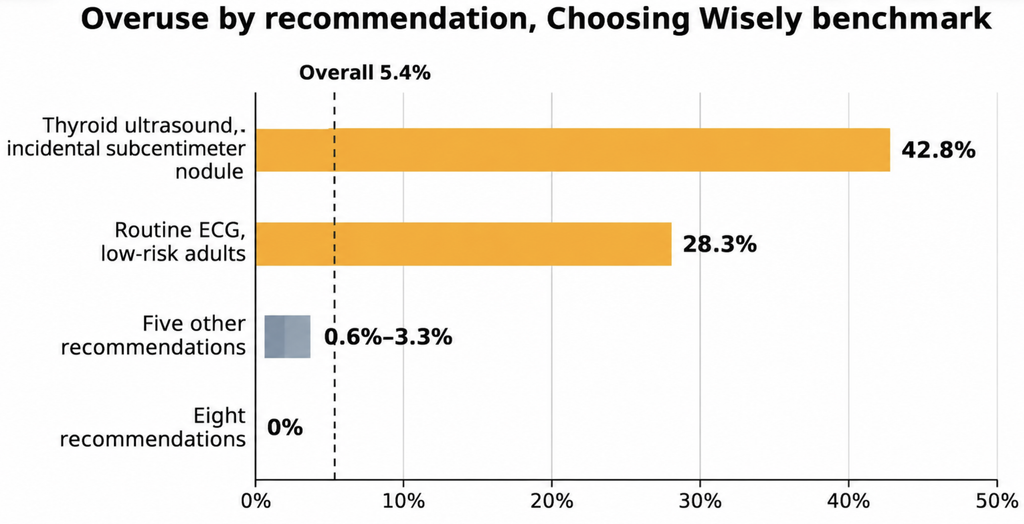
Ariel and colleagues built 225 scenarios from 15 Choosing Wisely recommendations. Each recommendation had 10 scenarios where the right answer was to hold back and 5 where the right answer was to act. The team ran each scenario through six commercial models three times between February and March 2026, for 4,050 responses [Ariel, Overuse and False Restraint, 2026]. Each prompt was a single question from a clinician, with no follow-up. The overuse rate was 5.4% (95% CI, 0.6% to 12.2%), and 8 of 15 recommendations had no overuse. The false restraint rate was 0.6% (CI, 0.1% to 1.2%). No false restraint occurred in 11 of 15 recommendations, and PSA screening had the highest rate, at 3.3%.
When settled questions were asked this way, the models mostly held back. They also almost never withheld indicated care, a finding as important as the low overuse rate. Two recommendations accounted for most of the overuse: ultrasound for an incidental subcentimeter thyroid nodule (42.8%) and routine ECG in low-risk adults (28.3%). In the other five recommendations with any overuse, rates ranged from 0.6% to 3.3%.
In both outliers, the answer the benchmark scored as correct was open to dispute. The authors noted that ECG overuse was concentrated in vignettes that mentioned palpitations, where an ECG may be reasonable.
They also noted that the thyroid results reflect an open disagreement between specialty societies [Jerusalem Post, Study Author Interviews, 2026]. Recommendation 6 of the 2015 American Thyroid Association guideline calls for neck ultrasound for any suspected nodule. It is a strong recommendation with the guideline’s highest evidence rating. The guideline’s commentary applies it to nodules found incidentally on CT or MRI as well [Haugen, 2015 ATA Guidelines, 2016].
The ACR white paper takes a narrower view. Without suspicious imaging features, it advises ultrasound for incidental nodules only at 1 cm or larger under age 35 and 1.5 cm or larger at 35 or older [Hoang, Managing Incidental Thyroid Nodules, 2015]. The benchmark scored the ACR position as correct, while the models’ choices matched the ATA position.
Clinical practice is similarly unsettled. In Ontario, 21.5% of 3,629,859 low-risk adults had an ECG within 30 days of an annual checkup. Those who had one were more likely to go on to further cardiac testing or consultation (odds ratio, 5.14; 95% CI, 5.07 to 5.21) [Bhatia, Electrocardiograms in Low-Risk Patients, 2017].
Whether a thyroid nodule is worked up depends heavily on how it is reported. At one academic center, nodules mentioned in the report’s impression were 14 times more likely to be worked up [Tanpitukpongse, Incidental Thyroid Nodules on CT or MRI, 2015]. Applied after the fact, ACR criteria would have avoided ultrasound in 49.2% of 307 patients who had one [Ní Mhuircheartaigh, Incidental Thyroid Nodules and Subsequent Ultrasound, 2016]. The lead author suggested that the models may have picked up clinicians’ looser habits from the medical literature. This explanation is plausible, but the study did not test it [Jerusalem Post, Study Author Interviews, 2026].
The design choices that keep the benchmark clean also limit what it can show. Each scenario was a single question, and the vignette stated the indication. An LLM judge classified the responses, with physician adjudication. With only five action scenarios per recommendation, the false restraint estimate rests on a small denominator. The authors state that the findings may not apply to consumer use. The benchmark therefore shows that current models can apply a settled rule. It does not test how they behave on questions the rule leaves open, and its own two outliers were questions of that kind.
Outside the Guideline, Errors Change Direction

When studies use real clinical notes and consumer prompts instead of guideline vignettes, the direction of error varies. On 10,000 emergency department visits, earlier GPT models leaned toward doing more. They recommended admission, imaging, or antibiotics for most patients who needed them, but also for many who did not. Their accuracy was on average 8% (GPT-4-turbo) and 24% (GPT-3.5-turbo) lower than a resident physician’s [Williams, LLM Clinical Recommendations in the ED, 2024].
A study of 422 emergency department patients with low back pain at one academic center found a different pattern. GPT-4 gave imaging recommendations that matched ACR criteria in 72.0% of cases and would have used fewer resources than actual practice [Prasad, LLMs as Cost-Conscious Decision Aids, 2025].
A third study built a simulation from 2,400 real patient cases with four abdominal conditions. Open-weight models had to request their own information, and they performed worse than physicians and did not follow guidelines [Hager, Limitations of LLMs in Clinical Decision-Making, 2024].
ChatGPT Health made both errors in a single study. The study used 60 vignettes under 16 conditions, for 960 responses. In clear nonurgent cases, 64.8% (83/128) of responses were overtriaged. In clear emergencies, 51.6% (33/64) of responses were undertriaged [Ramaswamy, ChatGPT Health Triage, 2026]. The emergency figure rests on a small number of cases. The emergency vignettes came from only two scenarios, asthma exacerbation and diabetic ketoacidosis. Of the undertriaged emergency responses, 84.8% came from the asthma scenario.
Textbook emergencies such as stroke and anaphylaxis had 0% undertriage across 128 responses. Adding objective findings raised overall accuracy from 54.6% to 77.9%. The test forced one choice at one point in time, so these rates show a pattern of failure more than how often it happens in real use.
A national registry study added outcome data. In 13,614 Korean patients with hepatocellular carcinoma, model recommendations matched the actual treatment in 26.8% to 32.7% of cases, even when the prompts referred to guidelines [Yang, LLMs for HCC Treatment Recommendations, 2026]. A match with the model’s recommendation was associated with better survival in BCLC-A disease (hazard ratio, 0.743; 95% CI, 0.665 to 0.831). It was associated with worse survival in BCLC-C disease (hazard ratios, 1.483 to 1.650). Physicians gave more weight to liver function, while the models gave more weight to tumor features.
These are associations. In advanced disease with preserved liver function, physicians often chose locoregional therapy over the systemic therapy the guideline recommends. In that setting, actual practice did not follow the guideline.
| Study | Setting | Asker | Reference standard | Dominant error | Key figure |
|---|---|---|---|---|---|
| [Ariel, Overuse and False Restraint, 2026] | 225 Choosing Wisely vignettes | Clinician, single turn | Guideline-settled answer | Overuse on two arguable items | Overuse 5.4%, false restraint 0.6% |
| [Williams, LLM Clinical Recommendations in the ED, 2024] | 10,000 ED visits | Clinical notes | Physician decisions | Overintervention | Accuracy 8% and 24% below a resident |
| [Prasad, LLMs as Cost-Conscious Decision Aids, 2025] | 422 ED back pain patients | Triage notes | ACR criteria | Less imaging than practice | 72.0% ACR-concordant |
| [Ramaswamy, ChatGPT Health Triage, 2026] | 960 consumer triage responses | Patient voice | Physician consensus | Overtriage low acuity, undertriage evolving emergencies | 64.8% overtriaged, 51.6% undertriaged |
| [Hager, Limitations of LLMs in Clinical Decision-Making, 2024] | 2,400 abdominal admissions | Simulated workup | Diagnosis, guidelines | Underperformance | — |
| [Yang, LLMs for HCC Treatment Recommendations, 2026] | 13,614 HCC patients | Registry data | Treatment and survival | Varies by stage | Concordance 26.8% to 32.7% |
Across these studies, the direction of error depends more on the type of task and how clear the warning signs are than on any fixed habit of the models. Models tend to act when danger is visible at a single point in time. They can miss urgency that only becomes clear as the illness evolves. The studies differ in model generation, in who asked the question, and in reference standard. The abdominal-pain simulation also used open-weight models that are older than current frontier systems. The table therefore maps patterns of failure and does not rank models.
Inside the Gray Zone: Confident Inconsistency

The most direct test of gray-zone behavior gave six widely used models four inpatient vignettes that have no single correct answer. Each model answered each vignette five times, for 120 interactions [Landon, Variation in LLM Recommendations, 2025]. The decisions were transfusion at a borderline hemoglobin, restarting anticoagulation after gastrointestinal bleeding, discharge despite a modest creatinine rise, and periprocedural bridging on apixaban.
The models disagreed on every decision, with splits of 67% vs 33%, 50% vs 50%, 50% vs 50%, and 17% vs 83%. Several models gave different answers to the same vignette on repeated runs, with internal consistency as low as 0.60. OpenEvidence was the most consistent of the six. The study is small, but its vignettes were chosen because they have no single correct answer.
Models rarely warn about this instability. In 300 vignettes that each contained one fabricated detail, six models expanded on the fabricated detail in 50% to 82% of outputs.
A prompt designed to reduce this lowered the rate from 66% to 44% [Omar, Adversarial Hallucination Attacks, 2025]. In the MetaMedQA benchmark, 12 models answered confidently even when none of the options was correct [Griot, LLMs Lack Metacognition, 2025]. A preprint tested 17 models on questions where the correct answer had been removed, so “none of the above” was the right choice. The models picked a wrong option 52% to 71% of the time and chose to admit uncertainty only 5% to 9% of the time [Guo, CLEAR, 2026]. Newer models appear somewhat better calibrated.
When the answer is uncertain, models tend to write longer and vaguer text instead of giving the clinician a calibrated estimate. Four commercial models each received 800 prompts and declined to give a numeric estimate in 30.9% to 93.5% of responses. They were more likely to decline when the wording was anxious (odds ratio, 4.63) or the condition was severe (odds ratio, 3.25). Anxious wording also made responses 69% longer [Jackson, LLMs and Communication of Medical Probabilities, 2025]. When the models did give numbers, they put “common” at 16.5% to 65.5%. European regulatory guidance sets the upper limit for “common” at 10%.
The ChatGPT Health study also included edge cases, where two neighboring triage levels were both clinically reasonable. In these cases the instability was harder to see. Of these responses, 96.0% fell within the acceptable range, but 60.8% chose the less urgent option. When urgent and emergency care were both acceptable, 72.7% chose urgent care [Ramaswamy, ChatGPT Health Triage, 2026]. The model stayed within acceptable limits but leaned toward less care. This is the same direction as its undertriage of clear-cut emergencies.
One plausible mechanism lies in how these systems are trained and scored. Preference-based training rewards answers that people rate highly, and people often prefer answers that agree with them [Sharma, Towards Understanding Sycophancy, 2024]. Researchers at OpenAI have argued that most benchmarks grade answers only as right or wrong. Under that scoring, a model that guesses scores higher than one that declines to answer [Kalai, Why Language Models Hallucinate, 2025]. Neither paper tested clinical gray zones, so the link to the behavior above is mechanistically plausible but clinically unproven.
How the Question Shapes LLM Clinical Recommendations

When a gray-zone answer is unstable, the wording of the question can change it. In the ChatGPT Health edge cases, some prompts included a remark from family or friends, either false reassurance or a false alarm. With such a remark, the triage level shifted in 13.3% of responses, compared with 3.3% without one (odds ratio, 11.7; 95% CI, 3.7 to 36.6). Of these shifts, 52.5% were toward less urgent care [Ramaswamy, ChatGPT Health Triage, 2026]. The effect appeared only in edge cases, and most shifted responses stayed within acceptable limits.
In a separate experiment, prompts were changed with typos, extra spaces, an uncertain or colorful tone, or different gender markers. On average, these changes produced a shift toward self-management of about 7% and wrongly reduced care of about 4% [Gourabathina, The Medium is the Message, 2025].
Labels with no clinical meaning also shift recommendations. One study produced 1.7 million outputs from nine models, using 1,000 cases in 32 variations. Sociodemographic labels alone changed the recommendations. Some LGBTQIA+ subgroups were recommended mental health assessment six to seven times more often than clinically indicated, and high-income labels led to more CT and MRI [Omar, Sociodemographic Biases in LLM Decisions, 2025]. ChatGPT Health showed no significant effect of race or sex, although its confidence intervals were wide [Ramaswamy, ChatGPT Health Triage, 2026].
The asker’s own view also shifts the answer. Five frontier models went along with illogical drug-safety requests up to 100% of the time, even though they could tell that the brand and generic drugs were the same [Chen, When Helpfulness Backfires, 2025]. A preprint tested 21 reasoning variants across 8 models. When expert clinician reasoning was added, the correct diagnosis appeared in the models’ lists more often in all 21 variants, by 20.4 points on average. Part of this gain came from the models copying the clinician’s list. Misleading reasoning lowered accuracy in 14 of 21 variants [Lopez, Clinician Input Steers Frontier AI Models, 2026].
One of the benchmark’s authors put the practical problem in clinical terms. A physician must hold a position in front of an anxious patient, while a model tends to go along with whoever is asking [Jerusalem Post, Study Author Interviews, 2026].
For a clinician, the model’s answer therefore partly reflects how the question was asked. A worried prompt, a confident hunch, or a reassuring relative can shift the response. In the triage study, this shift appeared only in edge cases where two triage levels were acceptable. The same sensitivity to input helps when the input is expert and correct. Benefit and risk therefore differ across users, although this has so far been shown only in vignette studies and preprints.
What Role the Evidence Supports for LLMs in Gray Zones

Taken together, the evidence supports treating an LLM answer in a clinical gray zone as one of many possible answers. Which answer appears depends on the model, the run, and the wording of the question. Three positions follow.
Gray-zone decisions should stay with the clinician. The model is more useful for laying out the options and the strongest case against what the clinician is inclined to do. In a randomized trial, 92 physicians worked through simulated management cases designed to have no single right answer. Access to GPT-4 raised their rubric scores by 6.5% (95% CI, 2.7 to 10.2). Physicians using the LLM scored no differently from the LLM alone (−0.9%) [Goh, GPT-4 Assistance for Patient Care Tasks, 2025].
In a diagnostic reasoning trial of 50 physicians, access to GPT-4 did not improve scores (76% vs 74%). The adjusted difference was 2 percentage points (95% CI, −4 to 8). In an exploratory comparison, the LLM alone scored 16 percentage points higher than physicians using conventional resources (95% CI, 2 to 30) [Goh, LLM Influence on Diagnostic Reasoning, 2024]. Both trials measured performance on vignettes, not patient outcomes. Read alongside the run-to-run variation in the inpatient study [Landon, Variation in LLM Recommendations, 2025], they indicate that the gain depends on how the tool is used. No single answer should stand in for the decision.
Restraint on guideline-settled questions should be built into the ordering system through defaults and hard stops, not left to a chatbot’s judgment. Advisory prompts alone have not reliably changed ordering. Models mostly know the settled rule, and the two items where they erred had arguable answers.
For the incidental thyroid nodule, where societies disagree, an institution can settle the question by choosing a position and building it into the system. A meta-analysis pooled 23 studies, most of them nonrandomized and 3 of them randomized trials. Decision support in the electronic health record moderately improved the appropriateness of imaging (effect size, −0.49; 95% CI, −0.71 to −0.26). Hard stops appeared more effective [Goldzweig, EHR-Based Interventions for Appropriate Imaging, 2015]. A cluster randomized trial covered 65,764 imaging requests in 26 departments at 3 German university hospitals. An advisory system did not reduce inappropriate requests (difference-in-differences, 1.3 percentage points; 99% CI, −2.0 to 1.8) [Dijk, CDSS for Imaging Requests, 2025].
Clinical LLMs should also be judged on whether they show disagreement and uncertainty, in addition to whether their answers match a reference. Current models rarely decline to answer when they should [Griot, LLMs Lack Metacognition, 2025]. Right-or-wrong benchmarks reward guessing [Kalai, Why Language Models Hallucinate, 2025]. The inpatient study’s authors called for designs that make model uncertainty visible [Landon, Variation in LLM Recommendations, 2025].
In an NEJM Perspective, Sikora, Celi, and Abdulnour argued that clinical AI needs epistemic humility and that its handling of uncertainty should be tested before it is put into use [Sikora, Can AI Say “I Don’t Know”?, 2026]. Applied to the Choosing Wisely design, this standard would add a third outcome: how often a model flags vignettes in which the guideline itself is disputed.
In practice, a clinician can ask a gray-zone question again with the opposite framing, ask the model for the case against its first answer, or compare several runs. In one preprint, taking the majority answer across repeated runs reduced how often models repeated harmful steps suggested by the clinician. The relative reduction was 57.9% to 83.5%. For GPT-4o, after misleading input, telling the model that the clinician was unsure raised the rate of including the correct diagnosis from 26.8% to 42.1% [Lopez, Clinician Input Steers Frontier AI Models, 2026].
Re-asking with the opposite framing has no direct trial evidence and remains a practical suggestion. Health systems can build settled restraint into ordering defaults, including a stated position on incidental thyroid nodules below the ACR size thresholds. For those evaluating these tools, the most useful next measure is how often a model recognizes a disputed clinical question as disputed.
Key Takeaways
- On Choosing Wisely scenarios with a settled guideline answer, commercial models had an overuse rate of 5.4% and a false restraint rate of 0.6%.
- Most overuse involved incidental thyroid nodules and ECGs in low-risk adults, where society guidance or vignette details leave the answer open to debate.
- Outside settled questions, the direction of model error changes with the task, from doing too much to undertriaging emergencies that develop over time.
- On inpatient decisions that depend on judgment, widely used models disagreed with each other and sometimes gave different answers on repeated runs.
- Reassuring remarks, typos and tone, sociodemographic labels, and the asker’s reasoning all shift recommendations, and models rarely signal uncertainty.
- The evidence favors using LLMs to generate options and counterarguments, building restraint into ordering systems, and testing whether models show disagreement.
FAQ
Do LLMs recommend too many tests?
It depends on the question. On Choosing Wisely questions with a settled guideline answer, the overuse rate was 5.4%, mostly in two items with arguable answers [Ariel, Overuse and False Restraint, 2026]. On real emergency department notes, earlier GPT models leaned toward admission, imaging, and antibiotics [Williams, LLM Clinical Recommendations in the ED, 2024].
Can an LLM reliably triage emergencies?
No. In a structured stress test of a consumer health chatbot, 51.6% of responses to clear-cut emergencies were undertriaged [Ramaswamy, ChatGPT Health Triage, 2026]. Most of these came from an asthma scenario whose urgency depended on how the illness evolved, while textbook emergencies were triaged correctly. The test forced a single choice and used only two emergency scenarios, so the figure is a warning sign more than a precise rate.
Why do LLMs give different answers to the same clinical question?
Partly because of how they generate answers. Each response is sampled, so repeated runs can differ. Preference-based training is also thought to favor confident, agreeable answers over stated uncertainty. In four inpatient vignettes that depend on judgment, six models disagreed on every decision, with internal consistency as low as 0.60 [Landon, Variation in LLM Recommendations, 2025].
Should LLMs be used for gray-zone clinical decisions?
Yes, as an aid to reasoning and not as the decision-maker. In a randomized trial, physicians using GPT-4 on simulated management cases scored 6.5% higher than those using conventional resources [Goh, GPT-4 Assistance for Patient Care Tasks, 2025]. The benefit was measured on vignettes. Because answers vary across runs, it is worth comparing several answers before accepting one.
References
- Ariel D, Endelman S, Laban G. Overuse and false restraint in large language model recommendations for Choosing Wisely scenarios. Ann Intern Med. 2026.
- Jerusalem Post. Study author interviews on large language model restraint in Choosing Wisely scenarios. Published October 31, 2026. https://jpost.com/health-and-wellness/article-913210
- Haugen BR, Alexander EK, Bible KC, et al. 2015 American Thyroid Association management guidelines for adult patients with thyroid nodules and differentiated thyroid cancer. Thyroid. 2016;26(1):1-133.
- Hoang JK, Langer JE, Middleton WD, et al. Managing incidental thyroid nodules detected on imaging: white paper of the ACR Incidental Thyroid Findings Committee. J Am Coll Radiol. 2015;12(2):143-150. Size thresholds as summarized in: AuntMinnie. ACR committee offers tips for incidental thyroid nodules. https://www.auntminnie.com/clinical-news/ultrasound/article/15610817/acr-committee-offers-tips-for-incidental-thyroid-nodules
- Bhatia RS, Bouck Z, Ivers NM, et al. Electrocardiograms in low-risk patients undergoing an annual health examination. JAMA Intern Med. 2017;177(9):1326-1333.
- Tanpitukpongse TP, Grady AT, Sosa JA, et al. Incidental thyroid nodules on CT or MRI: discordance between what we report and what receives workup. AJR Am J Roentgenol. 2015;205(6):1281-1287.
- Ní Mhuircheartaigh JM, et al. Correlation between the size of incidental thyroid nodules detected on CT, MRI or PET-CT and subsequent ultrasound. Clin Imaging. 2016;40:1162-1166. Summarized in: American Thyroid Association. Clinical Thyroidology for the Public. 2017;10(8):10-11. https://thyroid.org/patient-thyroid-information/ct-for-patients/august-2017/vol-10-issue-8-p-10-11
- Williams CYK, Miao BY, Kornblith AE, Butte AJ. Evaluating the use of large language models to provide clinical recommendations in the emergency department. Nat Commun. 2024;15(1):8236.
- Prasad S, Rao AS, Russo MV, et al. Large language models as cost-conscious decision aids in emergency medicine: protocol support for imaging in lower back pain. Emerg Radiol. 2025;33(1):53-59.
- Hager P, Jungmann F, Holland R, et al. Evaluation and mitigation of the limitations of large language models in clinical decision-making. Nat Med. 2024;30(9):2613-2622.
- Ramaswamy A, Tyagi A, Hugo H, et al. ChatGPT Health performance in a structured test of triage recommendations. Nat Med. 2026;32(5):1671-1675.
- Yang K, Lee J, Jang JW, Sung PS, Han JW. Evaluating the clinical utility of large language models for hepatocellular carcinoma treatment recommendations: a nationwide retrospective registry study. PLoS Med. 2026;23(1):e1004855.
- Landon S, Savage T, Greysen SR, Bressman E. Variation in large language model recommendations in challenging inpatient management scenarios. J Gen Intern Med. 2025;41(5):1286-1291.
- Omar M, Sorin V, Collins JD, et al. Multi-model assurance analysis showing large language models are highly vulnerable to adversarial hallucination attacks during clinical decision support. Commun Med (Lond). 2025;5(1):330.
- Griot M, Hemptinne C, Vanderdonckt J, Yuksel D. Large language models lack essential metacognition for reliable medical reasoning. Nat Commun. 2025;16(1):642.
- Guo KH, Yan C, Baidya A, et al. CLEAR: revealing how noise and ambiguity degrade reliability in LLMs for medicine [preprint]. arXiv. 2026.
- Jackson NJ, et al. Large language models and communication of medical probabilities. JAMA Netw Open. 2025;8(12):e2550449.
- Sharma M, Tong M, Korbak T, et al. Towards understanding sycophancy in language models. In: International Conference on Learning Representations; 2024.
- Kalai AT, Nachum O, Vempala SS, Zhang E. Why language models hallucinate [preprint]. arXiv. 2025.
- Gourabathina A, Gerych W, Pan E, Ghassemi M. The medium is the message: how non-clinical information shapes clinical decisions in LLMs. In: Proceedings of the ACM Conference on Fairness, Accountability, and Transparency (FAccT ’25); 2025.
- Omar M, Soffer S, Agbareia R, et al. Sociodemographic biases in medical decision making by large language models. Nat Med. 2025;31(6):1873-1881.
- Chen S, Gao M, Sasse K, et al. When helpfulness backfires: LLMs and the risk of false medical information due to sycophantic behavior. NPJ Digit Med. 2025;8(1):605.
- Lopez I, Everett SS, Bunning BJ, et al. Clinician input steers frontier AI models toward both accurate and harmful decisions [preprint]. arXiv. 2026.
- Goh E, Gallo RJ, Strong E, et al. GPT-4 assistance for improvement of physician performance on patient care tasks: a randomized controlled trial. Nat Med. 2025;31(4):1233-1238.
- Goh E, Gallo R, Hom J, et al. Large language model influence on diagnostic reasoning: a randomized clinical trial. JAMA Netw Open. 2024;7(10):e2440969.
- Goldzweig CL, Orshansky G, Paige NM, et al. Electronic health record-based interventions for improving appropriate diagnostic imaging: a systematic review and meta-analysis. Ann Intern Med. 2015;162(8):557-565.
- Dijk SW, Wollny C, Barkhausen J, et al. Evaluation of a clinical decision support system for imaging requests: a cluster randomized clinical trial. JAMA. 2025;333(14):1212-1221.
- Sikora A, Celi LA, Abdulnour RE. Can AI say “I don’t know”? N Engl J Med. 2026;394(19):1873-1875.
Joonpyo Hong, MD is a board-certified otolaryngologist practicing in Korea. This article reflects his clinical interpretation of published research and does not constitute individual medical advice.
This article is not intended to advertise or promote any specific company or product.
For more articles:
https://curiousmd.com/sequential-diagnosis-ai-dxo-sdbench/
https://curiousmd.com/personal-health-agent-ai-team-before-the-clinic/
https://curiousmd.com/openevidence-ai-evidence-based-medicine/
Link out to:
Can AI say “I don’t know” in healthcare? — University of Colorado Anschutz, Department of Biomedical Informatics: Coverage of the NEJM Perspective on whether clinical AI can admit uncertainty.
Research identifies blind spots in AI medical triage — Mount Sinai Health System: Mount Sinai release on the ChatGPT Health triage stress test.
Large language models prioritize helpfulness over accuracy in medical contexts — Mass General Brigham: Release on LLM sycophancy with illogical medical requests.
AI gets risk wrong in the clinic — Vanderbilt University Medical Center: How LLMs translate verbal risk terms such as “rare” and “common.”
LLMs mostly avoid unnecessary care in Choosing Wisely tests — AuntMinnie: News summary of the Annals Choosing Wisely benchmark.