She wants three things: to get her BMI back under 30, to walk 10,000 steps a day again, and to stay out of the hospital. Before offering any advice, the personal health agent checks her numbers. Her BMI is about 36.1, so reaching her goal would mean a weight of around 83 kg. She averages roughly 5,463 steps a day.
Then it asks why these goals matter to her. She explains that her recent hospital stay frightened her, and that she feels sluggish and tired all the time. When she adds that her husband says she “snores like a freight train” and sometimes stops breathing in her sleep, the agent names obstructive sleep apnea. It explains how OSA connects to her type 2 diabetes and blood pressure, and asks whether she has ever been tested.
The conversation is an illustrative example published with a Nature study by Google researchers [Heydari, The Anatomy of a Personal Health Agent, 2026]. It is not a benchmark result. Even so, it is a clear picture of what happens before this patient reaches an examination room.
The agent tells her to talk to her doctor and says she will probably be referred to a sleep specialist. It describes polysomnography as the gold-standard test, mentions home sleep testing as an alternative, and walks through CPAP, oral appliances, surgery and weight loss. Because she asks, it also gives her something to do while she waits for the appointment: short, frequent walks, gentle stretching, seated exercises, breathing exercises, and a batch-cooking plan built around diabetes-friendly slow-cooker meals. The paper explicitly says the system is not a diagnostic or clinical triage system. Still, the patient ends the conversation with a working diagnosis in her head.
The paper points to two realities that are converging. AI systems are getting much better at reading granular, longitudinal personal health data. Meanwhile, in the paper’s own evaluations, the gap in how trustworthy lay users judged the system was far wider than its gain on knowledge benchmarks. Clinicians now practice in the space between those two facts.
Patients will consult an AI before they walk into the clinic. What matters now is what they carry through the door.
Everyone Gets an AI Assistant
At SIGGRAPH 2024, NVIDIA CEO Jensen Huang said that “everybody will have an AI assistant,” adding that “every single company, every single job within the company, will have AI assistance” [NVIDIA, Everybody Will Have an AI Assistant, 2024]. He was talking about work and enterprise. Health care is moving along the same path.
In a KFF poll fielded in February and March 2026, 32% of US adults said they had turned to AI chatbots for health information or advice in the past year [KFF, Use of AI for Health Information and Advice, 2026]. Among those users, 41% said they had uploaded personal medical information, such as test results or doctors’ notes, to get personalized explanations or advice. Health-seeking behavior differs from country to country, but the direction is unmistakable.
The software is changing too. In October 2025, Google began rolling out an optional public preview of a Gemini-based personal health coach in the Fitbit app, first for US Fitbit Premium users on Android [Google, Fitbit’s Personal Health Coach in Public Preview Is Here, 2025]. Google Research describes the coach as a multi-agent framework. A conversational agent handles dialogue and orchestration, a data science agent fetches and analyzes the user’s data, and a domain expert agent (for example, a fitness expert) builds personalized plans [Google Research, How We Are Building the Personal Health Coach, 2025].
Google lists the personal health agent paper among the research behind the coach [Google, The Research Behind the Personal Health Coach, 2025]. However, Google’s research blog describes that paper as a research framework that “should not be considered a description of any specific product” [Google Research, The Anatomy of a Personal Health Agent, 2025].
In February 2026, the preview expanded to iOS and to Premium users in the UK, Canada, Australia, New Zealand and Singapore [Google, Personal Health Coach Expanding in Public Preview, 2026]. In April 2026 it reached 31 more countries, including South Korea [Google, Personal Health Coach Expands to 37 Countries, 2026]. Google has also announced that US Public Preview users will be able to link their medical records, including lab results, medications and visit history, so the coach can use them [Google, Get a Fuller Picture with Fitbit’s Personal Health Coach, 2026].
The AI assistant is no longer just a search box. It is starting to read the patient’s chart.
Anatomy of a Personal Health Agent: Analyst, Doctor, Coach and Team Lead
The research team built the system around what users need, not around what the algorithms can do. They synthesized 1,370 consumer health queries from search engines and health forums, health-goal surveys from 555 users, and a design workshop with 14 UX and engineering experts [Heydari, The Anatomy of a Personal Health Agent, 2026]. From this they identified four critical user journeys: general health knowledge, personal data insights, wellness advice, and personal medical symptoms. Each needs different skills. Interpreting numerical trends calls for reliable code execution. Changing behavior calls for open-ended, motivational conversation. Questions about medical knowledge and symptoms call for grounding in authoritative evidence.
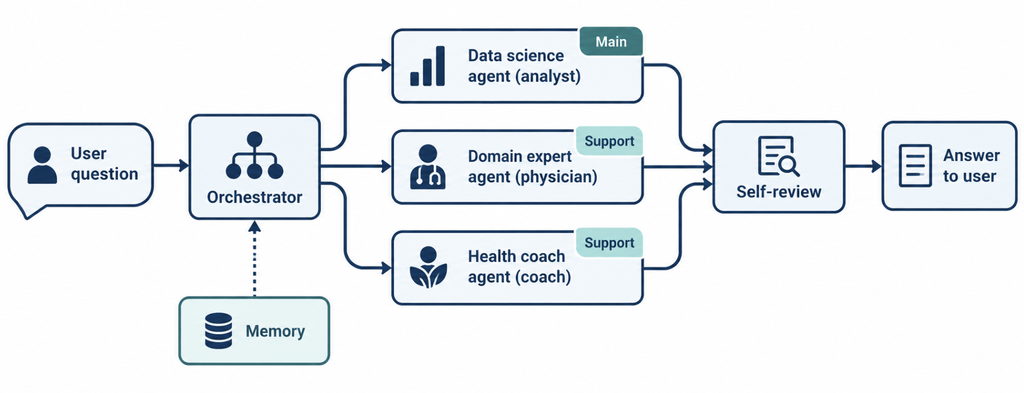
The resulting personal health agent works something like an outpatient care team.
- Data science agent (the quantitative analyst). It turns vague questions like “am I getting more fit?” into an explicit analysis plan, checks whether enough data is available, and then generates and runs Python code with an iterative self-correction loop.
- Domain expert agent (the specialist). It checks the user’s information against authoritative sources using web search, the NCBI API (which includes PubMed) and the DataCommons API.
- Health coach agent. It supports goal setting and behavior change through a modular design grounded in motivational interviewing.
- Orchestrator (the team lead). It assigns a main agent and supporting agents, runs a round of reflection, updates memory, and combines everything into a single response.
In stand-alone benchmarks, the specialized agents beat their base model.
- Analysis plans. The data science agent’s plans scored 75.6% against 53.7% for the baseline. The grader was an automated rater validated against annotations from expert data scientists.
- Data checks. The largest gain came on data availability, meaning whether the agent noticed missing or insufficient data. That score rose from 5.3% to 66.5%.
- Code. On 173 unit tests written by seven data scientists, the agent’s code passed on the first attempt 75.5% of the time, compared with 58.4% for the base model. These tests checked whether the analysis logic was correct, not merely whether the code ran.
- Differential diagnosis. On 2,000 real-world consumer cases, each a self-reported symptom description paired with the diagnosis the person eventually received, the domain expert agent reached a top-1 accuracy of 46.1%. That was 4.7 percentage points better than a Gemini-based state-of-the-art differential-diagnosis agent the team re-implemented. The answers were graded by a separate Gemini 2.5 Pro model, and the accuracy is still below 50%.
The most important test came when the sub-agents worked together. The researchers compared three designs:
| Single agent | Parallel team | Orchestrated team (PHA) | |
|---|---|---|---|
| How it works | One model handles data analysis, health knowledge and coaching | Three specialist agents respond independently; their outputs are combined | A team lead assigns a main agent and supporting agents, followed by reflection and memory update |
| Analogy | A lone general practitioner | Three separate reports stapled together | A coordinated clinical relay |
| Ranked first by 45 end users | 24.4% | 28.9% | 46.7% |
| Ranked first by 3 health experts (overall quality) | 12.6% | 20.7% | 66.7% |
| Time per response round | 36.4 s (3.0 LLM calls) | 244.4 s (7.0 calls) | 205.3 s (6.5 calls) |
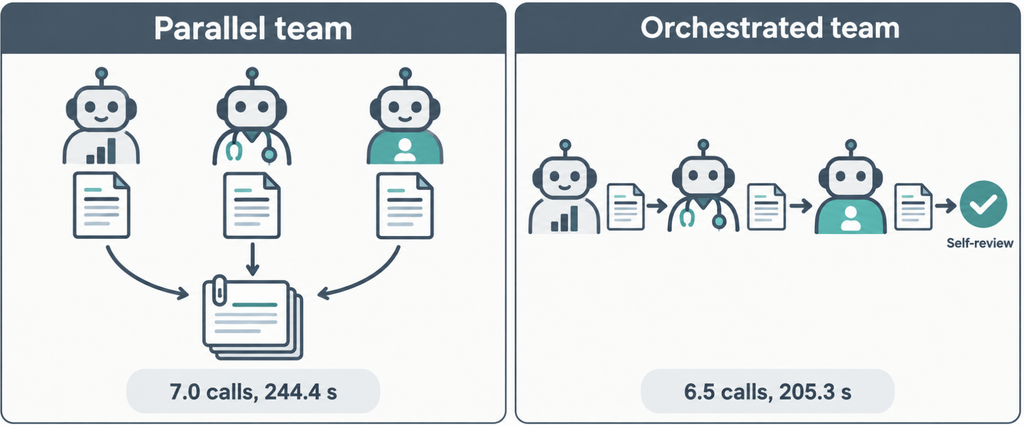
The orchestrated design came out on top. End users, role-playing personas built from real study participants’ data, ranked it first 46.7% of the time. The three health experts who reviewed the transcripts ranked it first 66.7% of the time. That is more than three times the rate for the parallel design and about five times the rate for the single agent.
The paper credits the iterative framework for letting the coach and domain expert agents build on the data science agent’s specific findings, which produced a more integrated answer. Despite the extra orchestration, the orchestrated team used fewer LLM calls and answered faster than the parallel team. Speed is still a real cost, though. A response round took about 3.4 minutes on average, and the single agent was more than five times faster.
The coordinated design gave noticeably better guidance, but at the price of long waits.
At the Clinic Door
Go back to the example conversation [Heydari, The Anatomy of a Personal Health Agent, 2026]. For an otolaryngologist, it reads like a referral note written before the patient has met a physician. She already has a candidate diagnosis, which is OSA. She knows the difference between an in-lab sleep study and a home test. She knows what CPAP is and that oral appliances and surgery are alternatives. She has already started acting: the agent recommended gentle activity “since we suspect sleep apnea,” and the conversation ends with her own list of action items. The first item is to call her doctor about sleep apnea.
That handoff to a doctor matters. The authors say the system is a research prototype for consumer wellness, not a diagnostic or clinical triage system, and that it should not replace professional care. Even so, a patient who arrives after a conversation like this is not a traditional new patient. She comes with an assumed differential diagnosis, expectations about testing, a basic grasp of how the treatments work, and an intervention plan she has already begun.
The outpatient visit is increasingly becoming the patient’s second clinical conversation.
Be Prepared: What Patients Trust Is Not What Is Safe
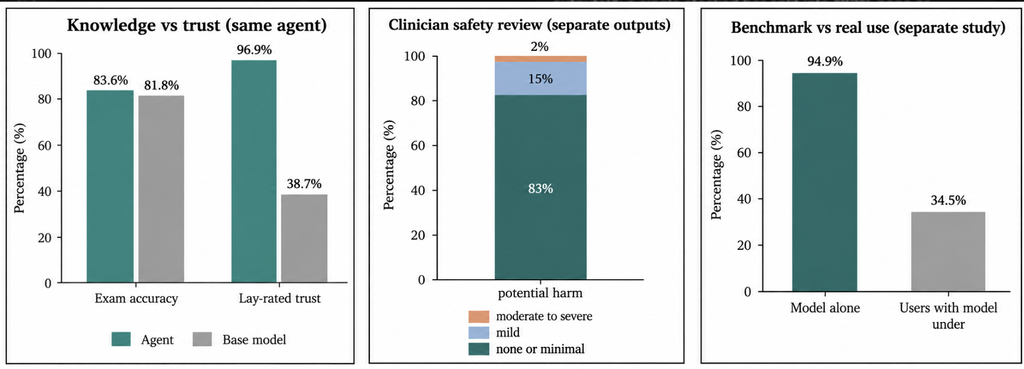
The tension shows up in three separate layers of evidence. Each looks at a different kind of failure, and they should not be mixed together.
| Layer | What was measured | Who judged | Finding |
|---|---|---|---|
| Knowledge vs trust | Domain expert agent vs base model | More than 2,000 board-certification and coaching exam questions; 17 lay raters on 50 personalized queries | Exam accuracy: 83.6% vs 81.8%. Rated trustworthy: 96.9% vs 38.7% |
| Safety | Agent-written health summaries for 30 study participants | Five clinicians (MDs) rated quality; the paper’s expert safety review rated potential harm | Usefulness: 65% vs 30%. Potential harm: 83% none or minimal, 15% mild, 2% moderate to severe |
| Benchmark vs real use | Three widely used LLMs used by members of the public | Randomized study of 1,298 UK participants | Model alone: 94.9% identified conditions. With participants: fewer than 34.5%, no better than control |
The first layer comes from the agent’s own component tests: On more than 2,000 exam questions in endocrinology, cardiology, fitness and sleep medicine, the domain expert agent beat the base model by a modest 1.8 percentage points [Heydari, The Anatomy of a Personal Health Agent, 2026]. Yet when 17 end users rated responses in a blinded study, they judged the agent’s answers trustworthy 96.9% of the time, compared with 38.7% for the base model.
Relevance to the question and groundedness in the user’s data were similar for both systems. In side-by-side comparisons, users preferred the agent for personalization (71.9%) and for the credibility of its citations (76.9%). The difference in explaining medical terms (60.4%) was not statistically significant. The paper does not say why trust differed so sharply. One plausible reading is that personalization and citations shape perceived credibility far more than measured knowledge does.
The second layer is clinical safety: The domain expert agent wrote health summaries for 30 study participants, combining unstructured text, wearable data and PDF lab results. A panel of five clinicians rated 65% of them useful or very useful, compared with 30% for the base model. The paper’s expert safety review, however, found potential for mild harm in 15% of the summaries and for moderate-to-severe harm in 2%. In other words, about one in six summaries (17%) carried some potential for harm. The summaries were built from real study data but were not used in live clinical care. Even so, the finding shows that a polished, useful-looking output is not the same thing as a safe one.
The third layer comes from outside the paper: In a preregistered randomized study, 1,298 UK participants worked through ten doctor-written medical scenarios with help from GPT-4o, Llama 3 or Command R+, or with any source they chose (the control group) [Bean, Reliability of LLMs as Medical Assistants, 2026]. Tested on their own, the models identified the relevant conditions in 94.9% of cases. Participants using the same models identified them in fewer than 34.5% of cases, no better than the control group.
When the authors examined a subset of conversations, they found that participants often gave the models incomplete or incorrect information, and that the models sometimes produced misleading or incorrect information themselves. High benchmark scores did not carry over to real use.
The same gap in perception appeared inside the paper’s own panels. Health experts favored the orchestrated team much more strongly than end users did. On the user-empowerment measure for the health coach agent, the experts preferred the coach 69.9% of the time, while end users rated the two systems about the same (48.4%) [Heydari, The Anatomy of a Personal Health Agent, 2026]. A passenger judges how comfortable the ride is; a mechanic checks the brakes. Both views matter, but only one catches a mechanical failure before someone gets hurt.
The study also has clear limits.
- Short-term only. The authors say their results show conversational quality and short-term task efficacy, not lasting behavior change or better long-term health outcomes.
- Short live sessions. Live conversations had multiple turns but ended at a natural stopping point or after 15 minutes.
- Role-play, not real patients. Participants role-played personas built from real data in the WEAR-ME study (n = 1,165) rather than responding as themselves. The evaluation is also Fitbit-centric.
- Few expert reviewers, some automated grading. Only three health experts reviewed the integrated system, and parts of the evaluation relied on LLM-based autoraters.
- Industry funding. The study was funded by Alphabet, and the authors are current or former Alphabet employees.
A citation shows where a model found a claim. It does not show that the model’s clinical reasoning is correct.
Put It to Work: A Colleague Before the Visit

The authors suggest a role that fits what the system does well. They note that simply telling people to “see a doctor” may not fix the delays that push them toward AI in the first place [Heydari, The Anatomy of a Personal Health Agent, 2026]. A future system could instead help users record their symptoms, spot patterns, prepare questions and navigate care, while avoiding diagnostic claims. The authors stress that even this preparatory role needs prospective validation and safeguards against early or inaccurate suggestions. The goal is better-prepared visits, not replacing the clinician.
Practicing physicians can also help shape the guardrails. The current prototype relies on disclaimers written into its prompts and on conservative rules for responding to symptoms. For future versions, the authors propose:
- persistent notices that carry across turns;
- detection of high-risk queries, which the system would either refuse or answer with an explicit handoff to a clinician so that care is not delayed;
- testing for both false reassurance and unnecessary escalation, with clinicians reviewing high-risk failures;
- limiting health retrieval to curated sources such as WHO, PubMed, NICE and the CDC, and showing the source next to each recommendation.
The team has released the code and benchmark tasks on GitHub under an Apache 2.0 license.
That leaves clinicians three practical ways to engage:
- Read AI summaries that patients bring in as preliminary intake material, much like an outside referral note.
- Use the citations the agent lists to check its reasoning quickly.
- Help set the clinical thresholds that decide when an AI must hand a patient off to a clinician.
Patient follow-through varies. In the KFF poll, 42% of adults who used AI for physical health questions said they did not follow up with a doctor or other health care provider afterward [KFF, Use of AI for Health Information and Advice, 2026]. Among all AI health users, 41% said that wanting to look up information before deciding whether to see a provider was a major reason they used AI. In the paper’s published example, the agent’s first concrete recommendation was to talk to her doctor. Whether that pattern holds across real-world use has not been tested.
When Jensen Huang described AI agents for customer service, he added an important qualifier: “In the future, my guess is that it’s going to be human still, but AI in the loop” [NVIDIA, Everybody Will Have an AI Assistant, 2024]. In medicine, whether clinicians stay at the center of that loop or get pushed to its edge is still a choice we get to make.
Key Takeaways
- A personal health agent can split a health question among specialized modules: a data analyst, a domain expert, a behavioral coach and an orchestrating team lead.
- In the developers’ evaluations, the orchestrated multi-agent design beat both single-agent and parallel designs, and health experts preferred it even more strongly than end users did.
- The gap in how trustworthy lay users judged the system (96.9% vs 38.7%) was far larger than its gain on knowledge exams (83.6% vs 81.8%). That mismatch shows up in clinical encounters.
- An expert safety review found potential for mild harm in 15% of agent-written health summaries and for moderate-to-severe harm in 2%. Even well-cited outputs need physician verification.
- The evidence covers conversational quality and short-term task efficacy in live sessions of up to 15 minutes. Effects on long-term behavior and health outcomes have not been shown.
- The most realistic clinical role for a personal health agent is helping patients prepare for visits, not making independent diagnoses.
FAQ
Can a personal health agent diagnose disease?
No. The authors describe the system as a research prototype for consumer wellness, not a diagnostic or clinical triage system, and say it should not replace professional care [Heydari, The Anatomy of a Personal Health Agent, 2026]. In practice, though, it can raise a likely diagnosis and outline testing and treatment options, as it did for sleep apnea in the published example. Patients may easily treat that as a working clinical opinion.
Are AI health agents like this already available to patients?
Partly. Google’s Gemini-based personal health coach has been in public preview in the Fitbit app since October 2025, and by April 2026 it had expanded to 37 countries, including South Korea [Google, Personal Health Coach Expands to 37 Countries, 2026]. The coach uses a multi-agent design, and Google lists this paper among the research behind it. However, Google says the paper describes a research framework, not a specific product [Google Research, The Anatomy of a Personal Health Agent, 2025]. The two should not be treated as the same system.
Does better benchmark performance mean better patient outcomes?
No. In a randomized study of 1,298 participants, LLMs that identified conditions accurately on their own did not help users do any better than a control group [Bean, Reliability of LLMs as Medical Assistants, 2026]. The personal health agent paper likewise measured conversational quality and short-term task efficacy, not clinical outcomes.
How should clinicians handle patients who consulted an AI first?
The safest approach is to treat the AI output as collateral history, not as verified diagnostic evidence. Ask what the system recommended and which sources it cited, then confirm those assumptions independently. In the paper’s expert safety review, about one in six AI-written health summaries (15% mild, 2% moderate to severe) carried some potential for harm, so direct verification is essential [Heydari, The Anatomy of a Personal Health Agent, 2026].
References
- Heydari AA, Gu K, Srinivas V, et al. The anatomy of a personal health agent. Nature. Published online October 21, 2026.
- Bean AM, Payne RE, Parsons G, et al. Reliability of LLMs as medical assistants for the general public: a randomized preregistered study. Nat Med. 2026;32(2):609-615.
- KFF. KFF tracking poll on health information and trust: use of AI for health information and advice. Published March 25, 2026.
- NVIDIA. ‘Everybody will have an AI assistant,’ NVIDIA CEO tells SIGGRAPH audience. NVIDIA Blog. Published July 29, 2024.
- Patel S, Thng F. How we are building the personal health coach. Google Research Blog. Published October 27, 2025.
- TechRepublic. Fitbit’s Gemini AI coach expands to iPhone, 5 new countries. Published February 11, 2026.
- T3. Fitbit just crossed a line: your medical records are now part of your fitness tracker. Published March 19, 2026.
Joonpyo Hong, MD is a board-certified otolaryngologist practicing in Korea. This article reflects his clinical interpretation of published research and does not constitute individual medical advice. This article is not intended to advertise or promote any specific company or product.
For more articles:
https://curiousmd.com/openevidence-ai-evidence-based-medicine/
https://curiousmd.com/claude-for-healthcare/
Link out to:
The anatomy of a personal health agent (Nature, open access) — The original paper describing the agent and its evaluation.
The anatomy of a personal health agent (Google Research Blog) — The research team’s plain-language overview of the framework.
How we are building the personal health coach (Google Research Blog) — How a similar multi-agent design became a consumer coach in the Fitbit app.
KFF poll on AI chatbots and health information — How many US adults use AI for health information, and how many follow up with clinicians.
Everybody will have an AI assistant (NVIDIA Blog) — Jensen Huang’s remarks at SIGGRAPH 2024.
Fitbit’s Gemini AI coach expands (TechRepublic) — Report on the coach’s expansion to iPhone and more countries.