
In 2026, AI hearing aids are everywhere — almost every device on the market is sold as “artificial intelligence.” Yet independent lab testing shows the gap between the best devices and the rest is wider than ever, especially in background noise. The question worth asking is whether the “AI chip” inside a $5,000 device is a real advance or a marketing label. This article explains what the AI actually does, how it differs from the noise cancellation in your earbuds, what it costs around the world, and who genuinely benefits.
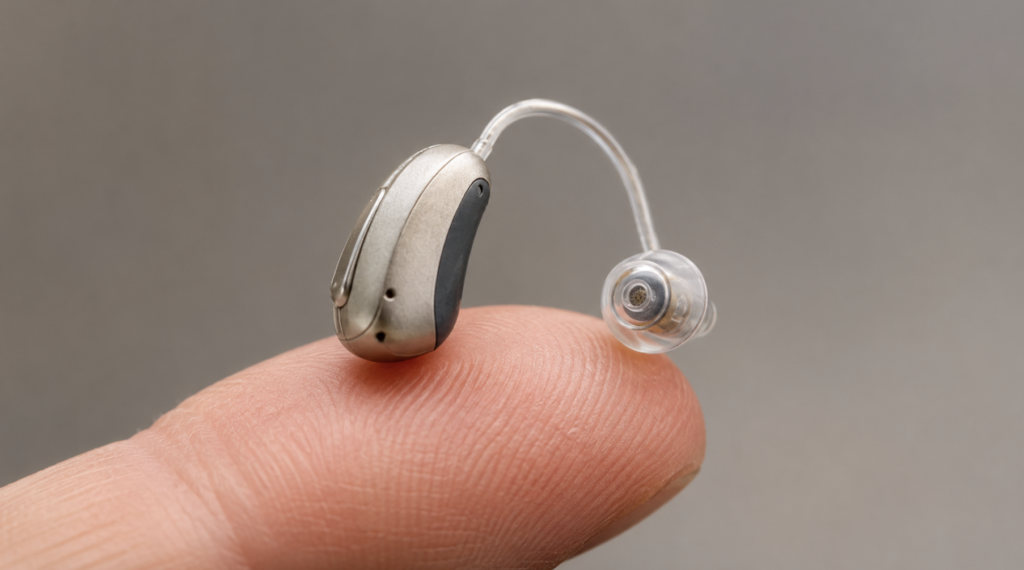
AI Hearing Aids vs Noise Cancellation: Not the Same Thing
The first question most readers have is reasonable: how is this different from the noise cancellation in my headphones? The answer matters, because the two technologies have opposite goals.
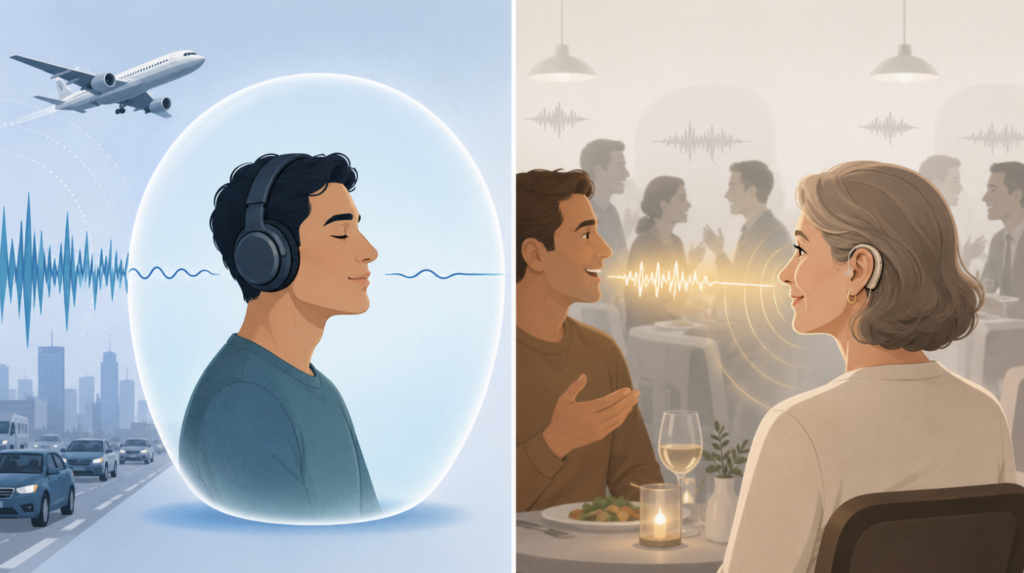
Active noise cancellation (ANC), the kind in earbuds and travel headphones, works by generating an inverted sound wave that cancels out steady ambient noise — engine hum, airplane drone, the rumble of a train. It is content-blind: it does not know or care whether a sound is speech or noise, and its aim is simply less sound. That is exactly why ANC headphones need a separate “transparency mode” to let voices back in.
An AI hearing aid does the reverse. It is content-aware. A deep neural network classifies the sound scene in real time, then reshapes the signal to pull speech forward while pushing competing noise back. The goal is not silence — it is intelligibility. Put simply: noise cancellation tries to give you quiet, while an AI hearing aid tries to give you speech.
AI-Powered vs AI-Trained: The Distinction That Matters
Most “AI hearing aids” are not doing what the marketing implies. The honest distinction the industry rarely makes clear is between devices that were designed with AI and devices that run AI while you wear them.
In the first group — which includes most major brands — engineers used machine learning during development to tune noise reduction and speech algorithms. The result is a smarter set of fixed rules, but the chip in the ear is not “thinking” in real time. Reviewers at Soundly call this category AI-trained rather than AI-powered, and it is now standard across the industry.
The second group is newer and smaller: a dedicated chip inside the device runs a deep neural network (DNN) in real time, actively pulling speech out of background noise as it happens. Phonak’s Infinio Sphere, with its separate DEEPSONIC chip, is the clearest commercial example. The useful analogy is following a recipe exactly versus an experienced cook adjusting to what is actually in the pan.
How an On-Device Neural Network Separates Speech From Noise
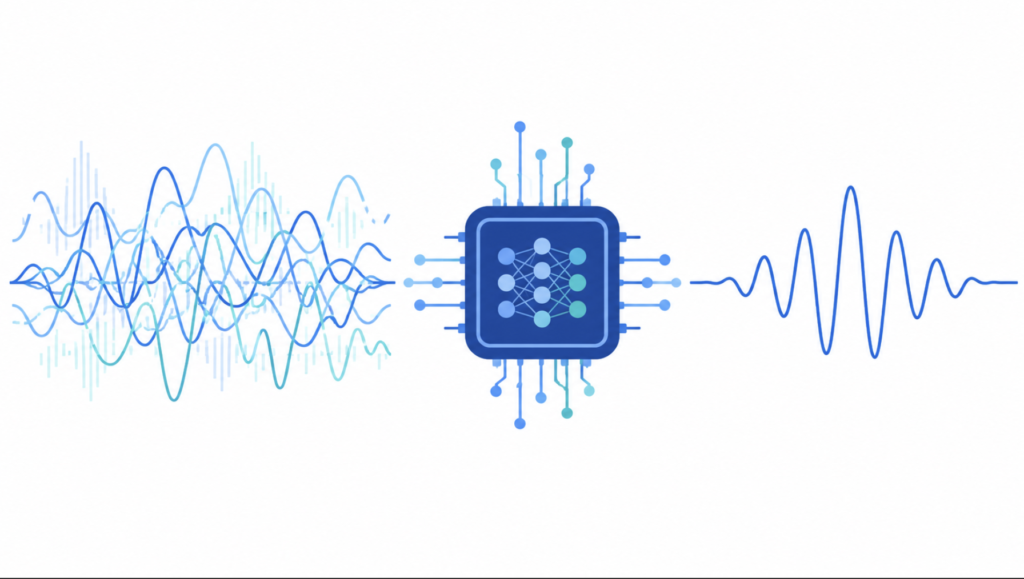
Traditional hearing aids amplify; they make sound louder, including the dishes clattering and the table behind you. A real-time DNN works at the processing level, before sound reaches the ear, classifying what is speech and what is noise and reshaping the signal accordingly.
The peer-reviewed data here is genuinely encouraging. In a study of hearing-impaired adults tested with AzBio sentences in multi-talker babble, a DNN-based “spheric speech in loud noise” program improved speech perception by 20 to 32 percentage points compared with the device’s standard calm-situation program, with a measured 4–5 dB signal-to-noise ratio improvement [Saoji, How Does Deep Neural Network-Based Noise Reduction in Hearing Aids Impact Cochlear Implant Candidacy?, 2024]. For context, in difficult listening every few decibels of SNR can mark the difference between following a conversation and giving up on it.
Real-world testing tells a similar story. An ecological momentary assessment study following 40 experienced users across two-week wear periods found that DNN-based noise reduction produced consistent sound satisfaction regardless of how noisy the environment got — which was not true for the traditional-noise-reduction device [Christensen, Evaluating Real-World Benefits of Hearing Aids With Deep Neural Network-Based Noise Reduction: An Ecological Momentary Assessment Study, 2024].
Independent lab testing backs the marketing in this one case: the Phonak Sphere currently holds the highest speech-in-noise score the HearAdvisor acoustic lab has recorded, a measurable result rather than a brochure claim.
What AI Hearing Aids Cost and How to Buy Them
Real-time AI is still a premium feature, and price varies sharply by region and channel.
In the United States, flagship prescription devices such as the Phonak Sphere run roughly $3,600 to $5,000 per pair, reaching as high as $7,500 depending on technology tier and provider, and are sold only through a hearing professional who fits and programs them (HearingTracker, 2026). At the other end, FDA-regulated over-the-counter (OTC) hearing aids for mild-to-moderate loss — legal since 2022 — start around $300 to $800 and are bought online or in retail stores, with some now including their own real-time AI noise reduction. Medicare does not cover hearing aids, though some Medicare Advantage plans and the Veterans Administration do.
In Europe, premium AI devices are generally purchased through audiology clinics at broadly similar private prices, with one user reporting roughly €4,000. Public health systems vary widely: some provide basic hearing aids at low or no cost, but the premium AI flagships usually remain a private upgrade rather than a covered option.
Across much of Asia, including Korea and Japan, premium devices are sold mainly through clinics and specialty retailers, and the OTC category is far less established than in the US. Public reimbursement tends to be limited and is often restricted to people registered with a hearing disability, so most buyers of flagship AI devices pay out of pocket.
The “Too Clean” Tradeoff (Clinical Perspective)
Here is what the product pages tend to leave out. Aggressive, effective denoising carries a cost that deserves as much attention as the speech-in-noise scores.
The brain uses background sound to do real work. Subtle environmental cues help a listener localize where a voice is coming from, sense the size of a room, and stay aware of surroundings — an alarm, a car, someone approaching from behind. When a processor strips noise too aggressively, it can flatten those spatial cues, and some patients describe the result as unnatural — aggressive and unsettling rather than restful.
A higher lab score therefore does not automatically mean a better day for every patient. The brain needs some noise to orient itself. It also follows that the most aggressive AI setting is unlikely to produce the highest satisfaction; the optimal amount of processing is best treated as an individual fitting decision rather than a fixed maximum.
The Balance Problem
This points to a deeper truth about hearing. Comfortable sound, for the human ear, requires a certain amount of background noise. A signal with every trace of noise removed does not feel natural, and it does not necessarily make listening more pleasant. The genuine challenge is not maximum noise removal — it is the balance between removing enough noise to sharpen speech clarity and preserving enough ambient sound to keep listening comfortable. Striking that balance is one of the hardest problems in modern hearing technology, and no chip solves it automatically.
Who Should — and Shouldn’t — Pay
The technology is real, but value depends entirely on the life it serves. The strongest case is for active people who are regularly in genuinely hard listening situations: restaurants, group dinners, busy offices, family gatherings. That is exactly where real-time DNN processing earns its premium.
The weaker case is for someone whose days are mostly quiet — one-on-one conversations at home, television, the occasional phone call. A well-fitted conventional premium hearing aid may serve them just as well for far less money. And no chip substitutes for the fundamentals: quality acoustic hardware and, above all, professional fitting with real-ear verification. An AI device fitted poorly will underperform a basic device fitted well.
Key Takeaways
- An AI hearing aid is not noise cancellation: ANC aims for silence and ignores content, while an AI hearing aid is content-aware and aims to make speech intelligible.
- “AI-powered” (a real-time neural network) and “AI-trained” (algorithms tuned during development) are different things, and most devices are only the latter.
- Peer-reviewed studies show DNN-based noise reduction can improve speech perception in noise by roughly 20–32 percentage points over conventional programs.
- Premium AI hearing aids cost about $3,600–$7,500 per pair through a professional, while OTC AI options start around $300–$800; coverage is limited in most regions. Prices can vary at any time.
- Comfortable hearing requires some background noise, so the real goal is balance — removing enough noise for clarity while keeping enough sound for comfort.
FAQ
How is an AI hearing aid different from noise-cancelling headphones?
Noise-cancelling headphones aim to remove ambient sound regardless of what it is, while an AI hearing aid identifies speech and enhances it while reducing competing noise. One technology tries to give you quiet; the other tries to give you clear speech.
Do AI hearing aids actually work?
Yes, for speech in noise the best real-time AI devices measurably outperform traditional processing. Both lab testing and peer-reviewed studies show meaningful gains in difficult listening, though everyday benefit still depends on proper fitting and individual hearing.
How much do AI hearing aids cost?
Premium prescription models with real-time AI generally run about $3,600 to $7,500 per pair through a hearing professional, while over-the-counter options for milder loss can start around $300 to $800. Insurance coverage is limited in most countries. Prices can vary at any time.
Can AI hearing aids sound “too clean”?
Yes. Very aggressive noise removal can strip away spatial and environmental cues the brain relies on, and some users find the result unnatural. The processing level should be fitted individually rather than maximized.
References
Christensen JH, Whiston H, Lough M, Gil-Carvajal JC, Rumley J, Saunders GH. Evaluating Real-World Benefits of Hearing Aids With Deep Neural Network-Based Noise Reduction: An Ecological Momentary Assessment Study. Am J Audiol. 2024;33(2).
Saoji AA, Sheikh BA, Bertsch NJ, Goulson KR, Graham MK, McDonald EA, Bross AE, Vaisberg JM, Kühnel V, Voss SC, Qian J, Hogan CH, DeJong MD. How Does Deep Neural Network-Based Noise Reduction in Hearing Aids Impact Cochlear Implant Candidacy? Audiol Res. 2024;14(6).
This article is independent and educational. It is not sponsored by, affiliated with, or intended to advertise or endorse any specific company or product; brand and device names are mentioned only as factual examples.
Joonpyo Hong, MD is a board-certified otolaryngologist practicing in Korea. This article reflects his clinical interpretation of published research and does not constitute individual medical advice.
For more interesting contents:
https://curiousmd.com/brain-controlled-hearing-aid-2026/
https://curiousmd.com/psap-vs-hearing-aid-clinical-evidence/
https://curiousmd.com/airpods-hearing-test-what-it-can-and-cannot-do/
https://curiousmd.com/bone-conduction-headphones-and-hearing-loss-15-years/
Link out to:
https://www.fda.gov/medical-devices/hearing-aids/otc-hearing-aids-what-you-should-know
https://www.nidcd.nih.gov/health/over-counter-hearing-aids
https://pmc.ncbi.nlm.nih.gov/articles/PMC11673434/