
For decades, every treatment an ear, nose, and throat surgeon could offer a patient with obstructive sleep apnea (OSA) was mechanical: a CPAP mask, upper-airway surgery, or a hypoglossal nerve stimulator implanted under the skin. On December 20, 2024, that list gained something it had never held before — a drug. The U.S. Food and Drug Administration approved tirzepatide for sleep apnea — marketed as Zepbound — in adults with moderate-to-severe OSA and obesity, the first medication ever cleared for the condition (U.S. FDA, 2024). This article explains what that approval actually covers, how the drug works, where its limits are, and why an oral pill now in late-stage trials may be the more interesting story.
What the FDA Actually Approved
The approval is narrower than the headlines suggest. Tirzepatide is cleared specifically for adults who have both moderate-to-severe OSA and obesity — not for OSA across the general population, and not as a first-line replacement for existing therapy.
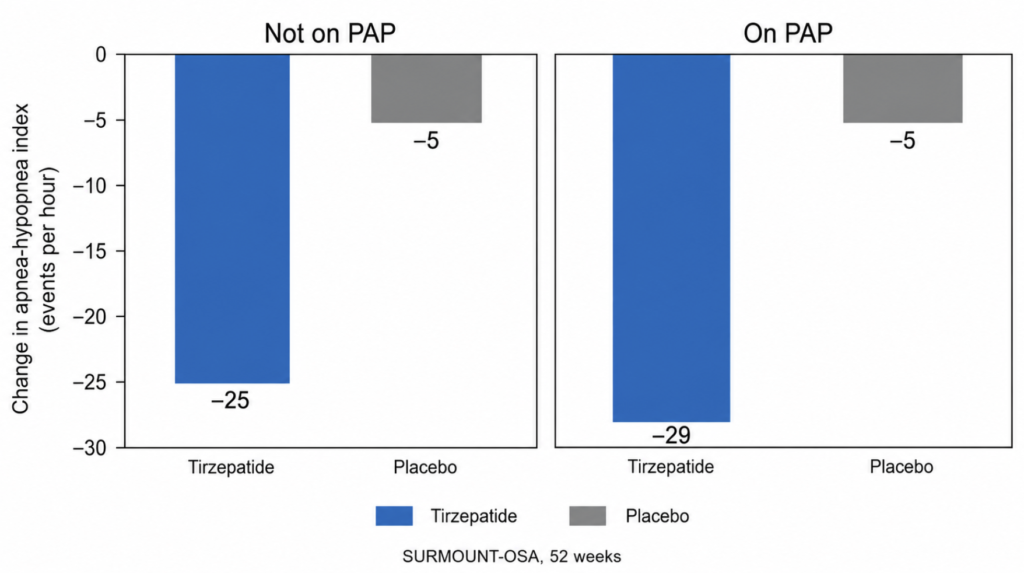
The evidence came from the SURMOUNT-OSA program, two phase 3 trials reported together [Malhotra, Tirzepatide for the Treatment of Obstructive Sleep Apnea and Obesity, 2024]. One trial enrolled patients not using positive airway pressure (PAP); the other enrolled patients who were. Both measured the change in the apnea-hypopnea index (AHI) — the number of breathing interruptions per hour of sleep — over 52 weeks.
The numbers were substantial. In the trial of patients not on PAP, AHI fell by about 25 events per hour with tirzepatide versus about 5 with placebo. In the trial of patients on PAP, the drug lowered AHI by roughly 29 events per hour versus about 5 with placebo [Malhotra, Tirzepatide for the Treatment of Obstructive Sleep Apnea and Obesity, 2024]. Participants also lost close to a fifth of their body weight. For a condition where the only pharmacologic option had previously been “none,” this is a meaningful result.
Zepbound and Mounjaro Are the Same Drug
A point of frequent confusion: Zepbound and Mounjaro are the same molecule. Both are tirzepatide, a once-weekly injection that activates two gut-hormone receptors, GIP and GLP-1. Eli Lilly sells the identical compound under two brand names in the United States — Mounjaro for type 2 diabetes and Zepbound for obesity and, now, OSA. The names track the approved indication, not the chemistry.
Other countries handle this differently. In South Korea, the Ministry of Food and Drug Safety approved tirzepatide under the single Mounjaro brand — first for type 2 diabetes in June 2024, then as an adjunct for chronic weight management on July 30, 2024 (Korea MFDS; Medipana, 2024). Eli Lilly Korea chose not to launch a separate Zepbound brand, so in Korea one product name spans all of its indications — including the moderate-to-severe OSA indication, which Korea’s regulator added to Mounjaro in August 2025.
How Tirzepatide for Sleep Apnea Actually Works
Tirzepatide improves OSA mainly by treating obesity, which is an established causal driver of the disease. As patients lose weight, fat is lost from around the neck, tongue, and pharyngeal walls, and the upper airway becomes less prone to collapse during sleep. This weight-mediated pathway is the best-supported explanation for the AHI improvement and is consistent with how ENT surgeons already understand the mechanics of the airway.
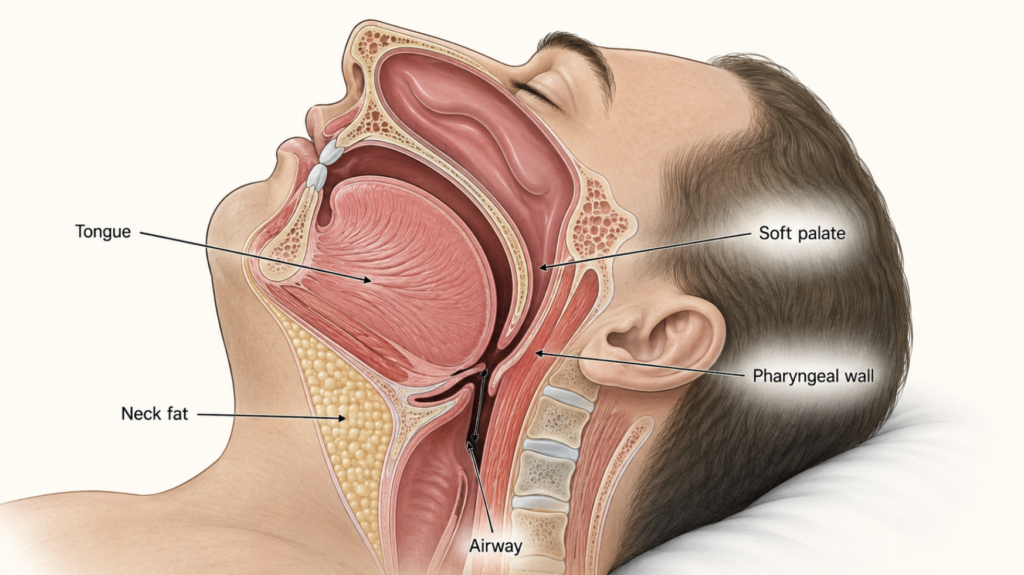
A second, more speculative idea has drawn attention: that tirzepatide might help the airway through routes independent of weight loss — by dampening systemic inflammation, improving insulin sensitivity, or altering the neural control of breathing. This is not pure conjecture. In SURMOUNT-OSA, high-sensitivity C-reactive protein (a marker of inflammation) fell significantly with the drug [Malhotra, Tirzepatide for the Treatment of Obstructive Sleep Apnea and Obesity, 2024]. But a drop in a blood marker is not the same as a demonstrated effect on airway collapsibility, and current reviews describe the weight-independent airway benefit as a hypothesis that still needs direct testing. Treating it as proven would get ahead of the data.
Clinical Perspective It is worth separating two claims that often get blurred together. “Tirzepatide reduces AHI in people with obesity” is well supported by phase 3 data. “Tirzepatide fixes the airway through anti-inflammatory action regardless of weight” is an interesting mechanistic story with a real biomarker signal behind it — but not yet a proven clinical effect. Holding both statements at their correct confidence level is the honest way to read this literature.
Zepbound Versus CPAP: Replacement or Complement?
Tirzepatide does not cure sleep apnea, and it is not a universal substitute for CPAP. It reduces the load that obesity places on the airway, but it does not change the underlying anatomy, and the benefit depends on continued treatment — weight regain after stopping is a realistic concern. The FDA approval reflects this: it is positioned as an option, particularly for patients with obesity who cannot tolerate or decline PAP, rather than as a first-line replacement for a therapy that already works well when used.
The more useful framing is additive. A patient carrying significant weight-related airway load may do better with weight reduction plus an airway-directed therapy than with either alone. The drug widens the menu; it does not close it.
The Next Frontier: An Oral Pill
If an injection for OSA is new, an oral pill would be a further shift — and one is well into testing. AD109 is an investigational once-daily bedtime tablet that combines aroxybutynin (an antimuscarinic) with atomoxetine (a norepinephrine reuptake inhibitor). Its target is different from tirzepatide’s: instead of acting on weight and metabolism, it aims at the neuromuscular problem in OSA, increasing upper-airway muscle tone during sleep so the airway is less likely to collapse [Taranto-Montemurro, Aroxybutynin and atomoxetine (AD109) for the treatment of obstructive sleep apnea, 2025].
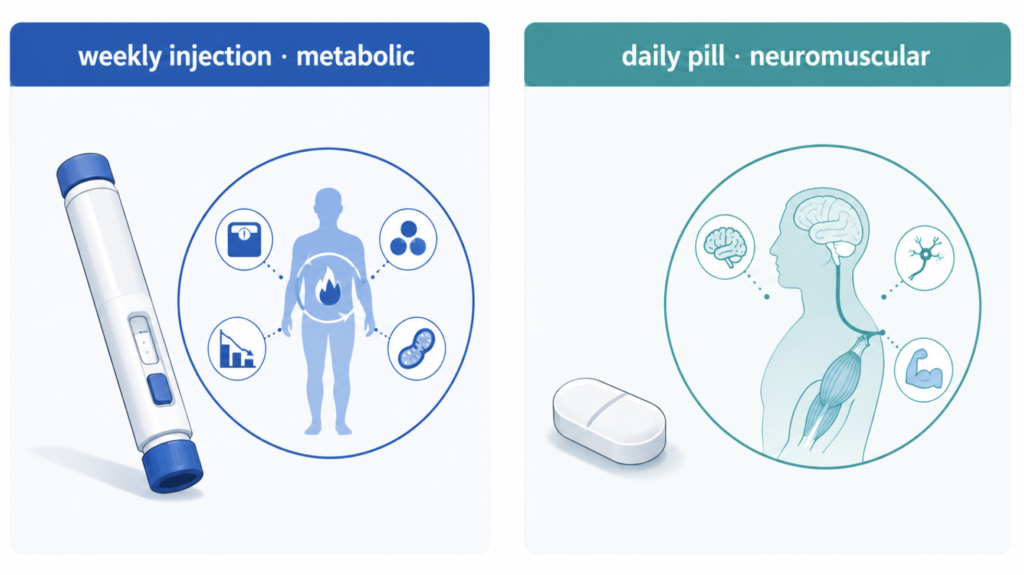
The phase 3 SynAIRgy trial has now reported. Across 646 adults with mild-to-severe OSA who could not use PAP, AD109 lowered AHI by a treatment difference of about 4 events per hour versus placebo at 26 weeks — a roughly 44% reduction from baseline compared with about 18% on placebo — and improved oxygenation measures [Strollo, Aroxybutynin and atomoxetine (AD109) for obstructive sleep apnea: a randomized phase 3 trial (SynAIRgy), 2026].
The absolute AHI change is smaller than tirzepatide’s, but the trial population was different: lower baseline AHI, and it deliberately included patients across weight categories rather than requiring obesity. Notably, the study did not show a significant improvement in patient-reported fatigue, and about one in five participants stopped the drug because of side effects such as dry mouth and urinary hesitation [Strollo, 2026]. It is a real signal, not a finished story.
Because AD109 works through muscle tone rather than weight, it could extend drug therapy to patients whose OSA is not primarily driven by obesity — a group tirzepatide’s approval does not reach.
Key Takeaways
- Tirzepatide (Zepbound) is the first drug ever approved by the FDA for obstructive sleep apnea, cleared in December 2024.
- The approval applies only to adults who have both moderate-to-severe OSA and obesity.
- Zepbound and Mounjaro are the same molecule (tirzepatide); the brand name reflects the approved indication, and in Korea a single Mounjaro brand covers both diabetes and weight management.
- The established mechanism is weight loss; a weight-independent, anti-inflammatory airway effect remains a hypothesis despite a real drop in an inflammatory marker.
- AD109, an investigational oral pill targeting airway muscle tone, has completed phase 3 testing and points toward a second class of OSA drugs.
FAQ
Does Zepbound cure sleep apnea? No. It reduces the severity of OSA and helped a substantial share of trial participants reach mild or resolved disease, but it does not permanently correct the anatomical basis of airway collapse, and benefit depends on staying on treatment.
Can I use Zepbound instead of CPAP? Only in specific situations. It is approved as an option for adults with obesity and OSA, especially those who cannot tolerate or decline PAP — not as a blanket replacement for a therapy that is highly effective when used consistently.
Does tirzepatide work for sleep apnea if I’m not obese? The FDA approval requires obesity, and the supporting trials enrolled patients with obesity, so benefit outside that group is not established for this indication.
Is there a pill for sleep apnea instead of an injection? There may be soon. AD109, an investigational oral tablet taken at bedtime, met its primary endpoint in a phase 3 trial by improving airway obstruction and oxygenation, though it is not yet FDA-approved.
References
- Malhotra A, Grunstein RR, Fietze I, et al. Tirzepatide for the Treatment of Obstructive Sleep Apnea and Obesity. N Engl J Med. 2024;391(13):1193-1205.
- Strollo PJ, Farkas R, Taranto-Montemurro L, Cronin J, Patel SR, et al. Aroxybutynin and atomoxetine (AD109) for obstructive sleep apnea: a randomized phase 3 trial (SynAIRgy). Am J Respir Crit Care Med. 2026;212(7):1569-1584.
- Taranto-Montemurro L, Patel SR, Strollo PJ, et al. Aroxybutynin and atomoxetine (AD109) for the treatment of obstructive sleep apnea: rationale, design and baseline characteristics of the phase 3 clinical trials. Contemp Clin Trials Commun. 2025;47:101538.
For more interesting content:
https://curiousmd.com/apple-watch-sleep-apnea-accuracy/
https://curiousmd.com/wearable-ai-for-sleep-apnea-2026/
https://curiousmd.com/sleep-cycles-by-age/
Link out to:
https://www.fda.gov/news-events/press-announcements/fda-approves-first-medication-obstructive-sleep-apnea
https://aasm.org/zepbound-approved-fda-first-sleep-apnea-medication/
https://sleepeducation.org/sleep-disorders/obstructive-sleep-apnea/
Joonpyo Hong, MD is a board-certified otolaryngologist practicing in Korea. This article reflects his clinical interpretation of published research and does not constitute individual medical advice.