
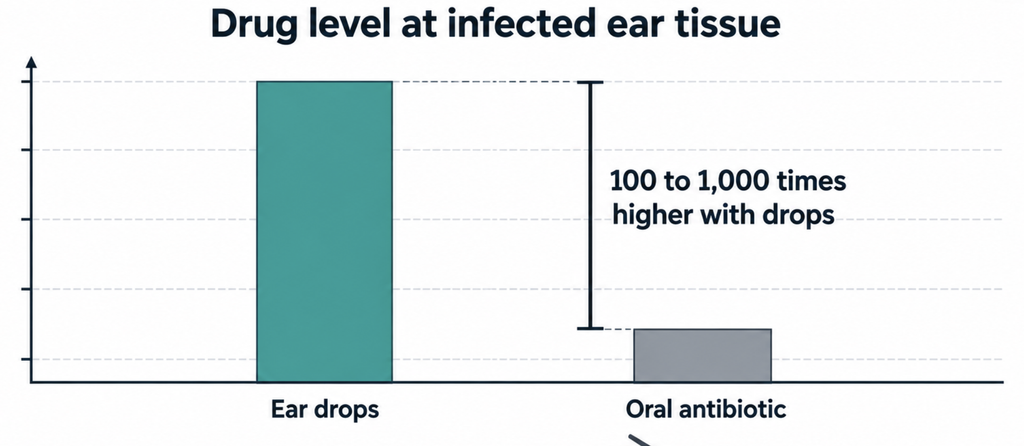
Ear drops vs oral antibiotics comes down to delivery more than strength. An antibiotic drop placed on an infected ear canal can reach concentrations 100 to 1,000 times higher than a pill delivers to the same tissue [Rosenfeld, Clinical practice guideline: acute otitis externa, 2014]. Yet a prescription to swallow often feels like the “real” treatment, and the drops like an afterthought.
The same logic applies to the nose, where the drug in question is a steroid rather than an antibiotic. This article compares drops and sprays with pills, alone and in combination, for inflammatory ear disease and for severe allergic rhinitis. In most cases the deciding question is whether the drug can reach the problem. Which drug is stronger rarely settles it.
How much drug reaches the target? Topical vs oral delivery
Think of an oral medicine as a sprinkler system for an entire city. To wet one burning room, it has to soak every street on the way. A drop or a spray is a fire extinguisher carried into that room: less total drug, far more of it on the fire, and far less everywhere else.
Antibiotics: drops versus pills
A swallowed antibiotic is absorbed through the gut and diluted in the bloodstream, and only a small share reaches the skin of the ear canal or the middle ear. A drop sits directly on the infected surface, which is why guideline authors describe topical concentrations far beyond what systemic therapy achieves [Rosenfeld, Clinical practice guideline: acute otitis externa, 2014]. Drops also spare the rest of the body. In a trial of children with ear tubes, diarrhea was a common side effect of oral amoxicillin-clavulanate, while the drops caused ear pain in only a small share of children [Dohar, Topical ciprofloxacin/dexamethasone superior to oral amoxicillin/clavulanic acid in acute otitis media with otorrhea through tympanostomy tubes, 2006].
Steroids: nasal spray versus tablets
A steroid nasal spray works on the lining of the nose, not through the bloodstream. In a trial of 304 patients with hay fever, researchers gave the same steroid either as a nasal spray or as a much larger oral dose. Only the spray relieved symptoms. The oral version produced higher blood levels yet was, with few exceptions, no better than placebo [Howland, The efficacy of fluticasone propionate aqueous nasal spray for allergic rhinitis and its relationship to topical effects, 1996]. Many newer sprays are poorly absorbed when swallowed and quickly cleared, which keeps body-wide exposure low [Daley-Yates, Intranasal corticosteroids: topical potency, systemic activity and therapeutic index, 2021].
Oral steroids act everywhere at once. In a large US insurance database, about one in five adults received a short course (under a month) over three years. The weeks after starting were linked to higher rates of serious problems: within 30 days, sepsis at 5.3 times, blood clots at 3.3 times, and fractures at 1.9 times the baseline rate [Waljee, Short term use of oral corticosteroids and related harms among adults in the United States, 2017]. That study shows an association, not proof of cause. Still, it is a reason not to treat “just a few days” of steroid pills as harmless.
| Route | Drug level at the target | Exposure for the rest of the body | Main concerns |
|---|---|---|---|
| Antibiotic ear drops | Very high | Minimal | Local irritation; some drops unsuitable if the eardrum is open |
| Oral antibiotics | Low | Whole body | Diarrhea, rash, pressure toward resistance |
| Steroid nasal spray | High on the nasal lining | Low for modern sprays | Nasal dryness, sneezing, headache |
| Oral steroids | Diluted | Whole body | Linked to sepsis, blood clots and fractures; diabetes with repeated injections |
The catch: drops only work where they can reach
The fire extinguisher only helps if the door is open. Behind an intact eardrum, the middle ear is a sealed room, and drops placed in the ear canal cannot get there. For that reason, doctors manage a typical middle ear infection with an intact eardrum with pain control and either oral antibiotics or watchful waiting, not antibiotic drops [Lieberthal, The diagnosis and management of acute otitis media, 2013].
The ear canal can block access too. When it is swollen shut or packed with debris, guidelines call for cleaning the canal, placing a small wick that carries the medicine inward, or both [Rosenfeld, Clinical practice guideline: acute otitis externa, 2014]. Technique also matters. Only about 40% of patients who give their own drops do it correctly in the first few days [American Academy of Family Physicians, AAO-HNSF releases clinical practice guideline on acute otitis externa, 2014]. A drop that pools at the entrance of the canal never reaches the infection.
Numbing ear drops cause further confusion. Anesthetic drops are not antibiotic drops, and the guideline’s patient advice discourages them during an active canal infection because they can hide a poor response to treatment [Rosenfeld, Clinical practice guideline: acute otitis externa, 2014].
Ear drops vs oral antibiotics: which combination for which ear problem?
Where drops can reach the infection, drops alone are usually the first choice, and adding pills rarely adds benefit. An expert panel of the American Academy of Otolaryngology–Head and Neck Surgery found no evidence that oral antibiotics, alone or added to drops, improve outcomes over drops alone for swimmer’s ear, discharging ear tubes or chronic perforated-eardrum infections. The exceptions were a body-wide infection or a serious underlying illness [Hannley, Use of ototopical antibiotics in treating 3 common ear diseases, 2000].
| Ear problem | Drops alone | Pills alone | Drops plus pills |
|---|---|---|---|
| Swimmer’s ear (acute otitis externa) | First choice | Not recommended as first treatment | Infection spreading beyond the canal, drops cannot be delivered, or diabetes or weak immunity |
| Ear tube with new discharge | First choice | Less effective | No proven added benefit |
| Middle ear infection that has burst the eardrum | Not yet shown to match pills | Usual first choice | Not well studied |
| Chronic discharge through a perforated eardrum | Preferred, though trials are small | Possibly less effective | Adding pills appears to add little |
| Middle ear infection behind an intact eardrum | Cannot reach | Antibiotic or watchful waiting | Not applicable |
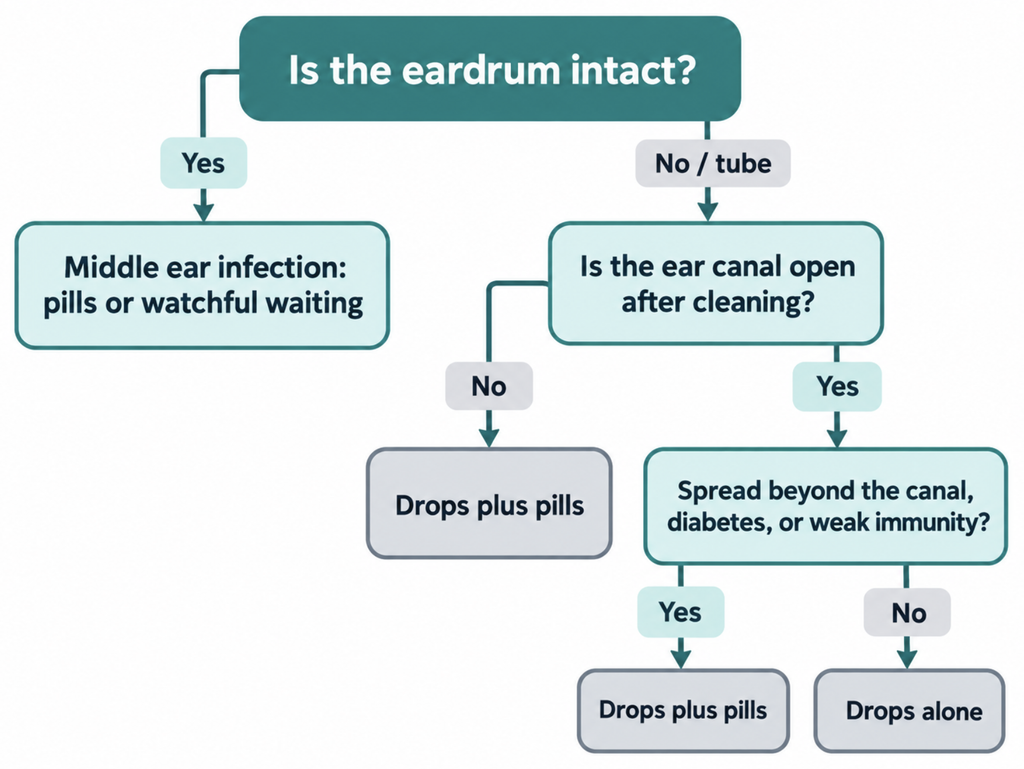
Swimmer’s ear. A Cochrane review concluded that topical treatment alone works for uncomplicated cases and that the type of drop rarely changes the outcome [Kaushik, Interventions for acute otitis externa, 2010]. The current guideline strongly recommends against starting with oral antibiotics, because the antibiotics usually given by mouth do not kill most of the germs involved [Rosenfeld, Clinical practice guideline: acute otitis externa, 2014].
Ear tubes. In a trial of 230 children with a newly discharging tube, 5% of those given antibiotic-steroid drops still had discharge at two weeks, compared with 44% given oral antibiotics and 55% who were simply observed [van Dongen, A trial of treatment for acute otorrhea in children with tympanostomy tubes, 2014]. An earlier trial found clinical cure in 85% with drops versus 59% with oral antibiotics [Dohar, Topical ciprofloxacin/dexamethasone superior to oral amoxicillin/clavulanic acid in acute otitis media with otorrhea through tympanostomy tubes, 2006].
A middle ear infection that bursts the eardrum. This looks similar to tube discharge, but so far the evidence favors pills. A Dutch trial designed to show drops were as good as pills recruited only 58 of a planned 350 children and stopped early. By the third day, pain and fever had resolved in 42% of children on drops versus 65% on oral antibiotics, although the drop group had less stomach upset and rash [Hullegie, Topical or oral antibiotics in childhood acute otitis media and ear discharge, 2024]. The numbers are too small to settle the question, so for now oral antibiotics remain the usual choice here.
Chronic discharge through a perforated eardrum. Small, older trials suggest the same antibiotic may dry the ear more often as a drop than as a pill [Chong, Topical versus systemic antibiotics for chronic suppurative otitis media, 2021]. When everyone already used ciprofloxacin drops, adding oral ciprofloxacin appeared to make little or no difference [Chong, Systemic antibiotics for chronic suppurative otitis media, 2025].
Antibiotic-only drops versus antibiotic-steroid drops
A steroid in the drop seems to speed recovery modestly without changing the final result. In 201 children with tube discharge, an antibiotic-steroid drop dried the ear in 4.2 days versus 5.3 days with the antibiotic alone, about one day sooner, with no difference in cure by two weeks [Roland, Topical ciprofloxacin/dexamethasone is superior to ciprofloxacin alone in pediatric patients with acute otitis media and otorrhea through tympanostomy tubes, 2003]. Pooled trials in children with tubes show short-term resolution of 35% versus 20%, but the reviewers warn that unpublished negative studies may exaggerate this gap [Venekamp, Interventions for children with ear discharge occurring at least two weeks following grommet insertion, 2016].
What about oral steroids for ear infections?
No good evidence supports routine steroid pills in these ear infections. For middle ear infections in children, only two small trials exist and the effect remains uncertain [Ranakusuma, Systemic corticosteroids for acute otitis media in children, 2018]. For swimmer’s ear, the Cochrane review found no trials of oral steroids at all, while topical treatment alone was effective [Kaushik, Interventions for acute otitis externa, 2010]. When the ear needs a steroid, the drop usually supplies it.
Safety when the eardrum is open
If the eardrum has a hole or a tube, some drop types can harm the inner ear. Guidelines therefore call for a non-ototoxic preparation whenever a perforation or tube is known or suspected [Rosenfeld, Clinical practice guideline: acute otitis externa, 2014]. A drop that is safe for one ear may be wrong for another, which is one reason not to reuse leftover drops.
When to use both
Doctors add oral antibiotics to drops, rather than substitute them, in a few defined situations [Rosenfeld, Clinical practice guideline: acute otitis externa, 2014]:
- Infection spreading beyond the ear canal, such as redness and swelling of the outer ear or nearby skin
- Diabetes, a weakened immune system or prior radiation to the area
- A canal that stays blocked even after cleaning, so drops cannot get in
If the ear has not improved after 48 to 72 hours, the guideline’s next step is a re-examination to confirm the diagnosis, not an automatic pill [Rosenfeld, Clinical practice guideline: acute otitis externa, 2014].
Severe allergic rhinitis: nasal steroid spray vs oral steroids, alone or together?
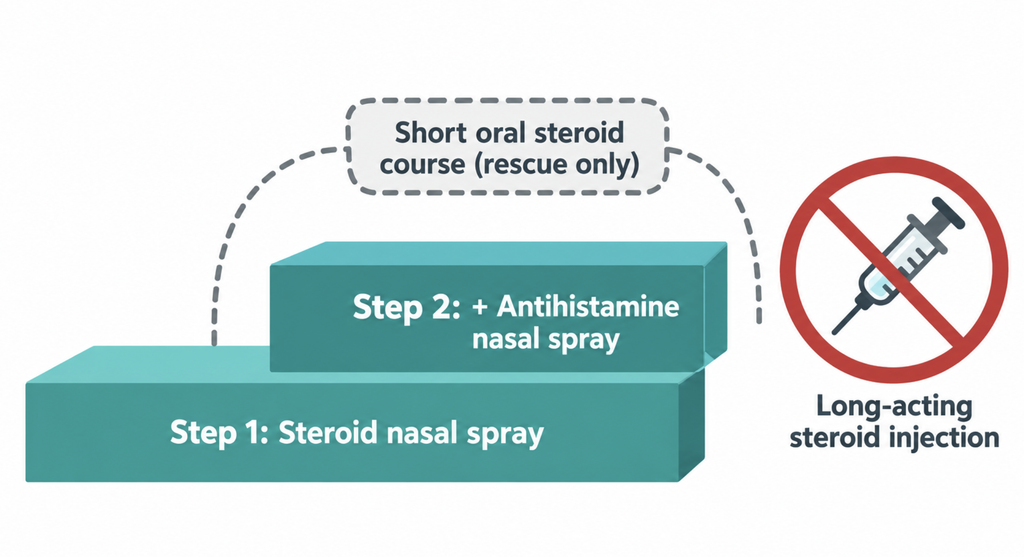
A steroid nasal spray is the first-line treatment for allergic rhinitis that affects quality of life [Seidman, Clinical practice guideline: allergic rhinitis, 2015], and oral steroids are at most a short rescue. A meta-analysis of 35 randomized trials found that nasal steroid sprays relieve nasal symptoms and improve quality of life more than oral antihistamines or montelukast [Torres, Intranasal versus oral treatments for allergic rhinitis, 2024]. In a small open-label comparison, a mometasone spray and an oral steroid tablet gave nearly the same nasal relief. That suggests the pill adds body-wide risk without adding benefit [Karaki, Efficacy of intranasal steroid spray (mometasone furoate) on treatment of patients with seasonal allergic rhinitis, 2013].
| Option | Effect on nasal symptoms | Body-wide steroid exposure | Where it fits |
|---|---|---|---|
| Steroid spray alone | Strongest single option | Low | First line |
| Steroid tablets alone | Similar to the spray in a small study | High | Not for routine use |
| Short tablet course plus spray | Not tested in trials; based on expert guidance | High, briefly | Severe flares uncontrolled by other treatment |
| Long-acting steroid injection | Not a reason to choose it | High and uncontrolled | Avoid because of risks |
| Steroid spray plus antihistamine spray | Adds benefit over the steroid spray alone | Low | Next step when the spray alone falls short |
When an oral steroid is worth adding
Expert guidance allows a short course of oral steroids for moderate to severe symptoms that other treatments have not controlled [Brozek, Allergic Rhinitis and its Impact on Asthma (ARIA) guidelines: 2010 revision, 2010]. A more recent international consensus argues against routine use [Wise, International consensus statement on allergy and rhinology: allergic rhinitis – 2023, 2023]. No trial has directly tested a short pill course added to a spray, so the reasoning is practical rather than proven. When the nasal lining is so swollen that the spray cannot reach it, a brief course may reopen the passage so the spray can work.
Doctors sometimes give long-acting steroid injections once a season as a “hay fever shot,” but current guidance does not recommend them [Dykewicz, Rhinitis 2020: a practice parameter update, 2020]. In a Danish registry study, people who received such injections year after year had 1.5 times the rate of diabetes and 1.2 times the rate of osteoporosis compared with people treated with allergen immunotherapy [Aasbjerg, Treating allergic rhinitis with depot-steroid injections increase risk of osteoporosis and diabetes, 2013].
If the spray alone is not enough, the next step usually stays in the nose. Adding an antihistamine spray to a steroid spray gives additional benefit [Dykewicz, Rhinitis 2020: a practice parameter update, 2020].
How to choose a nasal steroid spray
- Pick one with low body-wide exposure for long-term use. Growth slowing has been reported with twice-daily use of some older sprays, but it does not appear with once-daily sprays that the liver clears efficiently [Allen, Systemic effects of intranasal steroids: an endocrinologist’s perspective, 2000]. In children aged three to nine, a year of mometasone spray did not slow growth [Schenkel, Absence of growth retardation in children with perennial allergic rhinitis after one year of treatment with mometasone furoate aqueous nasal spray, 2000].
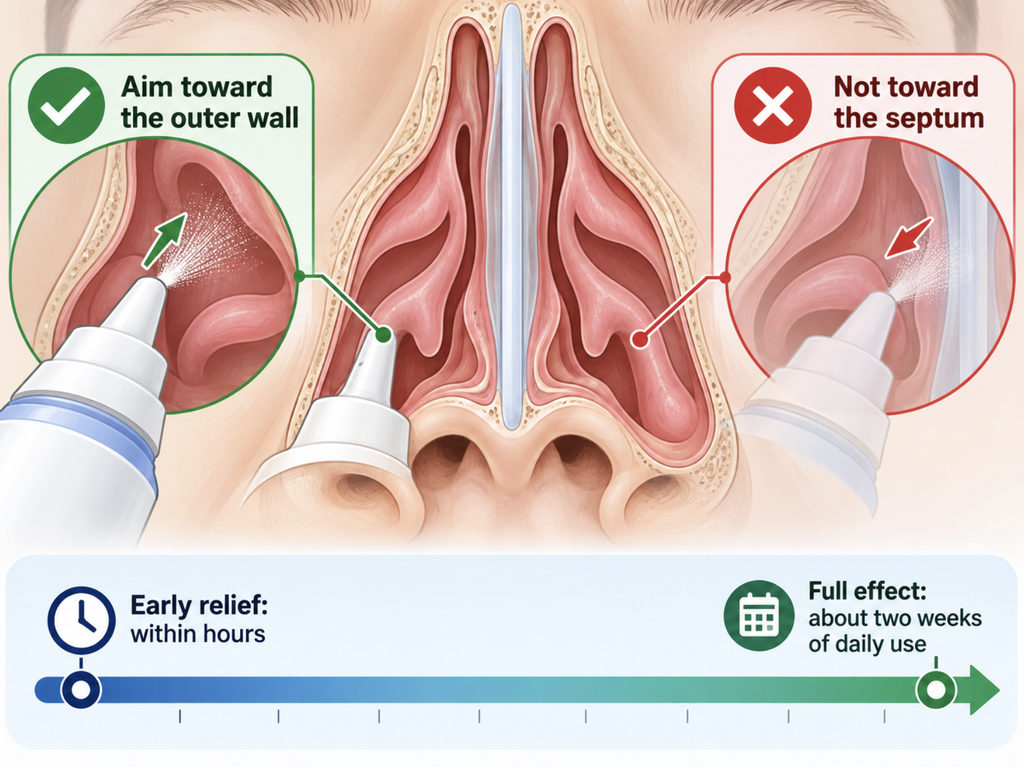
- Use it daily and expect gradual results. Symptoms can begin to improve within 4 hours of the first dose [Bende, A randomized comparison of the effects of budesonide and mometasone furoate aqueous nasal sprays on nasal peak flow rate and symptoms in perennial allergic rhinitis, 2002], but full benefit can take about two weeks of daily use [MedlinePlus, Nasal corticosteroid sprays, 2025].
- Aim away from the center. Spraying toward the outer wall of the nostril, not the septum, avoids the rare risk of damaging the septum [MedlinePlus, Nasal corticosteroid sprays, 2025].
Key takeaways
- When choosing between a drop or spray and a pill, first ask whether the drug can physically reach the problem.
- For swimmer’s ear and discharging ear tubes, antibiotic drops alone outperform oral antibiotics. Pills are added only for spreading infection, high-risk patients or blocked access.
- Drops cannot treat a middle ear infection behind an intact eardrum, and for an eardrum that has just burst, oral antibiotics remain the usual choice.
- For allergic rhinitis, a steroid nasal spray is first line. Oral steroids are a short rescue at most, and long-acting steroid injections should be avoided.
- Combine treatments when one route cannot reach the target. Adding a pill to make treatment “stronger” rarely helps.
FAQ
Do I need oral antibiotics or ear drops for an ear infection?
It depends on where the infection is. Swimmer’s ear and discharging ear tubes are best treated with antibiotic drops alone [Rosenfeld, Clinical practice guideline: acute otitis externa, 2014; van Dongen, A trial of treatment for acute otorrhea in children with tympanostomy tubes, 2014]. Drops cannot reach a middle ear infection behind an intact eardrum, so doctors manage it with oral antibiotics or watchful waiting [Lieberthal, The diagnosis and management of acute otitis media, 2013].
Can ear drops and oral antibiotics be used together?
Yes, in specific situations. Pills are added when infection spreads beyond the ear canal, when drops cannot get in, or in people with diabetes or weakened immunity [Rosenfeld, Clinical practice guideline: acute otitis externa, 2014]. Otherwise, adding pills to drops has not been shown to help [Hannley, Use of ototopical antibiotics in treating 3 common ear diseases, 2000].
Do steroid-containing ear drops work better than antibiotic-only drops?
Slightly. In children with ear tubes, an antibiotic-steroid drop dried the ear about one day sooner than the antibiotic alone, with similar final cure rates [Roland, Topical ciprofloxacin/dexamethasone is superior to ciprofloxacin alone in pediatric patients with acute otitis media and otorrhea through tympanostomy tubes, 2003].
Is a nasal steroid spray safer than oral steroids?
Yes. Modern sprays act on the nasal lining with little body-wide exposure [Daley-Yates, Intranasal corticosteroids: topical potency, systemic activity and therapeutic index, 2021], while even short courses of steroid pills have been linked to sepsis, blood clots and fractures [Waljee, Short term use of oral corticosteroids and related harms among adults in the United States, 2017].
Can I use a nasal steroid spray and oral steroids together?
Sometimes, briefly. Some guidelines allow a short oral course for moderate to severe symptoms that other treatments have not controlled [Brozek, Allergic Rhinitis and its Impact on Asthma (ARIA) guidelines: 2010 revision, 2010]. The course is not meant for routine or repeated use [Wise, International consensus statement on allergy and rhinology: allergic rhinitis – 2023, 2023].
How long does a nasal steroid spray take to work?
Hours to weeks. Some relief can start within 4 hours [Bende, A randomized comparison of the effects of budesonide and mometasone furoate aqueous nasal sprays on nasal peak flow rate and symptoms in perennial allergic rhinitis, 2002], but full effect can take about two weeks of daily use [MedlinePlus, Nasal corticosteroid sprays, 2025].
References
- Rosenfeld RM, Schwartz SR, Cannon CR, Roland PS, Simon GR, Kumar KA, et al. Clinical practice guideline: acute otitis externa. Otolaryngol Head Neck Surg. 2014 Feb;150(1 Suppl):S1-S24.
- American Academy of Family Physicians. AAO-HNSF releases clinical practice guideline on acute otitis externa. Am Fam Physician. 2014 Nov 15. Available from: https://www.aafp.org/pubs/afp/issues/2014/1115/p731.html
- Kaushik V, Malik T, Saeed SR. Interventions for acute otitis externa. Cochrane Database Syst Rev. 2010 Jan 20;2010(1):CD004740.
- Hannley MT, Denneny JC, Holzer SS. Use of ototopical antibiotics in treating 3 common ear diseases. Otolaryngol Head Neck Surg. 2000 Jun;122(6):934-40.
- van Dongen TM, van der Heijden GJ, Venekamp RP, Rovers MM, Schilder AG. A trial of treatment for acute otorrhea in children with tympanostomy tubes. N Engl J Med. 2014 Feb 20;370(8):723-33.
- Venekamp RP, Javed F, van Dongen TM, Waddell A, Schilder AG. Interventions for children with ear discharge occurring at least two weeks following grommet (ventilation tube) insertion. Cochrane Database Syst Rev. 2016 Nov 17;11(11):CD011684.
- Dohar J, Giles W, Roland P, Bikhazi N, Carroll S, Moe R, et al. Topical ciprofloxacin/dexamethasone superior to oral amoxicillin/clavulanic acid in acute otitis media with otorrhea through tympanostomy tubes. Pediatrics. 2006 Sep;118(3):e561-9.
- Roland PS, Anon JB, Moe RD, Conroy PJ, Wall GM, Dupre SJ, et al. Topical ciprofloxacin/dexamethasone is superior to ciprofloxacin alone in pediatric patients with acute otitis media and otorrhea through tympanostomy tubes. Laryngoscope. 2003 Dec;113(12):2116-22.
- Hullegie S, Damoiseaux RAMJ, Hay AD, Zuithoff NPA, van Dongen TMA, Little P, et al. Topical or oral antibiotics in childhood acute otitis media and ear discharge: a randomized controlled non-inferiority trial. Fam Pract. 2024 Oct 8;41(5):857-861.
- Lieberthal AS, Carroll AE, Chonmaitree T, Ganiats TG, Hoberman A, Jackson MA, et al. The diagnosis and management of acute otitis media. Pediatrics. 2013 Mar;131(3):e964-99.
- Chong LY, Head K, Webster KE, Daw J, Richmond P, Snelling T, et al. Topical versus systemic antibiotics for chronic suppurative otitis media. Cochrane Database Syst Rev. 2021 Feb 9;2(2):CD013053.
- Chong LY, Head K, Webster KE, Daw J, Strobel NA, Richmond PC, et al. Systemic antibiotics for chronic suppurative otitis media. Cochrane Database Syst Rev. 2025 Jun 9;6(6):CD013052.
- Ranakusuma RW, Pitoyo Y, Safitri ED, Thorning S, Beller EM, Sastroasmoro S, et al. Systemic corticosteroids for acute otitis media in children. Cochrane Database Syst Rev. 2018 Mar 15;3(3):CD012289.
- Howland WC, Hampel FC, Martin BG, Ratner PH, van Bavel JH, Field EA. The efficacy of fluticasone propionate aqueous nasal spray for allergic rhinitis and its relationship to topical effects. Clin Ther. 1996;18(6):1106-17.
- Daley-Yates PT, Larenas-Linnemann D, Bhargave C, Verma M. Intranasal corticosteroids: topical potency, systemic activity and therapeutic index. J Asthma Allergy. 2021 Sep 8;14:1093-1104.
- Waljee AK, Rogers MA, Lin P, Singal AG, Stein JD, Marks RM, et al. Short term use of oral corticosteroids and related harms among adults in the United States: population based cohort study. BMJ. 2017 Apr 12;357:j1415.
- Seidman MD, Gurgel RK, Lin SY, Schwartz SR, Baroody FM, Bonner JR, et al. Clinical practice guideline: allergic rhinitis. Otolaryngol Head Neck Surg. 2015 Feb;152(1 Suppl):S1-43.
- Torres MI, Gil-Mata S, Bognanni A, Ferreira-da-Silva R, Yepes-Nuñez JJ, Lourenço-Silva N, et al. Intranasal versus oral treatments for allergic rhinitis: a systematic review with meta-analysis. J Allergy Clin Immunol Pract. 2024 Dec;12(12):3404-3418.
- Karaki M, Akiyama K, Mori N. Efficacy of intranasal steroid spray (mometasone furoate) on treatment of patients with seasonal allergic rhinitis: comparison with oral corticosteroids. Auris Nasus Larynx. 2013 Jun;40(3):277-81.
- Brozek JL, Bousquet J, Baena-Cagnani CE, Bonini S, Canonica GW, Casale TB, et al. Allergic Rhinitis and its Impact on Asthma (ARIA) guidelines: 2010 revision. J Allergy Clin Immunol. 2010 Sep;126(3):466-76.
- Wise SK, Damask C, Roland LT, Ebert C, Levy JM, Lin S, et al. International consensus statement on allergy and rhinology: allergic rhinitis – 2023. Int Forum Allergy Rhinol. 2023 Apr;13(4):293-859.
- Dykewicz MS, Wallace DV, Amrol DJ, Baroody FM, Bernstein JA, Craig TJ, et al. Rhinitis 2020: a practice parameter update. J Allergy Clin Immunol. 2020 Oct;146(4):721-767.
- Aasbjerg K, Torp-Pedersen C, Vaag A, Backer V. Treating allergic rhinitis with depot-steroid injections increase risk of osteoporosis and diabetes. Respir Med. 2013 Dec;107(12):1852-8.
- Allen DB. Systemic effects of intranasal steroids: an endocrinologist’s perspective. J Allergy Clin Immunol. 2000 Oct;106(4 Suppl):S179-90.
- Schenkel EJ, Skoner DP, Bronsky EA, Miller SD, Pearlman DS, Rooklin A, et al. Absence of growth retardation in children with perennial allergic rhinitis after one year of treatment with mometasone furoate aqueous nasal spray. Pediatrics. 2000 Feb;105(2):E22.
- Bende M, Carrillo T, Vóna I, da Castel-Branco MG, Arheden L. A randomized comparison of the effects of budesonide and mometasone furoate aqueous nasal sprays on nasal peak flow rate and symptoms in perennial allergic rhinitis. Ann Allergy Asthma Immunol. 2002 Jun;88(6):617-23.
- MedlinePlus. Nasal corticosteroid sprays [Internet]. Bethesda (MD): National Library of Medicine (US); [reviewed 2025 Oct 1; cited 2026 Oct 17]. Available from: https://medlineplus.gov/ency/patientinstructions/000404.htm
Joonpyo Hong, MD is a board-certified otolaryngologist practicing in Korea. This article reflects his clinical interpretation of published research and does not constitute individual medical advice.
For more articles:
https://curiousmd.com/preauricular-sinus-infection/
https://curiousmd.com/itchy-ear-canal-no-infection-otitis-externa/
https://curiousmd.com/otomycosis/
Link out to:
https://www.aafp.org/pubs/afp/issues/2014/1115/p731.html — American Family Physician’s summary of the AAO-HNSF guideline on swimmer’s ear: drops first, pills only in specific situations.
https://www.entnet.org/sites/default/files/AOEGuidelinePatientFAQFinal_0.pdf — AAO-HNS Foundation patient FAQ explaining why ear drops beat pills for swimmer’s ear.
https://cochranelibrary.com/cdsr/doi/10.1002/14651858.CD011684.pub2 — Cochrane review comparing treatments for ear discharge in children with ear tubes.
https://medlineplus.gov/ency/patientinstructions/000404.htm — MedlinePlus guide to using nasal corticosteroid sprays and how long they take to work.
https://www.nationalasthma.org.au/resources/intranasal-spray-technique — National Asthma Council Australia guidance on correct nasal spray technique.