
A primary care physician has a few minutes before the next patient walks in. In front of them is a chart thick with years of notes, lab results and specialist letters, and one question to answer fast: what has changed? Claude for Healthcare and its partners say they can shrink that problem, and in January 2026 they had a headline number to point to. The electronic health record (EHR) vendor Elation Health reported a 61% reduction after moving its chart-summary tool onto Anthropic’s Claude [Elation Health, Press Release, 2026]. What it reduced is narrower than the number first suggests.
Physicians had reason to pay attention. Time-motion research has found that for every hour physicians spend face to face with patients, they spend nearly 2 hours of EHR and desk work [Sinsky, Allocation of Physician Time, 2016]. In one primary care system, physicians spent 5.9 hours of an 11.4-hour workday in the EHR, more than half of it [Arndt, Tethered to the EHR, 2017]. Any tool that promises to give some of that back deserves a hearing.
Eleven days later, though, Elation’s own media roundup described the same 61% as a cut in “documentation time,” a different and much larger claim [Elation Health, Media Roundup, 2026]. The underlying progress is real, but the number grew as it was retold.
This article traces that number back to its source, then looks the same way at the prior authorization tools launched alongside it. In both cases the evidence supports a narrower version of the story than the retelling.
The Two Jobs That Eat a Physician’s Day: Charts and Forms
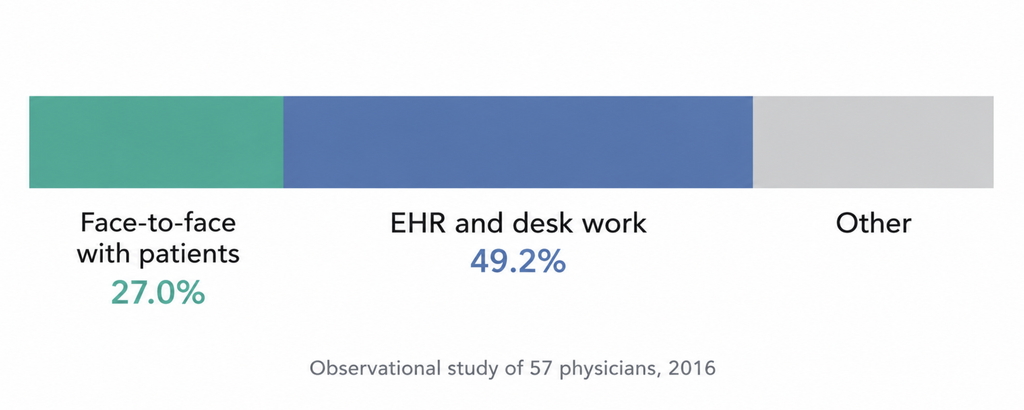
The first job is the chart. A 2017 study of 142 family physicians used EHR activity logs, checked against direct observation, to measure where the day went. Physicians logged 5.9 hours of an 11.4-hour workday in the record, including 1.4 hours after clinic hours. Clerical and administrative tasks (documentation, order entry, billing) took 44.2% of that EHR time, nearly half [Arndt, Tethered to the EHR, 2017]. An earlier observational study of 57 physicians in 4 specialties found a similar pattern. Physicians spent 27.0% of the office day face to face with patients, about a quarter, and 49.2% on EHR and desk work, about half. Those who kept after-hours diaries reported 1 to 2 hours of additional work each night [Sinsky, Allocation of Physician Time, 2016].
The second job is the form. Prior authorization, the requirement that an insurer approve a test, drug or procedure before it is covered, has become a shift of its own. In the American Medical Association’s survey of 1,000 physicians in late 2024, doctors reported an average of 39 prior authorizations per physician per week, nearly 8 every working day, consuming 13 hours of physician and staff time per week [AMA, Prior Authorization Survey, 2025]. The figures are self-reported, from a group that lobbies on the issue.
Both burdens are widely linked to burnout, though neither is its only cause. The AMA’s own tracking shows burnout was already falling: 53% of physicians reported at least one symptom in 2022, 48.2% in 2023 and 43.2% in 2024 (about 4 in 10), and the 2024 figure drew on nearly 18,000 physician responses [AMA, Physician Burnout, 2025]. Many forces besides software move that number, so no single tool can claim credit for a change in it.
The problem also has a built-in limit. Some paperwork exists because information is scattered, and some exists because rules demand it. AI can help with the first kind. The second kind is policy, and software can help assemble the paperwork without changing the rule behind it.
Inside the Chart: How Claude Summarizes Records in Elation’s EHR
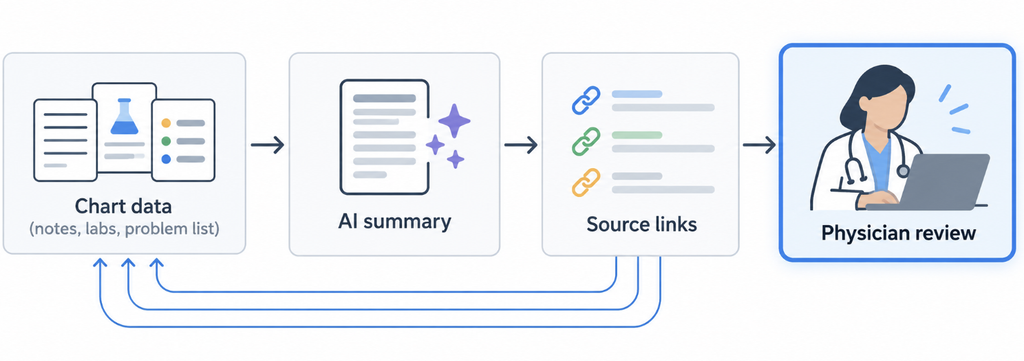
Elation Health builds an EHR for primary care and says it serves more than 46,000 clinical users caring for 24 million patients across 50 states [Anthropic, Elation Health Customer Story, 2026]. Its chart-summary feature, Clinical Insights, first launched in September 2025 with another model provider. In January 2026, Elation announced that Claude now powers it [Elation Health, Press Release, 2026].
The most important design choice has little to do with speed. According to Elation, each summary links back to the note, lab result or problem-list entry it came from, so a physician can click through and check [Anthropic, Elation Health Customer Story, 2026]. Elation says the citations are meant to keep the physician in control of clinical decisions [Elation Health, Press Release, 2026]. The summary works like a map; the chart is still the territory.
This matters because AI-written clinical summaries do make mistakes. One large evaluation looked at AI-generated clinical notes drafted from conversations (a different task from chart summary), using 12,999 clinician-annotated sentences. The hallucination rate, meaning content that was not in the source, was 1.47%, about 1 sentence in 70. The omission rate was 3.45%, about 1 in 30 [Asgari, Clinical Safety and Hallucination Rates, 2025]. The authors also showed that better prompts and workflows reduced major errors.
Human-written summaries are not a clean baseline either. In a Nature Medicine reader study, 10 physicians compared summaries from adapted language models with summaries written by medical experts. The AI versions were rated equivalent in 45% of cases and superior in 36%, so as good or better in roughly 8 of 10 comparisons [Van Veen, Adapted LLMs Outperform Experts, 2024]. Human summaries contained errors too. Neither study tested Elation’s tool, and no error rate for Clinical Insights itself has been published.
Errors are uncommon but real in both machine and human summaries, which is why the citations matter: they let a physician check instead of simply trusting.
Clinical Perspective. A cited summary changes the physician’s job from reading everything to checking what matters. That is a real improvement, as long as physicians keep checking even when it would be easier not to.
Dissecting the 61%: What Actually Got Faster
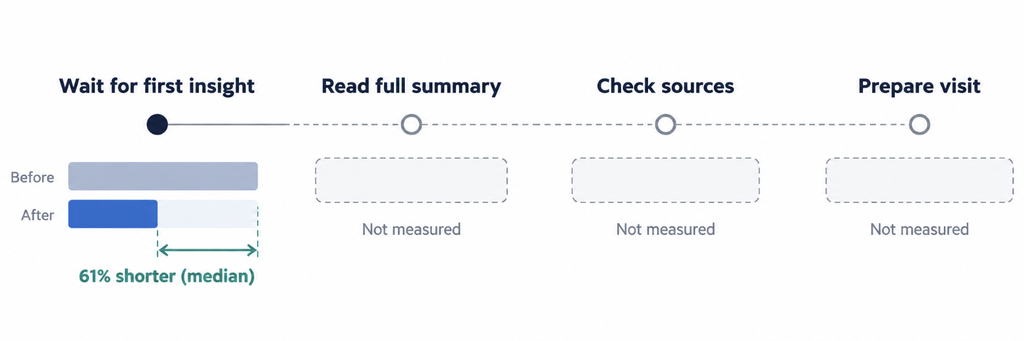
The 61% describes one specific moment in the workflow. Anthropic’s customer story defines it as a 61% reduction in median time to first insight, meaning how long a clinician waits before the first useful piece of the summary appears on screen [Anthropic, Elation Health Customer Story, 2026]. Elation says a single Claude model, Haiku, now powers the feature, and the comparison is with its previous model provider. Responses stream as they are generated, so the physician can start reading sooner. That speeds up the first answer, not necessarily the whole task.
The wording then drifted. The table below shows how the same figure was described in different places.
| How the 61% was described | Where | What it measures | Supported by the published definition? |
|---|---|---|---|
| “61% reduction in median time to first insight” | Anthropic customer story | Wait until the first insight appears | Yes (company-reported) |
| “61% faster answers at the point of care” | Elation press release | Same metric, framed as answers | Consistent, but broader wording |
| “61% faster chart review and documentation” / “61% reduction in documentation time” | Elation media roundup blog | Total charting and note-writing time | No |
| Shorter total visit preparation | Not reported in any source reviewed | Whole pre-visit workflow | Not measured |
The first two rows come from the original announcements. The third appeared in Elation’s own roundup of press coverage, where the figure became “faster chart review and documentation” [Elation Health, Media Roundup, 2026]. No one invented a new number. The same figure was simply given a bigger job.
The improvement still matters. Waiting is friction, and friction decides whether a busy clinician opens a tool at all. Elation reports that usage of the feature doubled after the switch [Anthropic, Elation Health Customer Story, 2026], which suggests clinicians found it worth opening, though usage is not the same as better care. The measurement period, sample and method behind both figures have not been published, and neither has been peer reviewed.
A faster first answer is a real gain, but it does not mean a shorter day.
Clinical Perspective. In clinic, speed to the first answer often decides whether a summary gets used before the patient is in the room. That makes the 61% meaningful as a usability result. However, we should keep in mind that it says nothing about whether visits are better prepared, notes are shorter or patients do better.
What Claude for Healthcare Actually Ships for Prior Authorization
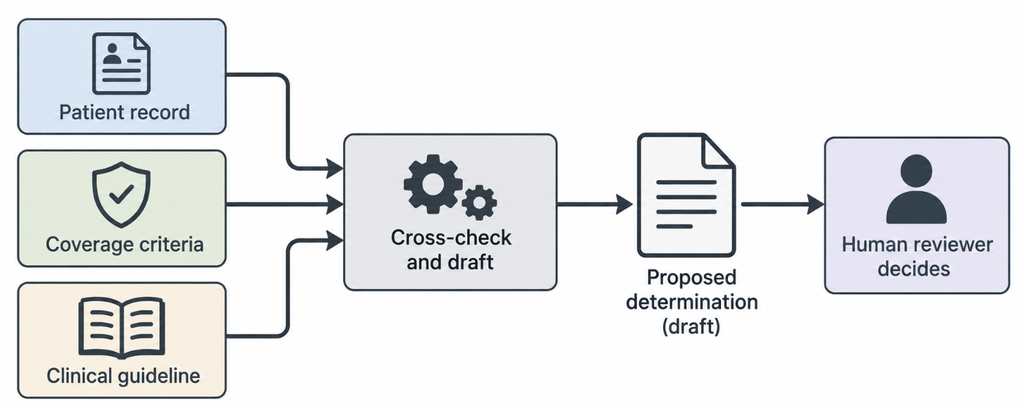
Anthropic’s January 2026 announcement of Claude for Healthcare was framed around tasks like prior authorization and claims appeals [Anthropic, Claude for Healthcare Announcement, 2026]. That framing invites readers to assume automation, but the components are more modest. Anthropic released connectors to the Centers for Medicare & Medicaid Services (CMS) Coverage Database, to ICD-10 diagnosis and procedure codes, and to the National Provider Identifier Registry. It also released a skill for FHIR, the standard format for exchanging health data between systems, and a sample prior authorization review skill, which is a template each organization adapts to its own policies. In Anthropic’s description, Claude proposes a determination with supporting materials for the payer’s review.
In other words, Anthropic shipped a toolkit, not a finished machine. The task does suit language models: matching a patient’s chart against a payer’s written criteria and a clinical guideline is document-heavy cross-checking, which they handle well. Whether that leads to faster approvals or fewer wrongful denials is still largely unproven.
The evidence so far is thin. A 2026 systematic review found 16 studies applying AI to real prior authorization workflows. Of these, 62.5% (nearly two-thirds) focused on insurer-side review, and few measured operational outcomes such as decision speed, denial rates or cost [Mousavi, AI in Prior Authorization, 2026]. A study of 29 AI-drafted prior authorization letters for simulated nephrology cases, written by a different company’s model, found the clinical reasoning mostly sound. But only 23 of the 29 letters (79.3%) carried correct diagnosis codes, so about 1 letter in 5 had a coding error [Aiumtrakul, LLM Prior Authorization Letters, 2026].
The most pointed finding comes from a simulated test using 836 synthetic patient records, published as a preprint and not yet peer reviewed. AI agents, including a Claude model, completed most prior authorization forms in a mock insurer portal but rarely stopped to flag cases where the paperwork was incomplete. In a plain conversational setting, the same models caught most of those gaps [Nie, Hard to Halt, 2026]. In this test, the problem looked less like missing knowledge than momentum. An agent built to finish a form tended to finish it.
Regulation is pushing the work toward software regardless. A federal rule finalized in 2024 requires Medicare Advantage, Medicaid and CHIP plans to answer urgent prior authorization requests within 72 hours and standard ones within 7 days. Marketplace plans are covered by other parts of the rule. Operational provisions began January 1, 2026, and electronic prior authorization systems are due from January 1, 2027 [CMS, Prior Authorization Final Rule, 2024].
The same tools sit on both sides of the counter. A 2024 U.S. Senate investigation raised concerns that large Medicare Advantage insurers were denying more post-acute care as automated review tools spread. The investigation said the pattern was troubling whether the tools or the people using them drove those decisions, and it did not show that AI caused the denials [Senate PSI, Refusal of Recovery, 2024]. Software that helps a clinic assemble a request can just as easily be used to screen one.
Anthropic markets its provider and payer products as “HIPAA-ready” [Anthropic, Claude for Healthcare Announcement, 2026]. In practice, that means a signed business associate agreement covering Anthropic’s commercial enterprise or API products, with specific settings enabled. Data passed on to third parties through connectors falls outside that agreement [Anthropic, BAA for Commercial Customers, 2026]. A personal chat account does not have that setup.
Patients at the Other End: Connecting Personal Health Records
The same January 2026 launch reached patients directly. Paid Pro and Max subscribers in the United States could connect lab results and health records to Claude through HealthEx and Function, with Apple Health and Android Health Connect integrations rolling out in beta. As announced, the feature was a U.S.-only beta, and users had to opt in explicitly to each connection [Anthropic, Claude for Healthcare Announcement, 2026].
Anthropic describes the use as helping people understand their own records and test results. The company says it does not use users’ health data to train its models. It later clarified that its HIPAA-ready products are aimed at providers and payers, and that personal health integrations are a separate offering [Anthropic, Claude for Healthcare Announcement, 2026].
The limits are just as clear. The service was not offered outside the United States at launch, it is not a diagnostic device, and an explanation of a lab value is not a clinical assessment of the person behind it. A patient who arrives with better questions makes a visit more productive. A patient who arrives with a machine’s conclusion may need part of the visit to untangle it.
What the AI Scribe Trials Show, and Three Questions to Ask
The closest thing to hard evidence on AI paperwork tools comes from AI scribes, which listen to visits and draft the note, rather than from chart summaries. The first randomized trials were published in 2025. In one, 238 physicians in 14 specialties were assigned to one of two scribe products or usual care. One product cut time spent writing notes by 9.5%, while the other showed no significant change (−1.7%) [Lukac, Ambient AI Scribes RCT, 2025]. In another, 66 practitioners over 24 weeks spent 0.36 hours less on notes per day (about 20 minutes) and reported less work exhaustion, without a clear gain in professional fulfillment [Afshar, Ambient AI Pragmatic RCT, 2025].
Taken together, the trials point toward modest time savings for some products, not all, and the effect on burnout is even less certain. A crossover trial of 160 clinicians, which compared two scribe products with each other rather than with no scribe, found burnout scores fell with both, but after-hours EHR time barely moved [Chowdhury, Comparing Ambient Scribes, 2026]. A 2026 review offered one way to read this: AI often moves work rather than removing it, shifting effort from writing to supervising [Sucharitrak, AI and Clinician Burnout, 2026]. None of these trials tested Claude.
The Elation story suggests three questions worth asking of any medical AI headline. What was measured: the first answer, the whole task, or the patient’s outcome? Compared with what: the previous software, no software, or a human?
And who makes the final call: the model, or a person who can still say no?
These questions don’t take anything away from the news. They make it easier to read correctly.
Key Takeaways
- Elation Health’s 61% measures how quickly the first AI insight appears on screen, not total charting or documentation time.
- Cited summaries that link back to the original chart are an important safeguard in AI chart review, because AI and human summaries both contain errors.
- Claude for Healthcare’s prior authorization offering is a set of data connectors and a customizable template that drafts a determination for human review, not an autonomous approval system.
- Research on AI in prior authorization still measures technical accuracy far more often than faster approvals, fewer denials or lower costs.
- The first randomized trials of AI scribes show modest time savings for some products but not others, and early, unsettled signs of reduced burnout.
- Any medical AI claim becomes clearer once three things are known: what was measured, what it was compared with, and who makes the final decision.
FAQ
Does Claude for Healthcare cut physicians’ documentation time by 61%?
No. The 61% refers to the median time until the first insight appears in Elation Health’s chart-summary tool, not to total documentation or visit-preparation time. Some later descriptions widened the claim, but the original definition is narrower, and the measurement method has not been published [Anthropic, Elation Health Customer Story, 2026].
Can Claude approve or deny prior authorization requests on its own?
No. Anthropic describes Claude as proposing a determination with supporting materials for the payer’s review, built on connectors and a sample template that each organization customizes. In a simulated test published as a preprint and not yet peer reviewed, AI agents rarely paused on incomplete paperwork, which argues for keeping a human reviewer in place [Nie, Hard to Halt, 2026].
Are AI-generated chart summaries accurate enough to trust?
Not without checking. Studies of AI clinical summaries find errors uncommon but real (one large evaluation found content not in the source in about 1 sentence in 70), and human summaries also contain mistakes. Summaries that cite their sources let physicians check quickly [Asgari, Clinical Safety and Hallucination Rates, 2025].
Can patients outside the United States connect their health records to Claude?
No, not at launch. The personal health record connections announced in January 2026 were a U.S.-only beta for paid Pro and Max subscribers, required opt-in for each connection, and Anthropic stated it does not use that health data to train its models [Anthropic, Claude for Healthcare Announcement, 2026].
References
- Arndt BG, Beasley JW, Watkinson MD, et al. Tethered to the EHR: primary care physician workload assessment using EHR event log data and time-motion observations. Ann Fam Med. 2017;15(5):419.
- Sinsky C, Colligan L, Li L, et al. Allocation of physician time in ambulatory practice: a time and motion study in 4 specialties. Ann Intern Med. 2016.
- AMA (American Medical Association). Fixing prior auth: nearly 40 prior authorizations a week is way too many. Published April 24, 2025. https://ama-assn.org/practice-management/prior-authorization/fixing-prior-auth-nearly-40-prior-authorizations-week-way
- AMA (American Medical Association). U.S. physician burnout hits lowest rate since COVID-19. Published May 1, 2025. https://www.ama-assn.org/practice-management/physician-health/us-physician-burnout-hits-lowest-rate-covid-19
- Elation Health. Elation Health and Anthropic team to power Clinical Insights for primary care [press release]. Business Wire; January 12, 2026. https://www.businesswire.com/news/home/20260112338194/en
- Anthropic. Elation Health delivers faster clinical insights with Claude [customer story]. 2026. https://claude.com/customers/elation-health
- Elation Health. Media roundup: how Elation & Anthropic’s Claude AI are showing up in the headlines. January 23, 2026. https://www.elationhealth.com/resources/blogs/media-roundup-how-elation-anthropic-s-claude-ai-are-showing-up-in-the-headlines
- Asgari E, Montaña-Brown N, Dubois M, et al. A framework to assess clinical safety and hallucination rates of LLMs for medical text summarisation. NPJ Digit Med. 2025.
- Van Veen D, Van Uden C, Blankemeier L, et al. Adapted large language models can outperform medical experts in clinical text summarization. Nat Med. 2024.
- Anthropic. Advancing Claude in healthcare and the life sciences. January 11, 2026. https://www.anthropic.com/news/healthcare-life-sciences
- CMS (Centers for Medicare & Medicaid Services). CMS Interoperability and Prior Authorization Final Rule (CMS-0057-F) fact sheet. January 17, 2024. https://www.cms.gov/newsroom/fact-sheets/cms-interoperability-and-prior-authorization-final-rule-cms-0057-f
- Mousavi T, Tohme Shaya F, Cooke CE, et al. Artificial intelligence in prior authorization and coverage decisions: a systematic review of methods, evidence gaps, and future implications for patient access. J Manag Care Spec Pharm. 2026;32(9).
- Aiumtrakul N, Thongprayoon C, Kookanok C, et al. Quality assessment of large language model-generated prior authorization letters in nephrology. Front Digit Health. 2026.
- Nie M, Chung W, Waxler J, et al. Hard to halt: automation bias in agent-driven sequencing prior authorization workflows [preprint]. medRxiv. 2026.
- Senate PSI (U.S. Senate Permanent Subcommittee on Investigations). Refusal of recovery: how Medicare Advantage insurers have denied patients access to post-acute care. Majority staff report. October 17, 2024. As reported by AJMC: https://www.ajmc.com/view/insurers-ai-denials-of-postacute-care-face-senate-scrutiny
- Anthropic. Business associate agreements (BAA) for commercial customers. Anthropic Privacy Center. Accessed October 8, 2026. https://privacy.claude.com/en/articles/8114513-business-associate-agreements-baa-for-commercial-customers
- Lukac PJ, Turner W, Vangala S, et al. Ambient AI scribes in clinical practice: a randomized trial. NEJM AI. 2025.
- Afshar M, Baumann MR, Resnik F, et al. A pragmatic randomized controlled trial of ambient artificial intelligence to improve health practitioner well-being. NEJM AI. 2025.
- Chowdhury A, Casey M, Wilson J, et al. Comparing ambient scribes: a randomized crossover clinical trial addressing ambient scribe technologies’ impact on physician burnout. J Am Med Inform Assoc. 2026.
- Sucharitrak C. Artificial intelligence and clinician burnout in the United States: a narrative review. Cureus. 2026.
Joonpyo Hong, MD is a board-certified otolaryngologist practicing in Korea. This article reflects his clinical interpretation of published research and does not constitute individual medical advice. This article is not intended to advertise or promote any specific company or product.
For more articles:
https://curiousmd.com/openevidence-ai-evidence-based-medicine/
https://curiousmd.com/ai-doctor-recommendations-hidden-influence/
https://curiousmd.com/ai-ent-referral/
Link out to:
Advancing Claude in healthcare and the life sciences — Anthropic’s official announcement of Claude for Healthcare, including prior authorization tools and personal health record connectors.
CMS Interoperability and Prior Authorization Final Rule (CMS-0057-F) — Federal fact sheet on the 2024 prior authorization rule and its deadlines.
Fixing prior auth: Nearly 40 prior authorizations a week is way too many — The AMA’s 2024 physician survey on prior authorization workload.
U.S. physician burnout hits lowest rate since COVID-19 — AMA data on physician burnout from 2022 to 2024.
Business associate agreements for commercial customers — Which Claude products can be covered by a HIPAA business associate agreement.