
On October 5, 2026, Vaxcyte, a company that has never sold a product, announced that its VAX-31 pneumococcal vaccine had met its main goals against the two market leaders in a pivotal trial. Vaxcyte’s shares opened about 54% higher and closed up 30.7% [Yahoo Finance, PCVX Quote, 2026]. Merck, maker of the newest adult pneumococcal vaccine, fell about 3.3% [Trading Economics, MRK Quote, 2026]. The headline number was thirty-one. Pfizer’s Prevnar 20 covers twenty serotypes, or strains, of Streptococcus pneumoniae, and Merck’s Capvaxive covers twenty-one.
It is tempting to read the number as a scoreboard, where more serotypes means more protection and a better vaccine. That reading misses two things. The race to add serotypes exists because the earlier vaccines worked so well that other strains moved into the space they cleared. And for now, the evidence that VAX-31 is better rests on antibody levels measured one month after a shot, not on fewer people falling ill.
Thirty-one serotypes is a real advance in vaccine engineering. Whether it also improves protection has not been tested. Judging VAX-31 requires looking at what the current vaccines left behind, what Vaxcyte actually measured, and what the market is pricing.
Who Is Vaxcyte? A Company Without a Product Takes On Two Giants
Vaxcyte has never sold a vaccine; VAX-31 would be its first product [Vaxcyte, OPUS-1 Topline Release, 2026]. The company went public in June 2020 and held about $2.5 billion in cash as of June 30, 2026 [TIKR, Vaxcyte Soars on Phase 3 Win, 2026]. In September 2026 it hired Luis Jodar as chief medical officer. Jodar previously led medical work on Prevnar 13 and Prevnar 20 at Pfizer [Vaxcyte, Form 8-K, 2026].
Its distinguishing asset is a manufacturing method. Pneumococcal conjugate vaccines (PCVs) attach the sugar coat of each serotype to a carrier protein. The carrier recruits help from the immune system’s T cells and turns a weak response into a durable one. The traditional method attaches sugars to the carrier more or less at random. Vaxcyte builds its carrier protein in a cell-free system and places chemical “handles” at chosen positions, away from the parts T cells need to see, so each sugar attaches at a defined spot [Fairman, Non-clinical Comparison of VAX-24, 2021]. The aim is to fit more serotypes into one vaccine while using less carrier protein.
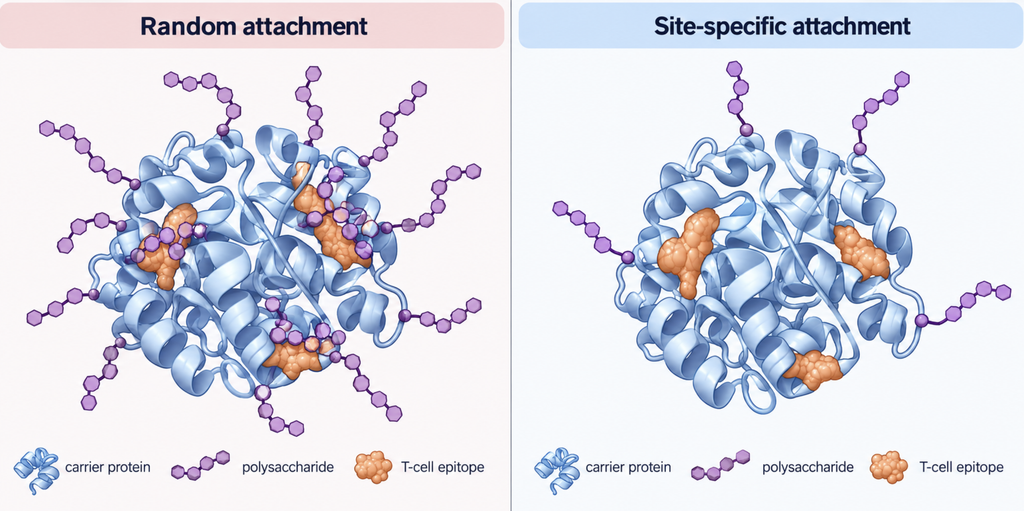
This matters because older-style vaccines ran into a trade-off. Each time they added serotypes, antibody responses to the existing ones dipped, a problem known as carrier suppression [King, Serotype Distribution and Coverage, 2025]. In adults, Prevnar 20 produced numerically lower responses than Prevnar 13 for 11 of 13 shared serotypes; in infants, 5 serotypes missed the noninferiority bar. Whether that dip costs real-world protection is not known.
Vaxcyte’s platform is designed to avoid the trade-off. The latest trial supports that goal, but independent groups have yet to confirm it. All published data on the platform come from Vaxcyte’s own scientists [Wassil, Phase 2 Trial of VAX-24, 2024], so for now the company that built the technology is also the only one that has evaluated it.
Why Serotype Counts Matter: A Vaccine’s Success Creates Its Own Gaps
Pneumococcal conjugate vaccines protect the vaccinated person, and they also reduce how often the bacteria live harmlessly in the nose and throat. Fewer carriers means less transmission, which protects people who were never vaccinated.
That indirect effect is large. After the US switched childhood vaccination to the 13-valent PCV, invasive pneumococcal disease (IPD: bloodstream infection, meningitis, and pneumonia with bacteria in the blood) fell 64% in young children compared with what would have been expected, about two-thirds fewer cases [Moore, Effect of PCV13 in Children, 2015]. For the newly added serotypes, the drop was 93%. Adults were not the target of the program, yet their overall IPD fell 12-32%, and IPD from the added serotypes fell 58-72%. In its first 3 years, the switch averted an estimated 30,000 cases and 3,000 deaths. Vaccinating children reduced serious pneumococcal infections among their grandparents too.
Over the longer run, IPD among Americans aged 65 and older fell by more than half, from 61.1 per 100,000 in 1999 to 24 per 100,000 in 2016 [CDC, ABCs Report S. pneumoniae, 2016]. Childhood vaccination accounts for part of that decline; other factors may also have contributed.
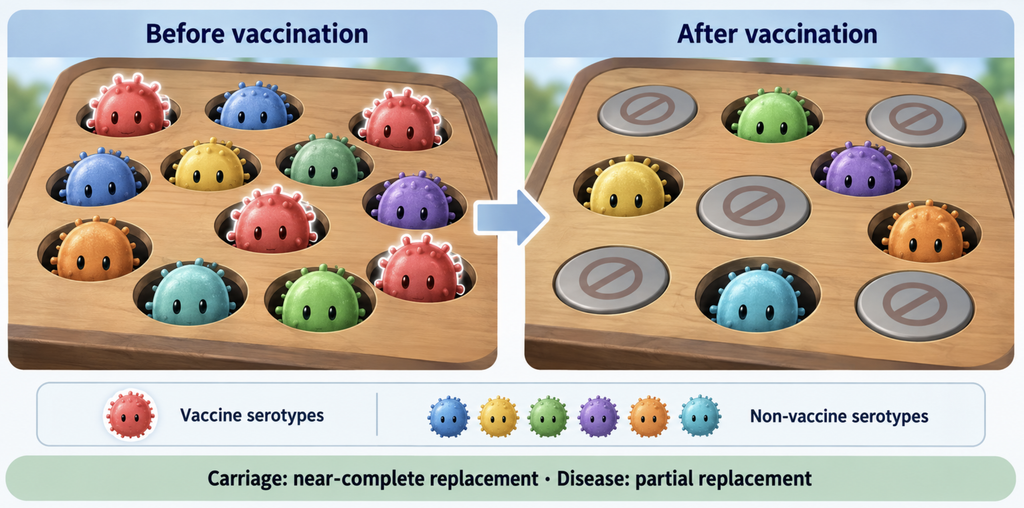
This success has a limit. More than 100 pneumococcal serotypes have been identified, and the vaccines target only a fraction [King, Serotype Distribution and Coverage, 2025]. When vaccine types disappeared from the nose and throat, other serotypes moved in. Among carriers the replacement was almost complete; in serious disease it was partial [Weinberger, Serotype Replacement, 2011]. It resembles whack-a-mole at an arcade: each hit works, but another head rises from a different hole. This serotype replacement is why vaccine makers keep reformulating [King, Serotype Distribution and Coverage, 2025].
So the push toward higher-valent vaccines does not mean the old vaccines failed. They succeeded, and the strains causing disease shifted as a result.
Are Prevnar 20 and Capvaxive Good Enough?
They work, and they leave gaps.
The strongest evidence that conjugate vaccines prevent adult disease comes from CAPiTA, a trial of 84,496 adults aged 65 and older [Bonten, CAPiTA, 2015]. Prevnar 13 cut vaccine-type pneumonia by 45.6%, roughly in half, and prevented 75.0% of vaccine-type invasive infections, three in four. Against pneumonia from any cause, however, the effect was 5.1% and not statistically significant, so there was no measurable drop in pneumonia overall. The vaccine protected against the strains it contains, and the trial found no measurable effect beyond them. Pfizer, Prevnar’s maker, funded the trial. It remains the only trial of its size, so its results have not been independently replicated.
The newer vaccines were approved on a different basis. Prevnar 20, Capvaxive and Merck’s earlier Vaxneuvance were licensed because their antibody responses were noninferior to those of older vaccines, not because trials counted fewer infections. Their real-world effectiveness is still being established [King, Serotype Distribution and Coverage, 2025]. Pfizer’s own label notes that the pneumonia indication for 7 of Prevnar 20’s serotypes rests on immune responses and may depend on a confirmatory study [Pfizer, 25vPnC Release, 2026].
Current guidance sits between these two kinds of evidence. On October 23, 2024, the CDC’s vaccine advisers recommended a single conjugate vaccine for all previously unvaccinated adults aged 50 and older, with Prevnar 20, Capvaxive, or Vaxneuvance followed by the older polysaccharide shot as options [Kobayashi, Expanded Recommendations, 2025]. The vote was 14 to 1. The dissenter, who chaired the working group, argued for Capvaxive alone [CIDRAP, ACIP Lowers Age to 50, 2024]. Capvaxive had been approved on June 17, 2024, and was designed around adult disease patterns: it added 8 new serotypes and dropped several found in earlier vaccines [Kobayashi, Use of PCV21, 2024].
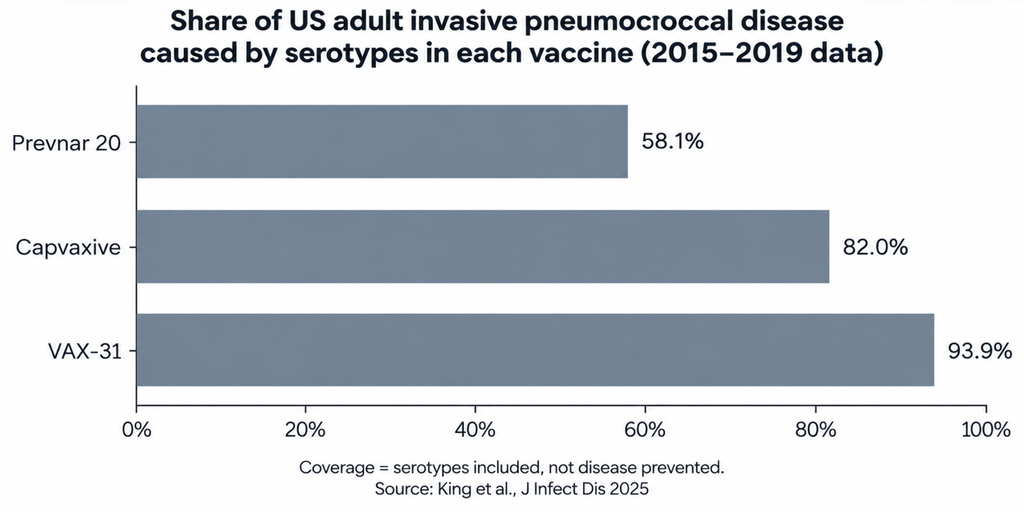
Independent data show the size of the gap. In a CDC-coauthored analysis of 2015-2019 surveillance, the serotypes in Prevnar 20 caused 58.1% of adult IPD, those in Capvaxive 82.0%, and those in VAX-31 93.9%, or about six, eight and nine in ten [King, Serotype Distribution and Coverage, 2025].
| Prevnar 20 (Pfizer) | Capvaxive (Merck) | VAX-31 (Vaxcyte) | |
|---|---|---|---|
| Serotypes | 20 | 21 | 31 |
| Adult IPD caused by included serotypes (2015-2019) | 58.1% | 82.0% | 93.9% |
| Adult non-bacteremic pneumonia caused by included serotypes | 52.1% | 68.5% | 86.7% |
| Basis of approval | Antibody noninferiority | Antibody noninferiority | Not yet approved |
| Status | Approved, children and adults | Approved, adults and some at-risk children | Phase 3 (adults), Phase 2 (infants) |
Coverage means only that the serotypes are in the vaccine. It does not show that disease from them is prevented.
The disease burden is substantial. In 2024, the most recent year with CDC estimates, invasive pneumococcal disease caused about 34,350 cases and 3,430 deaths in the US, about one death for every ten cases [CDC, ABCs Report S. pneumoniae, 2024]. Bacteremic pneumonia made up 73.5% of cases, about three in four. In CDC surveillance areas, incidence climbs with age: 15.8 per 100,000 at ages 50-64, 20.5 at 65-74, 23.7 at 75-84 and 33.3 at 85 and older. Risk roughly doubles from the 50s to the oldest group.
Serotype 3 complicates the arithmetic. It has been in the vaccine since 2010, yet in 2015-2019 data it was still the most common single serotype behind invasive disease in the US [King, Serotype Distribution and Coverage, 2025]. A meta-analysis written largely by Pfizer scientists estimated 63.5% effectiveness against serotype 3 disease in children [Sings, PCV13 and Serotype 3, 2019], but the strain has persisted at the population level. Pfizer itself now calls serotype 3 a key driver of residual disease [Pfizer, 25vPnC Release, 2026]. Including a serotype in a vaccine, in other words, does not guarantee control of it.
What the VAX-31 Pneumococcal Vaccine Trial Proved, and What It Didn’t
According to the company’s topline report, which has not yet been peer-reviewed, OPUS-1 enrolled 4,047 participants: 3,572 adults aged 50 and older, randomized to VAX-31, Prevnar 20 or Capvaxive, plus 475 adults aged 18-49 [Vaxcyte, OPUS-1 Topline Release, 2026]. Antibody function was measured one month after vaccination.
On its own terms, the trial was a clear success. All 28 serotypes shared with one or both rivals met noninferiority. The bar was stricter than usual. The lower end of the statistical range had to reach a margin of 0.667, meaning at least two-thirds of the rival’s antibody level, instead of the historical margin of 0.5, or half. The 3 unique serotypes plus 20B cleared a superiority margin of 2.0, meaning at least double. Safety was similar to both comparators.
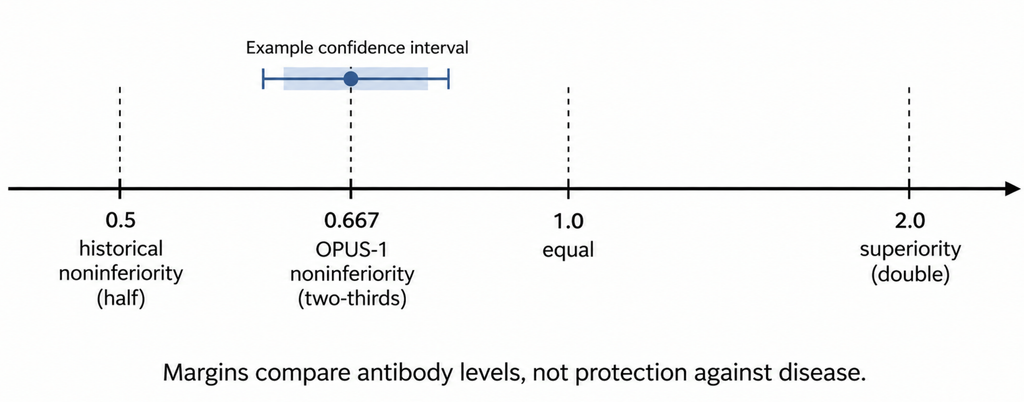
The results differ by comparator. Compared one rival at a time, VAX-31 met the stricter bar for all 20 serotypes shared with Prevnar 20, but for only 17 of 19 shared with Capvaxive. The two that fell short were serotypes 3 and 12F, and both still met the older 0.5 margin. Vaxcyte’s own scientific chief expects the Capvaxive comparison to be a particular focus of FDA review, because Capvaxive’s serotypes account for more of current adult disease. One of the two near-misses is serotype 3, the same strain that has persisted despite being in the vaccine.
An earlier Phase 1/2 study in 1,015 adults, also reported by the company, pointed the same way. At the highest dose, 18 of 20 shared serotypes had higher average responses than Prevnar 20, and 7 were statistically higher [Vaxcyte, Phase 1/2 Topline, 2024]. On company-reported data from both trials, the platform’s main promise of more serotypes without weaker responses has largely held up in adults.
An antibody assay cannot count prevented infections. Antibody levels are the accepted standard for approving these vaccines, but no one has shown that a higher antibody level means fewer infections [King, Serotype Distribution and Coverage, 2025]. Some reviewers regard a functional antibody titer of 1:8 as the most reliable marker of protection against invasive disease [Luvira, PCVs in Older Adults, 2025]. Clearing a threshold is meaningful; how much protection is gained by clearing it by a wider margin is unknown. The company estimates that VAX-31 would cover about 95% of IPD in adults 50 and older, 13-36% more than current vaccines. That figure describes serotypes included, not cases prevented.
OPUS-1 showed that the vaccine can be built and that it produces the antibody responses it was designed to produce. A trial of this design could not show whether it prevents more disease.
Clinical Perspective. For a clinician, the relevant question is whether VAX-31 prevents more hospitalizations in older adults, and a lab comparison with Prevnar 20 cannot answer it. The answer will come only from post-approval surveillance. The serotype 3 result is the detail most worth watching.
Overreaction or Rational Re-Rating? Reading the Market’s Verdict
The market has reacted this way before. When the Phase 1/2 results arrived on September 3, 2024, Vaxcyte shares rose as much as 48% during the day and closed up 36.4%. The company launched a $1 billion stock offering the same day [Reuters, Vaxcyte Shares Hit Record High, 2024]. Pfizer closed down 2.45%, and Merck traded about 1.3% lower [Schaeffer’s, Vaxcyte Pushes Biotech Stocks Lower, 2024], a move of a percent or two.
In 2026 the pattern repeated with one difference. Vaxcyte opened about 54% higher, then gave back much of the gain to close up 30.7% at $73.82, roughly a third [Yahoo Finance, PCVX Quote, 2026]. Within hours, investors had trimmed their initial enthusiasm.
Merck fell from $144.30 to $139.54, about 3.3%, then rebounded 1.7% the next day [Trading Economics, MRK Quote, 2026]. Pfizer reportedly slipped about 1%. Both incumbents fell on the day of the readout, but a single day of trading cannot show that the whole move came from one competitor’s data. Vaxcyte also sold new stock and convertible notes immediately after the results [Vaxcyte, Form 424B5, 2026].
The stakes differ for the two incumbents. The Prevnar family brought in about $6.5 billion in 2025, about 10% of Pfizer’s revenue, while Capvaxive brought in $759 million, about 1% of Merck’s [TIKR, Pfizer’s Prevnar Franchise, 2026]. Vaxcyte projects the market growing from $8.5 billion in 2025 to about $12 billion by 2030; this is the company’s own projection, not an independent one [TIKR, Vaxcyte Soars on Phase 3 Win, 2026]. For Pfizer, VAX-31 threatens an existing franchise. For Merck, it threatens a growth story.
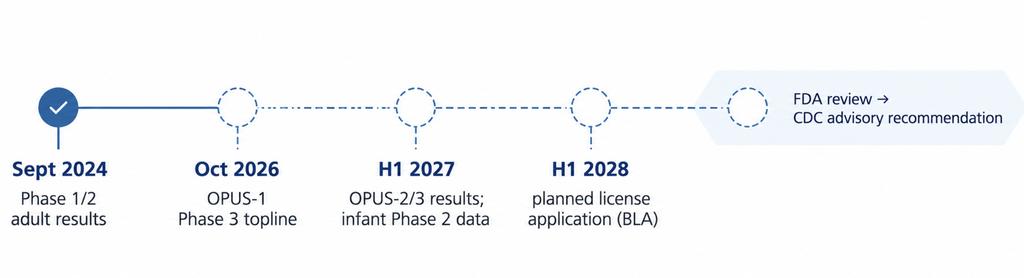
Several hurdles remain. Two more adult Phase 3 trials report in the first half of 2027, followed by a manufacturing consistency study, with a license application planned for the first half of 2028 [Vaxcyte, OPUS-1 Topline Release, 2026]. Approval alone would not decide how widely the vaccine is used; that depends on a recommendation from the CDC’s vaccine advisers. Infant results, due by the end of the first half of 2027, are a harder test.
When VAX-24, the company’s earlier candidate, reported interim infant data on March 31, 2025, the stock fell about 46% in a day, from $69.46 to $37.76, nearly half, even though the company called the results positive [Clinical Trials Arena, Vaxcyte Infant Stock Sinks, 2025]. Final results later showed a handful of serotypes short of the usual antibody bar: 20 of 24 and 19 of 24 met it, depending on the dose [Vaxcyte, Form 10-K, 2025].
Competitors are also moving. Pfizer began a pediatric Phase 3 trial of a 25-valent vaccine in May 2026 and plans to move a 35-valent adult candidate into the clinic by the end of 2026, with better serotype 3 responses as an explicit goal [Pfizer, 25vPnC Release, 2026]. GSK started a Phase 1 trial of a 30-plus valent candidate, Merck has early-stage successors [Vaxcyte, Form 10-Q, 2026], and Sanofi and SK bioscience are running an infant Phase 3 trial of a 21-valent vaccine [Pharmaphorum, Sanofi Takes SK Bio Shot into Phase 3, 2024].
The rise in Vaxcyte’s value is best read as a higher estimate of the probability that VAX-31 reaches the market. Investors are pricing approval risk far more than clinical superiority, which has not been measured. The small dip in the incumbents fits that reading. The threat to Pfizer is real but distant. The threat to Capvaxive is more direct, since it is the comparator regulators are expected to focus on. The window may also narrow as rival vaccines catch up. The share price reflects a trial that met its goals, while the question of whether VAX-31 prevents more disease remains open.
Key Takeaways
- VAX-31 includes the serotypes behind roughly nine in ten cases of adult invasive pneumococcal disease, compared with about six in ten for Prevnar 20 and eight in ten for Capvaxive.
- Its pivotal trial met its antibody goals against both rivals. Antibody levels stand in for protection; they do not measure it directly.
- The push for more serotypes comes from the success of childhood vaccination, which let other strains fill the gap. It does not mean current vaccines failed.
- Serotype 3 shows that including a strain in a vaccine does not guarantee control of it. It was also one of two serotypes where VAX-31 missed the strictest comparison with Capvaxive.
- The share price jump reflects a higher chance of approval. Approval, a CDC recommendation and infant data are still ahead, and rivals are developing broader vaccines.
- Current adult pneumococcal vaccines remain effective and recommended for adults aged 50 and older.
FAQ
Is VAX-31 available now?
No. Only the first of three adult Phase 3 trials has reported results, and Vaxcyte plans to apply for a license in the first half of 2028 [Vaxcyte, OPUS-1 Topline Release, 2026]. Broad use would also require a CDC recommendation.
Does covering more serotypes mean better protection?
Not necessarily. Coverage means a serotype is in the vaccine. Protection depends on how well the vaccine prevents disease from it. Serotype 3 has been in the vaccine since 2010 and was still the most common single serotype behind invasive disease in recent US data [King, Serotype Distribution and Coverage, 2025].
Should eligible adults wait for VAX-31 instead of getting vaccinated now?
No. Current guidance recommends a conjugate vaccine for all previously unvaccinated adults aged 50 and older [Kobayashi, Expanded Recommendations, 2025], and VAX-31 is likely years from routine use. Existing vaccines prevent disease caused by the strains they contain. Talk with a clinician about the decision.
How well do current pneumococcal vaccines work?
It depends on the outcome. Against the strains they contain, they work well; against pneumonia overall, the evidence is weaker. In a large Pfizer-funded trial, Prevnar 13 prevented 75.0% of vaccine-type invasive infections in older adults but did not measurably reduce pneumonia from all causes [Bonten, CAPiTA, 2015].
References
- Vaxcyte, Inc. Vaxcyte reports positive topline data from OPUS-1, the pivotal adult Phase 3 trial of VAX-31 [Form 8-K, Exhibit 99.1]. October 5, 2026. https://www.sec.gov/Archives/edgar/data/0001649094/000119312526413168/d21202dex991.htm
- Vaxcyte, Inc. Vaxcyte reports positive topline data from Phase 1/2 study of VAX-31 in adults aged 50 and older [press release]. September 3, 2024.
- Vaxcyte, Inc. Annual Report on Form 10-K for fiscal year 2025; Quarterly Report on Form 10-Q for the period ended June 30, 2026; Current Report on Form 8-K, September 3, 2026; Prospectus Supplement (Form 424B5), October 2026.
- Fairman J, Agarwal P, Barbanel S, et al. Non-clinical immunological comparison of a next-generation 24-valent pneumococcal conjugate vaccine (VAX-24) using site-specific carrier protein conjugation to the current standard of care (PCV13 and PPV23). Vaccine. 2021;39(23):3197-3206.
- Wassil J, Sisti M, Fairman J, et al. A phase 2, randomized, blinded, dose-finding, controlled clinical trial to evaluate the safety, tolerability, and immunogenicity of a 24-valent pneumococcal conjugate vaccine (VAX-24) in healthy adults 65 years and older. Vaccine. 2024;42(25):126124.
- King LM, Andrejko KL, Kobayashi M, et al. Pneumococcal serotype distribution and coverage of existing and pipeline pneumococcal vaccines. J Infect Dis. 2025;232(4):e609-e620.
- Moore MR, Link-Gelles R, Schaffner W, et al. Effect of use of 13-valent pneumococcal conjugate vaccine in children on invasive pneumococcal disease in children and adults in the USA: analysis of multisite, population-based surveillance. Lancet Infect Dis. 2015;15(3):301-309.
- Weinberger DM, Malley R, Lipsitch M. Serotype replacement in disease after pneumococcal vaccination. Lancet. 2011;378(9807):1962-1973.
- Bonten MJ, Huijts SM, Bolkenbaas M, et al. Polysaccharide conjugate vaccine against pneumococcal pneumonia in adults. N Engl J Med. 2015;372(12):1114-1125.
- Sings HL, De Wals P, Gessner BD, et al. Effectiveness of 13-valent pneumococcal conjugate vaccine against invasive disease caused by serotype 3 in children: a systematic review and meta-analysis of observational studies. Clin Infect Dis. 2019;68(12):2135-2143.
- Luvira V, Ngamprasertchai T, Pitisuttithum P. Pneumococcal conjugate vaccines in older adults and immunocompromised individuals. Expert Rev Vaccines. 2025;25(1):1-10.
- Kobayashi M, Leidner AJ, Gierke R, et al. Expanded recommendations for use of pneumococcal conjugate vaccines among adults aged ≥50 years: recommendations of the Advisory Committee on Immunization Practices — United States, 2024. MMWR Morb Mortal Wkly Rep. 2025;74(1):1-8.
- Kobayashi M, Leidner AJ, Gierke R, et al. Use of 21-valent pneumococcal conjugate vaccine among U.S. adults: recommendations of the Advisory Committee on Immunization Practices — United States, 2024. MMWR Morb Mortal Wkly Rep. 2024;73(36):793-798.
- CDC. Active Bacterial Core Surveillance Report, Emerging Infections Program Network, Streptococcus pneumoniae, 2024 (and 1999, 2016 reports). https://www.cdc.gov/abcs/media/pdfs/2026/04/SPN_Surveillance_Report_2024.pdf
- CIDRAP. CDC endorses ACIP recommendation to lower age for pneumococcal vaccination to 50. October 2024.
- Pfizer Inc. Pfizer advances pivotal pediatric pneumococcal vaccine program following strong positive Phase 2 results [press release]. May 20, 2026. https://www.pfizer.com/news/press-release/press-release-detail/pfizer-advances-pivotal-pediatric-pneumococcal-vaccine
- Reuters. Vaxcyte’s shares hit record high after early data on pneumococcal vaccine. September 3, 2024.
- Schaeffer’s Investment Research. Vaxcyte’s drug update pushes 2 biotech stocks lower. September 3, 2024.
- TIKR. Vaxcyte soars 36% on Phase 3 pneumococcal vaccine win. October 5, 2026. https://finance.yahoo.com/healthcare/articles/vaxcyte-soars-36-phase-3-144316157.html
- TIKR. Pfizer’s $6.49 billion Prevnar franchise faces a new challenger. October 2026.
- Yahoo Finance. Vaxcyte, Inc. (PCVX) quote, October 5, 2026 close; Kalkine. What drove Vaxcyte and biotech peers: news or hype? October 6, 2026.
- Trading Economics. Merck & Co (MRK) stock price. Accessed October 7, 2026. https://tradingeconomics.com/mrk:us
- Clinical Trials Arena. Vaxcyte’s IPD vaccine meets Phase II endpoints in infants, but stock sinks. March 31, 2025.
- Pharmaphorum. Sanofi takes SK Bio-partnered pneumococcal shot into phase 3. December 2024.
Joonpyo Hong, MD is a board-certified otolaryngologist practicing in Korea. This article reflects his clinical interpretation of published research and does not constitute individual medical advice. This article is not intended to advertise or promote any specific company or product.
For more articles:
https://curiousmd.com/flu-vaccine-mismatch/
https://curiousmd.com/rsv-vaccine-effectiveness-adults-infants/
https://curiousmd.com/hpv-vaccine-and-throat-cancer/
https://curiousmd.com/chickenpox-vaccine-for-adults/
Link out to:
- CDC — Recommended pneumococcal vaccines for adults: https://www.cdc.gov/pneumococcal/vaccines/adults.html
- CDC — Active Bacterial Core Surveillance report on invasive pneumococcal disease, 2024: https://www.cdc.gov/abcs/media/pdfs/2026/04/SPN_Surveillance_Report_2024.pdf
- Vaxcyte (SEC filing) — OPUS-1 Phase 3 topline results: https://www.sec.gov/Archives/edgar/data/0001649094/000119312526413168/d21202dex991.htm
- Pfizer — Next-generation 25-valent and 35-valent pneumococcal vaccine programs: https://www.pfizer.com/news/press-release/press-release-detail/pfizer-advances-pivotal-pediatric-pneumococcal-vaccine
- PharmaVoice — Industry coverage of the 2024 Phase 1/2 readout: https://www.pharmavoice.com/news/vaxcyte-pfizer-prevnar-pneumococcal-vaccine/725957/