
The United States lost its measles elimination status on November 17, 2026. The Pan American Health Organization (PAHO) made the decision after its regional commission found that one chain of measles had spread without a break for 12 months or more [PAHO, Measles Elimination Status Withdrawn, 2026]. Bolivia and Mexico lost their status at the same meeting. The US had held it since 2000 [Papania, Elimination of Endemic Measles, 2014].
The Centers for Disease Control and Prevention (CDC) answered the same day with a joint statement and a re-elimination plan. CDC Director Erica Schwartz said, “The measles elimination designation is not what protects Americans. Vaccination does.” [CDC, Joint Statement on Measles Elimination, 2026] The label itself protects no one, but losing it records that public health action did not stop one chain of spread within 12 months.
Two doses of MMR are about 97% effective against measles [CDC, MMR Vaccine Considerations, 2026]. National kindergarten MMR coverage was 92.4% in the 2025–26 school year [CDC, SchoolVaxView Kindergarten Coverage, 2026]. Yet CDC had counted 5,412 confirmed cases as of November 12, 2026, a provisional total more than twice the 2025 total [CDC, Measles Cases and Outbreaks, 2026]. There is no sign that the vaccine stopped working. National coverage figures can hide local gaps, as PAHO noted in its announcement [PAHO, Measles Elimination Status Withdrawn, 2026], and measles kept spreading in such gaps for more than a year.
Explaining the loss requires separating what elimination measures from how well the vaccine works, and then finding the local gaps in coverage and surveillance.
What Measles Elimination Status Means and What It Never Meant
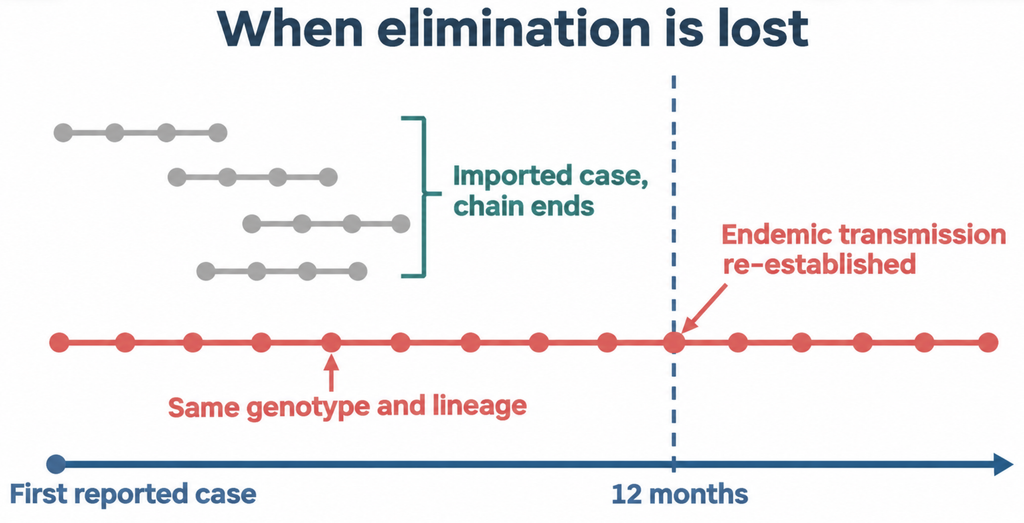
Public health uses three different terms for progress against an infection [Dowdle, Principles of Disease Elimination, 1998]. Control lowers cases to a level a community accepts. Elimination ends ongoing local spread in one defined area, although imported cases can still occur. Eradication brings infection to zero worldwide and permanently, and it is the only stage at which prevention can stop.
| Term | Scope | What it means | Continued vaccination needed? |
|---|---|---|---|
| Control | Local | Cases reduced to an accepted level | Yes |
| Elimination | One country or region | No local chain of spread lasting 12 months or more; imported cases still occur | Yes |
| Eradication | Worldwide | Infection reduced to zero, permanently | No |
For measles in the Americas, PAHO counts endemic spread as re-established when the same genotype and lineage circulate without a break for 12 months or more [PAHO, Update on the Review, 2026]. For the US, the review period began on January 20, 2025, when the reported outbreaks started. The status therefore depends on how long any single chain lasts, and a year-long chain can be confirmed only after the year has passed.
Elimination has never meant zero cases. From 2001 to 2011, US measles incidence stayed below 1 case per 1,000,000 people, and 88% of those cases were imported or linked to an importation [Papania, Elimination of Endemic Measles, 2014]. The annual median was 56 cases in 2001–2008 and 130 in 2009–2014 [Fiebelkorn, Postelimination Measles Epidemiology, 2017]. Imported cases kept arriving, but the review found high population immunity and no endemic genotypes [Papania, Elimination of Endemic Measles, 2014].
In 2009–2014, about 22% of US cases were imported [Fiebelkorn, Postelimination Measles Epidemiology, 2017]. Since the start of 2025, a separate analysis of CDC data puts the imported share at only about 6–7% [Bischops, Will the USA Lose Its Measles Elimination Status, 2026]. The same analysis found that about 90% of recent cases were acquired in the US, so most spread now happens inside the country.
Canada lost its status in November 2025, and the Region had regained elimination status only in 2024 [PAHO, Measles Elimination Status Withdrawn, 2026]. As of November 13, 2026, the Americas had 58,213 confirmed cases and 82 deaths, compared with 12,806 cases in the same period of 2025 [PAHO, Measles Elimination Status Withdrawn, 2026]. Measles also circulates in more than 100 countries [CDC, Joint Statement on Measles Elimination, 2026]. With that much measles abroad, elimination in any one country depends on imported cases not reaching enough susceptible people.
The Vaccine Did Not Change
Estimates of MMR protection look the same as they did before the outbreaks. CDC puts protection at about 97% after two doses and about 93% after one [CDC, MMR Vaccine Considerations, 2026]. A Cochrane review of cohort studies in children found similar figures: 95% after one dose and 96% after two [Di Pietrantonj, Vaccines for MMR and Varicella, 2021].
About 95% of children respond to a dose given at 12 months or older, and more than 99% have serologic immunity after two doses. After one dose, about 2% to 7% of people have primary vaccine failure [CDC, Pink Book Measles Chapter, 2024]. Vaccine immunity appears to be long-lasting, probably lifelong, in most people, and CDC describes waning as rare.
The virus also shows no sign of escaping the vaccine. The measles hemagglutinin (H) protein is antigenically stable, and serum from vaccinated people neutralizes the different genotypes about equally well [Tahara, Measles Virus Hemagglutinin Epitopes, 2016]. A 2024 review named waning immunity and more virulent strains as possible contributing factors but identified failure to vaccinate as the main reason control fails [Moss, What’s Going On With Measles, 2024].
Vaccinated people can still get measles. In a 2011 New York City outbreak, a twice-vaccinated patient infected 4 of 88 contacts, and none of the 231 contacts of those secondary patients got measles [Rosen, Measles Among Persons With Prior Immunity, 2014]. Outbreak reports suggest that spread from vaccinated patients is uncommon [Iwamoto, Secondary Vaccine Failure NYC, 2021]. When almost everyone is vaccinated, vaccinated people can make up a sizable share of cases even with a vaccine that works well. In the one-dose era of 1985–1988, 68% of US school-age cases had received one dose, and this pattern led to the 1989 recommendation for a second dose [CDC, Pink Book Measles Chapter, 2024].
Measles still causes serious harm. Encephalitis occurs in about 1 of every 1,000 cases, and 1 to 3 of every 1,000 infected children die [CDC, Clinical Overview of Measles, 2026]. Otitis media, pneumonia, croup, and diarrhea are common complications, and croup and otitis media are more frequent in very young children [Perry, Clinical Significance of Measles, 2004]. From January 1 to April 17, 2025, 11% of US patients were hospitalized, and 96% were unvaccinated or had unknown vaccination status [Mathis, Measles Update, 2025].
Why Measles Has the Smallest Margin
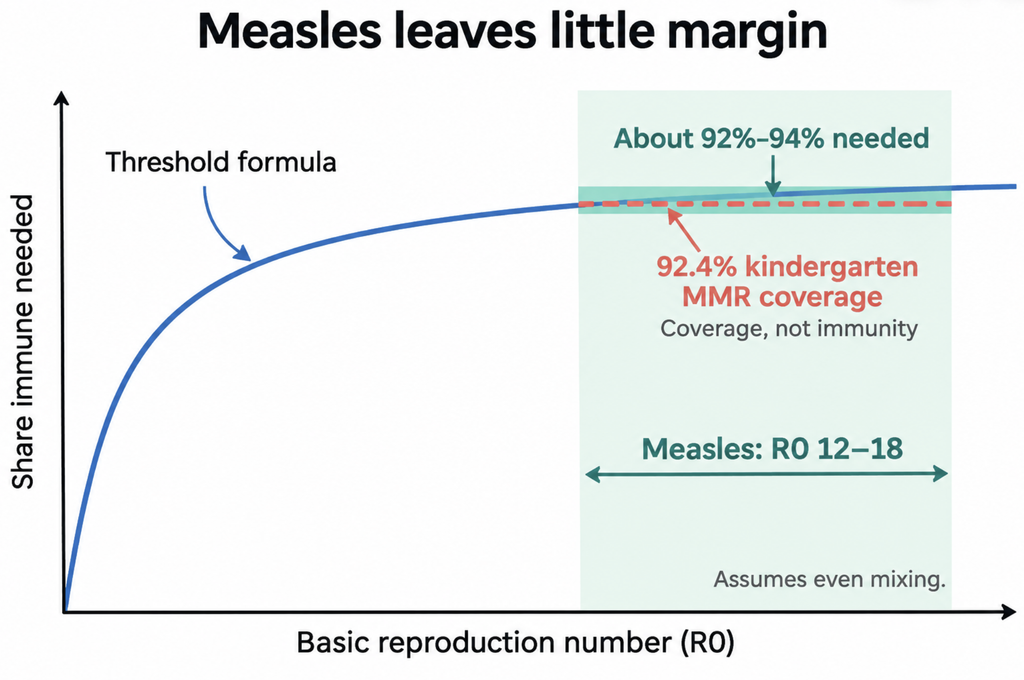
Measles is among the most contagious infections known, with a basic reproduction number (R0) often cited as 12 to 18. A systematic review of 58 estimates from 18 studies found that estimates vary more widely, depending on setting [Guerra, Basic Reproduction Number of Measles, 2017].
The herd immunity threshold follows from R0 as (R0 − 1)/R0 [Fine, Herd Immunity: A Rough Guide, 2011]. With an R0 of 12 to 18, about 92% to 94% of people must be immune, assuming people mix evenly. PAHO’s target is 95% coverage with two doses in every community [PAHO, Measles Elimination Status Withdrawn, 2026]. The national kindergarten MMR figure of 92.4% falls near the low end of the 92% to 94% range. It measures documented vaccination in one age group rather than immunity in the whole population. The figure therefore points to a thin margin but cannot show whether the threshold is met.
Because measles needs such high immunity to block spread, it is expected to be among the first diseases to return when coverage falls. A drop of a few percentage points leaves little room for an infection with an R0 this high.
The threshold calculation assumes even mixing, and real communities do not mix evenly. In one modeling study, clustering of unvaccinated people had its largest effect when coverage was close to the threshold calculated under random mixing [Salathé, Effect of Opinion Clustering, 2008].
How a National Average Hides Local Gaps
Kindergarten MMR coverage was 95.2% in 2019–20 [CDC, Joint Statement on Measles Elimination, 2026]. It was 92.4% in 2025–26, a drop of 2.8 percentage points [CDC, SchoolVaxView Kindergarten Coverage, 2026]. Exemptions from one or more vaccines rose from 3.6% to 4.2% in one year and covered about 155,000 kindergartners. About 280,000 kindergartners had no documented complete MMR series. These figures count only kindergartners, so they miss homeschooled children, older children, and adults.
The national figure combines states with very different coverage. Exemptions exceeded 5% in 24 states [CDC, SchoolVaxView Kindergarten Coverage, 2026]. By KFF’s count, 39 states fell below 95% coverage [KFF, A Step Back for US Public Health, 2026]. State coverage ranged from 75.2% in Idaho to 98.9% in West Virginia, according to an Axios report of the CDC data [Axios, Kindergarten Vaccine Exemptions, 2026].
Counties within a state also differ. In 33 states with county data, coverage fell in 78% of 2,066 counties after the pandemic began. The average county rate dropped from 93.92% to 91.26% [Dong, County-Level MMR Coverage, 2025]. In Michigan, grouping school-level data into the larger units used for public reporting could badly misstate how many students were at risk and where they were [Masters, Nonvaccination Clustering in Michigan, 2021].
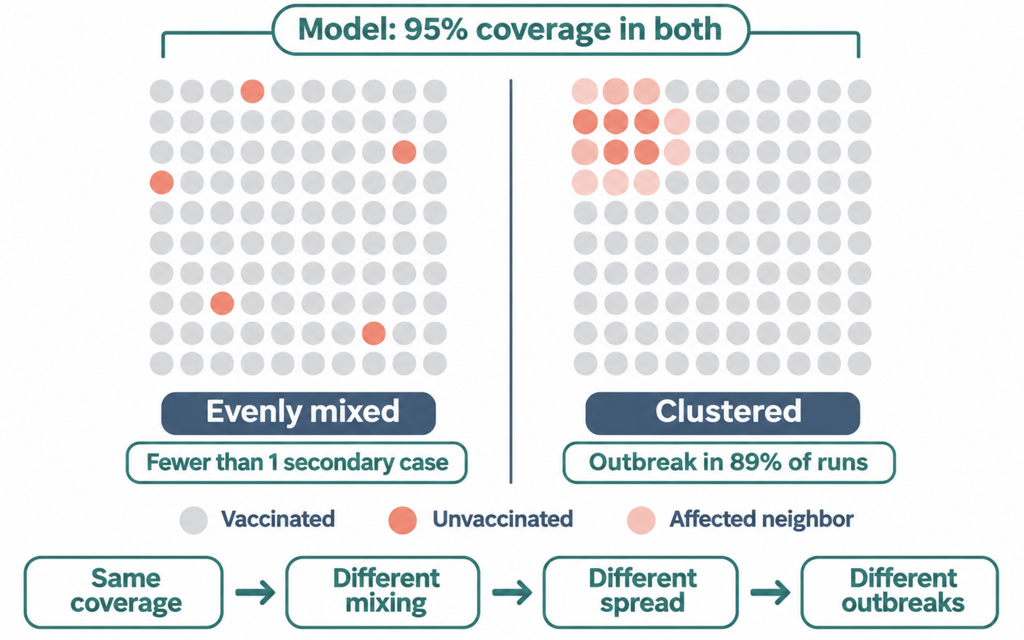
Modeling studies from several groups agree that when unvaccinated people cluster, outbreaks grow far larger than the same average coverage would predict. In one model with an R0 of 16 and 95% coverage, clustered nonvaccination produced an outbreak of 5 or more cases in 89% of runs. Random placement of the same unvaccinated people produced fewer than 1 secondary case [Masters, Spatial Clustering of Measles Nonvaccination, 2020].
In a California model, clustered exemptions gave some early protection against a randomly placed introduction. Over time, though, they allowed outbreaks with thousands more infections than random placement did. Random placement matched those outbreak sizes only when coverage was more than 6 percentage points lower [Gromis, Spatial Clustering of Vaccine Exemptions, 2022].
Older cohort data put a number on the individual risk. From 1985 to 1992, people aged 5–19 with religious or philosophical exemptions were 35 times more likely than vaccinated people to get measles (95% CI 34–37). In California, people with exemptions tended to cluster in certain regions [Salmon, Health Consequences of Exemptions, 1999].
Recent outbreaks followed this pattern. By April 17, 2025, 654 of 800 US cases (82%) were linked to one outbreak in close-knit communities with low coverage in New Mexico, Oklahoma, and Texas. CDC noted that large US outbreaks usually follow an imported case reaching such a community [Mathis, Measles Update, 2025]. South Carolina later had 997 cases from October 2025 to March 2026, the largest US outbreak in about 30 years [Miller, Nowcasting Measles South Carolina, 2026]. Of the 2026 cases counted through November 12, 96% were outbreak-associated [CDC, Measles Cases and Outbreaks, 2026].
The people at greatest risk include those who cannot protect themselves. Infants do not get their first routine dose until 12 through 15 months. After exposure, ACIP advises immune globulin for pregnant people without evidence of immunity and for severely immunocompromised patients [McLean, ACIP Measles Recommendations, 2013]. Preliminary CDC figures reported by the Associated Press count 112 measles cases in pregnancy and 13 congenital cases from January 2025 through September 2026 [Ungar, US Babies Born With Measles, 2026].
The joint statement attributes part of a decline in trust in healthcare institutions to what it calls “pandemic overreach,” including lockdowns and mandates [CDC, Joint Statement on Measles Elimination, 2026]. That causal attribution is CDC’s interpretation, and none of the data cited here test it.
Surveillance Is the Other Half of Elimination

A country also has to demonstrate elimination with surveillance data. PAHO checks whether countries report at least 2 suspected cases per 100,000 people a year. It also sets 80% targets for adequate case investigation, adequate blood samples, samples reaching the lab within 5 days, and results within 4 days [PAHO, Measles and Rubella Best Buys, 2025].
Investigators also have to link cases into chains. Outbreaks in Texas, Utah, and South Carolina shared sequence type D8-9171, which also circulated in Canada and Mexico. The standard short gene segment could not distinguish in-country spread from repeated imports. US labs therefore sequenced about 1,000 whole genomes from samples collected January 20, 2025, to January 20, 2026 [Maxmen, US Scientists Sequence 1,000 Measles Genomes, 2026]. KFF Health News reported that the data reached the public months late, and a CDC scientist cited an understaffed lab and a learning curve.
A research letter in The Lancet found the US had missed 4 of 7 CDC elimination indicators by early 2026. Incidence in early 2026 was about 93 cases per 10 million, against a cutoff of fewer than 1. The effective reproduction number had been above 1 more than 75% of the time since early 2025 [Bischops, Will the USA Lose Its Measles Elimination Status, 2026].
Surveillance starts with a clinician who suspects measles. The prodrome of fever, cough, coryza, and conjunctivitis lasts 2 to 4 days (range 1 to 7) before the rash. Koplik spots in the mouth can appear 1 to 2 days before the rash [CDC, Pink Book Measles Chapter, 2024]. Patients are contagious from 4 days before to 4 days after rash onset [CDC, Clinical Overview of Measles, 2026]. In the first days, the illness is easy to mistake for a common upper respiratory infection.
Any delay in recognition exposes others quickly, because the secondary attack rate is above 90% among susceptible close contacts [CDC, Pink Book Measles Chapter, 2024]. The virus can stay infectious in the air for up to 2 hours after a patient leaves a room [CDC, Clinical Overview of Measles, 2026]. From 2001 to 2014, a period with few cases, 78 US cases came from spread inside healthcare facilities, including 29 healthcare workers [Fiebelkorn, Measles in Healthcare Facilities, 2015].
Testing also depends on timing. CDC advises a throat or nasopharyngeal swab for RT-PCR plus serum at first suspicion. RT-PCR works best from the first day of rash through 3 days after, and detection is possible up to 10–14 days. IgM may not be detectable until 3 days after onset, so a repeat serum at 3 to 10 days may be needed [CDC, Measles Laboratory Testing, 2024]. An early negative IgM does not rule out measles, and neither does prior vaccination [Rosen, Measles Among Persons With Prior Immunity, 2014].
Case counts depend on every step working. Patients must seek care, clinicians must consider measles, and labs and health departments must report. In the 1980s and 1990s, estimates of reporting completeness ranged from 3% to 58% [Harpaz, Completeness of Measles Case Reporting, 2004]. Those figures come from a different era, but they show that a falling count can reflect less testing as well as less measles.
Questions That Show Where the Gaps Are
To regain elimination, a country must document more than one year without measles virus transmission and show it can sustain elimination [PAHO, Regional Framework for Re-Verification, 2021]. Canada has interrupted the chain linked to its outbreak and is working to regain status [PAHO, Measles Elimination Status Withdrawn, 2026]. Since August, CDC has provided about $100 million to state and local health departments, with funding that runs through most of 2027 [CDC, Joint Statement on Measles Elimination, 2026].
At what level is local coverage known?
State and county averages can hide schools and communities far below target. Grouping data into larger units can also hide at-risk students [Masters, Nonvaccination Clustering in Michigan, 2021]. The useful figure is the one for the school, county, or community where patients live. Where only state-level data exist, local risk cannot be judged from coverage figures.
Which patients lack evidence of immunity?
Acceptable evidence is written documentation of vaccination, laboratory evidence of immunity, laboratory confirmation of disease, or birth before 1957. Verbal reports do not count. Facilities should consider vaccinating staff born before 1957 who lack laboratory evidence [CDC, MMR Vaccine Considerations, 2026]. Infants traveling abroad can get an early dose at 6 through 11 months, at least 2 weeks before travel, and still need the routine doses later [CDC, Plan for Travel: Measles, 2026].
How fast can a suspected case be recognized, isolated, and tested?
After exposure, MMR within 72 hours or immune globulin within 6 days can prevent disease or make it milder [CDC, MMR Vaccine Considerations, 2026]. In limited studies, MMR given after exposure prevented about 74% of cases [Di Pietrantonj, Vaccines for MMR and Varicella, 2021]. Both windows are short, so any delay in recognition reduces what prophylaxis can do.
Do confirmed cases reach sequencing?
Investigators use genetic data to judge whether an outbreak is one chain or several imports [Maxmen, US Scientists Sequence 1,000 Measles Genomes, 2026]. A confirmed specimen that is never sequenced makes the chain harder to trace and the country’s status harder to judge.
What re-elimination depends on
There is no sign that the vaccine has stopped working, but a national coverage average can be a poor guide to immunity in any one community. With even mixing, measles needs about 92% to 94% immunity. Large US outbreaks usually grew in close-knit communities with low coverage, and one chain of spread lasted 12 months or more. Re-elimination will depend on finding those communities, testing suspected cases quickly, and sequencing confirmed cases. Elimination still allows imported cases: South Korea kept its status in 2026 while recording 86 cases from 2025 to mid-2026, all imported or linked to imports [KDCA, Measles Elimination Certification, 2026].
Key Takeaways
- PAHO, not CDC, withdrew US measles elimination status on November 17, 2026, after one lineage spread for 12 months or more.
- Elimination has always allowed imported cases, but it requires that no local chain lasts a year.
- CDC puts MMR protection at about 97% after two doses, and serum from vaccinated people neutralizes the different measles genotypes about equally well.
- Assuming even mixing, an R0 of 12 to 18 means about 92% to 94% immunity is needed, so measles is expected to return early when coverage falls.
- National kindergarten MMR coverage of 92.4% can hide places far below target, and in models, clustered nonvaccination causes much larger outbreaks than the same coverage spread evenly.
- Elimination also depends on surveillance: recognizing the prodrome, testing, reporting, and sequencing decide whether local spread is found in time.
FAQ
Does losing elimination status mean measles is spreading everywhere in the US?
No. The status is lost when one chain of spread lasts 12 months or more. CDC counted cases in 47 jurisdictions in 2026, but nearly all came from defined outbreaks: of cases counted through November 12, 96% were outbreak-associated [CDC, Measles Cases and Outbreaks, 2026].
Is the MMR vaccine less effective against the current measles strains?
Not so far. CDC still puts two-dose protection at about 97% [CDC, MMR Vaccine Considerations, 2026]. Serum from vaccinated people neutralizes the different measles genotypes about equally well [Tahara, Measles Virus Hemagglutinin Epitopes, 2016].
Do vaccinated adults need another MMR dose?
It depends on records and risk. Written documentation of adequate vaccination, laboratory evidence of immunity, laboratory confirmation of disease, or birth before 1957 counts as presumptive evidence of immunity [CDC, MMR Vaccine Considerations, 2026]. ACIP recommends two doses for adults at higher risk, such as healthcare personnel, international travelers, and college students [McLean, ACIP Measles Recommendations, 2013].
How soon can the US regain measles elimination status?
Not until transmission has stopped for more than a year. PAHO requires a country to document more than one year without measles virus transmission and to show it can sustain elimination [PAHO, Regional Framework for Re-Verification, 2021]. That year cannot begin while an endemic chain is still spreading.
References
- Pan American Health Organization (PAHO). PAHO urges countries to step up efforts to stop measles outbreaks and move towards elimination in the Americas [Internet]. Washington (DC): PAHO; 2026 Nov 17 [cited 2026 Nov 19]. Available from: https://www.paho.org/node/105661
- Papania MJ, Wallace GS, Rota PA, et al. Elimination of endemic measles, rubella, and congenital rubella syndrome from the Western hemisphere: the US experience. JAMA Pediatr. 2014;168(2):148-55.
- Centers for Disease Control and Prevention (CDC). Joint statement on loss of U.S. measles elimination status [Internet]. Atlanta (GA): CDC; 2026 Nov 17 [cited 2026 Nov 19]. Available from: https://www.cdc.gov/media/releases/2026/loss-of-usmeasles-elimination-status.html
- Centers for Disease Control and Prevention (CDC). MMR vaccine considerations for healthcare providers [Internet]. Atlanta (GA): CDC; 2026 [cited 2026 Nov 19]. Available from: https://www.cdc.gov/measles/hcp/vaccine-considerations/index.html
- Centers for Disease Control and Prevention (CDC). Vaccination coverage and exemptions among kindergartners (SchoolVaxView) [Internet]. Atlanta (GA): CDC; 2026 Aug 17 [cited 2026 Nov 19]. Available from: https://www.cdc.gov/schoolvaxview/data/index.html
- Centers for Disease Control and Prevention (CDC). Measles cases and outbreaks [Internet]. Atlanta (GA): CDC; 2026 [updated 2026 Nov 12; cited 2026 Nov 19]. Available from: https://www.cdc.gov/measles/data-research/index.html
- Dowdle WR. The principles of disease elimination and eradication. Bull World Health Organ. 1998;76 Suppl 2:22-5.
- Pan American Health Organization (PAHO). Update on the review of measles elimination status [Internet]. Washington (DC): PAHO; 2026 Mar 2 [cited 2026 Nov 19]. Available from: https://www.paho.org/en/news/2-3-2026-update-review-measles-elimination-status
- Fiebelkorn AP, Redd SB, Gastañaduy PA, et al. A comparison of postelimination measles epidemiology in the United States, 2009-2014 versus 2001-2008. J Pediatric Infect Dis Soc. 2017;6(1):40-8.
- Bischops AC, Hulland EN, Patzakis M, Majumder MS. Will the USA lose its measles elimination status? Lancet. 2026;407(10540):1679-81.
- Di Pietrantonj C, Rivetti A, Marchione P, Debalini MG, Demicheli V. Vaccines for measles, mumps, rubella, and varicella in children. Cochrane Database Syst Rev. 2021;11(11):CD004407.
- Centers for Disease Control and Prevention (CDC). Measles. In: Epidemiology and prevention of vaccine-preventable diseases (Pink Book) [Internet]. Atlanta (GA): CDC; 2024 [cited 2026 Nov 19]. Available from: https://www.cdc.gov/pinkbook/hcp/table-of-contents/chapter-13-measles.html
- Centers for Disease Control and Prevention (CDC). Clinical overview of measles [Internet]. Atlanta (GA): CDC; 2026 [updated 2026 Aug 5; cited 2026 Nov 19]. Available from: https://www.cdc.gov/measles/hcp/clinical-overview/index.html
- Tahara M, Bürckert JP, Kanou K, Maenaka K, Muller CP, Takeda M. Measles virus hemagglutinin protein epitopes: the basis of antigenic stability. Viruses. 2016;8(8):216.
- Moss WJ, Griffin DE. What’s going on with measles? J Virol. 2024;98(8):e0075824.
- Rosen JB, Rota JS, Hickman CJ, et al. Outbreak of measles among persons with prior evidence of immunity, New York City, 2011. Clin Infect Dis. 2014;58(9):1205-10.
- Iwamoto M, Hickman CJ, Colley H, et al. Measles infection in persons with secondary vaccine failure, New York City, 2018-19. Vaccine. 2021;39(38):5346-50.
- Perry RT, Halsey NA. The clinical significance of measles: a review. J Infect Dis. 2004;189 Suppl 1:S4-16.
- Mathis AD, Raines K, Filardo TD, et al. Measles update — United States, January 1–April 17, 2025. MMWR Morb Mortal Wkly Rep. 2025;74(14):232-8.
- Guerra FM, Bolotin S, Lim G, et al. The basic reproduction number (R0) of measles: a systematic review. Lancet Infect Dis. 2017;17(12):e420-8.
- Fine P, Eames K, Heymann DL. “Herd immunity”: a rough guide. Clin Infect Dis. 2011;52(7):911-6.
- Salathé M, Bonhoeffer S. The effect of opinion clustering on disease outbreaks. J R Soc Interface. 2008;5(29):1505-8.
- KFF. A step back for U.S. public health: the U.S. is likely to lose its measles elimination status [Internet]. San Francisco (CA): KFF; 2026 Nov 13 [updated 2026 Nov 17; cited 2026 Nov 19]. Available from: https://www.kff.org/quick-insights/a-step-back-for-u-s-public-health-the-u-s-is-likely-to-lose-its-measles-elimination-status/
- Axios. Kindergarten vaccine exemptions rose in 2025–2026: CDC [Internet]. Axios; 2026 Aug 17 [cited 2026 Nov 19]. Available from: https://axios.com/2026/08/17/kindergarten-vaccine-rates-fall
- Dong E, Saiyed S, Nearchou A, Okura Y, Gardner LM. Trends in county-level MMR vaccination coverage in children in the United States. JAMA. 2025;334(8):730-2.
- Masters NB, Delamater PL, Boulton ML, Zelner J. Measuring multiple dimensions and indices of nonvaccination clustering in Michigan, 2008-2018. Am J Epidemiol. 2021;190(6):1113-21.
- Masters NB, Eisenberg MC, Delamater PL, Kay M, Boulton ML, Zelner J. Fine-scale spatial clustering of measles nonvaccination that increases outbreak potential is obscured by aggregated reporting data. Proc Natl Acad Sci U S A. 2020;117(45):28506-14.
- Gromis A, Liu KY. Spatial clustering of vaccine exemptions on the risk of a measles outbreak. Pediatrics. 2022;149(1):e2021050971.
- Salmon DA, Haber M, Gangarosa EJ, Phillips L, Smith NJ, Chen RT. Health consequences of religious and philosophical exemptions from immunization laws: individual and societal risk of measles. JAMA. 1999;282(1):47-53.
- Miller PB, Routledge I, Pollock ED, et al. Use of nowcasting to estimate real-time transmission trends during a measles outbreak — South Carolina, October 2025–March 2026. MMWR Morb Mortal Wkly Rep. 2026;75(33):516-21.
- McLean HQ, Fiebelkorn AP, Temte JL, Wallace GS. Prevention of measles, rubella, congenital rubella syndrome, and mumps, 2013: summary recommendations of the Advisory Committee on Immunization Practices (ACIP). MMWR Recomm Rep. 2013;62(RR-04):1-34.
- Ungar L. Doctors sound the alarm about US babies born with measles for the first time in decades [Internet]. Associated Press; 2026 Nov 17 [cited 2026 Nov 19]. Available from: https://www.wcax.com/2026/11/17/doctors-sound-alarm-about-us-babies-born-with-measles-first-time-decades/?outputType=amp
- Pan American Health Organization (PAHO). [Measles and rubella elimination: best buys] [Internet]. Washington (DC): PAHO; 2025 [cited 2026 Nov 19]. Available from: https://www.paho.org/sites/default/files/2025-09/best-buys-measless-rubella-2025_0.pdf
- Maxmen A. US scientists sequence 1,000 genomes from measles, a disease long eliminated with vaccines [Internet]. KFF Health News; 2026 Apr 2 [cited 2026 Nov 19]. Available from: https://kffhealthnews.org/MjE3NzU3NA
- Fiebelkorn AP, Redd SB, Kuhar DT. Measles in healthcare facilities in the United States during the postelimination era, 2001-2014. Clin Infect Dis. 2015;61(4):615-8.
- Centers for Disease Control and Prevention (CDC). Measles laboratory testing [Internet]. Atlanta (GA): CDC; 2024 [cited 2026 Nov 19]. Available from: https://www.cdc.gov/measles/php/laboratories/index.html
- Harpaz R. Completeness of measles case reporting: review of estimates for the United States. J Infect Dis. 2004;189 Suppl 1:S185-90.
- Pan American Health Organization (PAHO). Regional framework for the monitoring and re-verification of measles, rubella, and congenital rubella syndrome elimination in the Americas. Washington (DC): PAHO; 2021. Available from: https://iris.paho.org/handle/10665.2/55074
- Centers for Disease Control and Prevention (CDC). Plan for travel: measles [Internet]. Atlanta (GA): CDC; 2026 [updated 2026 Apr 29; cited 2026 Nov 19]. Available from: https://www.cdc.gov/measles/travel/index.html
- Korea Disease Control and Prevention Agency (KDCA). Korea certified by WHO for measles elimination for 13 consecutive years [Internet]. Cheongju: KDCA; 2026 Nov 18 [cited 2026 Nov 19]. Korean. Available from: https://www.kdca.go.kr/bbs/kdca/42/313473/artclView.do?layout=unknown
For more articles:
https://curiousmd.com/is-covid-over-2026/
https://curiousmd.com/global-aging-and-ai-medicine/
Link out to:
PAHO: Bolivia, Mexico, and the US lose measles elimination status: PAHO’s November 2026 announcement, with the criteria and regional recommendations.
CDC joint statement on the loss of US measles elimination status: CDC and partner commitments for re-elimination.
CDC: Measles cases and outbreaks: CDC’s running count of US cases and outbreaks.
CDC SchoolVaxView: kindergarten vaccination coverage and exemptions: national and state kindergarten coverage data.
CDC: Clinical overview of measles for healthcare providers: clinical features, isolation, and complications.
KFF: What losing measles elimination status means: an independent analysis of coverage and case data.
ASTHO and partners: unified statement on the loss of US measles elimination status: a call to action from state and local public health groups.