
Capsaicin nasal spray for rhinitis uses the same compound that makes a nose run to stop one. Nonallergic rhinitis accounts for 25% to 50% of patients with rhinitis [Gevorgyan, Capsaicin for non-allergic rhinitis, 2015]. Capsaicin works in one subgroup, idiopathic rhinitis, and its place is after standard sprays fail.
Which Rhinitis Are We Talking About?
Idiopathic rhinitis is chronic nasal blockage, rhinorrhea, or sneezing without allergic sensitization, infection, or a structural cause. It is the most common subtype of nonallergic rhinitis [Gevorgyan, Capsaicin for non-allergic rhinitis, 2015]. Its main clinical feature is nasal hyperreactivity, with symptoms triggered by cold air, strong smells, or smoke. Diagnosis is by exclusion, based on history, testing to rule out sensitization, and nasal endoscopy to look for rhinosinusitis or polyps [Hellings, Non-allergic rhinitis: Position paper of the European Academy of Allergy and Clinical Immunology, 2017].
Nonallergic rhinitis divides into an inflammatory endotype, such as NARES, and a neurogenic endotype that includes idiopathic, gustatory, and senile rhinitis. Capsaicin is a treatment for idiopathic rhinitis, and there is no evidence that it works in allergic rhinitis, inflammatory forms, rhinitis of the elderly, or smoking-related rhinitis [Fokkens, Capsaicin for Rhinitis, 2016]. A typical candidate has rhinorrhea in cold air, congestion near perfume, negative skin tests, and a normal endoscopy.

How Capsaicin Calms an Overreactive Nose
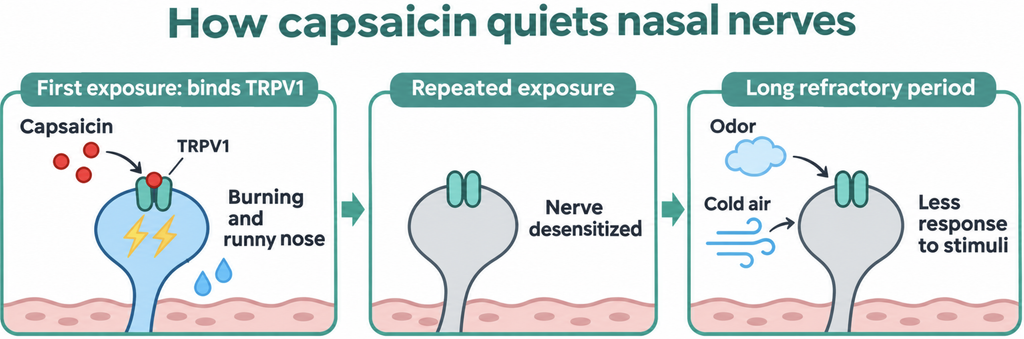
Capsaicin activates TRPV1, an ion channel on sensory C-fibers in the nasal mucosa. The first exposure fires these nerves, so the spray burns and the nose runs. A long refractory period follows, during which the same neurons stop responding to many stimuli [Fokkens, Capsaicin for Rhinitis, 2016].
Patients with idiopathic rhinitis have more TRPV1 in the nasal mucosa and more substance P in nasal secretions than healthy controls. In the study that found this, TRPV1 expression fell after capsaicin treatment, the epithelium stayed intact, and 11 of 14 patients reported relief [Van Gerven, Capsaicin treatment reduces nasal hyperreactivity and TRPV1 overexpression in patients with idiopathic rhinitis, 2014]. These data explain how capsaicin acts; the case for clinical benefit rests on the placebo-controlled trials.
How It Is Given: Products, Doses, and Schedules
The standard protocol is given in clinic on a single day: 0.1 mM capsaicin as 5 applications at 1-hour intervals [Zebda, Double-blinded randomized prospective trial of intranasal capsaicin treatment for nonallergic rhinitis, 2021]. Because this dose is very irritating, a local anesthetic is often applied first. The Cochrane review found the strongest support for 5 applications in 1 day, at least 4 µg per puff [Gevorgyan, Capsaicin for non-allergic rhinitis, 2015].
A 2021 trial tested a gentler option in 68 patients with idiopathic rhinitis. A 0.01 mM spray used daily at home for 4 weeks worked as well as the in-clinic 0.1 mM course, while 0.001 mM had no effect [Van Gerven, Low-dose capsaicin (0.01 mM) nasal spray is equally effective as the current standard treatment for idiopathic rhinitis, 2021]. The home regimen is a practical alternative to the anesthetized clinic protocol.
Over-the-counter sprays differ from the research formulations; Sinus Buster, for example, is a low-dose homeopathic mix of Capsicum annuum and eucalyptol made for daily use. In its 2-week trial, stinging lasted seconds, with no rebound congestion or loss of smell [Bernstein, A randomized, double-blind, parallel trial comparing capsaicin nasal spray with placebo in subjects with a significant component of nonallergic rhinitis, 2011]. The FDA has not reviewed any homeopathic product for safety or effectiveness [FDA, Homeopathic Products, 2025].
| Research protocol | Over-the-counter spray | |
|---|---|---|
| Formulation | 0.1 mM in clinic, or 0.01 mM at home | Low-dose capsicum plus eucalyptol |
| Schedule | 5 applications, 1 hour apart, 1 day | Twice daily for 2 weeks in its trial |
| Anesthesia | Often used with 0.1 mM | Not used |
| Main trial population | Idiopathic rhinitis | Mostly mixed rhinitis |
Burning, sneezing, tearing, rhinorrhea, and cough are expected during treatment [Fokkens, Capsaicin for Rhinitis, 2016].

What Trials Show About Capsaicin Nasal Spray for Rhinitis
Idiopathic (nonallergic) rhinitis
The 2015 Cochrane review included 4 trials with 302 participants, all with idiopathic rhinitis. The trials are small, but both placebo-controlled trials favored capsaicin. In one, overall symptoms on a 0 to 10 VAS were 3.34 points lower than placebo at 2 weeks and 3.52 points lower at 36 weeks. In the other, symptom resolution at 4 weeks was more likely with capsaicin (RR 3.17, 95% CI 1.38 to 7.29). A head-to-head trial also favored capsaicin over budesonide on overall symptom score [Gevorgyan, Capsaicin for non-allergic rhinitis, 2015].
Newer studies confirm the effect. In a 2021 trial of 22 patients, 0.1 mM capsaicin improved symptom scores at 4 and 12 weeks [Zebda, Double-blinded randomized prospective trial of intranasal capsaicin treatment for nonallergic rhinitis, 2021]. A 2024 meta-analysis of 9 placebo-controlled studies found better symptom scores and more responders with capsaicin [Wang, Efficacy of Capsaicin for Non-allergic Rhinitis: An Updated Systematic Review and Meta-analysis, 2024].
Mixed and allergic rhinitis
The Sinus Buster trial enrolled 42 patients, 33 of them with mixed rhinitis. After twice-daily use for 2 weeks, TNSS (maximum 70) fell 12.4 points with capsaicin and 7.7 points with placebo. In allergic rhinitis, capsaicin had no therapeutic effect in the only trial that a 2006 Cochrane review found [Cheng, Capsaicin for allergic rhinitis in adults, 2006].
How long the effect lasts
Benefit lasted up to 36 weeks in one trial in the Cochrane review and had worn off by 24 weeks in the 2021 low-dose trial. Patients with mixed rhinitis return for a second course sooner than those with idiopathic rhinitis, so repeat courses should be expected [Van Gerven, Therapeutic effect of capsaicin nasal treatment in patients with mixed rhinitis unresponsive to intranasal steroids, 2018].
What Guidelines Say
None of the sources below lists capsaicin as a first-line treatment.
| Source | Population | Position on capsaicin |
|---|---|---|
| EAACI position paper | Nonallergic rhinitis | Lasting relief in idiopathic rhinitis; not shown in allergic rhinitis |
| AAAAI/ACAAI Rhinitis 2020 | Allergic and nonallergic | No formal recommendation; asks for larger trials |
| Cochrane, idiopathic rhinitis | Idiopathic rhinitis | Reasonable to try under physician supervision |
| Cochrane, allergic rhinitis | Allergic rhinitis | Not enough evidence |
The Rhinitis 2020 parameter notes that capsaicin is not FDA-approved for rhinitis. For first-line care in nonallergic rhinitis, it states that an intranasal antihistamine or corticosteroid may be offered, with ipratropium when rhinorrhea dominates [Dykewicz, Rhinitis 2020: A practice parameter update, 2020].
When to Consider It, and When Not To
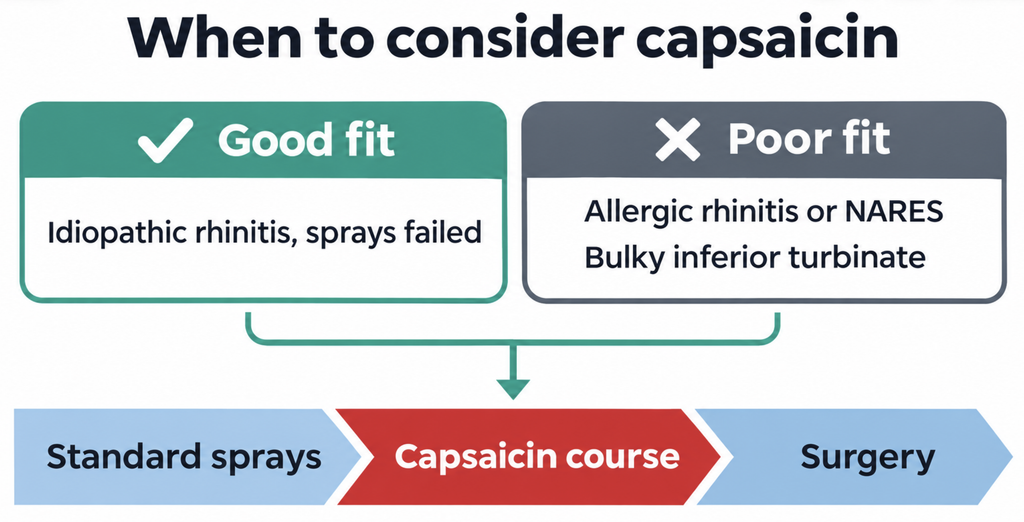
Capsaicin belongs in confirmed idiopathic rhinitis that standard sprays have not controlled.
Consider it when:
- Allergy tests are negative and endoscopy shows no rhinosinusitis, polyps, or major structural cause.
- Symptoms follow nonspecific triggers. Self-reported hyperreactivity predicts a better response [Van Gerven, Therapeutic effect of capsaicin nasal treatment in patients with mixed rhinitis unresponsive to intranasal steroids, 2018].
- An intranasal antihistamine, corticosteroid, or ipratropium has failed.
- The patient accepts burning during treatment, and a formulation is available.
Look elsewhere when:
- Allergic rhinitis drives the symptoms.
- The presentation suggests NARES or rhinitis of the elderly.
- A bulky inferior turbinate causes most of the blockage.
The EAACI surgical task force advises at least 3 months of optimized medical therapy before turbinate reduction or posterior nasal nerve ablation [Lundberg, Surgical Management of Non-Allergic Rhinitis-An EAACI Task Force Position Paper, 2026]. In idiopathic rhinitis, a capsaicin course should come within that window, before any surgery.
Key Takeaways
- Capsaicin nasal spray for rhinitis works in idiopathic (nonallergic) rhinitis, not in allergic rhinitis.
- Capsaicin first activates and then desensitizes TRPV1 nerves in the nose, which explains the burning early in treatment.
- Both placebo-controlled trials in the Cochrane review favored capsaicin, and benefit lasted up to 36 weeks in one of them.
- The standard protocol (0.1 mM, 5 applications in 1 day) differs from over-the-counter homeopathic sprays, which the FDA has not reviewed.
- Capsaicin is not first-line; it belongs after standard sprays fail and before surgery.
FAQ
Does capsaicin nasal spray work for allergic rhinitis?
No. In the only allergic rhinitis trial that a Cochrane review found, capsaicin had no therapeutic effect [Cheng, Capsaicin for allergic rhinitis in adults, 2006].
How does capsaicin nasal spray work?
It desensitizes nasal nerves: capsaicin activates TRPV1 on nasal C-fibers, and a long refractory period follows [Fokkens, Capsaicin for Rhinitis, 2016].
How is capsaicin nasal spray used?
The standard protocol is given in clinic on 1 day, as 0.1 mM capsaicin in 5 applications 1 hour apart. The Cochrane review rated a single-day, 5-application schedule as the best supported [Gevorgyan, Capsaicin for non-allergic rhinitis, 2015].
Is capsaicin nasal spray safe?
Yes. Burning, sneezing, and cough during treatment are expected, and no long-term side effects are known [Gevorgyan, Capsaicin for non-allergic rhinitis, 2015]. Biopsies up to 9 months after treatment showed no change in inflammatory cells [Blom, The long-term effects of capsaicin aqueous spray on the nasal mucosa, 1998].
References
- Gevorgyan A, Segboer C, Gorissen R, et al. Capsaicin for non-allergic rhinitis. Cochrane Database Syst Rev. 2015 Jul 14;2015(7):CD010591.
- Hellings PW, Klimek L, Cingi C, et al. Non-allergic rhinitis: Position paper of the European Academy of Allergy and Clinical Immunology. Allergy. 2017 Nov;72(11):1657-1665.
- Fokkens W, Hellings P, Segboer C. Capsaicin for Rhinitis. Curr Allergy Asthma Rep. 2016 Aug;16(8):60.
- Van Gerven L, Alpizar YA, Wouters MM, et al. Capsaicin treatment reduces nasal hyperreactivity and transient receptor potential cation channel subfamily V, receptor 1 (TRPV1) overexpression in patients with idiopathic rhinitis. J Allergy Clin Immunol. 2014 May;133(5):1332-9, 1339.e1-3.
- Van Gerven L, Steelant B, Cools L, et al. Low-dose capsaicin (0.01 mM) nasal spray is equally effective as the current standard treatment for idiopathic rhinitis: A randomized, double-blind, placebo-controlled trial. J Allergy Clin Immunol. 2021 Jan;147(1):397-400.e4.
- Bernstein JA, Davis BP, Picard JK, et al. A randomized, double-blind, parallel trial comparing capsaicin nasal spray with placebo in subjects with a significant component of nonallergic rhinitis. Ann Allergy Asthma Immunol. 2011 Aug;107(2):171-8.
- U.S. Food and Drug Administration (FDA). Homeopathic Products [Internet]. Silver Spring (MD): FDA; 2025 Jan 17 [cited 2026 Nov 21]. Available from: https://www.fda.gov/drugs/understanding-over-counter-medicines/homeopathic-products
- Zebda D, Jiang ZY, Gibson MM, et al. Double-blinded randomized prospective trial of intranasal capsaicin treatment for nonallergic rhinitis. Int Forum Allergy Rhinol. 2021 Jan;11(1):24-30.
- Wang J, Zhang L, Zheng K, et al. Efficacy of Capsaicin for Non-allergic Rhinitis: An Updated Systematic Review and Meta-analysis. Clin Rev Allergy Immunol. 2024 Dec;67(1-3):40-46.
- Cheng J, Yang XN, Liu X, et al. Capsaicin for allergic rhinitis in adults. Cochrane Database Syst Rev. 2006 Apr 19;(2):CD004460.
- Dykewicz MS, Wallace DV, Amrol DJ, et al. Rhinitis 2020: A practice parameter update. J Allergy Clin Immunol. 2020 Oct;146(4):721-767.
- Van Gerven L, Steelant B, Alpizar YA, et al. Therapeutic effect of capsaicin nasal treatment in patients with mixed rhinitis unresponsive to intranasal steroids. Allergy. 2018 Jan;73(1):248-250.
- Lundberg M, van Waterschoot J, Moyaert M, et al. Surgical Management of Non-Allergic Rhinitis-An EAACI Task Force Position Paper. Allergy. 2026 Nov;81(11):3779-3796.
- Blom HM, Severijnen LA, Van Rijswijk JB, et al. The long-term effects of capsaicin aqueous spray on the nasal mucosa. Clin Exp Allergy. 1998 Nov;28(11):1351-8.
Joonpyo Hong, MD is a board-certified otolaryngologist practicing in Korea. This article reflects his clinical interpretation of published research and does not constitute individual medical advice.
For more articles:
https://curiousmd.com/when-to-take-allergic-rhinitis-medication/
https://curiousmd.com/allergic-vs-nonallergic-rhinitis/
https://curiousmd.com/allergen-immunotherapy-for-allergic-rhinitis/
Link out to:
https://www.cochrane.org/CD010591/ENT_capsaicin-non-allergic-rhinitis — Cochrane’s plain-language summary of the review on intranasal capsaicin for non-allergic rhinitis.
https://college.acaai.org/sites/default/files/Resources/rhinitis_2020-a_practice_parameter_update.pdf — Full text of the AAAAI/ACAAI Rhinitis 2020 practice parameter, covering allergic and nonallergic rhinitis.
https://www.aafp.org/pubs/afp/issues/2018/0801/p171.html — American Family Physician review of chronic nonallergic rhinitis subtypes and treatment.
https://www.fda.gov/drugs/understanding-over-counter-medicines/homeopathic-products — FDA explains that homeopathic products have not been reviewed for safety and effectiveness.