
Sudden hearing loss prognostic factors explain why patients on the same steroid course can end with very different hearing. Two hypothetical patients show the range: one with a rising low-tone loss and loud tinnitus, the other with a flat profound loss and spinning vertigo. This review sets out which factors predict complete, partial, or no recovery, assuming prompt standard treatment, and does not compare treatments.
FYI, In medical terminology, more specific terms such as sudden sensorineural hearing loss (SSNHL) or idiopathic sudden sensorineural hearing loss (ISSNHL) are preferred over sudden hearing loss. However, for simplicity and readability, I will use the more commonly understood term sudden hearing loss throughout this article to refer to sudden sensorineural hearing loss.
What “Recovery” Means in These Studies
Studies sort outcomes into complete, partial, slight, or no recovery, but they do not share one definition. Common systems include the Siegel criteria, the AAO-HNS classes, and Chinese Medical Association criteria. In a cohort of 663 patients, Siegel and Chinese criteria gave similar complete recovery rates, at 14.3% and 13.6% [Xie, Lupus and rheumatoid arthritis in SSNHL, 2020]. How the pure-tone average is built can matter more. In frequency-specific losses, averaging only the affected frequencies showed 8.7 dB more recovery than the standard average [Nordlie, Precision and prediction matter, 2025].
The percentages below are best compared within each study rather than across studies. Spontaneous recovery is also common. In an early prospective natural history study, 65% of patients recovered completely to functional hearing without treatment, most within 14 days [Mattox, Natural history of sudden sensorineural hearing loss, 1977]. Current NIH patient material gives a more cautious figure of about half [National Institute on Deafness and Other Communication Disorders, Sudden Deafness, 2018]. The factors below shift the odds around this baseline.
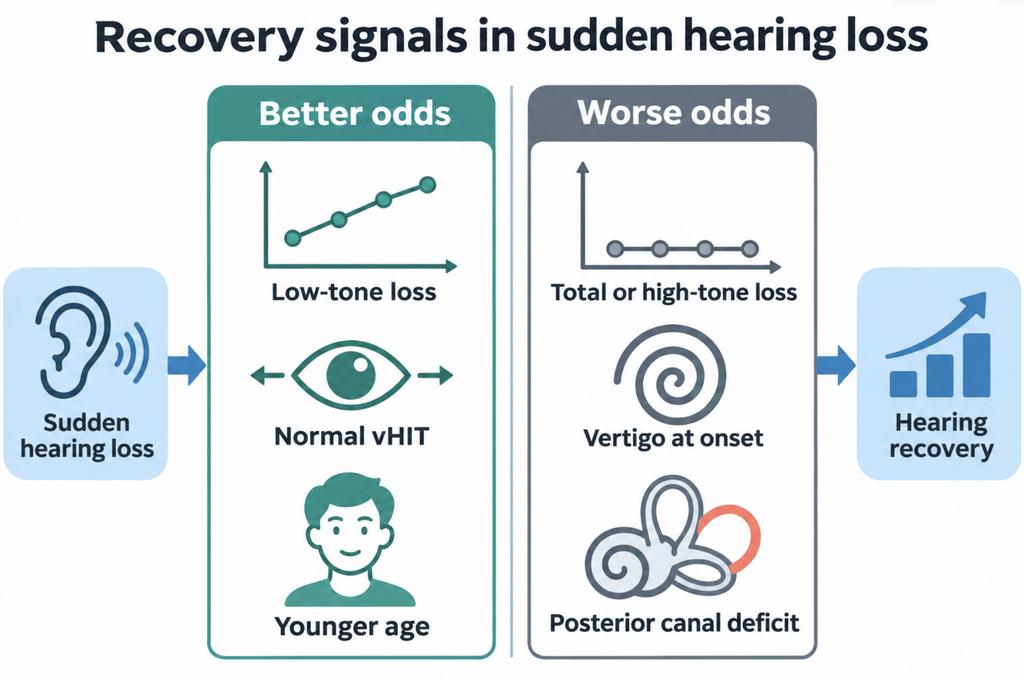
Sudden Hearing Loss Prognostic Factors at a Glance
| Factor | Points toward better recovery | Points toward worse recovery | Strength of evidence |
|---|---|---|---|
| Initial severity | Mild to moderate loss | Severe, profound, or total loss | Meta-analyses and large cohorts |
| Audiogram shape | Low-tone or ascending | High-tone, descending, or total | Large cohorts, some conflict |
| Vertigo | Absent | Present at onset | Meta-analysis |
| Vestibular tests | Normal vHIT and caloric test | Posterior canal deficit on vHIT | Recent meta-analyses of small studies |
| Tinnitus | Present | Absent | One meta-analysis, conflicting cohorts |
| Age | Younger | 60 to 65 years or older | Large cohorts |
| Comorbidities | None | Metabolic syndrome, heart disease, autoimmune disease | Mostly single cohorts |
| Other ear | Normal hearing | Prior hearing loss or bilateral onset | Single cohort; meta-analysis for bilateral onset |
| Early response | Gain of 10 dB or more on days 6–7 | Little early gain | Single cohort |
The most consistent signals come from large registries. A Japanese nationwide registry of 3,419 patients linked poor prognosis to severe initial loss, heart disease, and vertigo [Kitoh, Nationwide epidemiological survey of ISSNHL in Japan, 2017]. Age 65 years or older and more than 7 days from onset to treatment were also linked. A Chinese multicenter study found the same direction for age, delay, and initial severity [Wang, Prognostic factors of SSNHL in a Chinese multicenter study, 2015].
Studies from single cohort should be read with caution.
Audiogram Shape: Low-Tone, High-Tone, Flat, and Total Loss
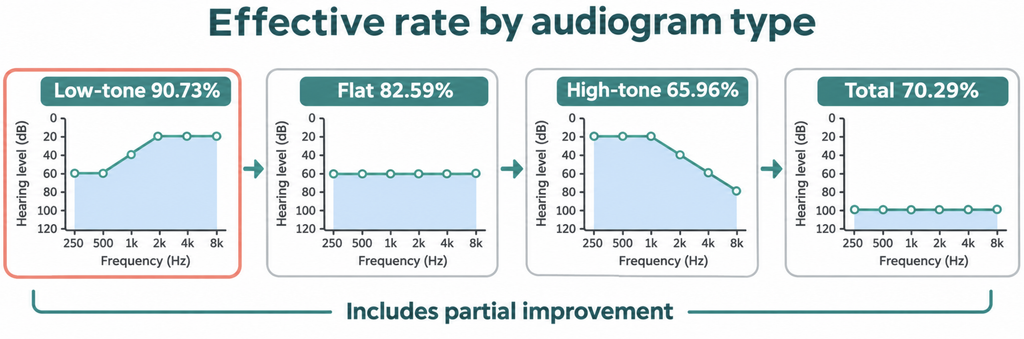
The Chinese multicenter study sorted 1,024 patients from 33 hospitals into 4 audiogram types [Wang, Prognostic factors of SSNHL in a Chinese multicenter study, 2015]. Its effective rate included partial improvement, not only complete recovery. That rate was 90.73% for low-tone loss, 82.59% for flat loss, 70.29% for total deafness, and 65.96% for high-tone loss. The order matches the older finding that low-frequency losses do better than high-frequency losses [Mattox, Natural history of sudden sensorineural hearing loss, 1977].
Low-tone loss: best odds, more recurrences
In a small Greek cohort, complete recovery was 77.7% for low-tone loss and 15% for high-tone loss [Psillas, Low-tone compared to high-tone SSHL, 2018]. The trade-off was recurrence: 22% of low-tone cases recurred, against 10% of high-tone cases. In another cohort, most ascending and acute low-frequency cases recovered completely within 10 days of onset [Diao, Prognosis of acute low-frequency and ascending SSNHL, 2023]. Japanese registry data suggest acute low-tone hearing loss may be a different inner ear disease from typical idiopathic SSNHL [Yoshida, ISSNHL and acute low-tone hearing loss in Japan, 2017].
High-tone loss: the 4 kHz signal
High-frequency damage predicts a poorer course. In 965 patients, complete recovery was 20% when 4 kHz was the worst of the tested thresholds, 36% when it was intermediate, and 49% when it was the best [Tseng, A novel audiogram model for SSNHL prognosis, 2025]. In patients without vertigo, high-tone loss (4–8 kHz) of 30 dB or more independently predicted incomplete recovery (HR 9.170) [Lin, Audiovestibular factors in SSNHL without vertigo, 2024]. Both come from single cohorts, but they agree with the natural history data.
Flat and total loss: severity drives the result
“Flat” is a mixed group. A reanalysis of the Chinese multicenter cohort split 402 flat cases by slope [Diao, Reclassification of flat type sudden deafness, 2023]. Cure rates were 70.7% for ascending-flat, 17.1% for descending-flat, and 34.0% for consistent-flat curves. Total deafness did worse, at 14.5%. Among patients with a PTA over 90 dB, 3.5% of total-deafness cases reached 50 dB or better, against 29.9% of profound cases [Zhao, Profound versus total sudden hearing loss, 2010].
Initial hearing level and word recognition
Initial severity is one of the most reproducible factors. In 186 patients on a standard oral steroid protocol, severe or profound initial loss was an independent risk factor for worse recovery (OR 6.634) [Perez Ferreira Neto, Clinical Profile of Unilateral SSNHL, 2021]. A meta-analysis limited to severe-to-profound SSNHL still linked profound loss to poorer recovery (OR 4.68; 15 studies, 2,632 patients) [Chen, Reasons for Poor Prognosis in Severe to Profound SSNHL, 2025]. One study found that the initial word recognition score adds independent information, mainly when it is poor [Kwak, The value of an initial word recognition score, 2021]. Not all data agree on shape: an older chart review of 837 patients found audiogram shape was not a useful indicator [Fetterman, Prognosis and treatment of sudden sensorineural hearing loss, 1996].
Does Vertigo Mean a Worse Prognosis?
Vertigo as a symptom
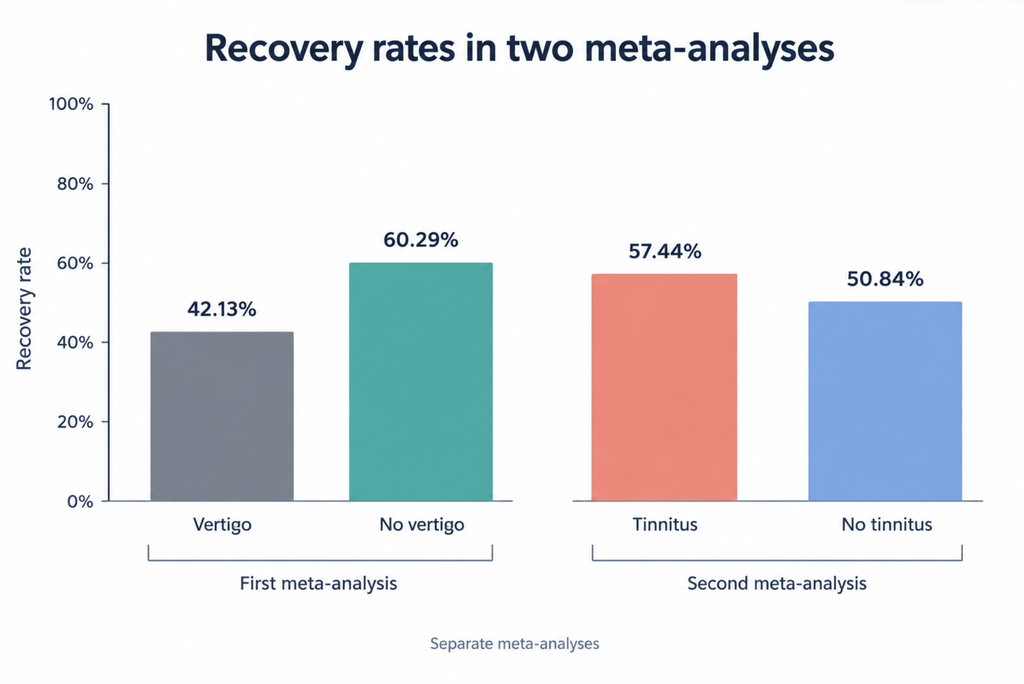
A meta-analysis of 10 studies and 4,814 patients found recovery in 42.13% of patients with vertigo and 60.29% of those without [Yu, Vertigo and Hearing Outcomes in SSHL, 2018]. Vertigo was linked to worse recovery (OR 2.22; 95% CI 1.54–3.20), though heterogeneity was high. The link held within severe-to-profound loss (OR 1.95) [Chen, Reasons for Poor Prognosis in Severe to Profound SSNHL, 2025]. It was not seen in the intratympanic steroid subgroup, so the link may weaken with some treatment approaches.
Part of this signal may come from severity. In 183 patients, vertigo by itself did not predict hearing gain, but its interaction with initial hearing level did [Cho, Prognostic factors using interaction effects, 2013]. In another cohort of patients with vertigo, profound audiograms were 3.89 times more likely than low-frequency ones to show vestibular dysfunction [Wang, Hearing prognosis and vestibular function in SSNHL with vertigo, 2020].
What vestibular tests add
Vestibular testing shows which end organ is damaged. A meta-analysis of multivariable-adjusted estimates linked objective vestibular dysfunction to poor recovery (OR 4.46; 95% CI 1.98–10.04; 5 studies) [Andrade, Vestibular dysfunction and hearing prognosis in ISSNHL, 2026]. The authors rated certainty as moderate, and the study pool was small.
Canal-level data single out the posterior canal. Across 7 studies and 781 patients, normal posterior canal function on vHIT predicted favorable recovery (OR 6.929) [Zongyi, Semicircular canal function testing in ISSHL, 2026]. Normal horizontal canal function (OR 3.14) and a normal caloric test (OR 3.184) also predicted better outcomes. Anterior canal function did not.
In patients with vertigo, a posterior canal deficit was present in 50% [Guo, Prognostic value of the video head impulse test, 2026]. Reduced posterior canal gain carried a 4.14-fold risk of poor recovery, and reduced horizontal canal gain a 3.06-fold risk. Of the 5 end organs mapped in 135 patients, only the posterior canal was linked to poor prognosis in multivariable analysis [Seo, Vestibular mapping assessment in ISSNHL, 2022].
Otolith findings are less consistent. In one cohort, patients with saccular dysfunction on cVEMP were 0.07 times as likely to recover after adjustment [Wang, Hearing prognosis and vestibular function in SSNHL with vertigo, 2020]. In 133 patients with severe-to-profound loss, caloric and vHIT results were independent predictors, but cVEMP and oVEMP were not [Huang, Vestibular dysfunction and short-term auditory outcome, 2025]. In 48 flat-descending cases, mean gain was only 3.13 dB when all 4 vestibular tests were abnormal [Zhu, Vestibular function in flat descending SSNHL, 2025].
Why the posterior canal matters
One explanation is vascular. In 29 patients, 45% had a vestibular lesion, and 53% of those combined cochlear and posterior canal damage [Rambold, Differential vestibular dysfunction in sudden unilateral hearing loss, 2005]. The authors suggested this pattern may reflect disease of the common cochlear artery. A pooled analysis of 464 cases found vestibular dysfunction in 72.4%, with some patterns that may fit the vestibulocochlear and common cochlear artery supply [Andrade, Vestibular Functional Patterns in Sudden Sensorineural Hearing Loss, 2026]. On this view, a posterior canal deficit may mark a wider vascular injury, but this remains a hypothesis.

Abnormal tests without vertigo
In a prospective cohort of 51 patients without vertigo, 80.4% had at least one abnormal vestibular test [Lin, Audiovestibular factors in SSNHL without vertigo, 2024]. An abnormal posterior canal vHIT predicted incomplete recovery (HR 14.502), but the confidence interval was very wide (1.371–153.355). In flat-descending cases, test results predicted outcome while the vertigo symptom did not [Zhu, Vestibular function in flat descending SSNHL, 2025].
Secondary BPPV
Positional vertigo after sudden hearing loss is common. Secondary BPPV occurred in 12.1% of 519 patients, and multicanal involvement was more frequent than in idiopathic BPPV [Kim, BPPV accompanied by sudden sensorineural hearing loss, 2012]. Among 90 patients with vertigo, hearing recovery did not differ between the 17 with BPPV and those without it [Kim, BPPV is not a prognostic factor in SSNHL, 2011]. In that small study, BPPV added no separate effect on hearing outcome beyond the vertigo itself.
Limits of the vestibular data
In a prospective cohort of 39 patients without acute vestibular syndrome, vHIT and cVEMP results did not predict recovery, while baseline severity did [Rodríguez-Izquierdo, Diagnostic value of vestibular tests, 2026]. Test thresholds and outcome definitions also differ between studies [Andrade, Vestibular dysfunction and hearing prognosis in ISSNHL, 2026].
Is Tinnitus a Good Sign?
A meta-analysis of 10 studies and 4,782 patients found recovery in 57.44% of patients with tinnitus and 50.84% of those without [Wei, Tinnitus and Hearing Recovery in SSNHL, 2025]. Tinnitus was linked to better recovery (OR 0.60; 95% CI 0.42–0.85), with substantial heterogeneity. As with vertigo, the link was not seen in the intratympanic steroid subgroup.
Single cohorts do not all agree: one found tinnitus linked to 4.9 dB less recovery [Nordlie, Precision and prediction matter, 2025]. The reason for the pooled finding is unclear, so tinnitus at onset is a weak, uncertain signal and should not be used to reassure patients.
Age, Comorbidities, and the Other Ear
Age
Older age predicts a poorer outcome across large cohorts. Age 65 years or older predicted poor prognosis in the Japanese registry [Kitoh, Nationwide epidemiological survey of ISSNHL in Japan, 2017]. Age 60 years or older was an independent poor factor in a cohort of 332 patients [Shimanuki, Early hearing improvement predicts the prognosis of ISSHL, 2021].
Diabetes, hypertension, and metabolic syndrome
Pooled data suggest metabolic syndrome is linked to poorer recovery (OR 2.77; 95% CI 2.33–3.28) [Lam, Sudden Sensorineural Hearing Loss and Metabolic Syndrome, 2021]. That estimate rests on only 3 studies and 608 patients. The role of diabetes is less clear. In 317 patients, baseline thresholds were 41.3 dB without diabetes, 56.3 dB with well-controlled diabetes, and 62.5 dB with poorly controlled diabetes [Koh, Elderly patients with diabetes mellitus and ISSNHL prognosis, 2025]. Gains at 6 months were similar, at 6.3, 7.5, and 8.8 dB.
In that cohort, final hearing was worse with diabetes because the starting point was worse. Findings for other vascular risk factors are inconsistent. In 90 patients, only smoking was linked to poorer low-frequency recovery; other cardiovascular risk factors were not [Lemons, Recovery from ISSNHL and cardiovascular disease risk, 2023].
Heart disease and autoimmune disease
Heart disease predicted poor prognosis in the Japanese registry [Kitoh, Nationwide epidemiological survey of ISSNHL in Japan, 2017]. In 663 patients, lupus, rheumatoid arthritis, and diabetes were each linked to poor recovery under both Siegel and Chinese criteria [Xie, Lupus and rheumatoid arthritis in SSNHL, 2020].
The other ear
In 445 patients, prior hearing loss in the opposite ear carried a 2.76-fold risk of treatment failure [Xie, Contralateral hearing loss and ISSNHL prognosis, 2026]. This risk interacted with age over 60, hypertension, and illness lasting more than 4 days. Bilateral onset is uncommon and carries a worse prognosis. Bilateral cases made up 11.9% of SSNHL in a meta-analysis, and PTA gain was 15.3 dB smaller than in unilateral cases [Bhat, Prognosis of Bilateral Sudden Sensorineural Hearing Loss, 2024].
Blood and MRI Markers
Evidence for blood markers is weak. A meta-analysis linked a higher neutrophil-to-lymphocyte ratio (NLR) to worse prognosis [Niknazar, Prognostic biomarkers in SSNHL, 2023]. Another review rated the inflammatory marker literature as varied and low in quality [Frosolini, Role of Inflammatory Biomarkers in SSNHL, 2022].
MRI findings show a clearer link. Across 8 studies and 638 patients, 29% showed high labyrinthine signal on 3D-FLAIR MRI [Lammers, Prognostic value of 3D-FLAIR MRI in ISSNHL, 2019]. These patients had final pure-tone averages 21 dB worse in multivariable analysis. The findings suggested labyrinthitis in most cases and intralabyrinthine hemorrhage in the rest.
Timing and Early Response During Treatment
Time to treatment
NIH patient guidance advises starting corticosteroids as soon as possible [National Institute on Deafness and Other Communication Disorders, Sudden Deafness, 2018]. Delay still appears as a prognostic factor in its own right. More than 7 days from onset predicted poor prognosis in the Japanese registry [Kitoh, Nationwide epidemiological survey of ISSNHL in Japan, 2017]. Starting at 15 days or later was an independent risk factor in another cohort [Perez Ferreira Neto, Clinical Profile of Unilateral SSNHL, 2021]. In a third, each day of delayed assessment cost 0.84 dB of recovery [Nordlie, Precision and prediction matter, 2025].
One prospective study of 326 patients found no difference between starting within 24 hours and within the first week [Huy, ISSNHL is not an otologic emergency, 2005]. The studies disagree on how much a delay of a few days matters.
Early response
Hearing gain in the first week of treatment refines the estimate. In 332 patients, the baseline risk factors were age 60 or older, initial hearing of 72.5 dB HL or worse, and vertigo [Shimanuki, Early hearing improvement predicts the prognosis of ISSHL, 2021]. Patients with none of these and a gain of 10 dB or more on days 6–7 had a complete recovery rate of 80%. Patients with 2 or 3 factors and less than 10 dB of gain had a rate of 1.5%.
Combined scores
A scoring system built on 784 patients combined age, time to treatment, initial hearing, audiogram shape, and vertigo [Diao, A Scoring System for Predicting the Cure Rate, 2025]. The cure rate was 81.4% for scores below 5 and 10.1% for scores of 12 or more. The system was built in one cohort and needs testing in other populations.
How to Use These Factors When Counseling a Patient
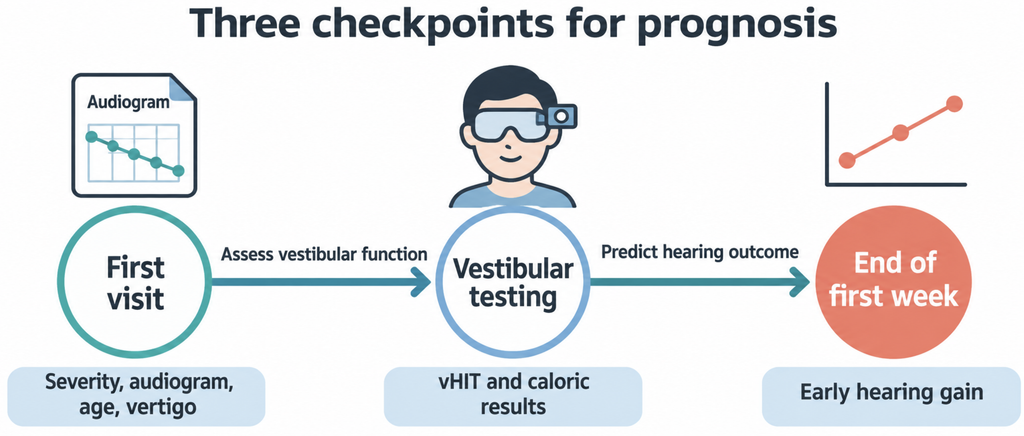
The estimate can be updated at three points. At the first visit, severity, audiogram shape, age, vertigo, and the other ear give a baseline estimate. After vestibular testing, a posterior canal deficit on vHIT may lower that estimate, even without vertigo. At the end of the first week, the size of early gain shows whether the course is on track.
The AAO-HNS guideline recommends that clinicians explain the natural history, the benefits and risks of treatment, and the limits of the evidence [Chandrasekhar, Clinical Practice Guideline: Sudden Hearing Loss (Update), 2019]. It also recommends follow-up audiometry at the end of treatment and within 6 months after it. Follow-up remains relevant after recovery: in 660 patients, those who recovered to good hearing reached non-serviceable hearing after a median of 16.4 years [Early, Accelerated Long-Term Hearing Loss Progression, 2021]. After incomplete recovery, the other ear also faced higher risk over the next 12 years.
Key Takeaways
- Initial severity, age, vertigo, and audiogram shape are the most consistent sudden hearing loss prognostic factors.
- Low-tone loss recovers best, while high-tone loss and total deafness recover least.
- On vHIT, posterior canal dysfunction is linked to poorer hearing recovery, including in some patients without vertigo.
- In pooled data, tinnitus at onset is linked to slightly better recovery, but cohort results conflict.
- Hearing gain in the first week of treatment refines the baseline estimate.
FAQ
Will hearing come back after sudden hearing loss?
Often, at least partly. About half of patients regain some hearing even without treatment, according to NIH patient material [National Institute on Deafness and Other Communication Disorders, Sudden Deafness, 2018]. The chance of full recovery is highest with mild, low-tone loss [Wang, Prognostic factors of SSNHL in a Chinese multicenter study, 2015]. It is lowest with profound or total loss, vertigo, and older age [Kitoh, Nationwide epidemiological survey of ISSNHL in Japan, 2017]. Hearing gain in the first week of treatment helps refine the outlook [Shimanuki, Early hearing improvement predicts the prognosis of ISSHL, 2021].
Does vertigo mean a worse prognosis in sudden hearing loss?
Usually, yes. In a meta-analysis, recovery was 42.13% with vertigo and 60.29% without [Yu, Vertigo and Hearing Outcomes in SSHL, 2018]. Vestibular testing sharpens this signal, and posterior canal dysfunction on vHIT shows the strongest link to poor recovery [Zongyi, Semicircular canal function testing in ISSHL, 2026]. In one small study, secondary BPPV did not change hearing outcome compared with other vertigo [Kim, BPPV is not a prognostic factor in SSNHL, 2011].
Is tinnitus a good or bad sign in sudden hearing loss?
Pooled data suggest a mildly good sign, but cohort results conflict. Recovery was 57.44% with tinnitus and 50.84% without in a meta-analysis of 4,782 patients [Wei, Tinnitus and Hearing Recovery in SSNHL, 2025]. At least one cohort found the opposite, so tinnitus alone should not be used as reassurance [Nordlie, Precision and prediction matter, 2025].
Does diabetes slow recovery from sudden hearing loss?
Not clearly. In one cohort, hearing gain over 6 months was similar with and without diabetes [Koh, Elderly patients with diabetes mellitus and ISSNHL prognosis, 2025]. Patients with diabetes started with worse hearing, so they also ended with worse hearing. Metabolic syndrome as a whole has been linked to poorer recovery in pooled data [Lam, Sudden Sensorineural Hearing Loss and Metabolic Syndrome, 2021].
References
- Chandrasekhar SS, Tsai Do BS, Schwartz SR, Bontempo LJ, Faucett EA, Finestone SA, et al. Clinical Practice Guideline: Sudden Hearing Loss (Update). Otolaryngol Head Neck Surg. 2019;161(1_suppl):S1-S45.
- Mattox DE, Simmons FB. Natural history of sudden sensorineural hearing loss. Ann Otol Rhinol Laryngol. 1977;86(4 Pt 1):463-80.
- National Institute on Deafness and Other Communication Disorders. Sudden Deafness. Bethesda (MD): NIDCD; 2018.
- Xie S, Ning H, She Y, Jing Q, Jiang Q, Zhang Y, et al. Effect of systemic lupus erythematosus and rheumatoid arthritis on sudden sensorineural hearing loss. Laryngoscope. 2020;130(10):2475-2480.
- Nordlie E, Elander J, Värendh M, Stenfeldt K, Tjernström F, Gisselsson-Solén M, et al. Precision and prediction matter: investigating hearing recovery measurements and prognosis in sudden sensorineural hearing loss. Eur Arch Otorhinolaryngol. 2025;283(1):205-214.
- Kitoh R, Nishio SY, Ogawa K, Kanzaki S, Hato N, Sone M, et al. Nationwide epidemiological survey of idiopathic sudden sensorineural hearing loss in Japan. Acta Otolaryngol. 2017;137(sup565):S8-S16.
- Wang J, Xiao S, Zeng Z, Zhen Z, Zhang X, Lin F, et al. Analyses prognostic factors relevant to sudden sensorineural hearing loss. Zhonghua Er Bi Yan Hou Tou Jing Wai Ke Za Zhi. 2015;50(6):448-52.
- Psillas G, Rizou A, Rachovitsas D, Tsiropoulos G, Constantinidis J. Hearing Outcome of Low-tone Compared to High-tone Sudden Sensorineural Hearing Loss. Int Arch Otorhinolaryngol. 2018;23(1):65-69.
- Diao T, Chen Y, Jing Y, Ma X. Clinical characteristics and prognosis of acute low-frequency hearing loss and ascending sensorineural sudden sensorineural hearing loss. Front Neurosci. 2023;16:1076109.
- Yoshida T, Sone M, Kitoh R, Nishio SY, Ogawa K, Kanzaki S, et al. Idiopathic sudden sensorineural hearing loss and acute low-tone sensorineural hearing loss: a comparison of the results of a nationwide epidemiological survey in Japan. Acta Otolaryngol. 2017;137(sup565):S38-S43.
- Tseng HW, Hsu CY, Chen CH, Chu YC, Liao WH. A novel audiogram model for predicting the prognosis of sudden sensorineural hearing loss. J Chin Med Assoc. 2025;88(11):851-857.
- Lin SC, Lin MY. Impact of audiovestibular factors on prognosis in patients with sudden sensorineural hearing loss without vertigo. Eur Arch Otorhinolaryngol. 2024;281(11):5709-5716.
- Diao TX, Jing YY, Zhang JL, Wang YX, Yu LS, Ma X. Reclassification of flat type sudden deafness. Zhonghua Er Bi Yan Hou Tou Jing Wai Ke Za Zhi. 2023;58(2):111-116.
- Zhao H, Fu YY, Zhang TY, Chi FL, Jing JH. Different prognostic characteristics between profound sudden sensorineural hearing loss and total sudden hearing loss. Zhonghua Er Bi Yan Hou Tou Jing Wai Ke Za Zhi. 2010;45(7):570-3.
- Perez Ferreira Neto A, da Costa Monsanto R, Dore Saint Jean L, Sonzzini Ribeiro de Souza L, de Oliveira Penido N. Clinical Profile of Patients With Unilateral Sudden Sensorineural Hearing Loss: Correlation With Hearing Prognosis. Otolaryngol Head Neck Surg. 2021;165(4):563-570.
- Chen L, Qiu J, Zhang Q, Xi Z, Wu Q, Xu M, et al. Analysis of the Reasons for Poor Prognosis in Severe to Profound Sudden Sensorineural Hearing Loss: A Systematic Review and Meta-Analysis. Diagnostics (Basel). 2025;15(21):2770.
- Kwak C, Seo YJ, Yoon C, Lee J, Han W. The value of having an initial word recognition score for a precise prognosis of idiopathic sudden sensorineural hearing loss. Auris Nasus Larynx. 2021;49(4):554-563.
- Fetterman BL, Saunders JE, Luxford WM. Prognosis and treatment of sudden sensorineural hearing loss. Am J Otol. 1996;17(4):529-36.
- Yu H, Li H. Association of Vertigo With Hearing Outcomes in Patients With Sudden Sensorineural Hearing Loss: A Systematic Review and Meta-analysis. JAMA Otolaryngol Head Neck Surg. 2018;144(8):677-683.
- Cho CS, Choi YJ. Prognostic factors in sudden sensorineural hearing loss: a retrospective study using interaction effects. Braz J Otorhinolaryngol. 2013;79(4):466-70.
- Wang Y, Wang L, Jing Y, Yu L, Ye F. Association Between Hearing Characteristics/Prognosis and Vestibular Function in Sudden Sensorineural Hearing Loss With Vertigo. Front Neurol. 2020;11:579757.
- Andrade A, Ferreira F, Marques Silva M, Camila Dias C, Coutinho G, Vaz R, et al. Vestibular dysfunction and hearing prognosis in idiopathic sudden sensorineural hearing loss: A systematic review and meta-analysis of multivariable-adjusted estimates. Eur Arch Otorhinolaryngol. 2026. Epub ahead of print.
- Zongyi W, Shizhen Z, Danheng Z, Shuzhi Y, Mingfang D. The prognostic value of semicircular canal function testing in idiopathic sudden sensorineural hearing loss: a systematic review and meta-analysis. Front Neurol. 2026;17:1796414.
- Guo Q, Lin Y, Wang Z, Hang P, Zha D. Prognostic value of the video head impulse test in sudden sensorineural hearing loss with vertigo: a systematic review and meta-analysis. Front Neurol. 2026;16:1756795.
- Seo HW, Chung JH, Byun H, Lee SH. Vestibular mapping assessment in idiopathic sudden sensorineural hearing loss. Ear Hear. 2022;43(1):242-249.
- Huang S, Zhu J, Zhang J, Li S, Jin Y, Zhang Q, et al. Impact of vestibular dysfunction on short-term auditory outcome in severe to profound unilateral idiopathic sudden sensorineural hearing loss: a retrospective analysis. Acta Otolaryngol. 2025;146(3):313-319.
- Zhu J, Huang S, Li S, Chen J, Zheng G, Zhang Q, et al. Relationship between short-term prognosis and symptoms of vertigo and vestibular function in patients with unilateral flat descending sudden sensorineural hearing loss. Lin Chuang Er Bi Yan Hou Tou Jing Wai Ke Za Zhi. 2025;39(10):930-934.
- Rambold H, Boenki J, Stritzke G, Wisst F, Neppert B, Helmchen C. Differential vestibular dysfunction in sudden unilateral hearing loss. Neurology. 2005;64(1):148-51.
- Andrade A, Ferreira F, Marques Silva M, Camila Dias C, Coutinho G, Vaz R, et al. Vestibular Functional Patterns in Sudden Sensorineural Hearing Loss: A Systematic Review and Pooled Analysis. Ear Hear. 2026;47(5):1372-1379.
- Kim MB, Ban JH. Benign paroxysmal positional vertigo accompanied by sudden sensorineural hearing loss: a comparative study with idiopathic benign paroxysmal positional vertigo. Laryngoscope. 2012;122(12):2832-6.
- Kim YH, Kim KS, Choi H, Choi JS, Han CD. Benign paroxysmal positional vertigo is not a prognostic factor in sudden sensorineural hearing loss. Otolaryngol Head Neck Surg. 2011;146(2):279-82.
- Rodríguez-Izquierdo C, Avdiyuk A, Rodríguez-Ocaña D, Plaza G. Diagnostic value of vestibular tests (video head impulse test and cervical vestibular evoked myogenic potentials) in idiopathic sudden sensorineural hearing loss. Acta Otolaryngol. 2026;146(9):1131-1136.
- Wei W, Sun Y, You Y, Yan K. Association Between Tinnitus and Hearing Recovery in Sudden Sensorineural Hearing Loss: A Meta-analysis. Otol Neurotol. 2025;47(2):e151-e157.
- Shimanuki MN, Shinden S, Oishi N, Suzuki N, Iwabu K, Kitama T, et al. Early hearing improvement predicts the prognosis of idiopathic sudden sensorineural hearing loss. Eur Arch Otorhinolaryngol. 2021;278(11):4251-4258.
- Lam M, Bao Y, Hua GB, Sommer DD. Sudden Sensorineural Hearing Loss and Metabolic Syndrome: A Systematic Review and Meta-analysis. Otol Neurotol. 2021;42(9):1308-1313.
- Koh SM, Oh S, Song B, Cho YS, Cho YS. Effect of elderly patients with diabetes mellitus on the prognosis of idiopathic sudden sensorineural hearing loss. Auris Nasus Larynx. 2025;52(4):302-306.
- Lemons K, Archambault E, Anderson M, Kaizer A, Baiduc RR. Recovery From Idiopathic Sudden Sensorineural Hearing Loss: Association With Cardiovascular Disease Risk. Am J Audiol. 2023;32(4):865-877.
- Xie S, Chen Z, Huang L, Hong Y, Lin C. Impact of contralateral sensorineural hearing loss on prognosis in idiopathic sudden sensorineural hearing loss. PLoS One. 2026;21(3):e0345042.
- Bhat AM, Nanu DP, Nguyen SA, Meyer TA, Labadie RF. Prognosis of Bilateral Sudden Sensorineural Hearing Loss: A Systematic Review and Meta-Analysis. Laryngoscope. 2024;134(9):3883-3891.
- Niknazar S, Bazgir N, Shafaei V, Abbaszadeh HA, Zali A, Asghar Peyvandi A. Assessment of prognostic biomarkers in sudden sensorineural hearing loss: A systematic review and meta-analysis. Clin Biochem. 2023;121-122:110684.
- Frosolini A, Franz L, Daloiso A, Lovato A, de Filippis C, Marioni G. Digging into the Role of Inflammatory Biomarkers in Sudden Sensorineural Hearing Loss Diagnosis and Prognosis: A Systematic Review and Meta-Analysis. Medicina (Kaunas). 2022;58(7):963.
- Lammers MJW, Young E, Fenton D, Lea J, Westerberg BD. The prognostic value and pathophysiologic significance of three-dimensional fluid-attenuated inversion recovery (3D-FLAIR) magnetic resonance imaging in idiopathic sudden sensorineural hearing loss: A systematic review and meta-analysis. Clin Otolaryngol. 2019;44(6):1017-1025.
- Huy PT, Sauvaget E. Idiopathic sudden sensorineural hearing loss is not an otologic emergency. Otol Neurotol. 2005;26(5):896-902.
- Diao T, Wang Y, Zhang J, Yang S, Ma X, Yu L. A Scoring System for Predicting the Cure Rate of Unilateral Idiopathic Sudden Sensorineural Hearing Loss. Clin Otolaryngol. 2025;50(5):905-912.
- Early S, van der Valk JC, Frijns JHM, Stankovic KM. Accelerated Long-Term Hearing Loss Progression After Recovery From Idiopathic Sudden Sensorineural Hearing Loss. Front Neurol. 2021;12:738942.
oonpyo Hong, MD is a board-certified otolaryngologist practicing in Korea. This article reflects his clinical interpretation of published research and does not constitute individual medical advice.
For more articles:
https://curiousmd.com/hyperbaric-oxygen-for-sudden-hearing-loss/
https://curiousmd.com/age-related-hearing-loss-hear-not-understand/
https://curiousmd.com/earbud-hearing-loss-ent-guide/
Link out to:
https://www.enthealth.org/be_ent_smart/sudden-sensorineural-hearing-loss-ssnhl-frequently-asked-questions-faqs/ — Patient FAQ from the AAO-HNS Foundation, based on the 2019 sudden hearing loss guideline.
https://www.entnet.org/wp-content/uploads/2021/04/Sudden-Hearing-Loss-FAQs-Physician.pdf — Printable AAO-HNS FAQ handout that clinicians can give to patients.
https://www.nidcd.nih.gov/health/sudden-deafness — NIH (NIDCD) overview of sudden deafness, diagnosis, and treatment timing.
https://www.hey.nhs.uk/patient-leaflet/sudden-sensorineural-hearing-loss-ssnhl/ — NHS patient leaflet on sudden sensorineural hearing loss and recovery.