
Chronic rhinosinusitis (CRS) is one of the more common chronic inflammatory conditions, and one of the more frustrating to treat — many patients cycle through repeated courses of antibiotics without durable relief. A growing line of research points to the sinus microbiome, the community of microbes living in the nasal and sinus cavities, as central to why. The sinuses are not sterile, and chronic sinusitis increasingly looks like a disturbance of that community rather than a simple infection to be cleared. This article walks through what the evidence on the sinus microbiome actually shows, what researchers are now testing, and why “promising” is not yet the same as “proven.”
From Infection to Imbalance: The Dysbiosis Model
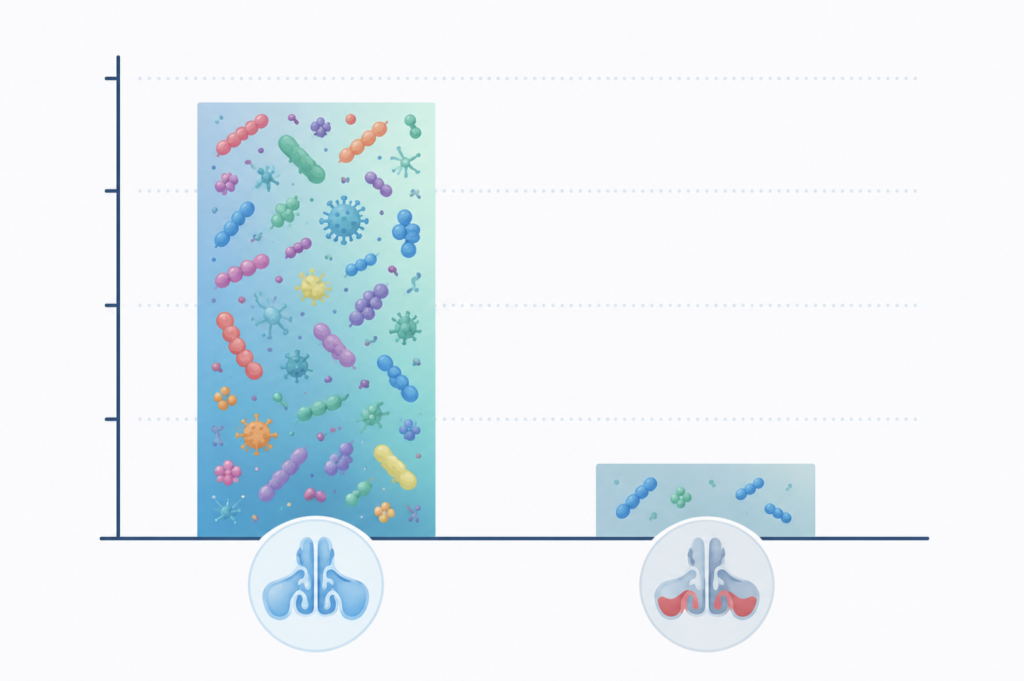
For most of the last century, sinusitis was treated as an infection — find the bad bacterium, kill it, done. Molecular sequencing has complicated that picture. Healthy sinuses are not sterile; they host a diverse community of resident microbes. CRS is increasingly described not as the arrival of one pathogen, but as an imbalance between commensal microbes and pathogens, with a loss of beneficial diversity and overgrowth of inflammation-triggering species [Cervin, The Potential for Topical Probiotic Treatment of Chronic Rhinosinusitis, a Personal Perspective, 2018].
That shift matters because it explains the frustration above. If antibiotics knock down a broad swath of bacteria without restoring a balanced community, symptoms can return once the drugs stop. The clinical target moves from “sterilize the sinus” to “rebalance the ecosystem.”

One consistent thread across studies is reduced microbial diversity in diseased sinuses. A recent clinical study of patients with nasal inflammatory disease reaffirmed that CRS is typically marked by lower diversity, and that certain genera cluster with an inflammatory, dysbiotic state [Brożek-Mądry, Nasal Rinsing with Probiotics-Microbiome Evaluation in Patients with Inflammatory Diseases of the Nasal Mucosa, 2025].
What the Sinus Microbiome Evidence Shows
Association is not causation, and this is where honesty matters. The microbiome is clearly linked to CRS, but proving it drives the disease — rather than simply changing alongside it — is much harder.
Still, the associations are striking enough to have clinical signal. In a 2025 study of patients undergoing functional endoscopic sinus surgery (FESS), the composition of the sinus microbiome differed between those who improved after surgery and those who did not. Staphylococcus was more abundant in non-responders, and a model based on microbial makeup distinguished responders from non-responders with high accuracy (AUC = 0.92) — though this came from a small sample and needs confirmation in larger cohorts before it means much clinically [Hoying, Investigating the Role of the Sinus Microbiome and Cytokine Profile in the SNOT-22 Response After Functional Endoscopic Sinus Surgery in Chronic Rhinosinusitis Patients, 2025].
The concrete takeaway: the sinus microbiome may not just reflect disease — it may help predict who benefits from our existing treatments. That is a meaningful step, even before anyone manipulates the microbiome directly.
Can We Manipulate the Microbiome to Treat It?
If a disturbed community is the problem, the logical next question is whether we can repair it. Two approaches are being actively explored.
Probiotics: adding “good” bacteria
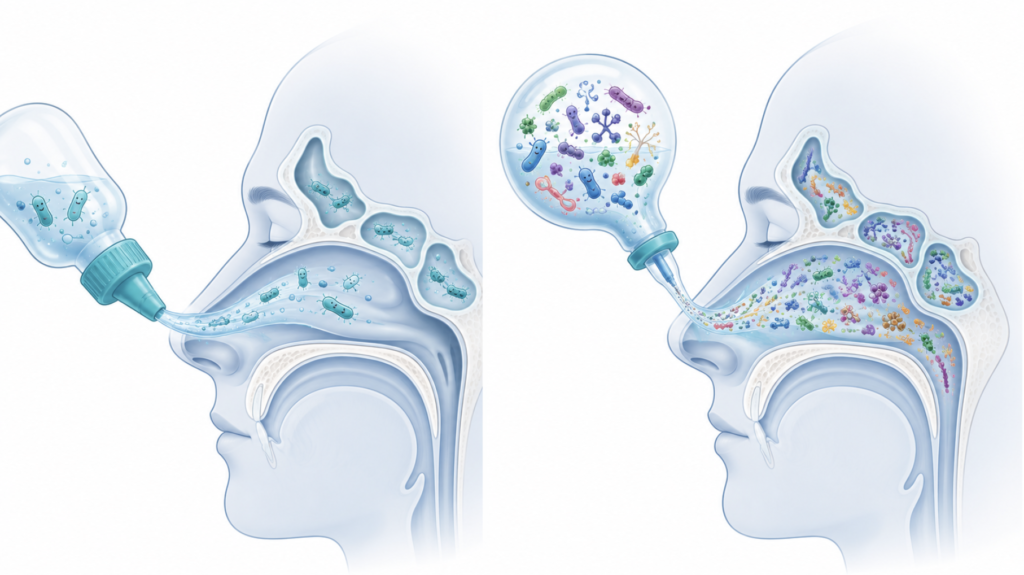
The idea is to reintroduce beneficial microbes, either as living competition against pathogens or as an immune-modulating signal [Cervin, The Potential for Topical Probiotic Treatment of Chronic Rhinosinusitis, a Personal Perspective, 2018]. A pilot trial applied the probiotic Lactococcus lactis W136 directly to the sinuses via twice-daily irrigation for 14 days in 24 patients with refractory CRS. Treatment was safe, with no major adverse events, and was associated with improvements in symptoms, quality of life, and endoscopic mucosal scores [Endam, Intranasal Application of Lactococcus lactis W136 Is Safe in Chronic Rhinosinusitis Patients With Previous Sinus Surgery, 2020].
More recently, probiotic nasal rinses were shown to shift the nasal community, reducing several genera associated with inflammatory dysbiosis [Brożek-Mądry, Nasal Rinsing with Probiotics-Microbiome Evaluation in Patients with Inflammatory Diseases of the Nasal Mucosa, 2025].
Encouraging — but note the scale. These are small studies, some without control groups. And crucially, the EPOS2020 steering group has advised against using probiotics in routine CRS treatment, precisely because the evidence remains too limited [Brożek-Mądry, Nasal Rinsing with Probiotics-Microbiome Evaluation in Patients with Inflammatory Diseases of the Nasal Mucosa, 2025]. Promising signals and a guideline recommendation are not the same thing.
Microbiome transplant: swapping the whole community
The more ambitious approach borrows directly from fecal microbiota transplantation (FMT), which has proven power in gut disease. The concept — nasal or sinonasal microbiome transplant — is to transfer a healthy donor’s microbial community into a patient’s sinuses to restore balance wholesale. Researchers have argued that lessons from FMT could guide this development, with a possible bonus: reducing reliance on antibiotics and, with it, antimicrobial resistance in respiratory infections [Shekhar, Nasal microbiota transplantation: a gateway to novel treatments, 2025].
This is genuinely early. A randomized, placebo-controlled crossover trial of sinonasal microbiome transplant for CRS is currently recruiting, with completion estimated years away (ClinicalTrials.gov, NCT07184684). Until such trials report, microbiome transplant for the sinuses remains a research intervention, not a clinic offering.
Why It’s “Promising but Unfinished”
Several gaps keep this field short of routine practice.
First, the association-versus-causation problem is unresolved. We can describe the microbial differences in CRS in detail, but we cannot yet say with confidence which changes cause disease and which are downstream effects.
Second, there is no standard protocol. Which strains, what dose, delivered how often, for which CRS subtype — none of this is settled. The disease itself is heterogeneous, and a single microbial recipe is unlikely to fit everyone.
Third, individual variation is large. Each person’s baseline microbiome differs, which complicates the idea of a one-size-fits-all transplant or probiotic.
There is also a quiet irony in current care. Antibiotics remain a mainstay of CRS treatment in many countries, yet by design they reduce microbial populations broadly — potentially deepening the very loss of diversity that characterizes the disease. That tension is exactly why microbiome-based strategies are attractive, and exactly why they need rigorous testing before replacing anything.
Clinical Perspective
In practice, the most useful shift right now is conceptual, not pharmacological. Thinking of stubborn CRS as an ecosystem problem — rather than a germ to be repeatedly bombed with antibiotics — helps set realistic expectations with patients and steers away from reflexive, repeated antibiotic courses that may do little for long-term balance.
What this does not mean is that patients should self-prescribe over-the-counter probiotics or attempt any form of microbial transfer at home. The studies showing benefit used specific strains, controlled preparation, and clinical monitoring; general supplements are not equivalent, and current guidelines do not endorse them for CRS. The honest message is that this is a field to watch closely over the next few years, not a menu of ready treatments today.
Key Takeaways
- Chronic sinusitis is increasingly understood as a disturbance of the sinus microbial ecosystem rather than a simple single-germ infection.
- A hallmark of the CRS sinus microbiome is reduced microbial diversity, not one specific pathogen.
- The sinus microbiome may help predict who responds to sinus surgery, showing clinical signal even before direct manipulation.
- Probiotics and microbiome transplants are promising in early studies but are not yet standard, proven treatments.
- Current guidelines (EPOS2020) advise against routine probiotic use for CRS because the evidence remains limited.
FAQ
Can probiotics cure chronic sinusitis? Not yet. Small early trials of sinus-applied probiotics have shown safety and some symptom improvement, but the evidence is too limited for routine use, and EPOS2020 guidelines currently advise against them for CRS. They remain an area of active research rather than an established cure.
Is chronic sinusitis an infection or an imbalance? Increasingly, it is viewed as an imbalance. The dominant model, called dysbiosis, describes CRS as a disturbed microbial community with reduced beneficial diversity, rather than infection by one culprit organism. Individual pathogens can still play a role, but within a broader ecosystem disturbance.
What is a sinonasal microbiome transplant? It is an experimental treatment that transfers a healthy donor’s microbial community into a patient’s sinuses to restore balance, modeled on fecal microbiota transplantation used in the gut. It is currently being tested in clinical trials and is not yet an available treatment.
References
Brożek-Mądry E, Ziuzia-Januszewska L, Misztal O, Burska Z, Sosnowska-Turek E, Sierdziński J. Nasal Rinsing with Probiotics-Microbiome Evaluation in Patients with Inflammatory Diseases of the Nasal Mucosa. J Clin Med. 2025;14(10):3341.
Cervin AU. The Potential for Topical Probiotic Treatment of Chronic Rhinosinusitis, a Personal Perspective. Front Cell Infect Microbiol. 2018;7:530.
Endam LM, Alromaih S, Gonzalez E, Madrenas J, Cousineau B, Renteria AE, Desrosiers M. Intranasal Application of Lactococcus lactis W136 Is Safe in Chronic Rhinosinusitis Patients With Previous Sinus Surgery. Front Cell Infect Microbiol. 2020;10:440.
Hoying D, Sangwan N, Chaaban MR. Investigating the Role of the Sinus Microbiome and Cytokine Profile in the SNOT-22 Response After Functional Endoscopic Sinus Surgery in Chronic Rhinosinusitis Patients. J Clin Med. 2025;14(13):4446.
Shekhar S, Schwarzer M, Dhariwal A, Petersen FC. Nasal microbiota transplantation: a gateway to novel treatments. Trends Microbiol. 2025;33(3):264-267.
Joonpyo Hong, MD is a board-certified otolaryngologist practicing in Korea. This article reflects his clinical interpretation of published research and does not constitute individual medical advice.
For more interesting content:
https://curiousmd.com/epos-vs-aao-hns-chronic-rhinosinusitis-guidelines/
https://curiousmd.com/anti-tslp-antibody-nasal-polyps/
Link out to:
https://www.euforea.org/news/european-position-paper-on-rhinosinusitis-and-nasal-polyps-2020/
https://clinicaltrials.gov/study/NCT07184684
https://www.ncbi.nlm.nih.gov/pmc/articles/PMC12250471/