
Three hours a month works out to about six minutes a day. That was the free allowance Meta briefly attached to Conversation Focus, the feature on its Ray-Ban glasses that amplifies the voice of whoever is sitting across from you. On July 25, 2026, after several weeks of public criticism, the company paused the plan. The episode is the sharpest test yet of what happens when people start treating smart glasses as hearing aids.
This article reflects the situation as of July 31, 2026. Meta has said it is still weighing its options, so the specifics may change.
The pricing story has been covered thoroughly elsewhere. What has not been examined is the more durable question underneath it: what happens to hearing support when it is delivered as a product feature rather than as a regulated medical device. On that question, one sentence from Meta turns out to matter far more than the twenty dollars.
What Actually Happened
Conversation Focus arrived in December 2025 on Ray-Ban Meta Gen 2 and Oakley Meta frames, and remains available only to users who opt into Meta’s Early Access Program. The glasses carry five directional microphones and two open-ear speakers built into the temples. Point your face at someone in a loud room and their voice comes forward while the room recedes.
In early July 2026 a software update quietly added usage limits: three hours per month free, or fifteen hours with a Meta One Premium subscription at $19.99 per month, with unused time not carrying over. The subscription itself had been in limited testing in only a handful of markets, so for most owners the paid tier was not available to buy in the first place. Reporting by The Verge established the detail that made the reaction so sharp — the feature runs entirely on the glasses. Tested with the internet connection cut, it kept working. There was no per-use server cost for Meta to recover.
The reversal came on July 25. A company spokesperson told The Verge that the subscription tests were being paused and that the feature would stay free for Early Access users while a better approach was worked out. In the same statement Meta said that some premium features will be subscription-based over time, and the company declined to say whether the usage caps were being abandoned outright.
The policy is paused, then, not cancelled.
The Sentence That Matters
When The Verge asked Meta about the accessibility implications, the company gave an answer that deserves more attention than it received. Meta said it does not regard Conversation Focus as an accessibility feature, because the feature is intended for people with normal hearing.
Read that as marketing and it sounds evasive. Read it as regulatory language and it is precise.
Under United States law, a hearing aid is any wearable device designed for, offered for the purpose of, or represented as aiding or compensating for impaired hearing (21 CFR 800.30). A personal sound amplification product, or PSAP, is defined by the FDA as a device intended to amplify environmental sound for consumers who are not hearing impaired. PSAPs are not medical devices, and FDA guidance dating to 2009 holds that they cannot be marketed as hearing aids or as a remedy for hearing loss.
The dividing line is not the hardware. A directional microphone array is a directional microphone array. The line is what the manufacturer says the device is for. Claim it helps hearing loss and you have built a medical device, with everything that follows: intended-use statements, performance controls, clinical evidence, labeling requirements. Say it is for people who hear normally and you have built a consumer accessory that can be metered, altered, or withdrawn at will.
Meta’s statement was not a dodge. It was an accurate description of the category the company chose.
Smart Glasses as Hearing Aids: What the Lab Found
The independent HearAdvisor lab tested Ray-Ban Meta Gen 2 with Conversation Focus on an acoustic manikin using a typical age-related hearing loss profile, with results published through HearingTracker in April 2026 and updated in July.
| Test condition | Ray-Ban Meta | Nuance Audio (FDA-cleared) |
|---|---|---|
| Speech in quiet | 2.6 | 4.3 |
| Speech in noise | 1.3 | 2.1 |
| Feedback handling | 1.9 | 2.0 |
| Own voice | 4.7 | 4.7 |
| Music streaming | 4.3 | — |
| Overall SoundScore | 3.7 (B) | 4.1 (A) |
The overall grade is respectable for a device never designed as a hearing aid. But look at where the points come from. The glasses score well on own-voice naturalness and music streaming. The single lowest score on the sheet, 1.3 out of 5, is speech in noise — the crowded restaurant, which is precisely the scenario the feature is sold on.
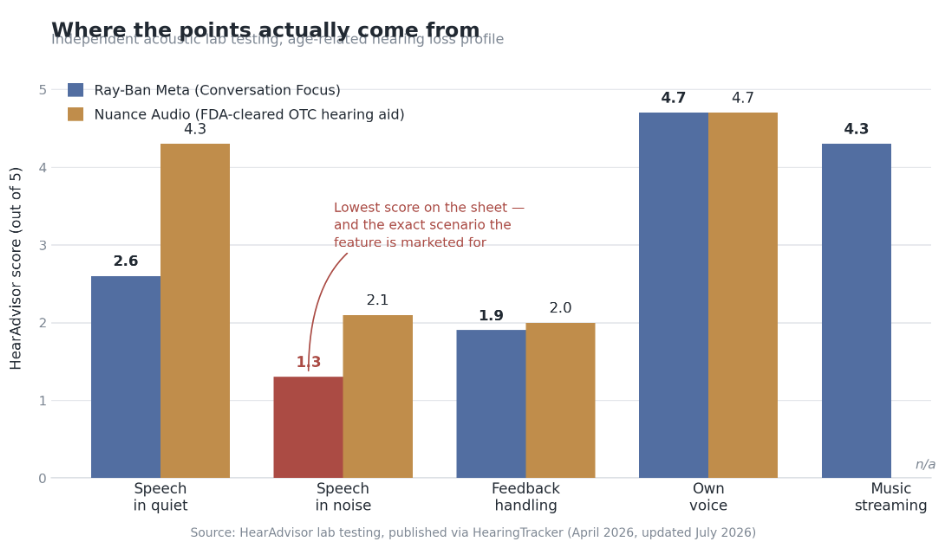
Two things follow. First, this is an excellent pair of audio glasses offering modest situational hearing help, which is roughly what the reviewing audiologist concluded. Second, even Nuance Audio, an FDA-cleared over-the-counter hearing aid built by Ray-Ban’s own parent company, manages only 2.1 in the same condition. Open-ear glasses have real acoustic limits regardless of regulatory status. Clearance does not repeal physics.
What Clearance Actually Buys
Two consumer products in this space have gone through regulators, and the contrast with Conversation Focus is instructive.
Apple’s Hearing Aid Feature received FDA de novo authorization on September 12, 2024 as the first over-the-counter hearing aid software. The clearance rests on a 118-participant multi-site trial in which self-fitted users achieved benefit comparable to those fitted by a professional, with no device-related adverse events. The indication is specific and narrow: adults 18 and over with perceived mild to moderate hearing loss. Korea’s Ministry of Food and Drug Safety approved the same software as a medical device on August 19, 2025. It ships as a free software update.
A Korean study offers independent context, though on an earlier capability rather than the cleared feature. Researchers at Samsung Medical Center compared AirPods Pro using the headphone accommodation setting — not the FDA-cleared Hearing Aid Feature — against a validated PSAP in 35 adults with mild to moderate hearing loss. Functional gain did not differ significantly between the two devices at any frequency except 8 kHz, and both improved word recognition and sentence-in-noise scores over the unaided condition [Kim, Apple AirPods Pro as a Hearing Assistive Device in Patients with Mild to Moderate Hearing Loss, 2024]. The same paper reports regular hearing aid use in Korea at 12.6%, with cost and stigma as the dominant barriers.
Nuance Audio was cleared by the FDA in early 2025 and carries CE marking under the EU Medical Devices Regulation.
Conversation Focus has no clearance, no submission, and no claim to one. Meta has not publicly said otherwise.
The Regulatory Picture in 2026
Both major regulators moved toward flexibility this year, which makes the definitional question more consequential rather than less.
On January 6, 2026 the FDA issued revised guidance on general wellness products and clinical decision support software, replacing documents from 2019 and 2022. The general wellness document addresses exactly the territory at issue here — consumer hardware that sits close to, but outside, medical device regulation.
Korea’s Ministry of Food and Drug Safety announced in its 2026 work plan that certification and review for everyday Class 2 medical devices, hearing aids among them, would move to a one-stop process to shorten approval times. Korea still has no separate over-the-counter hearing aid category. A device is either a medical device or it is not.
Which returns the burden to the same place: the label a manufacturer chooses.
Clinical Perspective
There is a real gain here that should not be argued away. A five-minute self-administered hearing test on a device someone already owns lowers the barrier to a first assessment further than most awareness campaigns have managed, and the resulting hearing profile can be shared with a clinician. Detection is where consumer hearables have done genuine good, and the regulatory record supports that: self-fitting produced benefit comparable to professional fitting in the trial underpinning Apple’s authorization.
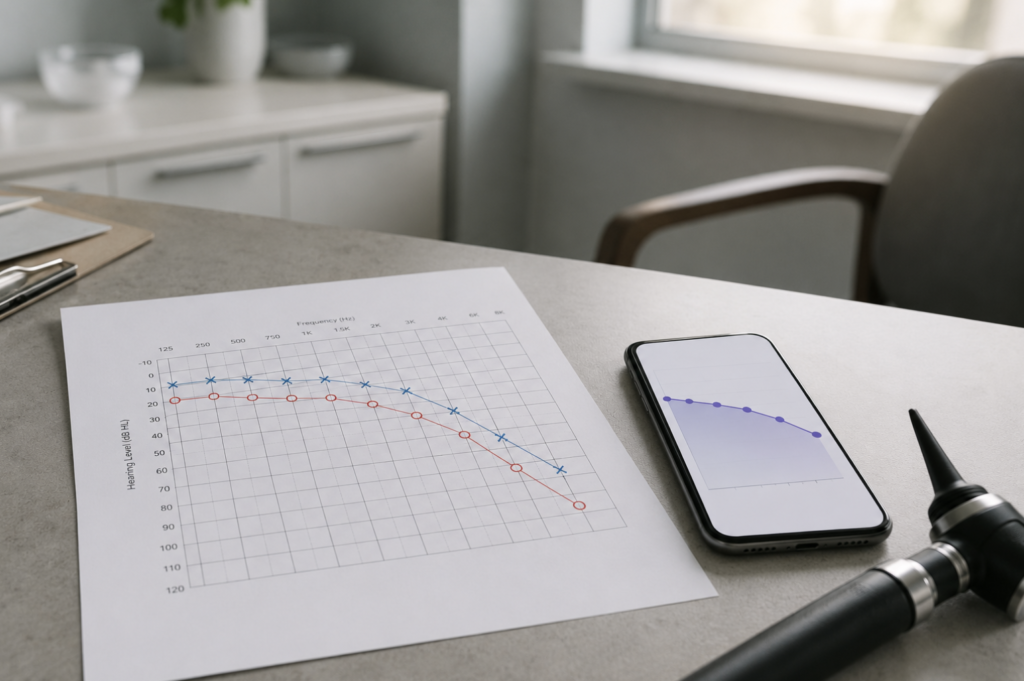
The concern is narrower. Amplification without a diagnosis can mask conditions that need prompt attention. Sudden sensorineural hearing loss has a treatment window measured in days. Unilateral hearing loss, pulsatile tinnitus, and progressive loss accompanied by vertigo all call for examination rather than a louder signal. A device that makes a poorly hearing ear tolerable can postpone the visit that mattered.
There is also a quieter problem of overstatement. Hearing loss carries a population attributable fraction of 7% for dementia, tied for the largest single modifiable risk factor in the most recent Lancet standing Commission [Livingston, Dementia prevention, intervention, and care: 2024 report of the Lancet standing Commission, 2024]. That figure is routinely stretched. The ACHIEVE trial, the first randomized trial to test the question directly in 977 adults aged 70 to 84, found no significant effect of hearing intervention on three-year cognitive decline overall, with benefit confined to a higher-risk subgroup [Lin, Hearing intervention versus health education control to reduce cognitive decline in older adults with hearing loss in the USA (ACHIEVE): a multicentre, randomised controlled trial, 2023]. Hearing rehabilitation is worth doing on its own terms. It should not be sold as dementia prevention as a major advantage.
Rehabilitation, though, is the operative word. It is a plan carried out over years, adjusted as hearing changes. A capability that can be capped, re-scoped, or withdrawn by software update is not a plan. That the cap was reversed is not reassurance. It is confirmation that it could happen at all.
Key Takeaways
- Conversation Focus is not an FDA-cleared hearing aid, and Meta has explicitly stated it is intended for people with normal hearing.
- In independent lab testing, the Ray-Ban Meta glasses scored 1.3 out of 5 for speech in noise — the lowest of any measure taken, and the exact scenario the feature is marketed for.
- Under FDA rules, what makes a device a hearing aid is the claim the manufacturer makes about it, not the hardware inside it.
- Two cleared alternatives exist for perceived mild to moderate hearing loss: Apple’s Hearing Aid Feature (FDA September 2024; Korea MFDS August 2025) and Nuance Audio (FDA early 2025).
- Sudden, one-sided, or rapidly progressive hearing loss is a reason to see a physician promptly, not a reason to turn up the amplification.
FAQ
Can Ray-Ban Meta glasses replace hearing aids? No. They are not cleared as hearing aids in any jurisdiction and were not designed to compensate for hearing loss. Lab testing shows meaningful but limited help, concentrated in quiet conditions, with weak performance in background noise. For anyone with diagnosed hearing loss, they are at best a situational supplement.
Is Conversation Focus still free? As of July 31, 2026, yes. Meta paused its subscription test on July 25 and the feature remains free through the Early Access Program. The company has not committed to keeping it that way and has said some premium features will move to subscription over time.
Which consumer wearables are actually cleared for hearing? As of July 31, 2026, Apple’s Hearing Aid Feature on AirPods Pro 2 and 3, and Nuance Audio glasses. Both are indicated for adults with perceived mild to moderate hearing loss only. Neither covers severe or profound loss, pediatric cases, or sudden hearing loss.
References
- Kim GY, Yun HJ, Jo M, Jo S, Cho YS, Moon IJ. Apple AirPods Pro as a hearing assistive device in patients with mild to moderate hearing loss. Yonsei Med J. 2024 Oct;65(10):596-601.
- Livingston G, Huntley J, Liu KY, et al. Dementia prevention, intervention, and care: 2024 report of the Lancet standing Commission. Lancet. 2024 Aug 10;404(10452):572-628.
- Lin FR, Pike JR, Albert MS, et al. Hearing intervention versus health education control to reduce cognitive decline in older adults with hearing loss in the USA (ACHIEVE): a multicentre, randomised controlled trial. Lancet. 2023 Sep 2;402(10404):786-797.
Joonpyo Hong, MD is a board-certified otolaryngologist practicing in Korea. This article reflects his clinical interpretation of published research and does not constitute individual medical advice.
For more interesting content:
https://curiousmd.com/otc-hearing-aids-2026/
https://curiousmd.com/ai-hearing-aids-2026-ent-review/
https://curiousmd.com/psap-vs-hearing-aid-clinical-evidence/
Link out to:
- FDA — Hearing Aids: OTC, prescription and PSAP comparison
- FDA — FDA Authorizes First Over-the-Counter Hearing Aid Software (September 12, 2024)
- HearingTracker — Can Ray-Ban Meta (Gen 2) Glasses Help You Hear Better? (HearAdvisor lab testing)
- Engadget — Meta walks back limits for its smart glasses’ Conversation Focus feature, for now