
Speech biomarkers in Parkinson’s disease are numbers taken from short voice recordings, and a 2025 study used them to test an old question: does levodopa change speech? Many earlier studies found little effect. In one cohort of 50 patients with advanced disease, levodopa had a poor effect on acoustic speech measures [Cavallieri, Dopaminergic treatment effects on speech, 2021].
Sousa and colleagues note that more than 90% of people with Parkinson’s develop speech changes at some stage [Sousa, Digital speech biomarkers, 2025]. They argue that the ear hears voice quality but may miss small shifts in pitch range, loudness and rhythm.
How Is Speech Tested in Parkinson’s? Three Short Tasks
The protocol takes 5–10 minutes and asks little of memory or attention [Sousa, Digital speech biomarkers, 2025]. Patients wore a head-mounted microphone about 5 cm from the mouth in a quiet room.
Sustained “ahh”
The patient holds /a/ on one breath, as long and steadily as possible. This is the task used for MDVP voice analysis, and it tests breath support and voice steadiness.
Fast “pa-ta-ka”
The patient repeats /pa/-/ta/-/ka/ 12 times on one breath, as fast and precisely as possible. The delay before each consonant reflects how quickly lip and tongue movements start.
Reading a short passage
The patient reads a standard passage of more than 100 words in their own language. This task adds pitch movement, loudness changes, speech rate and pauses.

What Do the Speech Measures Mean?
The team used 16 measures: 12 basic speech measures and 4 summary values of the long-term average spectrum (LTAS) [Sousa, Digital speech biomarkers, 2025].
| Domain | Measure | Task | What it reflects |
|---|---|---|---|
| Prosody | sdF0 (standard deviation of F0) | Reading | Pitch variation; low values mean monopitch |
| Prosody | Int sd, Int kurt | Reading | Loudness variation; low values mean monoloudness |
| Articulation | VOT (voice onset time) | Pa-ta-ka | Delay in starting each consonant |
| Phonation | HNR (harmonics-to-noise ratio) | Vowel | Harsh or breathy voice |
| Respiration | MPT (maximum phonation time), Int slope | Vowel | Breath support; how fast loudness fades |
| Timing | NSR, DPI, RST | Reading | Net speech rate, pause length, rate of speech timing |
| Exploratory | Int sd (vowel), Int skew (reading) | Both | Loudness instability that may come with dyskinesia |
| Spectrum | LTAS mean, SD, skewness, kurtosis | Reading | Shape of voice energy, linked to F0 and glottal closure |
HNR belongs to the same family as the noise-to-harmonics ratio in MDVP. In this study, the MDS-UPDRS-III speech item improved from OFF to ON but tracked HNR more closely than the other domains, so the clinical rating follows voice quality more than the prosody and timing changes that the acoustic measures also capture.

What One Study Found About Speech Biomarkers in Parkinson’s Disease
Study design
The Bern team included 51 patients with motor fluctuations who had a levodopa challenge between 2021 and 2023 [Sousa, Digital speech biomarkers, 2025]. Mean disease duration was 11.0 years, and patients spoke 4 languages. The reference group was 43 healthy controls matched for language and gender.
Patients were recorded OFF medication, at least 8 hours after their last levodopa dose. They were recorded again 30–60 minutes after soluble levodopa at 150% of the usual morning dose. Mean MDS-UPDRS-III fell from 46.1 to 22.3, a large motor response. In 10 patients recorded twice while OFF, the two recordings agreed closely, which argues against a practice effect.
What changed after levodopa
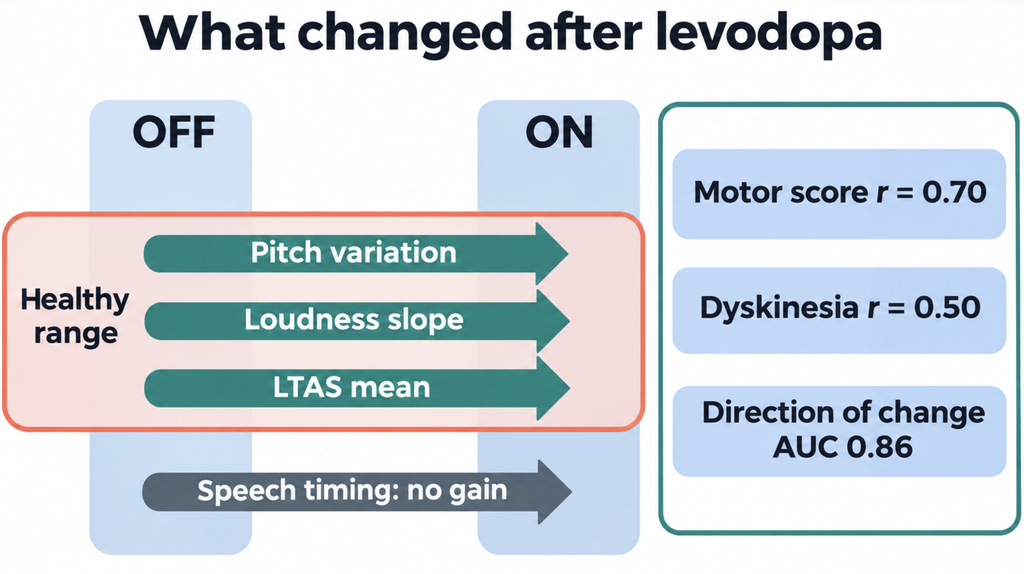
Three measures improved and moved toward control values: pitch variation (sdF0), loudness slope during the vowel and LTAS mean. Effect sizes ranged from 0.35 to 0.49. Net speech rate and rate of speech timing did not improve and were further from control values in the ON state, which the authors attribute to peak-dose dyskinesia.
Three scores built from the measures
The investigators used stepwise regression to select the measures for each score.
- A hypokinetic score from 8 measures correlated with change in MDS-UPDRS-III without tremor items (r = 0.70), with a mean absolute error of 6.06 points on a 92-point scale.
- A dyskinesia score from 6 measures correlated with change in the axial Marconi dyskinesia score (r = 0.50), with a mean absolute error of 1.81 of 12 points.
- From paired recordings, a model of 7 measures identified the direction of change (OFF-to-ON or ON-to-OFF) with an AUC of 0.86. Accuracy was 80%, sensitivity 76% and specificity 85%.
No measure differed significantly across languages, though some language groups were very small.
Limits of the study
The cohort was small, retrospective and from one center. All patients had advanced disease and received a high test dose, so the results may not apply to early disease or usual doses. The models were tested only by leave-one-out cross-validation, not in a new cohort.
Under cross-validation, the hypokinetic model explained 37% of the variance, down from 60% in training, and the dyskinesia model fell from 37% to 14%. Speech changes measurably with levodopa in this cohort, but the models have not been tested as a guide for dose changes.
Can Voice Analysis Catch Parkinson’s Early and Track Treatment?
Voice recordings are being studied before diagnosis and during treatment, but neither use is ready for routine care.
Earlier detection
A multicenter study recorded 448 people at 7 centers in 5 languages: 150 with idiopathic REM sleep behavior disorder (iRBD), 149 with early Parkinson’s disease and 149 controls [Rusz, Speech biomarkers in REM sleep behavior disorder, 2021]. A composite acoustic score was abnormal in both patient groups. Blinded listeners picked out only the Parkinson’s group, and monopitch was the one measure that separated iRBD from controls.
A 2025 narrative review calls this evidence convergent but preliminary [Cao, Speech and language biomarkers, 2025]. Smell loss is another early sign under study.
Tracking treatment and side effects
A 2024 review proposes speech measures for monitoring levodopa-induced motor complications, deep brain stimulation (DBS) and speech therapy [Rusz, From prodromal stages to clinical trials, 2024]. Sousa and colleagues suggest compound speech scores as clinical trial outcomes [Sousa, Digital speech biomarkers, 2025].
Moving recording out of the clinic
Phone calls and app-based tasks could allow frequent home recording, but background noise and microphone differences remain obstacles. In one device comparison, F0 and jitter agreed well between phones and a studio microphone, while HNR and shimmer showed bias [Fahed, Comparison of acoustic voice features, 2022]. That study included healthy adults and 6 people with Huntington’s disease, not people with Parkinson’s. Sousa and colleagues also call for legal and ethical rules on how voice data are stored and used [Sousa, Digital speech biomarkers, 2025].
The larynx comes first
A low HNR or short MPT can come from the nervous system or from the vocal folds, and the acoustic value alone cannot show which. In one small series of 15 patients with advanced Parkinson’s disease, 87% had marked vocal fold bowing on videostroboscopy [Blumin, Laryngeal findings in advanced Parkinson’s disease, 2004]. Laryngoscopy shows bowing, atrophy or a local lesion directly, so it is useful before a voice change is attributed to medication.
Key Takeaways
- Speech biomarkers in Parkinson’s disease come from short recordings of a sustained vowel, fast syllable repetition and a reading passage.
- In a 2025 study of 51 patients, pitch variation, loudness slope and LTAS mean moved toward healthy values after levodopa.
- Speech timing did not improve and stayed abnormal in the ON state, which the authors link to dyskinesia.
- Using paired recordings, a model of 7 measures identified the direction of medication change with an AUC of 0.86, without external validation.
- Voice tracking remains a research tool and has not been tested as a basis for adjusting medication.
FAQ
Does levodopa improve speech in Parkinson’s?
Partly, based on early evidence. In 51 patients, levodopa improved pitch variation, loudness slope and LTAS mean within 30–60 minutes, while speech timing did not improve [Sousa, Digital speech biomarkers, 2025]. Older studies using fewer measures often found little effect [Cavallieri, Dopaminergic treatment effects on speech, 2021].
Can voice analysis detect Parkinson’s early?
No, not yet in routine care. A multicenter study found acoustic changes in iRBD, a prodromal stage of α-synucleinopathy, even when listeners heard no difference [Rusz, Speech biomarkers in REM sleep behavior disorder, 2021]. These are group-level findings, not a validated screening test.
Can a smartphone track Parkinson’s by voice?
Possibly, for some measures. Pitch-based measures hold up well on mobile devices, while HNR and shimmer are less reliable [Fahed, Comparison of acoustic voice features, 2022]. The Bern models have not been tested on phone recordings.
Is this the same as an MDVP voice test?
No. MDVP analyzes a sustained vowel for voice quality. The Bern protocol adds syllable repetition and a reading passage to capture articulation, prosody and timing [Sousa, Digital speech biomarkers, 2025].
References
- Sousa M, Krýže P, Amstutz D, Petermann K, Averna A, Castelli M, et al. Digital speech biomarkers can measure acute effects of levodopa in Parkinson’s disease. NPJ Parkinsons Dis. 2025;11(1):184.
- Cavallieri F, Budriesi C, Gessani A, Contardi S, Fioravanti V, Menozzi E, et al. Dopaminergic treatment effects on dysarthric speech: acoustic analysis in a cohort of patients with advanced Parkinson’s disease. Front Neurol. 2021;11:616062.
- Rusz J, Hlavnička J, Novotný M, Tykalová T, Pelletier A, Montplaisir J, et al. Speech biomarkers in rapid eye movement sleep behavior disorder and Parkinson disease. Ann Neurol. 2021;90(1):62-75.
- Cao F, Vogel AP, Gharahkhani P, Renteria ME. Speech and language biomarkers for Parkinson’s disease prediction, early diagnosis and progression. NPJ Parkinsons Dis. 2025;11(1):57.
- Rusz J, Krack P, Tripoliti E. From prodromal stages to clinical trials: the promise of digital speech biomarkers in Parkinson’s disease. Neurosci Biobehav Rev. 2024;167:105922.
- Fahed VS, Doheny EP, Busse M, Hoblyn J, Lowery MM. Comparison of acoustic voice features derived from mobile devices and studio microphone recordings. J Voice. 2025;39(2):559.e1-559.e18. Epub 2022 Nov 12.
- Blumin JH, Pcolinsky DE, Atkins JP. Laryngeal findings in advanced Parkinson’s disease. Ann Otol Rhinol Laryngol. 2004;113(4):253-8.
Joonpyo Hong, MD is a board-certified otolaryngologist practicing in Korea. This article reflects his clinical interpretation of published research and does not constitute individual medical advice.
For more articles:
https://curiousmd.com/source-filter-theory-of-speech/
https://curiousmd.com/mdvp-voice-analysis-interpretation/
https://curiousmd.com/ai-laryngeal-cancer-detection/
Link out to:
https://www.nature.com/articles/s41531-025-01045-5 — Open-access full text of the 2025 Bern study on speech biomarkers and levodopa response.
https://www.parkinson.org/understanding-parkinsons/non-movement-symptoms/speech-swallowing — Parkinson’s Foundation overview of speech and swallowing changes and who treats them.
https://www.asha.org/Practice-Portal/Clinical-Topics/Dysarthria-in-Adults — ASHA Practice Portal on adult dysarthria, including hypokinetic dysarthria.
https://www.michaeljfox.org/publication/speech-biomarkers-rapid-eye-movement-sleep-behavior-disorder-and-parkinson-disease — Michael J. Fox Foundation summary of the multilanguage speech biomarker study in iRBD and early Parkinson’s.