
Ketorolac is supplied domestically in a 30 mg ampoule, and the same label sets the initial dose at 10 mg. A randomized trial of 240 emergency department patients found that 10 mg, 15 mg, and 30 mg intravenous doses produced the same pain reduction at 30 minutes, with mean pain scores falling from 7.7, 7.5, and 7.8 at baseline to 5.1, 5.0, and 4.8 respectively [Motov, Comparison of Intravenous Ketorolac at Three Single-Dose Regimens for Treating Acute Pain in the Emergency Department, 2017]. Rescue analgesia rates did not differ between groups.
So the larger dose may deliver no extra analgesia while carrying extra risk. The same kind of question runs through all three parenteral analgesics that carry most of the workload: ketorolac, intravenous acetaminophen, and tramadol. What separates them is what each one does and does not do, where each is eliminated, what the labels actually restrict, and which combinations have evidence behind them.

Three questions that decide the choice
Does the pain have an inflammatory component?
Only ketorolac addresses it. Acetaminophen and tramadol do not.
Does the patient need antipyresis?
Ketorolac and acetaminophen provide it. Tramadol does not.
Which organ clears the drug?
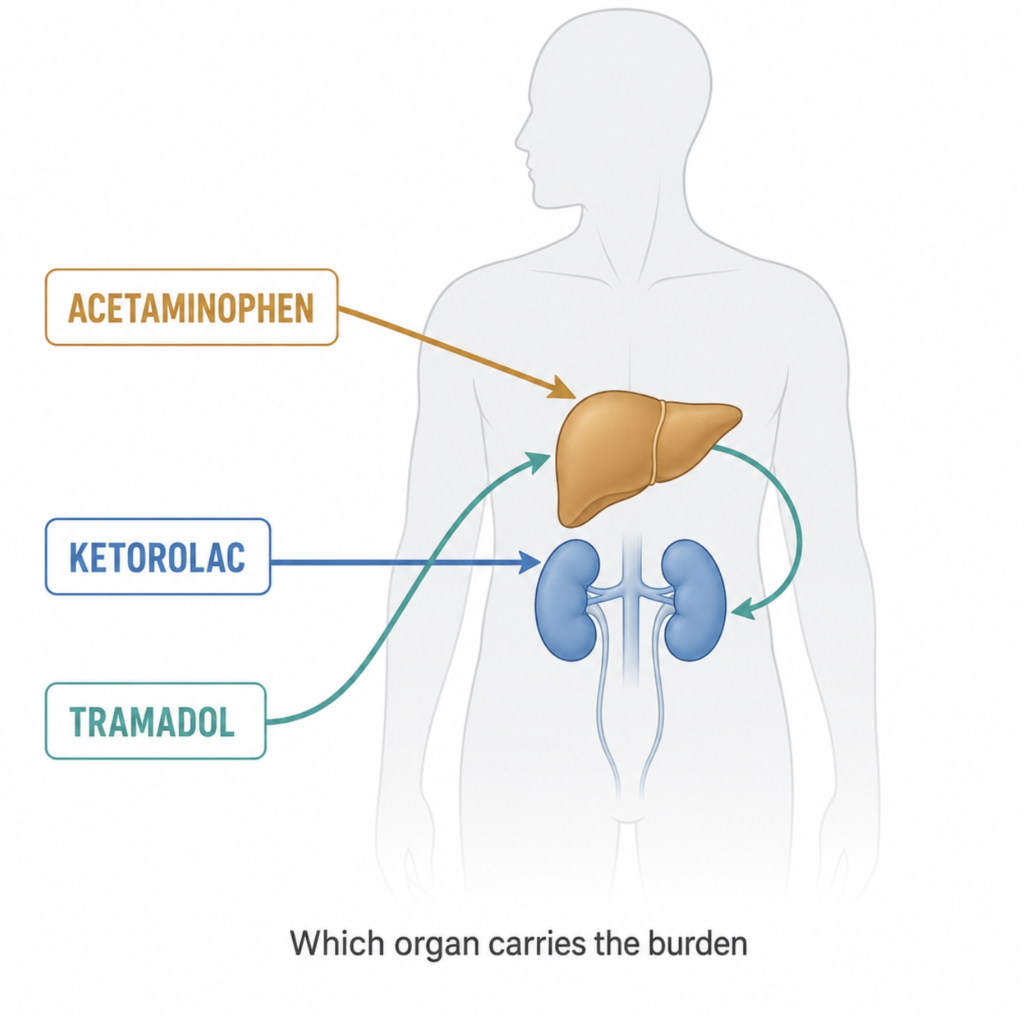
Ketorolac is renally eliminated and renally toxic. Acetaminophen is hepatically metabolized and hepatotoxic. Tramadol is hepatically metabolized through CYP2D6 and then renally excreted.
The elimination question does more work than the other two. These agents are rarely separated by potency. They are separated by which organ has to absorb the burden.
The three injectable analgesics at a glance
| Ketorolac | IV acetaminophen | Tramadol | |
|---|---|---|---|
| Class | NSAID, non-selective COX | Central non-opioid | Weak opioid + monoamine reuptake inhibitor |
| Analgesia | Strong | Moderate | Moderate |
| Anti-inflammatory | Yes | No | No |
| Antipyretic | Yes | Yes | No |
| Main elimination | Renal | Hepatic | Hepatic (CYP2D6) → renal |
| Ceiling limit | Analgesic ceiling near 10 mg IV | 4 g daily (hepatotoxicity) | 400 mg daily |
| Duration limit | 2 days parenteral (Korean label) | None specified | None specified |
| Principal risk | GI bleeding, acute kidney injury | Hepatotoxicity | Respiratory depression with CNS depressants |
The class-level potency ratings above are for orientation and not head-to-head comparative data.
Ketorolac: potent, capped, time limited
Ketorolac is a non-opioid whose analgesic potency has historically been compared to that of opioids. That reputation explains both how freely it gets used and why its constraints get overlooked.
The ceiling effect
The Motov trial showed no incremental benefit above 10 mg intravenously in emergency department patients with moderate to severe acute pain [Motov, Comparison of Intravenous Ketorolac at Three Single-Dose Regimens for Treating Acute Pain in the Emergency Department, 2017]. Adverse effect rates were similar across the three dose groups; the most common were dizziness, nausea, and headache.
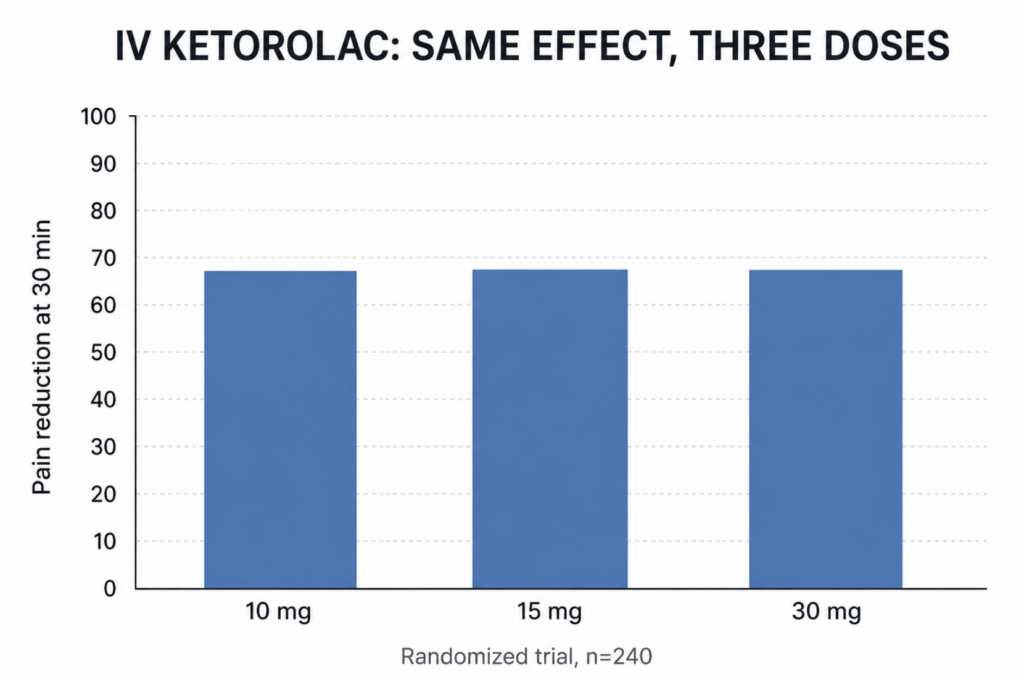
This is a single-center trial in one clinical setting, so it does not translate directly into a universal dosing rule. But it does undercut the assumption that a larger ampoule buys better analgesia. What larger doses reliably buy is longer duration, and with it a longer exposure window for adverse effects, which are dose- and duration-dependent.
Korean label limits are stricter than American ones
The domestic label sets the initial dose at 10 mg with maintenance doses of 10 to 30 mg every 4 to 6 hours, caps the total daily dose at 90 mg (reduced to 60 mg in older adults, patients with renal impairment, and patients weighing 50 kg or less), and limits parenteral treatment to no more than 2 days. The United States label permits up to 5 days of combined oral and parenteral use.
Two further constraints are easy to forget. Ketorolac injection is contraindicated for epidural and intrathecal administration because the formulation contains alcohol. And in children aged 2 and over, intravenous administration is preferred because intramuscular injection is painful.
The interaction that catches people out
The label states that warfarin and NSAIDs can act synergistically on gastrointestinal bleeding, so patients receiving both face a higher risk of serious gastrointestinal hemorrhage than those receiving either alone. In an older patient on anticoagulation who arrives with musculoskeletal pain, this is the interaction that matters most and the one most easily missed during a busy shift.
Ketorolac appears on the Beers Criteria, in both formulations
The 2023 AGS Beers Criteria lists ketorolac, specified as oral and parenteral, among medications to avoid in adults 65 and older, citing increased risk of gastrointestinal bleeding, peptic ulcer disease, and acute kidney injury. The recommendation is graded strong, the quality of evidence moderate [2023 American Geriatrics Society Beers Criteria Update Expert Panel, American Geriatrics Society 2023 Updated AGS Beers Criteria for Potentially Inappropriate Medication Use in Older Adults, 2023].
The entry needs context rather than alarm. The Beers document is explicit that “avoid” does not mean absolute contraindication unless the drug’s own label says so, that the criteria are not to be applied punitively, and that they are designed for the United States, with clinicians elsewhere expected to adapt them to local prescribing patterns and drug availability. The panel frames the criteria as support for shared decision-making, not as a prohibition list.
Read that way, the entry is not an instruction to stop using ketorolac in older Korean patients. It is a prompt to notice that the domestic label already builds in the same caution: the 60 mg daily cap for older adults and those with renal impairment exists for precisely the reasons Beers cites. Both documents point at the same risk from different directions.
Intravenous acetaminophen: the backbone with a hepatic ceiling
Acetaminophen is the agent most often described as weak, which undersells what it contributes. It has no meaningful anti-inflammatory effect and will not touch the inflammatory component of tissue injury. What it offers is analgesia and antipyresis without gastric mucosal injury, without platelet inhibition, and without renal prostaglandin suppression.
That profile makes it the natural base layer in patients where NSAIDs are constrained, which, given the ketorolac limits above, is a large fraction of hospitalized patients.
What the label actually says
Domestic labeling for acetaminophen injection specifies 1000 mg per dose, four times daily, with a minimum interval of 4 hours between doses and a maximum of 4 g per day. For children weighing 33 kg or more and adults weighing under 50 kg, the dose is approximately 15 mg/kg with the same minimum 4-hour interval, and a daily maximum of 60 mg/kg or 4 g, whichever is lower. In severe renal impairment with creatinine clearance at or below 30 mL/min, the minimum interval extends to 6 hours.
Note the 4-hour interval. A reflexive “q6h” order is more conservative than the label requires and may leave a gap in coverage. The label’s constraint is the daily total, not a rigid six-hour spacing.
Two warnings that are easy to skim past
The label carries an explicit warning that confusion between milligrams and milliliters can cause sudden toxicity or death. With a 10 mg/mL solution, a tenfold volumetric error is not hypothetical.
Hepatotoxicity is the real ceiling. The label notes that most liver injury occurs when the daily total exceeds 4,000 mg, often because the patient is receiving acetaminophen from more than one source, a genuine hazard when an injectable order coexists with an oral combination product. It also advises periodic liver function testing when doses above 1,500 mg daily are continued long term.
One more interaction: co-administration with oral anticoagulants can produce modest INR shifts, and the label recommends monitoring INR during co-administration and for one week after acetaminophen is stopped.

Tramadol: neither antipyretic nor anti-inflammatory
Tramadol combines weak mu-opioid agonism with monoamine reuptake inhibition. It has no antipyretic and no anti-inflammatory action, a point regularly muddled because tramadol sits in the same order set as drugs that do. If a patient is febrile, tramadol will not help. If the pain is driven by inflammation, it addresses the perception but not the source.
The domestic label specifies 50 to 100 mg per dose by intravenous or intramuscular injection, repeatable every 4 to 5 hours as required, with a maximum of 400 mg daily and no more than 300 mg daily in patients over 75.
The CNS depressant warning
The label warns that combining tramadol with benzodiazepines, other opioid analgesics, general anesthetics, phenothiazines, sedatives, hypnotics, tricyclic antidepressants, neuromuscular blockers, or alcohol produces additive central nervous system depression and can cause respiratory depression, hypotension, profound sedation, coma, or death. When such a combination is necessary, the label directs that one or both drugs be dose-reduced, prescribed at the lowest effective dose for the shortest duration, and monitored closely for sedation and respiratory depression. Tramadol must not be given with MAO inhibitors.
A physical incompatibility list worth posting
This one rarely surfaces in general references. The label for Tridol injection at 50 mg/mL and 100 mg/2 mL states that the product must not be mixed with injectable diclofenac, indomethacin, phenylbutazone, diazepam, flunitrazepam, midazolam, or nitroglycerin.
Two qualifications. This is a physical compatibility restriction, distinct from a pharmacological interaction. And it is product-specific labeling, so it should not be generalized to every tramadol generic without checking the individual product insert.
Ketorolac carries an equivalent restriction that is just as easily overlooked. Its label states that mixing the injection in a small container such as a syringe with morphine sulfate, pethidine hydrochloride, promethazine hydrochloride, or hydroxyzine hydrochloride can cause precipitation, and that these combinations must not be made.
IM or IV: a smaller difference than assumed
The route question generates more discussion than the pharmacology justifies, at least for ketorolac.
Bioavailability after intramuscular administration is equivalent to an intravenous bolus. Reported figures for onset and duration vary by source. Onset is described anywhere from about 10 to 30 minutes, and duration from roughly 4 to 8 hours, which is itself informative. If secondary sources cannot agree on the numbers, the difference between routes is unlikely to be clinically decisive.
What genuinely differs:
Vascular access: The intramuscular route works without a line. In an outpatient clinic, this is often the entire basis for the decision.
Injection site pain: Intramuscular administration hurts, which is why the label prefers the intravenous route in children.
Titratability: Intravenous dosing can be adjusted and stopped; an intramuscular depot cannot be retrieved.
Formulation constraints: Intravenous acetaminophen is given as an infusion rather than a bolus, so the two routes are not interchangeable across all three agents.
Route selection should follow access, patient tolerance, and titration needs rather than a belief that one route delivers fundamentally better analgesia.
Which combinations have evidence
Combining analgesics with different mechanisms is pharmacologically rational, but the evidence for specific parenteral pairings is thinner than the practice suggests.
Acetaminophen plus an NSAID
A systematic review of 21 studies enrolling 1,909 patients found the combination more effective than acetaminophen alone in 85% of relevant studies and more effective than an NSAID alone in 64%, with no evidence of increased adverse effects [Ong, Combining Paracetamol (Acetaminophen) with Nonsteroidal Antiinflammatory Drugs: A Qualitative Systematic Review of Analgesic Efficacy for Acute Postoperative Pain, 2010].
That finding is frequently cited to justify pairing intravenous ketorolac with intravenous acetaminophen. The citation deserves a caveat. Of the 21 studies, only one used ketorolac; the review is dominated by oral formulations and by diclofenac and ibuprofen. It also showed marked statistical heterogeneity. The principle is well supported, but the specific parenteral pairing is an extrapolation from oral data rather than a directly tested regimen.
Tramadol as the opioid-sparing third agent
Adding tramadol to a non-opioid base is the conventional escalation when the first two agents are insufficient. The rationale is mechanistic, since it recruits a different pathway rather than more of the same enzyme inhibition, and it allows the ketorolac dose to stay within the range the ceiling data support.
Combinations to avoid
Two NSAIDs together is more than inadvisable. The domestic ketorolac label lists patients already receiving another NSAID as a contraindication, and separately instructs that ketorolac not be combined with other NSAIDs including selective COX-2 inhibitors because the risk of adverse reactions increases. The pharmacology agrees: both agents act on the same enzyme, and given the ceiling effect described earlier there is no reason to expect additive analgesia while the gastrointestinal, renal, and platelet risks are shared and additive.
The same label also lists patients receiving anticoagulants as a contraindication, which is a stronger position than the interaction warning discussed earlier. Read together, the warfarin passage describes the mechanism of harm while the contraindication list states the conclusion.
Tramadol stacked with other central nervous system depressants is the combination the label warns about most forcefully, and the risk is not theoretical.
The elimination axis, applied
In practice
Renal impairment: Ketorolac becomes hazardous, and the domestic label already reduces the daily cap. Acetaminophen remains usable but the dosing interval extends to at least 6 hours when creatinine clearance is 30 mL/min or below.
Hepatic impairment: Acetaminophen’s ceiling drops. Tramadol’s activation via CYP2D6 becomes unpredictable.
Anticoagulated patients: Ketorolac plus warfarin is the combination the label singles out. Acetaminophen is not risk-free either, given the INR monitoring advice.
Older adults: The Beers Criteria flag ketorolac in both formulations, the domestic label reduces the cap, and the tramadol label lowers the daily maximum to 300 mg above age 75. Three separate documents converge on the same population.
What else is in the drawer
Three other agents appear often enough to deserve brief mention, though each carries caveats that place it outside routine first-line use.
Nefopam is a non-opioid, non-NSAID centrally acting analgesic used widely in postoperative care. Its label contains three interaction statements that bear directly on how it is actually ordered:
“Concomitant administration with narcotic analgesics has not yet been established.”
“Careful observation for hepatotoxicity is required when co-administered with acetaminophen-containing preparations.”
“Concomitant use with other anti-inflammatory analgesics is not recommended.”
Those three statements cover most of the combinations nefopam appears in. Labels reflect what was formally studied for registration rather than the full weight of clinical experience, so this does not make those combinations wrong, but clinicians should exercise caution when administering these drugs according to habitual combination patterns.
On efficacy, a randomized trial in 83 patients undergoing thoracoscopic lung resection found significantly lower fentanyl consumption at 24 hours, with a median difference of -270 µg (95% CI -400 to -150), yet no differences in quality of recovery, side effects, length of stay, or chronic postsurgical pain [Yoon, Effect of Continuous Infusion of Intravenous Nefopam on Postoperative Opioid Consumption After Video-Assisted Thoracic Surgery, 2022].
That is a single trial whose authors themselves attributed the absent downstream differences to modest sample size, so it should be read as one data point rather than a settled result. Two further points: the label does not recommend nefopam in older adults on anticholinergic grounds, and it does not characterize antipyretic activity either way, so the drug should not be relied on for fever.
Parecoxib, an injectable COX-2 selective inhibitor, spares platelet COX-1 at therapeutic doses [Jouzeau, Pharmacology and Classification of Cyclooxygenase Inhibitors, 2004], and a study in 18 healthy subjects found no effect on activated partial thromboplastin time, prothrombin time, or platelet count when given with unfractionated heparin [Noveck, Parecoxib Sodium, an Injectable COX-2-Specific Inhibitor, Does Not Affect Unfractionated Heparin-Regulated Blood Coagulation Parameters, 2004]. Unchanged coagulation parameters are a surrogate, not a clinical bleeding outcome. Whether COX-2 selectivity converts into fewer bleeding events remains unconfirmed, and the step from mechanism to outcome should not be taken on mechanism alone.
Pethidine is still encountered in Korean practice. The 2023 Beers Criteria list it among medications to avoid in adults 65 and older with a strong recommendation, on the grounds that it is not effective at commonly used doses, may carry a higher risk of neurotoxicity including delirium than other opioids, and that safer alternatives exist. The same contextual caveats noted above for ketorolac apply.
Clinical Perspective
Post-tonsillectomy analgesia is where these considerations stop being abstract, and it is also where the evidence is unsettled rather than merely incomplete.
Before the evidence, the regulatory position. The domestic ketorolac label lists patients who have undergone tonsillectomy among those to whom the drug must not be administered. It is a contraindication, not a caution. The label’s hematologic warning explains the reasoning: postoperative hematoma and wound bleeding have been reported with perioperative intravenous use, and specialists are directed to be aware of bleeding risk in procedures where hemostasis is critical, naming prostatectomy, tonsillectomy, and plastic surgery.
That settles the question in Korea more firmly than any of the literature below does, and anything that follows should be read as an account of how the international evidence has developed rather than as a case for using the drug against domestic labeling.
With that established, the evidence itself is worth understanding, because three sources disagree. A systematic review and meta-analysis found that adults receiving perioperative ketorolac had roughly a fivefold increased risk of post-tonsillectomy hemorrhage, with a relative risk of 5.64 (95% CI 2.08 to 15.27), while in children under 18 the increase was not statistically significant, with a relative risk of 1.39 (95% CI 0.84 to 2.30) [Chan, Perioperative Ketorolac Increases Post-Tonsillectomy Hemorrhage in Adults but Not Children, 2014].
A Cochrane review of 15 studies involving 1,101 children found NSAID use associated with a non-significant increase in bleeding requiring surgical intervention, with a Peto odds ratio of 1.69 (95% CI 0.71 to 4.01), and concluded there was insufficient evidence to exclude an increased risk [Lewis, Nonsteroidal Anti-Inflammatory Drugs and Perioperative Bleeding in Paediatric Tonsillectomy, 2013].
Then a 2024 meta-analysis of 18 studies and 11,729 patients found something that reframes the disagreement rather than adding to it. Ketorolac at 0.9 to 1.0 mg/kg significantly increased primary bleeding requiring operative control, with an odds ratio of 4.07 (95% CI 1.64 to 10.13), and primary significant bleeding, with an odds ratio of 2.32 (95% CI 1.13 to 4.75). At 0.5 mg/kg, no such effect on operative control appeared, and the lower dose still delivered significant reductions in postoperative pain from 2 to 24 hours, along with less nausea and vomiting [Kim, Dose-Related Effects and Bleeding Risk of Ketorolac in Pediatric Tonsillectomy, 2024].
Read alongside the emergency department ceiling data, that points to dose rather than the drug as the variable predicting harm. The doses associated with bleeding sit above the range where additional analgesia is being obtained, and the conflict in the literature may partly reflect older studies pooling dose ranges that behave differently.
One further data point belongs here. The same Cochrane review found clearly less vomiting when NSAIDs were part of the analgesic regimen, with a risk ratio of 0.72 (95% CI 0.61 to 0.85), a confidence interval that excludes 1, unlike every bleeding estimate in this literature. So the antiemetic benefit is established while the bleeding risk is dose-dependent and contested.
For adult tonsillectomy the picture stays less settled, since the dose-stratified analysis was conducted in children while the strongest bleeding signal was found in adults. That gap has not been closed.
None of this resolves into a protocol, and in the tonsillectomy setting the domestic contraindication settles the matter regardless of where the literature lands. Elsewhere, across the indications where ketorolac is labeled for use, dose is the part of the decision the evidence actually speaks to. And because intramuscular and intravenous ketorolac are equivalent in bioavailability, the ceiling-dose finding from intravenous studies bears on intramuscular ordering as well, which makes the default reach for the full 30 mg ampoule the part of the practice most worth revisiting.
Key Takeaways
Intravenous ketorolac at 10 mg produced the same 30-minute pain reduction as 15 mg and 30 mg in a randomized emergency department trial, indicating an analgesic ceiling well below the commonly used dose.
Korean labeling limits parenteral ketorolac to 2 days and 90 mg daily, reduced to 60 mg in older adults, renal impairment, or body weight of 50 kg or less, which is stricter than the 5-day United States limit. The 2023 AGS Beers Criteria list ketorolac in both oral and parenteral forms among medications to avoid in adults 65 and older, while stating that “avoid” is not an absolute contraindication and that the criteria are built on United States usage patterns.
Intravenous acetaminophen labeling allows 1000 mg four times daily at a minimum 4-hour interval, with the daily 4 g total, rather than a rigid six-hour spacing, as the binding constraint.
Tramadol has no antipyretic and no anti-inflammatory activity, and Tridol injection must not be physically mixed with diclofenac, indomethacin, phenylbutazone, diazepam, flunitrazepam, midazolam, or nitroglycerin.
In pediatric tonsillectomy, ketorolac at 0.9 to 1.0 mg/kg increased primary bleeding requiring operative control while 0.5 mg/kg did not, with the lower dose still reducing pain, nausea, and vomiting. Intramuscular and intravenous ketorolac are equivalent in bioavailability, so route selection turns on vascular access, injection site pain, and the need to titrate rather than on analgesic superiority. Korean ketorolac labeling lists patients who have undergone tonsillectomy, patients already receiving another NSAID, and patients receiving anticoagulants among those to whom the drug must not be administered.
FAQ
Can ketorolac and intravenous acetaminophen be given together?
The combination is widely used and pharmacologically rational, though the direct evidence is largely from oral studies. A systematic review of 21 studies found acetaminophen plus an NSAID more effective than acetaminophen alone in 85% of relevant studies and more effective than an NSAID alone in 64%, with no increase in adverse effects. Only one of those 21 studies used ketorolac, and most involved oral formulations. The principle is well supported; the specific intravenous pairing is an extrapolation.
Is intramuscular or intravenous ketorolac faster?
The difference is small. Bioavailability is equivalent between the two routes, and published onset figures range from roughly 10 to 30 minutes without consistent separation between them. The practical distinctions are that the intramuscular route needs no vascular access but causes injection site pain, which is why labeling prefers intravenous administration in children.
How long can ketorolac injection be continued?
Korean labeling limits parenteral ketorolac to 2 days, while United States labeling permits up to 5 days of combined oral and parenteral use. The daily cap is 90 mg, falling to 60 mg in older adults, patients with renal impairment, and those weighing 50 kg or less. The adverse effects are both dose- and duration-dependent, so extending treatment carries a different risk profile than a single dose.
Does tramadol reduce fever?
No. Tramadol acts through weak mu-opioid agonism and monoamine reuptake inhibition, neither of which affects thermoregulation. It has no antipyretic and no anti-inflammatory activity. A febrile patient requiring both analgesia and antipyresis needs acetaminophen or an NSAID instead of, or in addition to, tramadol.
Should ketorolac be avoided entirely in patients over 65?
Not necessarily, though caution is warranted. The 2023 AGS Beers Criteria list ketorolac in both oral and parenteral forms among drugs to avoid in this group because of gastrointestinal bleeding and acute kidney injury risk, with a strong recommendation. The same document states that “avoid” is not an absolute contraindication and that the criteria should support shared decision-making rather than replace it. Korean labeling independently reduces the daily cap to 60 mg in older adults, which addresses the same concern.
References
- Motov S, Yasavolian M, Likourezos A, Pushkar I, Hossain R, Drapkin J, et al. Comparison of intravenous ketorolac at three single-dose regimens for treating acute pain in the emergency department: a randomized controlled trial. Ann Emerg Med. 2017;70(2):177-184.
- Chan DK, Parikh SR. Perioperative ketorolac increases post-tonsillectomy hemorrhage in adults but not children. Laryngoscope. 2014;124(8):1789-93.
- Lewis SR, Nicholson A, Cardwell ME, Siviter G, Smith AF. Nonsteroidal anti-inflammatory drugs and perioperative bleeding in paediatric tonsillectomy. Cochrane Database Syst Rev. 2013;(7):CD003591.
- Kim DH, Jang DW, Hwang SH. Dose-related effects and bleeding risk of ketorolac in pediatric tonsillectomy. Otolaryngol Head Neck Surg. 2024;172(3):821-832.
- Ong CK, Seymour RA, Lirk P, Merry AF. Combining paracetamol (acetaminophen) with nonsteroidal antiinflammatory drugs: a qualitative systematic review of analgesic efficacy for acute postoperative pain. Anesth Analg. 2010;110(4):1170-9.
- By the 2023 American Geriatrics Society Beers Criteria Update Expert Panel. American Geriatrics Society 2023 updated AGS Beers Criteria for potentially inappropriate medication use in older adults. J Am Geriatr Soc. 2023;71(7):2052-2081.
- Yoon S, Lee HB, Na KJ, Park S, Bahk J, Lee HJ. Effect of continuous infusion of intravenous nefopam on postoperative opioid consumption after video-assisted thoracic surgery: a double-blind randomized controlled trial. Pain Physician. 2022;25(6):491-500.
- Noveck RJ, Hubbard RC. Parecoxib sodium, an injectable COX-2-specific inhibitor, does not affect unfractionated heparin-regulated blood coagulation parameters. J Clin Pharmacol. 2004;44(5):474-80.
- Jouzeau JY, Daouphars M, Benani A, Netter P. Pharmacology and classification of cyclooxygenase inhibitors. Gastroenterol Clin Biol. 2004;28 Spec No 3:C7-17.
Product labeling referenced: Korean Ministry of Food and Drug Safety approved labeling for ketorolac tromethamine injection, acetaminophen injection, nefopam hydrochloride injection (Acupan), and tramadol hydrochloride injection (Tridol); United States prescribing information for ketorolac tromethamine (Toradol).
Joonpyo Hong, MD is a board-certified otolaryngologist practicing in Korea. This article reflects his clinical interpretation of published research and does not constitute individual medical advice.
For more articles:
https://curiousmd.com/acetaminophen-vs-nsaids-evidence/
https://curiousmd.com/nsaid-induced-gastric-ulcers/
https://curiousmd.com/polypharmacy-in-older-adults/
Link out to:
https://www.cochrane.org/evidence/CD003591_do-nonsteroidal-anti-inflammatory-drugs-nsaids-increase-risk-bleeding-children-having-their-tonsils
https://health.kr/searchDrug/result_drug.asp?drug_cd=A11AOOOOO1574
https://www.accessdata.fda.gov/drugsatfda_docs/label/2013/019645s019lbl.pdf
Pingback: Steroids vs NSAIDs: The History Behind the Names
Pingback: Tooth Infection Spread to Neck: Timeline and Risk