
In the years just before the vaccine was licensed in the United States, adults who caught chickenpox were 25 times more likely to die of it than children aged 1 to 4, and across the study period, most people who died of varicella had been previously healthy [Meyer, Varicella mortality: trends before vaccine licensure in the United States, 1970-1994, 2000]. That ratio is why adult varicella vaccination deserves its own discussion rather than a line at the bottom of the childhood schedule.
Most people file chickenpox under “harmless childhood rite of passage.” The mortality data does not support that filing for adults. And the question is live right now, because on 1 January 2026 the United Kingdom added varicella vaccination to its routine childhood schedule, a step it had declined to take for two decades.
This article answers the four questions adults actually ask: when chickenpox vaccination became national policy, why the disease behaves differently in adults, whether it is worth catching up as an adult, and how the shingles vaccine fits in.
1. When did chickenpox vaccination become national policy?
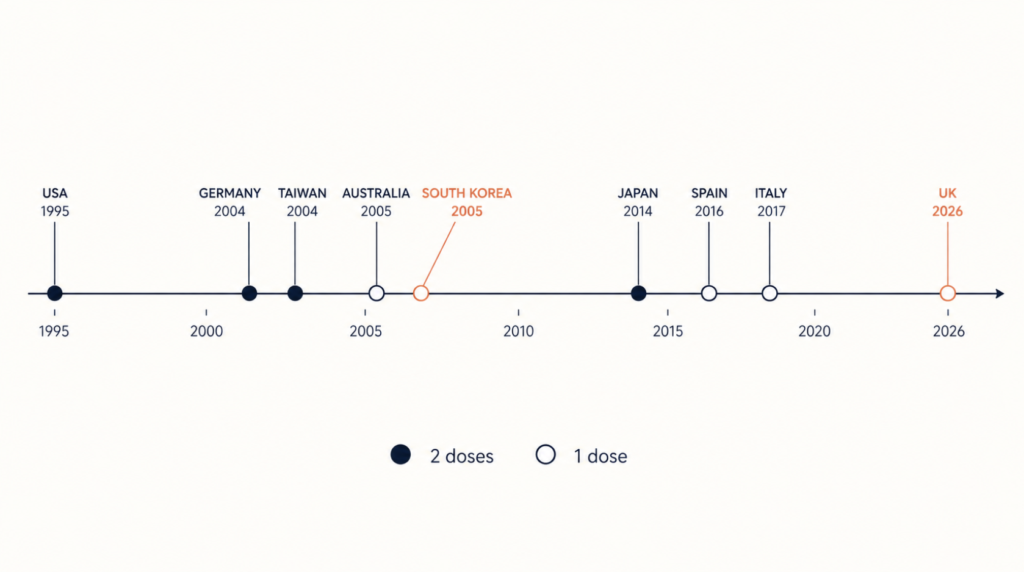
The live attenuated Oka strain was developed in Japan and first reported in 1974. Two decades passed before any country used it universally.
| Country | Added to national program | Current doses | Schedule |
|---|---|---|---|
| United States | 1995 (1 dose), then 2006 (2 doses) | 2 | 12-15 mo, 4-6 yr |
| Canada | 2000-2007 (provincial, 1 dose), then 2011 | 2 | 12-15 mo, 18 mo |
| Germany | 2004 (1 dose), then 2009 (2 doses) | 2 | 11-14 mo, 15-23 mo |
| Taiwan | 2004 | 1 | 12-18 mo |
| Australia | 2005 | 1 | 18 mo |
| South Korea | 2005 | 1 | 12-15 mo |
| Japan | 2014 | 2 | 12-15 mo, 18-23 mo |
| Spain | 2016 (nationwide) | 2 | 15 mo, 2-4 yr |
| Italy | 2017 (nationwide, mandatory) | 2 | 13-15 mo, 6 yr |
| United Kingdom | 2026 | 2 (MMRV) | 12 mo, 18 mo |
Sources: national immunization authorities; [Lee, Global varicella vaccination programs, 2022].
The United States went first in 1995 with a single dose. Then outbreaks appeared in communities where coverage was already near-universal, and in 2006 the schedule moved to two doses. Japan, the country that created the vaccine, did not adopt universal use until 2014.
The holdouts had two arguments. The first was cost-effectiveness. The second was more interesting: the exogenous boosting hypothesis. If children stop getting chickenpox, adults stop being re-exposed to the virus, and that lost immune “top-up” might mean more shingles in older people. It was a genuine concern, and it delayed programs for years.
A UK study using primary care records for 9,604 adults finally put numbers on it. Adults who lived with a child who had chickenpox were 33% less likely to develop shingles over the following two years, and still 27% less likely 10 to 20 years later. The effect is real and durable, but it is partial, and considerably weaker than the earlier cost-effectiveness models had assumed [Forbes, Risk of herpes zoster after exposure to varicella to explore the exogenous boosting hypothesis: self controlled case series study using UK electronic healthcare data, 2020].
Korea’s one-dose anomaly
Korea licensed the vaccine for the private market in 1988; the first domestically developed product followed in 1993. It was added to the national program in January 2005, and varicella became notifiable that July. Recent first-dose coverage has run at roughly 96 to 97%.
Korea is an outlier in a second way that rarely gets mentioned. The Oka strain is used for varicella vaccines essentially everywhere in the world, with one exception: a MAV/06-strain vaccine licensed in Korea [Lee, Global varicella vaccination programs, 2022].
Twenty-one years later, the schedule is still one dose.
The dose count matters more than it sounds. A global meta-analysis found one dose was 81% effective against varicella of any severity but 98% effective against moderate or severe disease; two doses raised protection against any varicella to 92% [Marin, Global varicella vaccine effectiveness: a meta-analysis, 2016]. One dose, in other words, is very good at preventing a bad case and only moderately good at preventing a case.
Korean national data show what that looks like over time. In a propensity-matched cohort of children born in 2011, one-dose effectiveness was 86.1% in the first year after vaccination but 49.9% measured across the full six-year follow-up, a decline of roughly 7.2% per year. The relative effectiveness of two doses compared with one was 73.4% [Hong, Waning effectiveness of one-dose universal varicella vaccination in Korea, 2011-2018: a propensity score matched national population cohort, 2021].
The gap in Korea comes from the dose count rather than from coverage.
2. Why adult chickenpox is a different disease
In a child, varicella is usually self-limiting: low fever, then an itchy vesicular rash that starts on the head and spreads to the trunk and limbs, crusting over within about a week to ten days.
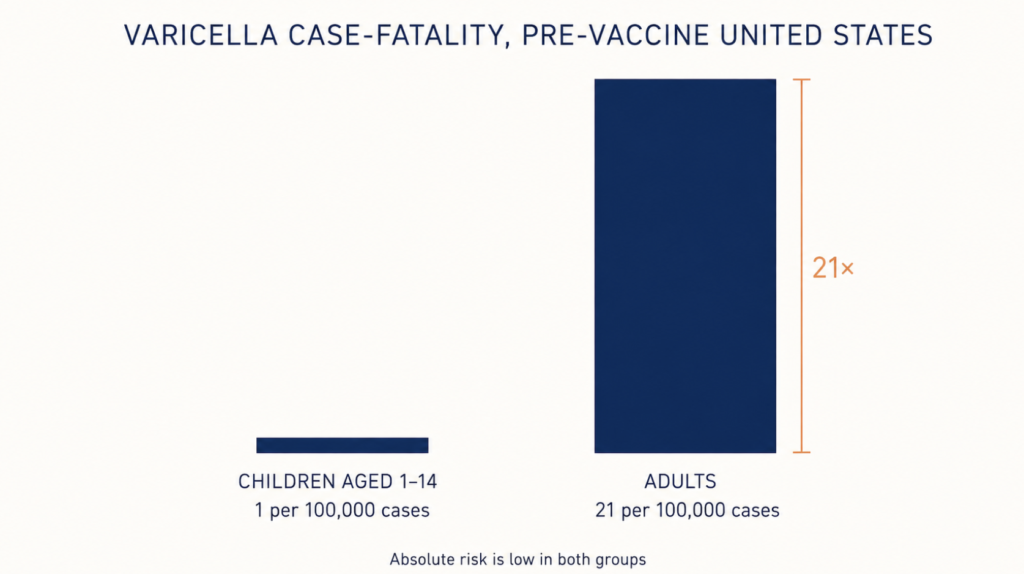
In an adult, the fever runs higher and longer, the rash is denser, and scarring is deeper. The complication profile also shifts. It helps to see both the ratio and the raw numbers: in the pre-vaccine United States, the case-fatality rate was roughly 1 per 100,000 cases in children aged 1 through 14, but about 21 per 100,000 cases in adults, according to the CDC’s Epidemiology and Prevention of Vaccine-Preventable Diseases. Any individual adult’s absolute risk is still small, but the gap between the two groups is wide.
Varicella pneumonia is the complication that turns a nuisance into an emergency. It is the most serious pulmonary manifestation of adult varicella, and smoking, immunosuppression, pregnancy, and chronic lung disease all raise the risk [Mohsen, Varicella pneumonia in adults, 2003]. It typically announces itself a few days after the rash, with breathlessness, pleuritic chest pain, and cough. Shortness of breath in an adult with chickenpox warrants prompt medical assessment rather than reassurance.
Other adult complications include bacterial superinfection of skin lesions, and, rarely, encephalitis and cerebellar ataxia.
Pregnancy is its own category. Maternal varicella carries a higher risk of severe disease, and the virus can cross the placenta. There is also a scheduling trap: the varicella vaccine is a live vaccine and cannot be given during pregnancy. Anyone planning a pregnancy who is not immune needs to sort this out beforehand, not after.
Why the difference? The prevailing explanation is that a mature adult immune system mounts a more vigorous inflammatory response, and in the lung that response is part of the injury. This remains a mechanistic account rather than a settled one.
Clinical Perspective
“I don’t think I ever had chickenpox” is one of the least reliable sentences in a medical history. It usually means one of three things: the person genuinely never had it, they had it before they were old enough to remember, or they had a case so mild that nobody labelled it. In practice the second and third are common enough that recall alone cannot be treated as evidence either way. Adult chickenpox is not childhood chickenpox arriving late. The clinical problem is different enough that it deserves to be thought about separately.
3. Is the chickenpox vaccine for adults worth it?
If you have no evidence of immunity, yes, in most cases.
The adult schedule differs from the childhood one. From age 13 onward, two doses are given 4 to 8 weeks apart. People who assume “one shot and done” because that is what children get in Korea are working from the wrong schedule.
Priority groups include healthcare workers, teachers and childcare staff, adults living with infants, household contacts of immunocompromised patients, women of childbearing age without immunity, people in dormitory or military settings, and travellers to areas with active transmission.
Should you get an antibody test first? For adults with an uncertain history it is a reasonable step, and testing before vaccinating has been described as more cost-effective than vaccinating everyone. But two caveats matter. False negatives are not rare, and a test result should not become the obstacle that stops someone getting vaccinated.
Birth year is often used as a rough proxy for immunity (before 1970 in Korea, before 1980 in the United States), and Korean serology broadly supports the older cutoff. In a 2023 study of 995 residual serum samples, seropositivity exceeded 95% in people aged 40 and over [Cho, Seroepidemiological study of varicella zoster virus in Korea, 2023, 2026]. Anyone born before 1970 sits comfortably inside that band.
The more useful finding in that study points the other way. Seropositivity was 80% in 1-4 year olds, fell to 53% at ages 5-9 and bottomed out at 43% at ages 10-14, then climbed back through 71% at 15-19 and 85% at 25-29. Rates among children aged 5-19 and adults aged 20-39 were lower than in earlier Korean surveys, a shift the authors attribute in part to reduced community exposure during the pandemic.
That is a map of who is actually susceptible, and it points at school-age children and adults in their twenties and thirties rather than at older adults, which is to say, many of the people asking this question. A pre-1970 birth date makes prior immunity likely rather than certain, and if your history is genuinely unclear, testing is the safer route than arithmetic.
Contraindications: pregnancy, significant immunosuppression, and severe allergy to a vaccine component.
If you have already been exposed and are not immune, vaccination within 3 days (up to 5) can prevent the illness or blunt it. Non-immune people at high risk may be candidates for varicella zoster immune globulin instead.
4. How the shingles vaccine is different
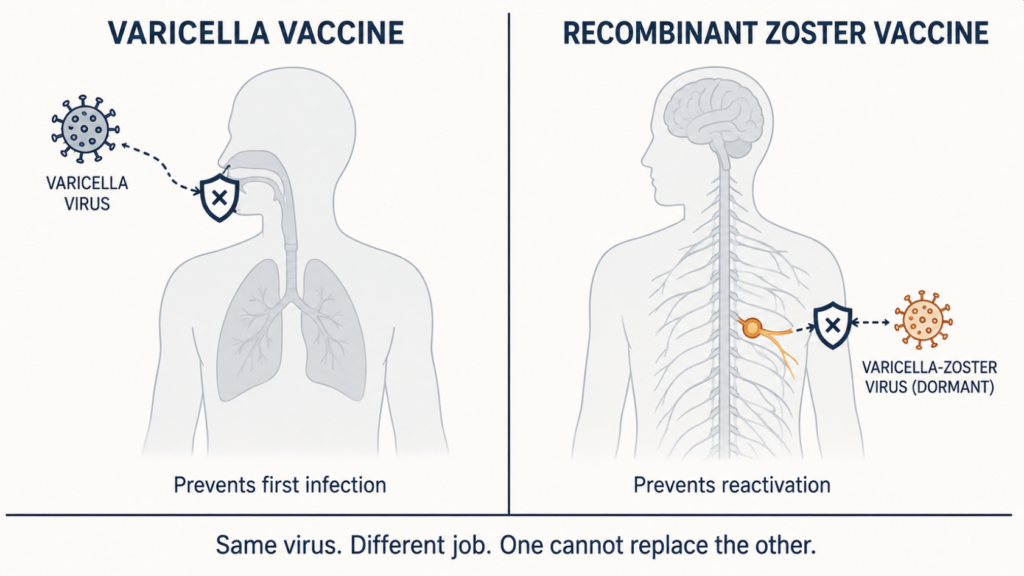
The varicella vaccine and the shingles vaccines act on the same virus, but they do two different jobs.
| Varicella vaccine | Live zoster vaccine | Recombinant zoster vaccine | |
|---|---|---|---|
| Examples | Varivax, Varilrix, SKYVaricella, SuduVax | SKYZoster; Zostavax (withdrawn in the US in 2020) | Shingrix |
| Type | Live attenuated | Live attenuated, high potency | Recombinant glycoprotein E + AS01 adjuvant |
| Purpose | Prevents primary infection | Prevents reactivation | Prevents reactivation |
| Doses | 1 (Korean children) / 2 (adults) | 1, subcutaneous | 2, 2-6 months apart, intramuscular |
| Immunocompromised | Contraindicated | Contraindicated | Can be given |
Does the chickenpox vaccine raise your shingles risk?
The vaccine strain can establish latency in nerve ganglia and reactivate. That part is documented rather than rumoured. In one active-surveillance study, 15% of virus-positive zoster specimens were vaccine strain, and among vaccinated children who developed shingles, roughly half the cases turned out to be wild-type virus rather than vaccine strain [Weinmann, Incidence and clinical characteristics of herpes zoster among children in the varicella vaccine era, 2005-2009, 2013].
Now the numbers that answer the question. Across 6.37 million children in six US health systems over 12 years, herpes zoster occurred at 38 per 100,000 person-years in vaccinated children versus 170 per 100,000 in unvaccinated children, 78% lower. Overall pediatric zoster incidence fell 72% across the study period [Weinmann, Incidence of herpes zoster among children: 2003-2014, 2019].
Canadian population data point the same direction, and add a dose effect: two doses carried a 41% lower zoster risk than one, and pediatric zoster incidence dropped 64% after the program began [Rafferty, The impact of varicella vaccination on paediatric herpes zoster epidemiology: a Canadian population-based retrospective cohort study, 2021].
“The vaccine strain can reactivate” and “the vaccine increases shingles” are not the same claim. The first is true; the second is not supported by the population data.
A Korean footnote: in 2024, reports of shingles following SKYVaricella prompted a review by the Korea Disease Control and Prevention Agency, which retained the vaccine in the national program while advising extra caution in high-risk groups such as immunocompromised patients, given a higher reported frequency of zoster relative to other products. That is an administrative determination rather than a controlled comparison, and it does not change the direction of the population evidence above.
If you never had chickenpox, which vaccine comes first?
The chickenpox vaccine comes first, and the order is not interchangeable.
Shingrix is not licensed to prevent primary varicella and has not been evaluated in people who are varicella-seronegative. Under current CDC guidance it also cannot be counted as the first dose of a two-dose varicella series, while a previously administered dose of the live zoster vaccine can be. The distinction catches out clinicians as often as patients.
ACIP guidance goes further and says not to screen for varicella history, verbally or serologically, before giving zoster vaccine to adults aged 50 and over, because false negatives are common and screening becomes a barrier. But if a negative serology result is already in hand, varicella vaccination guidance applies [Dooling, Recommendations of the Advisory Committee on Immunization Practices for use of herpes zoster vaccines, 2018].
The practical sequence: confirmed seronegative, then two doses of varicella vaccine, then zoster vaccine once you reach the eligible age.
Key Takeaways
- Before vaccine licensure in the United States, adults were 25 times more likely than children aged 1 to 4 to die of chickenpox, and most who died were previously healthy.
- One dose of varicella vaccine is 81% effective against varicella of any severity and 98% effective against moderate or severe disease; two doses raise protection against any varicella to 92%.
- In Korean national data, one-dose varicella vaccine effectiveness was 86.1% in the first year after vaccination but 49.9% measured across six years of follow-up.
- Adults and adolescents aged 13 and older without evidence of immunity need two doses, given 4 to 8 weeks apart.
- Herpes zoster occurred at 38 per 100,000 person-years in vaccinated children versus 170 per 100,000 in unvaccinated children, 78% lower.
- Korean serology from 2023 found varicella seropositivity above 95% in adults aged 40 and over, but only 43% among children aged 10 to 14.
- The recombinant shingles vaccine does not prevent chickenpox and cannot substitute for a dose of varicella vaccine.
FAQ
Is it too late to get the chickenpox vaccine as an adult? No. There is no upper age limit for varicella vaccination in adults who lack evidence of immunity. Because adult varicella carries a substantially higher mortality risk than childhood varicella, the argument for catching up gets stronger with age rather than weaker. The adult schedule is two doses, 4 to 8 weeks apart.
How do I know whether I already had chickenpox? Recall alone is unreliable, so a VZV IgG antibody test is the usual way to settle it. Birth year is sometimes used as a rough proxy (before 1970 in Korea, before 1980 in the United States), and Korean serology shows over 95% seropositivity in people aged 40 and over. But susceptibility is measurably higher in younger adults than it used to be, so a proxy is not a substitute for a test when the history is unclear.
Can I get the vaccine while trying to conceive? Not during pregnancy. This is a live vaccine and is contraindicated. If you are not immune and are planning a pregnancy, this needs to be handled before conception, with an appropriate interval afterward. Discuss timing with your physician.
Will the chickenpox vaccine give me shingles later? The vaccine strain can reactivate, but vaccinated children develop shingles at roughly a quarter the rate of unvaccinated children. Two doses lower the risk further than one. The population evidence points toward less shingles, not more.
I never had chickenpox. Can I just get Shingrix? Not as a substitute. Shingrix is not licensed for preventing primary varicella, has not been studied in seronegative people, and does not count toward the two-dose varicella series. If you are confirmed seronegative, varicella vaccine comes first.
References
- Meyer PA, Seward JF, Jumaan AO, Wharton M. Varicella mortality: trends before vaccine licensure in the United States, 1970-1994. J Infect Dis. 2000;182(2):383-90.
- Mohsen AH, McKendrick M. Varicella pneumonia in adults. Eur Respir J. 2003;21(5):886-91.
- Marin M, Marti M, Kambhampati A, Jeram SM, Seward JF. Global varicella vaccine effectiveness: a meta-analysis. Pediatrics. 2016;137(3):e20153741.
- Hong K, Sohn S, Choe YJ, Rhie K, Lee JK, Han MS, et al. Waning effectiveness of one-dose universal varicella vaccination in Korea, 2011-2018: a propensity score matched national population cohort. J Korean Med Sci. 2021;36(36):e222.
- Lee YH, Choe YJ, Lee J, Kim E, Lee JY, Hong K, et al. Global varicella vaccination programs. Clin Exp Pediatr. 2022;65(12):555-62.
- Weinmann S, Naleway AL, Koppolu P, Baxter R, Belongia EA, Hambidge SJ, et al. Incidence of herpes zoster among children: 2003-2014. Pediatrics. 2019;144(1):e20182917.
- Weinmann S, Chun C, Schmid DS, Roberts M, Vandermeer M, Riedlinger K, et al. Incidence and clinical characteristics of herpes zoster among children in the varicella vaccine era, 2005-2009. J Infect Dis. 2013;208(11):1859-68.
- Rafferty E, Reifferscheid L, Russell ML, Booth S, Svenson LW, MacDonald SE. The impact of varicella vaccination on paediatric herpes zoster epidemiology: a Canadian population-based retrospective cohort study. Eur J Clin Microbiol Infect Dis. 2021;40(11):2363-70.
- Forbes H, Douglas I, Finn A, Breuer J, Bhaskaran K, Smeeth L, et al. Risk of herpes zoster after exposure to varicella to explore the exogenous boosting hypothesis: self controlled case series study using UK electronic healthcare data. BMJ. 2020;368:l6987.
- Dooling KL, Guo A, Patel M, Lee GM, Moore K, Belongia EA, et al. Recommendations of the Advisory Committee on Immunization Practices for use of herpes zoster vaccines. MMWR Morb Mortal Wkly Rep. 2018;67(3):103-8.
- Varicella and herpes zoster vaccines: WHO position paper, June 2014. Wkly Epidemiol Rec. 2014;89(25):265-87.
- Cho Y, Cho EY, Lee A, Lee H. Seroepidemiological study of varicella zoster virus in Korea, 2023. J Korean Med Sci. 2026;41(3):e32.
Joonpyo Hong, MD is a board-certified otolaryngologist practicing in Korea. This article reflects his clinical interpretation of published research and does not constitute individual medical advice.
For more articles:
https://curiousmd.com/shingles-vaccine-and-hearing-loss/
https://curiousmd.com/ramsay-hunt-syndrome-facial-paralysis/
https://curiousmd.com/hand-foot-and-mouth-disease-in-adults/
Link out to:
https://www.cdc.gov/pinkbook/hcp/table-of-contents/chapter-22-varicella.html
https://www.cdc.gov/shingles/hcp/vaccine-considerations/index.html
Pingback: Flu Vaccine Mismatch: Does the Shot Still Work?