
Roughly 68,000 cases of Japanese encephalitis occur across Asia and the Western Pacific each year, yet only about one in ten is ever reported to health authorities [Campbell, Estimated global incidence of Japanese encephalitis: a systematic review, 2011]. Most people who carry the virus never feel a thing. The danger lives in the small fraction who do — and in a few quiet trends that are slowly reshaping who is at risk. This article walks through what spreads the disease, what it does to the body, when the Japanese encephalitis vaccine is given, and whether a hotter summer should change how you think about protection.
What carries Japanese encephalitis, and what it does
Japanese encephalitis is spread by Culex tritaeniorhynchus, often called the small red house mosquito. It breeds in rice paddies and standing water and feeds mainly at night. The virus circulates between mosquitoes and amplifying hosts such as pigs and wading birds; when an infected mosquito then bites a person, it can pass on the virus. Humans are a dead-end host, so the disease does not spread person to person — a sick patient needs no isolation.
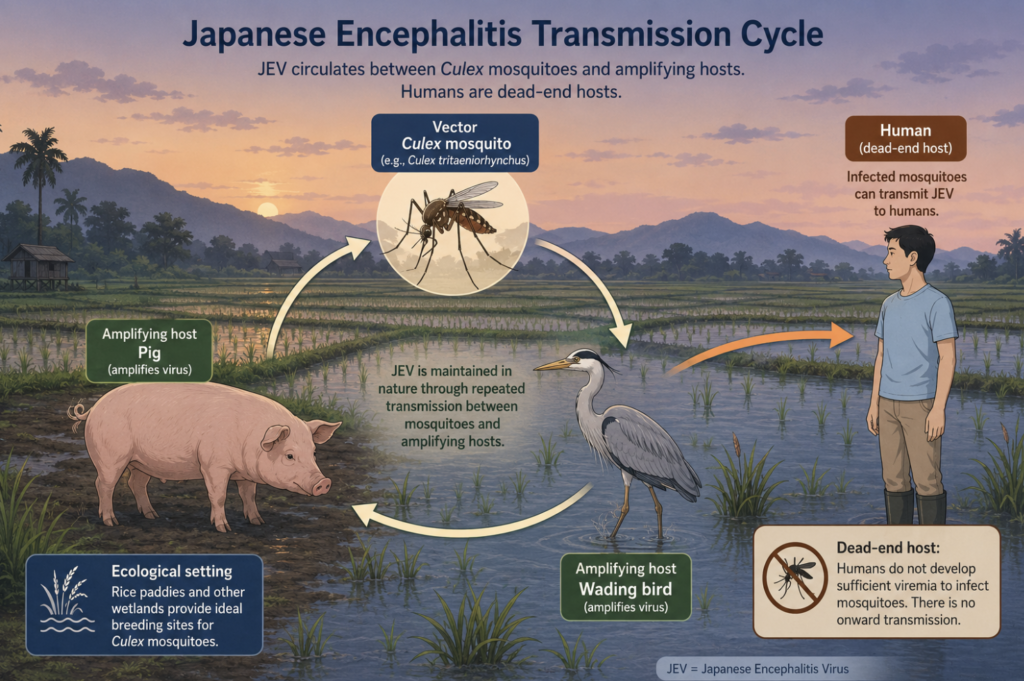
The infection itself is mostly silent. The large majority of people bitten by an infected mosquito develop no symptoms at all, and only a small minority feel anything beyond a mild, flu-like illness with fever, headache, and nausea. The problem is what happens in the rare case that the virus reaches the brain.
When Japanese encephalitis does progress to true encephalitis, it is severe. Among those who develop encephalitis, about one-third of cases are fatal, and roughly half of the survivors are left with lasting neurological damage such as cognitive impairment, weakness, or speech problems [Sharma, Pathobiology of Japanese encephalitis virus infection, 2021]. There is no specific antiviral drug; treatment is supportive, aimed at managing seizures, breathing, and complications. That gap between “no cure” and “high stakes” is exactly why prevention carries so much weight.
What the Japanese encephalitis vaccine is, and when to get it
Japanese encephalitis is vaccine-preventable, and the vaccine is the single most reliable form of protection. Two types are used: an inactivated vaccine (IJEV), which contains killed virus, and a live-attenuated vaccine (LJEV, sold as Imojev), which uses a weakened but living virus. In Korea, childhood vaccination begins at 12 months of age, and the schedule depends on which type is used.
| Inactivated vaccine (IJEV) | Live-attenuated vaccine (LJEV / Imojev) | |
|---|---|---|
| How it works | Killed virus | Weakened live virus |
| Total doses | 5 | 2 |
| Schedule | First two doses at 12–23 months, one month apart; third dose about 11 months later; boosters at ages 6 and 12 | First dose at 12–23 months; second dose about 12 months later |
| National program (Korea) | Free under the national immunization program | Not covered — paid out of pocket |
| Key cautions | Standard vaccination precautions | Generally avoided in people who are immunocompromised, pregnant, or have a severe allergy to a vaccine component — confirm eligibility with a clinician |
The two types are not interchangeable: a series should be completed with the same vaccine rather than mixed. One practical detail that surprises many parents is that only the inactivated vaccine is provided free through the national immunization program, while the live-attenuated option is paid out of pocket.
Adults are an increasingly important part of the picture. Because childhood immunization has sharply reduced pediatric cases, a larger share of the remaining burden now falls on adults, and the virus tends to cause adult cases whenever it reaches a population without prior immunity [Hills, Japanese Encephalitis among Adults: A Review, 2023]. In Korea, vaccination is generally recommended for previously unvaccinated adults who live in or will spend time in high-exposure areas — for example, near rice paddies or pig farms — and for travelers heading to endemic regions. Whether any individual should be vaccinated is a decision for a clinician who knows their history.
Does a warming climate raise the risk?
This is where the disease gets genuinely interesting, and where it is easy to overstate the case. The honest answer is that climate change clearly affects the conditions for transmission, while its effect on actual human case numbers in a well-vaccinated country is harder to pin down.
Start with the biology, which is solid. Temperature governs how well the mosquito can actually transmit the virus. In one laboratory study, a temperate Culex mosquito transmitted Japanese encephalitis virus at 25°C but failed to do so at 20°C, where the virus stayed trapped in the insect’s gut and never reached the saliva [Folly, Temperate conditions restrict Japanese encephalitis virus infection to the mid-gut and prevents systemic dissemination in Culex pipiens mosquitoes, 2021]. Warmer conditions also lengthen the mosquito season and push it earlier — Korean surveillance has been detecting the first vector mosquitoes progressively sooner in the year.
There is also a real-world signal. Japanese encephalitis recently expanded across a large new area of Australia in 2021–2022, an emergence that unfolded under warmer and wetter conditions linked to climate change [Pendrey, Japanese encephalitis clinical update: Changing diseases under a changing climate, 2023]. That is a striking example of the virus reaching places it had not previously established.
What this does not prove is that a hotter Korean summer will automatically produce more human infections. Korea’s childhood vaccination keeps case numbers low regardless of mosquito activity, which makes a clean cause-and-effect link hard to demonstrate. The fair reading is this: warming extends the window of exposure and widens the map of where the virus can circulate. The practical implication is less “panic” and more “don’t let your guard down” — a longer mosquito season raises the value of being up to date, especially for under-immunized adults in rural and farming areas.
Clinical Perspective With no specific treatment once encephalitis sets in, prevention is effectively the whole game. The climate trend does not call for alarm, but it is a reasonable prompt to do two unglamorous things well: confirm your vaccination status and take mosquito bites seriously during the warm months. Both are cheap insurance against a disease that offers very little once it turns serious.
Key Takeaways
- Japanese encephalitis is spread by night-biting Culex mosquitoes and does not pass from person to person.
- Most infections are silent, but when encephalitis develops, about one-third of cases are fatal and half of survivors have lasting neurological damage.
- The vaccine starts at 12 months in Korea — five doses for the inactivated type, two for the live-attenuated type — and the two types are not interchangeable.
- A warming climate lengthens the mosquito season and helps the virus reach new regions, raising exposure opportunity rather than guaranteeing more cases.
- Because there is no cure, vaccination and bite prevention are the main defenses, particularly for unvaccinated adults in high-risk areas.
FAQ
Should adults get the Japanese encephalitis vaccine? Some should. Adults are an increasingly important share of cases, and vaccination is generally recommended for previously unvaccinated adults living in or visiting high-exposure areas, such as near rice paddies or pig farms, and for travelers to endemic regions. Most adults in low-risk urban settings do not routinely need it. The decision depends on your exposure and vaccination history, so it is best confirmed with a clinician.
What is the difference between the inactivated and live vaccines? The inactivated vaccine uses killed virus and requires more doses (five in the Korean schedule), while the live-attenuated vaccine uses a weakened live virus and needs only two. Both are effective, but only the inactivated type is provided free through Korea’s national immunization program; the live-attenuated option is paid out of pocket. They are also not interchangeable — a series should be completed with the same type rather than mixed.
Is avoiding mosquito bites enough during a hot summer? Bite prevention helps but is not a substitute for vaccination. Repellent, long sleeves, and screens reduce exposure, especially at night when the vector feeds, yet they are imperfect. Because warmer seasons mean longer mosquito activity, combining bite prevention with an up-to-date vaccination status is the more reliable approach.
References
Campbell GL, Hills SL, Fischer M, Jacobson JA, Hoke CH, Hombach JM, et al. Estimated global incidence of Japanese encephalitis: a systematic review. Bull World Health Organ. 2011;89(10):766-74.
Sharma KB, Vrati S, Kalia M. Pathobiology of Japanese encephalitis virus infection. Mol Aspects Med. 2021;81:100994.
Hills SL, Netravathi M, Solomon T. Japanese encephalitis among adults: a review. Am J Trop Med Hyg. 2023;108(5):860-864.
Pendrey CGA, Martin GE. Japanese encephalitis clinical update: changing diseases under a changing climate. Aust J Gen Pract. 2023;52(5):275-280.
Folly AJ, Dorey-Robinson D, Hernández-Triana LM, Ackroyd S, Vidana B, Lean FZX, et al. Temperate conditions restrict Japanese encephalitis virus infection to the mid-gut and prevents systemic dissemination in Culex pipiens mosquitoes. Sci Rep. 2021;11(1):6133.
Joonpyo Hong, MD is a board-certified otolaryngologist practicing in Korea. This article reflects his clinical interpretation of published research and does not constitute individual medical advice.
For more interesting contents:
https://curiousmd.com/hpv-vaccine-and-throat-cancer/
https://curiousmd.com/shingles-vaccine-and-hearing-loss/
https://curiousmd.com/oral-cancer-swab-test-accuracy-explained/
Link out to:
WHO — Japanese encephalitis (fact sheet)
https://www.who.int/news-room/fact-sheets/detail/japanese-encephalitis
CDC — About Japanese Encephalitis Virus
https://www.cdc.gov/japanese-encephalitis/about/index.html
Encephalitis International — Japanese Encephalitis
https://www.encephalitis.info/types-of-encephalitis/infectious-encephalitis/japanese-encephalitis/
ECDC — Japanese encephalitis facts
https://www.ecdc.europa.eu/en/japanese-encephalitis/facts
Australian government (health.nsw.gov.au) — Japanese encephalitis fact sheet
https://www.health.nsw.gov.au/Infectious/factsheets/Pages/japanese_encephalitis.aspx