
Take a group of people on regular nonsteroidal anti-inflammatory drugs (NSAIDs) — ibuprofen, naproxen, diclofenac — and look inside their stomachs with an endoscope. Somewhere between 30% and 50% will have visible mucosal damage: pinpoint hemorrhages, erosions, sometimes frank ulcers (Sostres et al., Arthritis Res Ther 2013). Most of them feel nothing at all. That gap — between how often NSAIDs injure the stomach and how rarely patients notice — is the whole reason this belongs on the checklist for a routine prescription. This piece works through five practical questions: how common the problem really is, who is most vulnerable, whether duration or dose drives the risk, and two things patients do constantly — pairing NSAIDs with acetaminophen, and mixing NSAIDs together.
How Common Are NSAID-Induced Gastric Ulcers?
Common enough to keep in mind every time, but not a reason to panic. The key is to separate two very different numbers: visible damage and clinical events (Wolfe et al., N Engl J Med 1999).
Endoscopic injury is close to universal. About 30–50% of NSAID users have lesions such as subepithelial hemorrhages, erosions, and ulcerations, usually in the gastric antrum, and often with no symptoms (Sostres et al., Arthritis Res Ther 2013). Many of these lesions are minor and may even fade with continued use as the mucosa adapts.
Serious events are far less frequent. Roughly 1–2% of NSAID users experience a serious complication — bleeding, perforation, or obstruction — during treatment, and the relative risk of developing a peptic ulcer is about four- to fivefold higher than in non-users (Sostres et al., Arthritis Res Ther 2013).
The unsettling detail sits between those two figures: more than half of patients who develop a serious ulcer complication had no warning symptoms beforehand (Sostres et al., Arthritis Res Ther 2013). Dyspepsia does not reliably predict mucosal damage, and the absence of dyspepsia does not predict safety. That is precisely why prevention is driven by risk factors rather than by waiting for stomach pain to appear.

Who Is Most Vulnerable?
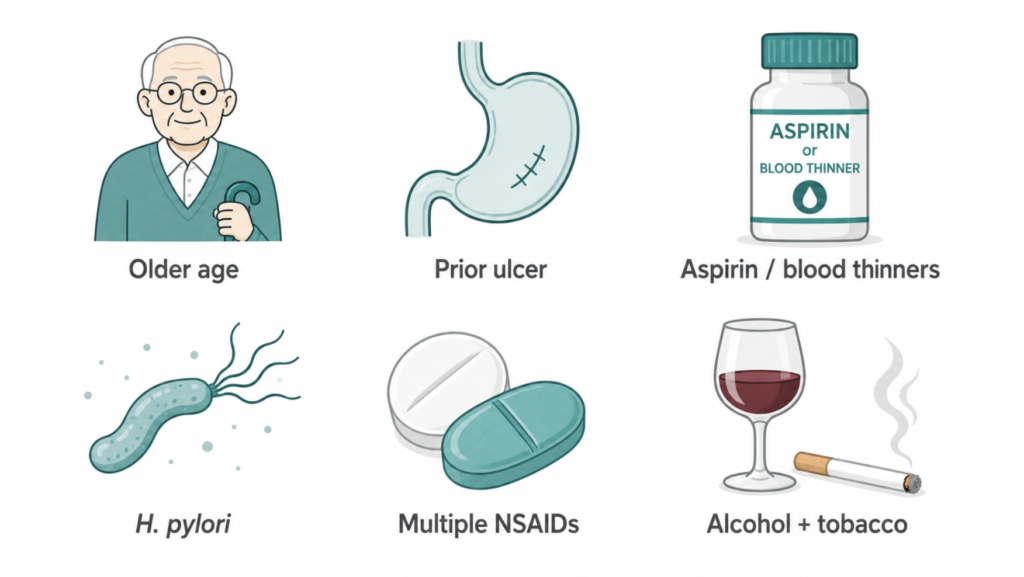
The risk is not uniform across patients. A well-defined set of factors raises it (Sostres et al., Arthritis Res Ther 2013; Lanza et al., Am J Gastroenterol 2009):
- Older age — 65 and over, especially 70 and over.
- Prior peptic ulcer — particularly a previously complicated (bleeding or perforated) ulcer, which is among the strongest predictors.
- Concomitant medications — low-dose aspirin, other antiplatelet agents, anticoagulants, corticosteroids, or selective serotonin reuptake inhibitors (SSRIs).
- Helicobacter pylori infection — which acts synergistically with NSAIDs. In one meta-analysis, the odds ratio for peptic ulcer when both an NSAID and H. pylori were present reached about 61, versus neither factor (Sostres et al., Arthritis Res Ther 2013).
- High-dose or more gastrolesive NSAIDs, and using two or more NSAIDs at once.
- Severe illness, alcohol, and tobacco.
These factors stack. A 72-year-old on low-dose aspirin with a prior bleed is a fundamentally different case from a healthy 30-year-old taking ibuprofen for a sprained ankle, even though both may leave with the same prescription.
Clinical Perspective
NSAIDs are a workhorse in ear, nose, and throat practice — after tonsillectomy or sinus surgery, for acute otitis, for pharyngitis. The courses are often short, the patients often young, and the reflex is to treat the stomach as an afterthought. The useful filter is not the diagnosis; it is the person in front of you. A brief course in a healthy young adult rarely needs gastroprotection. An older patient on aspirin, a steroid, or an anticoagulant is where a proton pump inhibitor and a deliberate conversation about risk earn their place.
Myth 1 — “Only Long-Term Use Is Dangerous”
This is the most common misconception, and it is false. The relative risk of a serious GI event is actually highest early in treatment. Across NSAIDs as a class, risk peaks in the first week of use (odds ratio around 11.7), eases somewhat with continued use (around 5.6), and drops after stopping (Lewis et al., Br J Clin Pharmacol 2002). Sostres and colleagues likewise place the risk highest during the first month (Sostres et al., Arthritis Res Ther 2013).
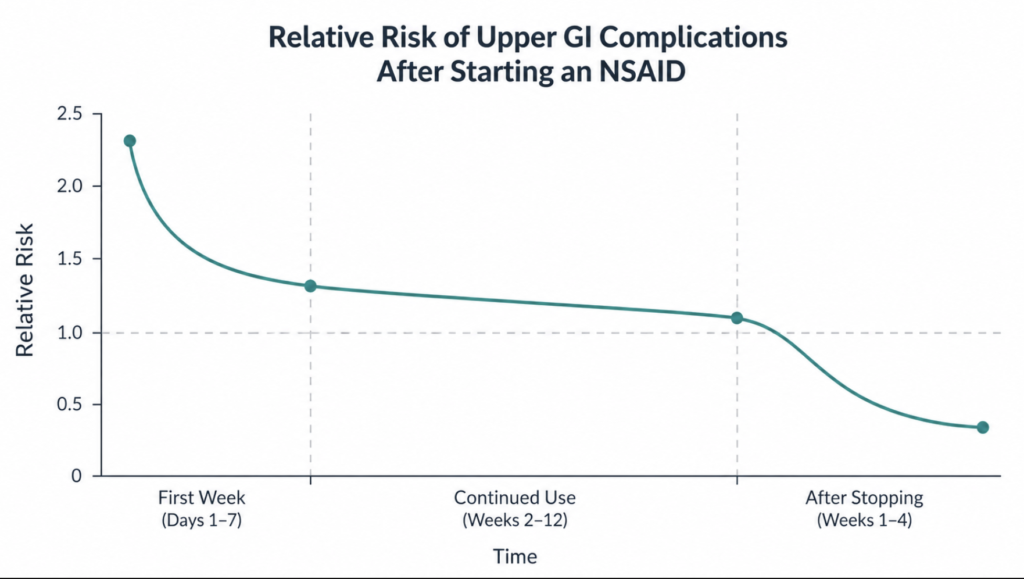
Dose matters too. Within ordinary dose ranges, risk climbs roughly three- to sevenfold from low to high doses (Lewis et al., Br J Clin Pharmacol 2002), and high-dose NSAIDs carry about double the risk of low-to-medium doses (García Rodríguez & Hernández-Díaz, Epidemiology 2001). So a short, high-dose course is not automatically safe — a predisposed or older patient can bleed within the first week.
Myth 2 — “Add Acetaminophen, It’s Stomach-Safe”
Partly true, with an important caveat. At standard analgesic doses (under about 2 g/day), acetaminophen is not associated with an increased risk of upper GI bleeding (García Rodríguez & Hernández-Díaz, Epidemiology 2001), which is why it is generally the preferred first-line analgesic when the stomach is a concern (Lewis et al., Br J Clin Pharmacol 2002).
But acetaminophen is not a gastroprotectant. Adding it to an NSAID does not shield the stomach — it simply lets you use less NSAID. And the picture shifts at higher doses: acetaminophen above 2 g/day has itself been linked to a threefold-plus increase in GI complications (relative risk about 3.6; García Rodríguez & Hernández-Díaz, Epidemiology 2001), and the risk of GI bleeding is greater when more than one of these analgesic agents is taken at the same time (García Rodríguez & Hernández-Díaz, Arthritis Res 2001). The practical reading: acetaminophen is a sound NSAID-sparing choice at normal doses, but “I’m also on acetaminophen” is not stomach protection, and high-dose combinations can add risk.
Myth 3 — “Two NSAIDs Are Better Than One”
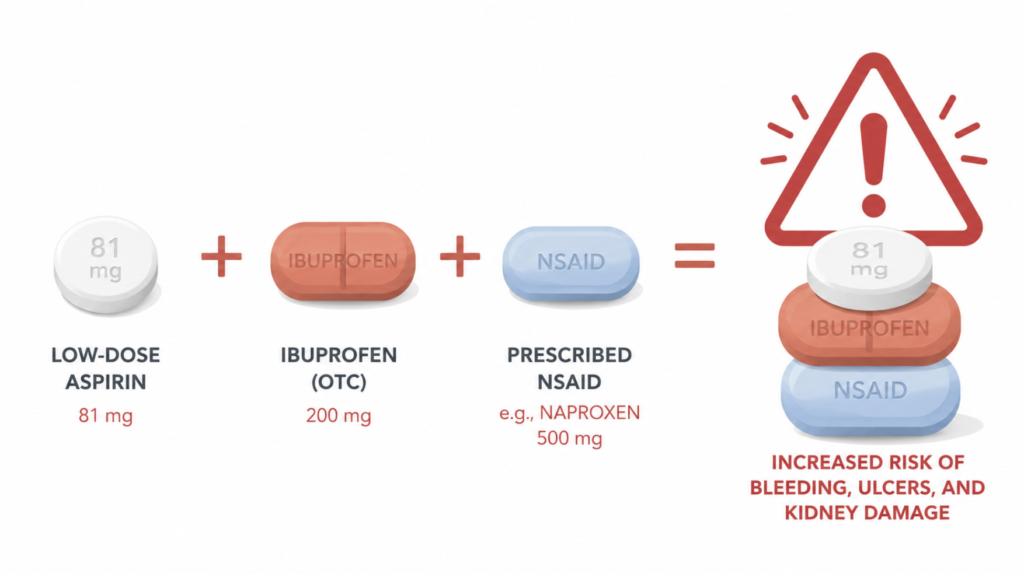
False, and specifically risky. Using two or more NSAIDs simultaneously is a recognized, independent risk factor for GI complications (Sostres et al., Arthritis Res Ther 2013), and concurrent use of more than one NSAID substantially increases bleeding risk (Lewis et al., Br J Clin Pharmacol 2002).
The trap is that patients rarely think of over-the-counter ibuprofen — or aspirin — as part of the same drug family. Two analgesic NSAIDs at once (say, a prescribed diclofenac plus an OTC ibuprofen for a headache) is the clearest example of stacking. Low-dose aspirin is a slightly different case: it is usually taken for the heart rather than for pain, and risk tables often list it separately — but it still adds to gastrointestinal bleeding risk on top of an NSAID. Either way, asking specifically about over-the-counter painkillers and aspirin catches what the generic “are you taking any medications?” tends to miss.
Key Takeaways
- Endoscopic stomach lesions appear in roughly 30–50% of regular NSAID users, but serious complications occur in about 1–2% during treatment.
- More than half of patients who develop a serious NSAID ulcer complication have no warning symptoms first, so the absence of stomach pain is not reassurance.
- The highest-risk patients are older adults, those with a prior (especially complicated) ulcer, and those also taking aspirin, anticoagulants, corticosteroids, or SSRIs, or who are H. pylori-positive.
- NSAID gastrointestinal risk is front-loaded and dose-dependent — highest in the first week to first month — so short, high-dose courses are not inherently safe.
- Acetaminophen at normal doses is stomach-safe and NSAID-sparing but not gastroprotective; taking more than one NSAID at once raises risk, and low-dose aspirin adds to it even when taken for the heart.
FAQ
Can a short course of NSAIDs cause a stomach ulcer? Yes. The risk of a serious gastrointestinal event is actually highest in the first week to first month of use, not only with long-term treatment. It is also dose-dependent, so a brief high-dose course can cause bleeding, especially in older patients or those with other risk factors. Short duration alone does not guarantee safety.
Is acetaminophen safer than NSAIDs for the stomach? At standard doses, yes. Acetaminophen under about 2 g/day is not associated with increased upper GI bleeding and is generally the preferred first-line analgesic when stomach risk is a concern. At higher doses (over 2 g/day) it has been linked to increased GI risk, so “safer” applies to normal dosing, not unlimited use.
Does taking acetaminophen with an NSAID protect my stomach? No. Acetaminophen is not a gastroprotective agent. Combining it with an NSAID can reduce how much NSAID you need, which helps indirectly, but the combination itself does not shield the stomach — and high-dose combinations may increase bleeding risk. Genuine gastroprotection in at-risk patients comes from measures such as a proton pump inhibitor.
Can I take two different NSAIDs at the same time? This is best avoided. Using more than one NSAID simultaneously is an established risk factor that substantially increases the chance of GI bleeding. Over-the-counter ibuprofen counts as a second NSAID; low-dose aspirin is usually taken for the heart rather than pain, but it still adds to bleeding risk on top of an NSAID. If pain control is inadequate on one NSAID, the safer route is to reassess rather than add a second.
References
- Sostres C, Gargallo CJ, Lanas A. Nonsteroidal anti-inflammatory drugs and upper and lower gastrointestinal mucosal damage. Arthritis Res Ther. 2013;15 Suppl 3:S3.
- Wolfe MM, Lichtenstein DR, Singh G. Gastrointestinal toxicity of nonsteroidal antiinflammatory drugs. N Engl J Med. 1999;340(24):1888-99.
- Lanza FL, Chan FKL, Quigley EMM. Guidelines for prevention of NSAID-related ulcer complications. Am J Gastroenterol. 2009;104(3):728-38.
- Lewis SC, Langman MJS, Laporte JR, Matthews JNS, Rawlins MD, Wiholm BE. Dose-response relationships between individual nonaspirin nonsteroidal anti-inflammatory drugs (NANSAIDs) and serious upper gastrointestinal bleeding: a meta-analysis based on individual patient data. Br J Clin Pharmacol. 2002;54(3):320-6.
- García Rodríguez LA, Hernández-Díaz S. Relative risk of upper gastrointestinal complications among users of acetaminophen and nonsteroidal anti-inflammatory drugs. Epidemiology. 2001;12(5):570-6.
- García Rodríguez LA, Hernández-Díaz S. The risk of upper gastrointestinal complications associated with nonsteroidal anti-inflammatory drugs, glucocorticoids, acetaminophen, and combinations of these agents. Arthritis Res. 2001;3(2):98-101.
Joonpyo Hong, MD is a board-certified otolaryngologist practicing in Korea. This article reflects his clinical interpretation of published research and does not constitute individual medical advice.
For more interesting contents:
https://curiousmd.com/acetaminophen-vs-nsaids-evidence/
https://curiousmd.com/polypharmacy-in-older-adults/
https://curiousmd.com/antivirals-vs-antibiotics-why-so-few/
Link out to:
https://medlineplus.gov/ency/article/000206.htm
https://www.nhs.uk/medicines/nsaids/
https://my.clevelandclinic.org/health/treatments/11086-non-steroidal-anti-inflammatory-medicines-nsaids
Pingback: Steroids vs NSAIDs: The History Behind the Names