
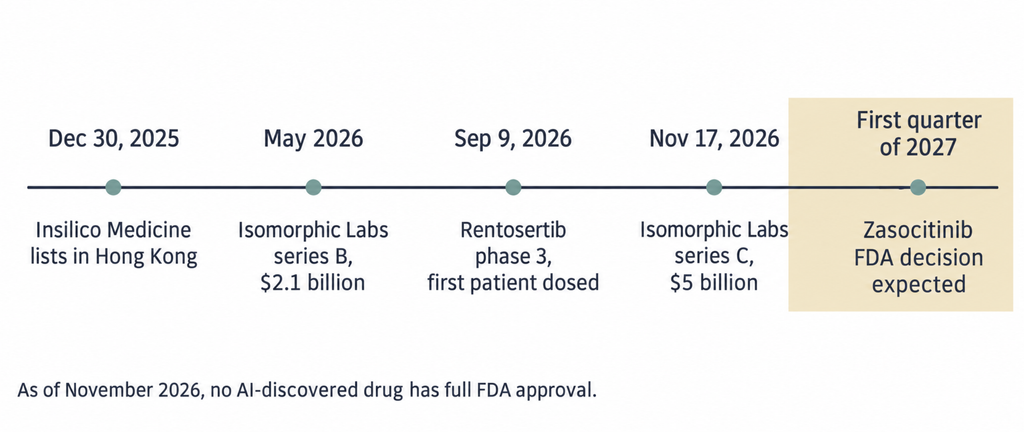
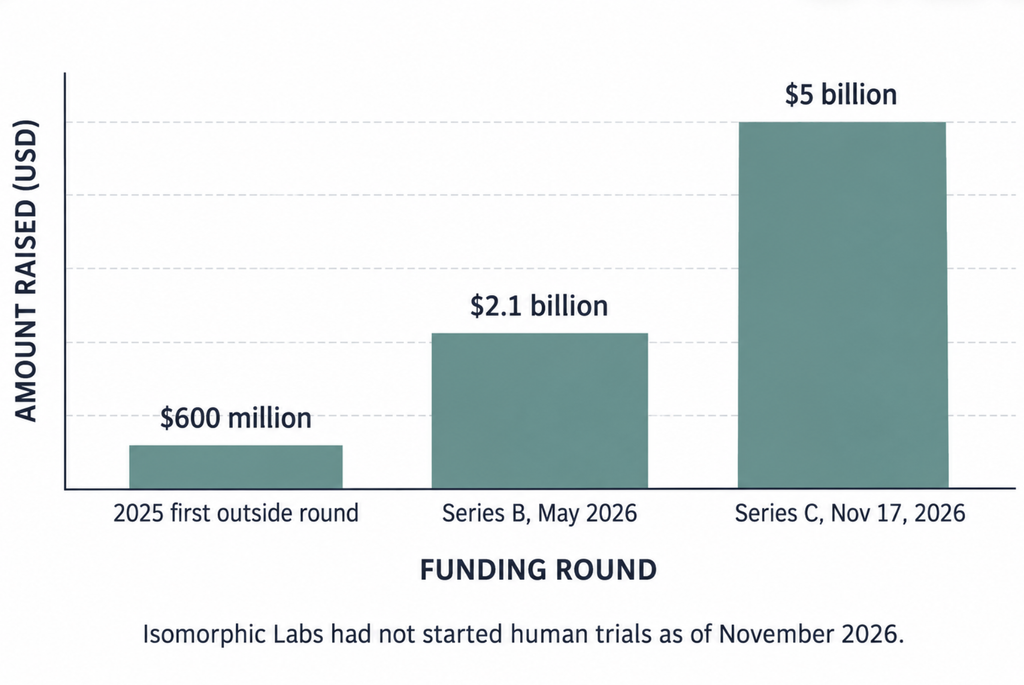
Investors are betting heavily on AI drug discovery. On November 17, 2026, Isomorphic Labs, a DeepMind spinout, announced a $5 billion series C [Isomorphic Labs, Series C Announcement, 2026]. Six months earlier it had raised $2.1 billion. As of that announcement, Isomorphic had not yet started human trials of its own candidates [City AM, Isomorphic Labs Raises $5bn, 2026].
No drug widely described as AI-discovered has yet won full FDA approval. The closest candidate, zasocitinib, faces an FDA decision expected in the first quarter of 2027 [Takeda, Zasocitinib Priority Review, 2026]. The head of R&D at Nimbus Therapeutics, which discovered it, has said he would not call it the first AI-approved drug [Pecci, Zasocitinib and AI Drug Discovery, 2026].
An earlier CuriousMD piece looked at what AI replaces inside drug development [Hong, AI Clinical Trials, 2026]. This follow-up asks how far human trial data have caught up with the money and talent now in the field. It covers funding and hiring, how much time AI can save and what the trial data show. Regulators are also changing how much evidence approval requires, through draft policies that are not specific to AI.
Money and talent are moving into AI drug discovery
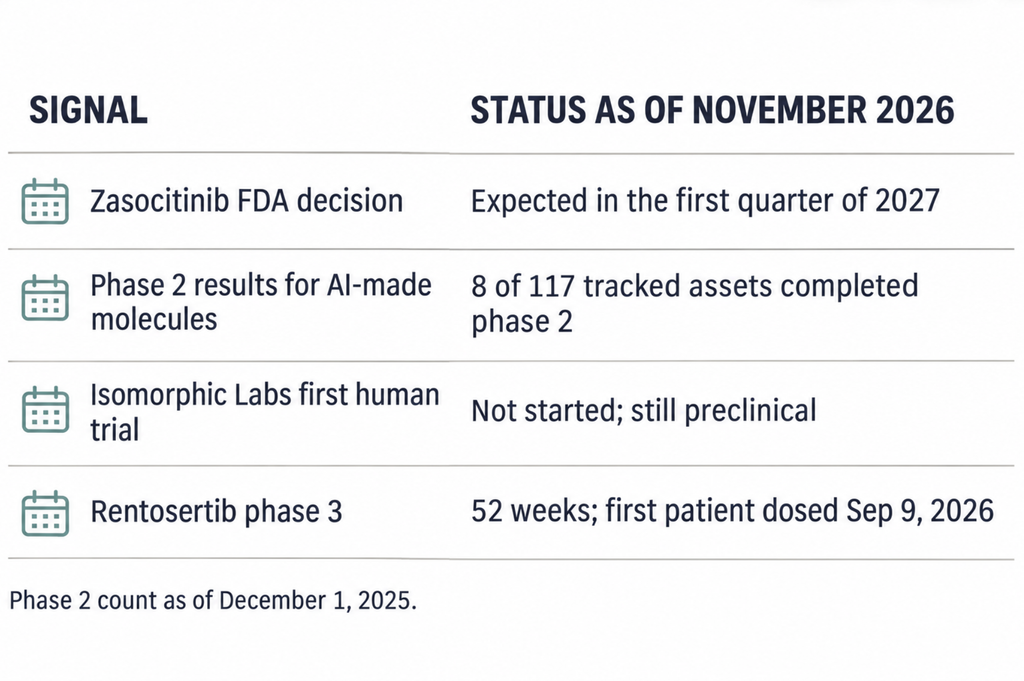
Isomorphic’s funding shows how fast the money has grown. The company raised a $600 million first outside round in 2025, a $2.1 billion series B in May 2026 and $5 billion in November [Fierce Biotech, Isomorphic Labs Raises $5B, 2026]. It spun out of DeepMind in 2021. Its leaders had promised human trials by the end of 2026. In October, executives said the work was still preclinical and would not confirm the deadline [STAT, Isomorphic Labs Drugmaking, 2026].
Investors have also backed new stock listings. Insilico Medicine listed in Hong Kong on December 30, 2025, at an offer price of HK$24.05 [Deloitte China, Insilico Listing, 2025]. The listing raised about $293 million, and the shares rose as much as 48% on the first day [The Star, Insilico Debut, 2025]. Retail investors in Hong Kong asked for about 1,427 times the shares set aside for them, and international investors for 26 times. Fifteen cornerstone investors took part, Eli Lilly among them [PharmCube, Insilico HKEX IPO, 2025].
Recursion, a listed AI drug company, has had a harder year. In the year to late 2026, the XBI biotech index returned about 33%, while Recursion’s share price fell about 37% [StockAnalysis, RXRX and XBI Data, 2026]. In the author’s reading, the strongest investor signals have come from private rounds and new listings.
Talent is moving in two directions
At least one AlphaFold alumnus has started a biology company. Simon Kohl worked on AlphaFold2 and co-led DeepMind’s protein design team. He left at the end of 2022 and launched Latent Labs with $50 million in February 2025 [TechCrunch, Latent Labs Launches, 2025]. Latent Labs builds protein design models for partners and has no drug pipeline of its own [TechCrunch, Latent Labs Launches, 2025].
Others went to general AI labs. John Jumper shared the 2024 Nobel Prize in Chemistry for AlphaFold [Hong, AI Clinical Trials, 2026]. On June 19, 2026, he announced that he would leave Google DeepMind after nearly 9 years to join Anthropic [TechCrunch, John Jumper Leaves DeepMind, 2026]. The FT reported that almost a quarter of the original AlphaFold authors had left Google DeepMind [The Decoder, AlphaFold Team Dismantled, 2026].
Anthropic moves into the lab
Anthropic launched Claude for Life Sciences on October 20, 2025. It connected the Claude chatbot to research tools such as Benchling, 10x Genomics and PubMed [SiliconANGLE, Claude for Life Sciences, 2025]. On June 30, 2026, the company released Claude Science as a beta workbench. By Anthropic’s own account, it runs existing Claude models and connects them to more than 60 scientific databases [TechCrunch, Claude Science Bets on Workflow, 2026].
The company also said it would run a small number of its own preclinical programs in neglected diseases [MIT Technology Review, Claude Science, 2026]. It has not shared details or said what it will do with any candidates [WTOP, Anthropic Plans Its Own Studies, 2026]. At least one drugmaker, Bristol Myers Squibb, has set an internal target of cutting development cycle times by 30% with AI tools [MedCity News, Anthropic Pharma Push, 2026].
One independent report, in MIT Technology Review, questioned how serious the company’s science push is [MIT Technology Review, Claude Science, 2026]. Tools of this kind are built to help with analysis and literature work, and none of them tests a drug in a person. In the author’s reading, any effect on patient care would come only after candidates pass the same human trials as other drugs.
How much time AI can save at each stage
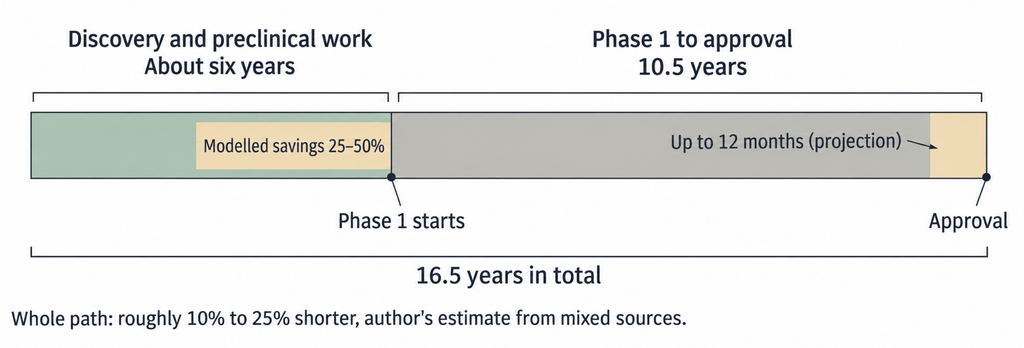
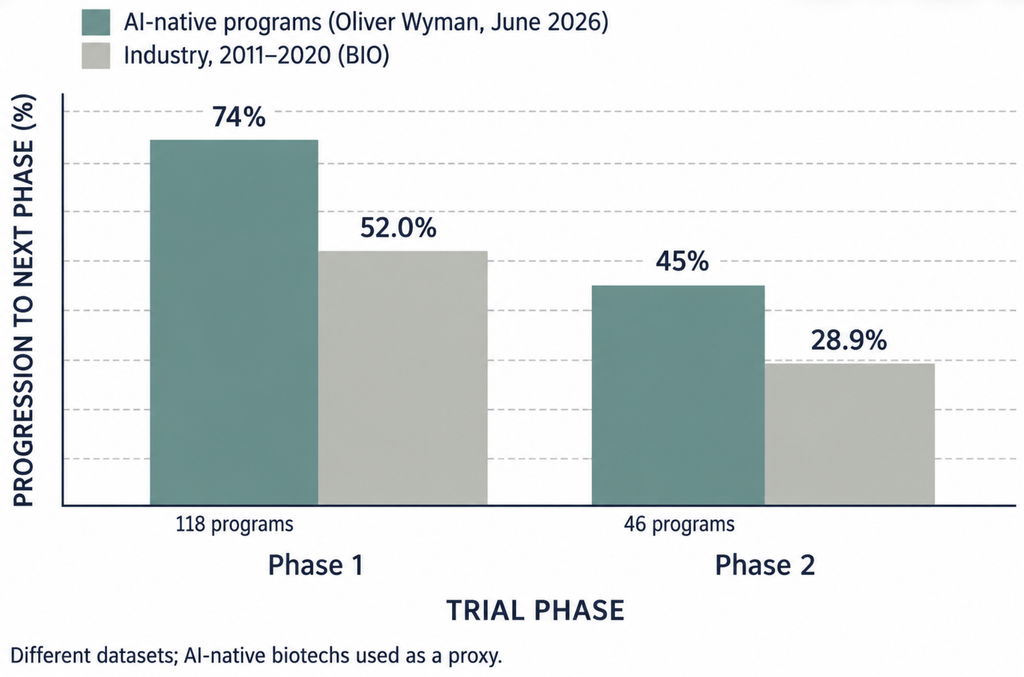
The earlier piece laid out the stages of development. In 2011–2020 industry data, about half of drugs cleared phase 1 (52.0%), and fewer than a third cleared phase 2 (28.9%) [Thomas, Clinical Development Success Rates 2011–2020, 2021]. Only 7.9% of drugs entering phase 1 reached approval, across 9,704 development programs. The trip from phase 1 to approval took 10.5 years on average.
Before phase 1, discovery and preclinical work take about six years on average, by one widely cited estimate [Nature, Is AI Accelerating Drug Discovery, 2023]. Current estimates, most of them modelled or reported by companies, put the largest AI time savings in this early stage. A BCG and Wellcome report modelled time and cost savings of about 25–50% up to the preclinical stage [Rodriguez, Unlocking the Potential of AI in Drug Discovery, 2023; Nature, Is AI Accelerating Drug Discovery, 2023]. Insilico reports that its programs typically reach a preclinical candidate in about 13 months, and its fastest in 9 months [Zulhusni, AI Shortening Discovery Timelines, 2026]. Its programs typically made and tested 60 to 200 molecules to get there. By the company’s own estimate, conventional work takes about four and a half years to reach the same point.
One peer-reviewed example is rentosertib, for idiopathic pulmonary fibrosis (IPF). Insilico’s team reports that it went from target discovery to a preclinical candidate in roughly 18 months [Ren, TNIK Inhibitor Preclinical and Clinical Models, 2025].
Estimated savings inside human trials are smaller. McKinsey projects that AI agents could cut trial durations by as much as 12 months [McKinsey, Agentic AI in Biopharma Development, 2025]. In its one reported deployment, the time from database lock to a final clinical study report fell from about 12 weeks to six. A Tufts analysis of a single oncology program estimated about 10 weeks saved and up to $5.6 million lower direct operating costs [Axios, AI Brings Savings to Clinical Trials, 2026]. Small gains at this stage still affect cost, because nearly 70% of R&D spending goes to clinical development, by McKinsey’s estimate [McKinsey, Rewiring Biopharma R&D with AI, 2026].
Adding these estimates gives a rough overall figure: six years before phase 1 plus 10.5 years after makes 16.5 years in total. Cutting the early stage by 25–50% and trimming up to a year from trials saves 1.5 to 4 years. The inputs come from different sources, and most are projections. Together they suggest AI could shorten the whole path by roughly 10% to 25%, by the author’s own rough calculation.
| Stage | Typical time | What AI changes | Evidence for the saving | Human data needed |
|---|---|---|---|---|
| Discovery and preclinical work (before phase 1) | About six years | Target finding, molecule design | Modelled 25–50%; to candidate only, about 13 months vs about four and a half years (company figures) | No |
| Phase 1 to approval | 10.5 years | Trial design, monitoring, documents | Up to 12 months (projection); about 10 weeks (one program) | Yes |
| Whole path | 16.5 years | Both of the above | Roughly 10% to 25% (author’s estimate) | Yes |
Human trials remain the longest stage, and AI cannot skip them. Under FDA rules, adequate and well-controlled studies are the primary basis for judging whether a drug works [FDA, Adequate and Well-Controlled Studies, 2026]. No current rule lets a model’s prediction replace these studies as proof that a drug works.
What the trial record shows so far
Three analyses, using different definitions and datasets, report phase 1 rates of 74% to 90% for AI programs, above the 52.0% industry figure. The first, in 2024, put phase 1 success at 80–90% and phase 2 at about 40%, similar to historical averages, on a small sample [Jayatunga, AI-Discovered Drugs in Clinical Trials, 2024]. IQVIA found a 75% phase 1 success rate for AI-enabled programs at emerging biotechs over the most recent three years [Roland, IQVIA Global R&D Trends 2026, 2026]. Oliver Wyman found AI-native programs advancing from phase 1 at 74%, against 52.0% in separate 2011–2020 industry data [Oliver Wyman, AI Investment Brings Results, 2026].
The analyses split on phase 2. Oliver Wyman found AI-native programs advancing from phase 2 at 45%, against an industry rate of 28.9%. That figure rests on just 46 phase 2 programs as of June 2026, and the benchmark comes from a different dataset. IQVIA found phase 2 rates on par with non-AI peers [Roland, IQVIA Global R&D Trends 2026, 2026]. Both are industry analyses, and their cohorts differ. Small, mostly non-peer-reviewed analyses point to higher phase 1 rates, and whether AI programs do better in phase 2, which tests efficacy, is still unknown.
The samples are small because few programs have gone far. An ASCO 2026 abstract counted 117 AI-enabled assets from 63 companies in human trials as of December 1, 2025 [Haque, Clinical-Stage AI-Enabled Therapeutic Assets, 2026]. Of these, 60 (51.3%) had completed phase 1 and 8 (6.8%) had completed phase 2. By Oliver Wyman’s count, as of June 2026, AI-discovered molecules made up about 1–2% of the clinical pipeline.
The first approval candidate shows how loosely the label is applied. Zasocitinib, a TYK2 inhibitor for moderate-to-severe plaque psoriasis, faces an FDA decision expected in the first quarter of 2027 [Takeda, Zasocitinib Priority Review, 2026]. Nimbus Therapeutics identified it in 2020 and sold it to Takeda in 2022. Its team used machine learning and physics-based free energy calculations to assess more than 13,000 compounds by computer [Pecci, Zasocitinib and AI Drug Discovery, 2026]. By the scientists’ estimate, that took about three months, against more than five years by conventional experiments. The head of R&D at Nimbus has said he would not call it the first AI-approved drug.
IQVIA found that the largest share of AI-enabled programs design molecules for targets that are already known [Roland, IQVIA Global R&D Trends 2026, 2026]. In rentosertib, AI was also used to choose the target, TNIK. In its 12-week phase 2a trial of 71 patients, adverse event rates were similar in the drug and placebo arms [Xu, Rentosertib Phase 2a Trial, 2025]. On a secondary endpoint, mean FVC rose by 98.4 mL in the 60 mg group (95% CI 10.9 to 185.9), against a 20.3 mL fall on placebo. The most common reasons for stopping treatment were liver toxicity and diarrhea. A 52-week phase 3 trial with about 320 participants at 47 centers in China dosed its first patient on September 9, 2026 [Insilico Medicine, GENESIS-IPF-3 First Patient Dosed, 2026].
FDA has no approval route specific to AI
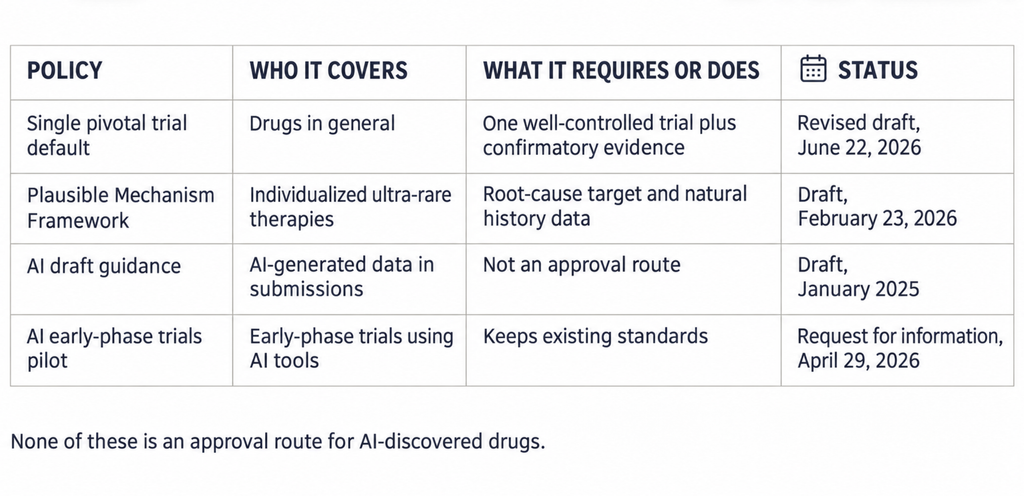
No approval pathway rewards a drug for having been found by AI. FDA’s January 2025 draft guidance, not final as of November 2026, covers AI-generated data used in regulatory decisions [FDA, AI for Drug Development, 2026]. The agency says it reviewed over 500 submissions with AI components from 2016 to 2023. In January 2026, FDA and EMA published 10 shared principles for good AI practice in drug development [FDA and EMA, Good AI Practice Principles, 2026]. On April 29, 2026, FDA asked for comments on a pilot that would use AI to make early-phase trials more efficient while keeping its standards [FDA, AI Early-Phase Trials Pilot RFI, 2026].
The larger changes to approval rules have come from outside AI. For ultra-rare genetic diseases, FDA released a draft Plausible Mechanism Framework on February 23, 2026 [HHS, Plausible Mechanism Framework, 2026]. It covers individualized therapies such as gene editing and antisense drugs. Sponsors must identify the disease-causing abnormality, target its root cause and rely on well-characterized natural history. They must also confirm that the drug hit its target and show clinical improvement. The framework still requires evidence of effectiveness, and relies on natural history data where randomized trials are not feasible.
FDA leadership proposed making one pivotal trial plus confirmatory evidence the general default. The proposal appeared in NEJM on February 18, 2026 [Prasad, One Pivotal Trial, 2026]. A revised draft guidance, not yet final, followed on June 22, 2026 [Arnold & Porter, Substantial Evidence Draft Guidance, 2026]. Single-trial approvals are already common: by one industry analysis, 66% of novel drug approvals in 2024 relied on one pivotal trial [Troutman, Single Pivotal Trial Default, 2026]. Former FDA drug center head Janet Woodcock said the shift could matter more for common diseases, since oncology and rare diseases already had single-trial flexibility [Applied Clinical Trials, FDA Removes Two-Study Requirement, 2026]. Critics said the policy came with too little explanation and that its post-market safeguards were thin [RAPS, Experts React to Single Pivotal Trials, 2026].
Trial size limits what a trial can show about rare side effects. Phase 3 trials enroll 300 to 3,000 participants [FDA, Step 3 Clinical Research, 2026]. If no case of a side effect appears among 3,000 people, the trial can only rule out, with 95% confidence, rates above about 1 per 1,000 [Hanley, Interpreting Zero Numerators, 1983]. Ruling out 1 in 10,000 needs about 30,000 participants.
In the author’s view, the ultra-rare framework’s weight on mechanism could suit AI tools that find targets, although it covers only individualized genetic therapies such as gene editing.
For chronic drugs, the author sees more risk. Phase 1 rates so far give no sign that AI-made molecules are riskier, but such small, short trials cannot exclude rare harms. Crowding on known targets is mainly a business risk for sponsors. The larger safety risk comes when three conditions combine: a new target with little prior human data, long-term use by many patients, and approval on a single trial.
Two scenarios and the signals to watch
In the bull case, the phase 1 advantage carries into phase 2 as samples grow. Zasocitinib wins approval in early 2027, rentosertib’s phase 3 shows a benefit over 52 weeks, and Isomorphic doses its first patient.
In the bear case, thinner evidence and faster timelines combine without any company breaking the rules. Errors in AI-produced analysis are one route. In July 2025, three current and former FDA staff told CNN that the agency’s Elsa tool had invented or misstated studies, a claim HHS disputed [Engadget, FDA Elsa Hallucinates Studies, 2025].
Funding is another route: Oliver Wyman warns that more programs reaching costly phase 2 and pivotal trials may outrun sponsors’ funding [Oliver Wyman, AI Investment Brings Results, 2026]. In the author’s view, a loose “AI-discovered” label is a third route, because a failure in one program would hurt trust in unrelated ones.
Severe, unexpected harms in first-in-human trials have also occurred with drugs unrelated to AI. In 2006, all six healthy volunteers given TGN1412 became critically ill, and all survived [Suntharalingam, TGN1412 Cytokine Storm, 2006]. In 2016, one volunteer in the BIA 10-2474 trial became brain dead, after 84 earlier volunteers had no severe events [Kerbrat, BIA 10-2474 Neurologic Disorder, 2016]. In the author’s view, a similar event with a heavily promoted AI drug would damage trust in the whole field, whatever its cause.
Concrete tests over the next 12 to 18 months include the zasocitinib decision, more phase 2 readouts for AI-made molecules, Isomorphic’s first human trial and rentosertib’s phase 3 progress. For clinicians, the evidence that counts will come from the same controlled trials used for every other drug. FDA is now redrafting the approval rules for those trials, through policies that apply however a drug was found.
Key Takeaways
- Isomorphic Labs raised $5 billion in November 2026, its third large round since 2025, before testing any of its own drugs in people.
- Estimated AI time savings fall mostly before human trials, and the author’s rough calculation suggests the whole path could shorten by about 10% to 25%.
- Analyses report higher phase 1 rates for AI programs and conflicting phase 2 results, and 8 of 117 tracked assets had completed phase 2 by December 2025.
- No drug widely described as AI-discovered has full FDA approval, and the company that discovered the leading candidate would not call it the first AI-approved drug.
- FDA has no approval route specific to AI-discovered drugs, and its draft single-trial default and ultra-rare framework apply however a drug was found.
- With zero cases among 3,000 patients, a trial can only rule out side effects more common than about 1 per 1,000. The author sees this as most relevant for chronic drugs approved on one trial.
FAQ
Has any AI-discovered drug been approved by the FDA?
No. As of November 2026, no drug widely described as AI-discovered has full FDA approval. The nearest candidate is zasocitinib for moderate-to-severe plaque psoriasis, with a decision expected in the first quarter of 2027 [Takeda, Zasocitinib Priority Review, 2026]. Nimbus scientists found it with machine learning and physics-based calculations, and Nimbus’s head of R&D would not call it the first AI-approved drug.
Does AI shorten drug development?
Probably, and mostly before human trials, although most figures are projections or company reports. A BCG and Wellcome report modelled savings of about 25–50% up to the preclinical stage [Rodriguez, Unlocking the Potential of AI in Drug Discovery, 2023]. Savings inside trials are smaller, from about 10 weeks to as much as 12 months. Combined, the author’s rough calculation suggests the whole path could shorten by about 10% to 25%.
Are AI-designed drugs more likely to succeed in clinical trials?
Possibly in phase 1, but phase 2 results conflict. Three analyses report phase 1 rates above the 52.0% industry figure. For phase 2, one consulting analysis found 45% against 28.9% in separate industry data, from 46 programs, while IQVIA found rates on par with non-AI peers [Oliver Wyman, AI Investment Brings Results, 2026; Roland, IQVIA Global R&D Trends 2026, 2026].
Is there a fast-track approval pathway for AI-discovered drugs?
No. FDA has no pathway specific to AI-discovered drugs, and the same evidence standards apply to them. Its January 2025 draft guidance covers how AI-generated data are used in regulatory decisions [FDA, AI for Drug Development, 2026]. The flexibility proposed in 2026, still in draft, covers individualized ultra-rare therapies and a single-trial default.
References
- Isomorphic Labs. Isomorphic Labs announces $5 Billion Series C funding [press release]. London: Isomorphic Labs; 2026 Nov 17. Available from: https://technode.global/?p=997987
- City AM. Isomorphic Labs raises $5bn in one of UK tech’s biggest funding rounds. City AM. 2026 Nov.
- Takeda. U.S. FDA accepts New Drug Application under Priority Review for Takeda’s zasocitinib in moderate-to-severe plaque psoriasis [press release]. 2026 Sep 14. Available from: https://www.takeda.com/newsroom/newsreleases/2026/fda-priority-review-zasocitinib-psoriasis/
- Hong J. AI clinical trials: what AI is actually replacing in drug development. CuriousMD. 2026 Oct 4. Available from: https://curiousmd.com/ai-clinical-trials-what-ai-replaces/
- Fierce Biotech. Isomorphic Labs raises $5B series C months after $2.1B round. Fierce Biotech. 2026 Nov. Available from: https://www.fiercebiotech.com/biotech/isomorphic-labs-raises-5b-series-c-months-after-21b-round
- STAT. Isomorphic Labs drugmaking. Boston Globe. 2026 Oct 21. Available from: https://www.bostonglobe.com/2026/10/21/business/isomorphic-labs-drugmaking/
- Deloitte China. Deloitte China assists listing of InSilico Medicine on SEHK [press release]. 2025 Dec. Available from: https://www.deloitte.com/cn/en/about/press-room/deloitte-china-assists-listing-of-insilico-medicine-on-sehk.html
- The Star. Insilico rockets on debut amid AI-biotech rally. The Star. 2025 Dec 31. Available from: https://www.thestar.com.my/business/business-news/2025/12/31/insilico-rockets-on-debut-amid-ai-biotech-rally
- PharmCube. Insilico Medicine lists on HKEX in 2025’s largest biotech IPO. PharmCube. 2025 Dec 31. Available from: https://global.pharmcube.com/news/detail/61e775bf57a04902b72a146202ccef9e
- StockAnalysis. RXRX statistics and XBI overview [Internet]. 2026 [cited 2026 Nov]. Available from: https://stockanalysis.com/stocks/rxrx/statistics/ and https://stockanalysis.com/etf/xbi/
- TechCrunch. Founded by DeepMind alumnus, Latent Labs launches with $50M to make biology programmable. TechCrunch. 2025 Feb 12. Available from: https://techcrunch.com/2025/02/12/founded-by-deepmind-alumnus-latent-labs-launches-with-50m-to-make-biology-programmable
- TechCrunch. Nobel laureate John Jumper is leaving DeepMind for rival Anthropic. TechCrunch. 2026 Jun 20. Available from: https://techcrunch.com/2026/06/20/nobel-laureate-john-jumper-is-leaving-deepmind-for-rival-anthropic
- The Decoder. DeepMind dismantles its AlphaFold team as key authors leave for Anthropic. The Decoder. 2026 Jul 29. Available from: https://the-decoder.com/deepmind-dismantles-its-alphafold-team-as-key-authors-leave-for-anthropic/
- SiliconANGLE. Anthropic takes aim at biotech with Claude for Life Sciences. SiliconANGLE. 2025 Oct 20. Available from: https://siliconangle.com/2025/10/20/anthropic-takes-aim-biotech-claude-life-sciences/
- TechCrunch. Anthropic’s Claude Science bets on workflow, not a new model, to win over scientists. TechCrunch. 2026 Jun 30. Available from: https://techcrunch.com/2026/06/30/anthropics-claude-science-bets-on-workflow-not-a-new-model-to-win-over-scientists/
- MIT Technology Review. Claude Science is Anthropic’s newest flagship product. MIT Technology Review. 2026 Jun 30. Available from: https://www.technologyreview.com/2026/06/30/1139987/claude-science-is-anthropics-newest-flagship-product/
- WTOP. AI giant Anthropic creates drug research tool, plans its own studies for overlooked diseases. WTOP. 2026 Jul. Available from: https://wtop.com/artificial-intelligence/2026/07/can-ai-come-up-with-cures-to-diseases-often-overlooked/
- MedCity News. Anthropic rolls out Claude Science for pharma researchers. MedCity News. 2026 Jun. Available from: https://medcitynews.com/2026/06/anthropic-pharma-healthcare/
- Thomas D, Chancellor D, Micklus A, et al. Clinical development success rates and contributing factors 2011–2020. Biotechnology Innovation Organization, Informa Pharma Intelligence, QLS Advisors; 2021. Available from: https://go.bio.org/rs/490-EHZ-999/images/ClinicalDevelopmentSuccessRates2011_2020.pdf
- Nature. Is AI starting to accelerate drug discovery? Nature. 2023. Available from: https://www.nature.com/articles/d41586-023-03172-6
- Rodriguez A, Meier C, Serazin E, et al. Unlocking the potential of AI in drug discovery. Boston Consulting Group; Wellcome; 2023. Available from: https://www.bcg.com/publications/2023/unlocking-the-potential-of-ai-in-drug-discovery
- Zulhusni M. How AI is shortening drug discovery timelines in China. AI News. 2026 Jul 27. Available from: https://www.artificialintelligence-news.com/news/ai-drug-discovery-china/
- Ren F, Aliper A, Chen J, et al. A small-molecule TNIK inhibitor targets fibrosis in preclinical and clinical models. Nat Biotechnol. 2025;43(1):63-75.
- McKinsey & Company. Agentic AI: unlocking peak performance in biopharma development. 2025 Dec 11. Available from: https://www.mckinsey.com/industries/life-sciences/our-insights/the-synthesis/agentic-ai-unlocking-peak-performance-in-biopharma-development
- Axios. AI brings savings to clinical trials: study. Axios. 2026 Aug 12. Available from: https://axios.com/2026/08/12/ai-clinical-trials-cost-savings
- McKinsey & Company. From linear gates to learning loops: rewiring biopharma R&D with AI. 2026 Jun 29. Available from: https://www.mckinsey.com/industries/life-sciences/our-insights/from-linear-gates-to-learning-loops-rewiring-biopharma-r-and-d-with-ai
- FDA. Adequate and well-controlled studies. 21 CFR § 314.126. Current as of 2026. Available from: https://www.law.cornell.edu/cfr/text/21/314.126
- Jayatunga MKP, Ayers M, Bruens L, Jayanth D, Meier C. How successful are AI-discovered drugs in clinical trials? A first analysis and emerging lessons. Drug Discov Today. 2024;29(6):104009.
- Roland A. IQVIA Institute’s Global R&D Trends 2026 report finds credible signal on AI-enabled programs. IQVIA. 2026 May 14. Available from: https://www.iqvia.com/blogs/2026/05/iqvia-institutes-global-r-and-d-trends-2026-report-finds-credible-signal-on-ai-enabled-programs
- Oliver Wyman. Biopharma’s AI investment brings results and new challenges. Oliver Wyman. 2026 Oct. Available from: https://www.oliverwyman.com/our-expertise/perspectives/health/2026/oct/biopharma-ai-drug-development-challenges.html
- Haque W, Sai-Palm K, Kasparcova M, et al. Clinical-stage AI-enabled therapeutic assets: an industry-wide analysis of scale, clinical progression, and company characteristics. J Clin Oncol. 2026;44(16 suppl):11072.
- Pecci A. Nimbus, Takeda and the AI behind zasocitinib. PharmaVoice. 2026 Sep 25. Available from: https://www.pharmavoice.com/news/nimbus-takeda-zasocitinib-ai-drug-discovery/831289/
- Xu Z, Ren F, Wang P, et al. A generative AI-discovered TNIK inhibitor for idiopathic pulmonary fibrosis: a randomized phase 2a trial. Nat Med. 2025;31(8):2602-2610.
- Insilico Medicine. Insilico Medicine doses first patient in GENESIS-IPF-3 [press release]. 2026 Sep 9. Available from: https://www.prnewswire.com/news-releases/insilico-medicine-doses-first-patient-in-genesis-ipf-3-the-worlds-first-phase-iii-trial-of-a-generative-ai-driven-innovative-drug-302873749.html
- FDA. Artificial intelligence for drug development [Internet]. Center for Drug Evaluation and Research; 2026. Available from: https://www.fda.gov/about-fda/center-drug-evaluation-and-research-cder/artificial-intelligence-drug-development
- FDA and EMA. Guiding principles of good AI practice in drug development. 2026 Jan. Available from: https://www.fda.gov/media/189581/download
- FDA. AI-enabled optimization of early-phase clinical trials pilot; request for information. Fed Regist. 2026 Apr 29;91(82):23100-23102. Available from: https://www.govinfo.gov/content/pkg/FR-2026-04-29/html/2026-08281.htm
- HHS. FDA launches framework for accelerating development of individualized therapies for ultra-rare diseases [press release]. 2026 Feb 23. Available from: https://www.hhs.gov/press-room/fda-launches-framework-accelerating-development-individualized-therapies-ultra-rare-diseases.html
- Prasad V, Makary MA. One pivotal trial, the new default option for FDA approval — ending the two-trial dogma. N Engl J Med. 2026;394(8):815-817.
- Arnold & Porter. FDA issues revised draft guidance on demonstrating substantial evidence of effectiveness for human drugs and biological products. 2026 Jun 24. Available from: https://www.arnoldporter.com/en/perspectives/advisories/2026/06/fda-issues-revised-draft-guidance-on-demonstrating-substantial-evidence-of-effectiveness
- Troutman Pepper Locke. FDA announces a single pivotal trial as the new default standard for all drug approvals. 2026 Apr 15. Available from: https://www.troutman.com/insights/fda-announces-a-single-pivotal-trial-as-the-new-default-standard-for-all-drug-approvals-and-unveils-a-plausible-mechanism-framework-for-individualized-therapies/
- Applied Clinical Trials. FDA removes two-study requirement for new drug approval process. 2026 Feb 19. Available from: https://www.appliedclinicaltrialsonline.com/view/fda-removes-two-study-requirement-new-drug-approval-process
- RAPS. Experts react to FDA’s shift to single pivotal trials for most drugs. Regulatory Focus. 2026 Feb 18. Available from: https://www.raps.org/resource/experts-react-to-fda-s-shift-to-single-pivotal-tri.html
- FDA. Step 3: Clinical research [Internet]. Silver Spring (MD): U.S. Food and Drug Administration; 2026. Available from: https://www.fda.gov/patients/drug-development-process/step-3-clinical-research
- Hanley JA, Lippman-Hand A. If nothing goes wrong, is everything all right? Interpreting zero numerators. JAMA. 1983;249(13):1743-1745.
- Engadget. FDA employees say the agency’s Elsa generative AI hallucinates entire studies. Engadget. 2025 Jul 23. Available from: https://www.engadget.com/ai/fda-employees-say-the-agencys-elsa-generative-ai-hallucinates-entire-studies-203547157.html
- Suntharalingam G, Perry MR, Ward S, et al. Cytokine storm in a phase 1 trial of the anti-CD28 monoclonal antibody TGN1412. N Engl J Med. 2006;355(10):1018-1028.
- Kerbrat A, Ferré JC, Fillatre P, et al. Acute neurologic disorder from an inhibitor of fatty acid amide hydrolase. N Engl J Med. 2016;375(18):1717-1725.
Joonpyo Hong, MD is a board-certified otolaryngologist practicing in Korea. This article reflects his clinical interpretation of published research and does not constitute individual medical advice. This article is not intended to advertise or promote any specific company or product.
For more articles:
https://curiousmd.com/ai-clinical-trials-what-ai-replaces/
https://curiousmd.com/why-small-cap-biotech-investing-is-hard/
https://curiousmd.com/ai-medical-device-approval-us-eu-korea/
Link out to:
FDA: Step 3, Clinical Research: FDA’s plain-language guide to the phases of clinical research.
FDA: Artificial Intelligence for Drug Development: FDA’s hub on AI guidance and principles in drug development.
HHS: Plausible Mechanism Framework for ultra-rare diseases: FDA’s draft framework for individualized ultra-rare therapies.
Oliver Wyman: AI-enabled drug programs and success rates: Analysis of clinical success rates for AI-enabled drug programs.
IQVIA Institute: Global R&D Trends 2026: IQVIA’s look at success rates of AI-enabled programs.
MIT Technology Review: Claude Science launch: Independent report on Anthropic’s science workbench.