
Casgevy was approved in December 2023, the first approved CRISPR therapy cleared anywhere in the world. Most of the coverage stopped at the approval itself. Three years on there are numbers instead of predictions, and they complicate both the celebration and the backlash.
What CRISPR is, and where it came from
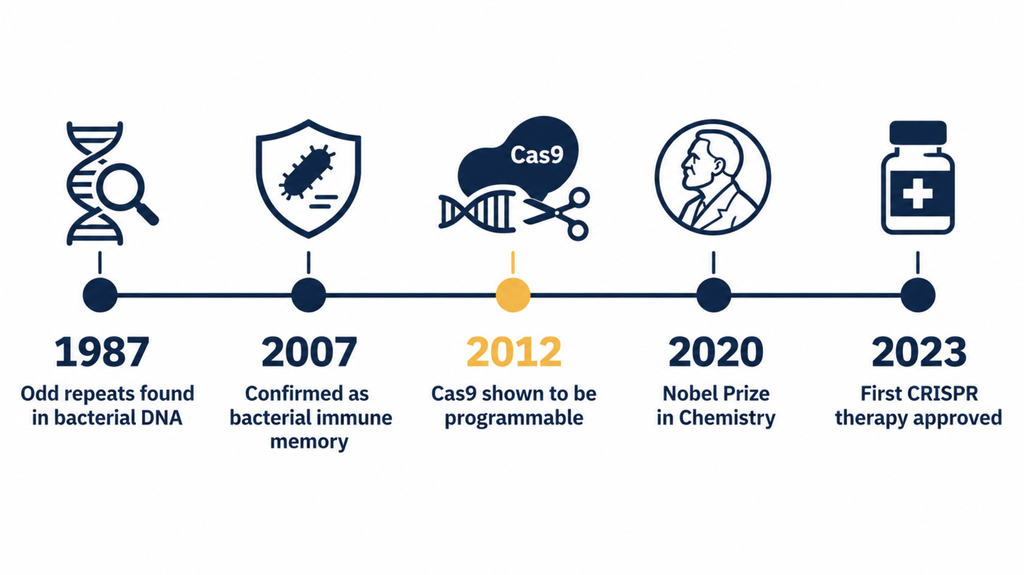
CRISPR started as a curiosity in bacterial genomes. Researchers in the late 1980s noticed odd repeating sequences in E. coli DNA with no obvious purpose. It took nearly two decades to work out what they were: a bacterial immune memory. When a virus attacks, the bacterium files away a fragment of the invader’s DNA between those repeats. If the same virus comes back, the bacterium uses the stored fragment as a search string to find and cut the viral genome.
Biology became technology in 2012. Working with Streptococcus pyogenes, a team showed the system could be reduced to two parts: a guide RNA that specifies an address in the genome, and the Cas9 protein that cuts there. The guide can be engineered to point anywhere the researcher chooses [Jinek, A programmable dual-RNA-guided DNA endonuclease in adaptive bacterial immunity, 2012]. Write a new address and the same molecular scissors cut somewhere else.
The practical consequence was speed. Earlier gene-editing tools existed, but each new target meant a months-long protein engineering project. With CRISPR, changing the target means synthesizing a different short strand of RNA. Emmanuelle Charpentier and Jennifer Doudna received the 2020 Nobel Prize in Chemistry for developing the method, eight years after the paper. By Nobel standards that is close to instantaneous.
What medicine expected from it
Several thousand diseases have been traced to a defect in a single gene. For nearly all of them, medicine has only ever offered management: transfusions, enzyme replacement, dietary restriction, symptom control, repeated for a lifetime. A tool that corrected the causative sequence would be repair rather than maintenance.
So the expectations were that single-gene diseases with no disease-modifying option would become treatable, that treatment could be one-time instead of lifelong, and that pointing the platform at a new disease would become an engineering problem rather than a discovery problem.
Casgevy is the first case where those expectations meet a market instead of a trial.
What the first approved CRISPR therapy actually does
Casgevy (exagamglogene autotemcel) treats sickle cell disease and transfusion-dependent beta thalassemia, two conditions caused by defects in adult hemoglobin.
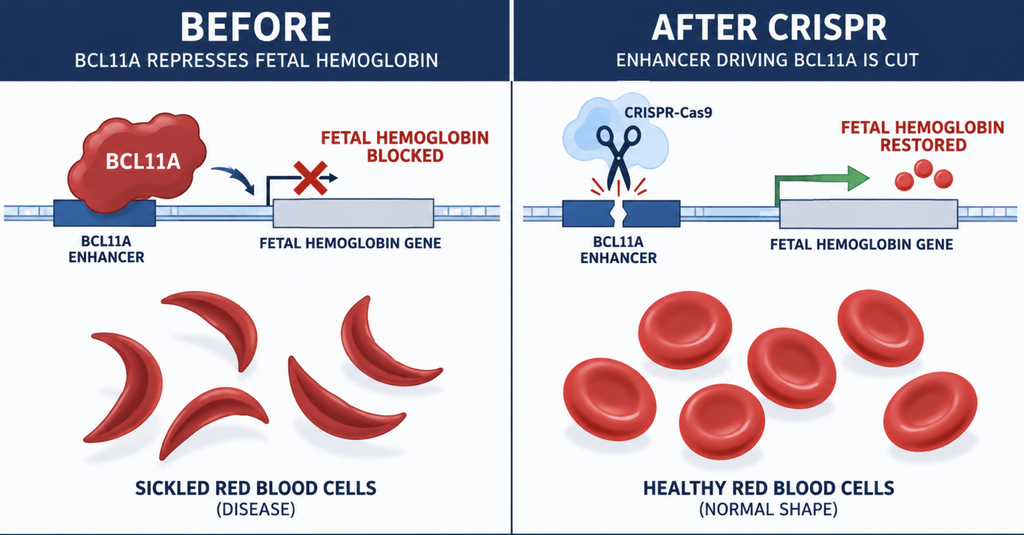
It does not repair the defective hemoglobin gene. It works around it. Everyone produces fetal hemoglobin before birth and switches it off shortly after, under the control of a repressor called BCL11A. Casgevy uses CRISPR-Cas9 to disable the enhancer that drives BCL11A in red cell precursors. With the brake off, fetal hemoglobin returns and substitutes for the defective adult version.
The pivotal results were substantial. Of the sickle cell patients with sufficient follow-up, 29 of 30 (97%) went at least 12 consecutive months without a severe vaso-occlusive crisis [Frangoul, Exagamglogene Autotemcel for Severe Sickle Cell Disease, 2024]. In transfusion-dependent beta thalassemia, 32 of 35 evaluable patients (91%) achieved transfusion independence [Locatelli, Exagamglogene Autotemcel for Transfusion-Dependent β-Thalassemia, 2024]. For diseases defined by recurring crises and standing transfusion schedules, that is a large change.
The 2026 numbers
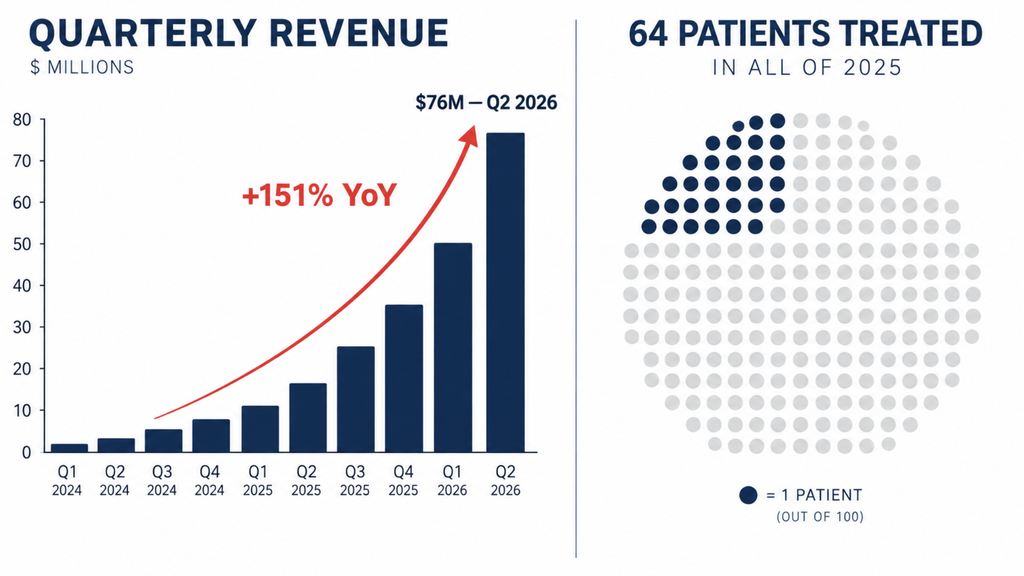
Casgevy generated $76 million in revenue in the second quarter of 2026, up 78% from the previous quarter and 151% from the same quarter a year earlier. The FDA also expanded the label to children as young as 2, which made roughly 5,500 additional patients eligible for the first time.
| At approval (Dec 2023) | Q2 2026 | |
|---|---|---|
| Eligible age | 12 and older | 2 and older |
| Newly eligible patients | ~5,500 added | |
| Quarterly revenue | $0 | $76 million |
| Year-over-year growth | +151% |
Why 151% growth is still a small number
The absolute numbers stay small. Across all of 2025, 64 patients received Casgevy, nearly half of them in the final quarter. The growth looks steep because the base is very low.
Price is the obvious explanation, and it is increasingly the wrong one. CRISPR Therapeutics reported at the start of 2026 that 90% of eligible U.S. patients have access to reimbursed Casgevy. On the public side, 34 Medicaid programs (32 states plus the District of Columbia and Puerto Rico) have joined a federal outcomes-based access model in which manufacturers rebate part of the cost if the therapy underdelivers. Reimbursement is largely solved. What remains is the procedure.
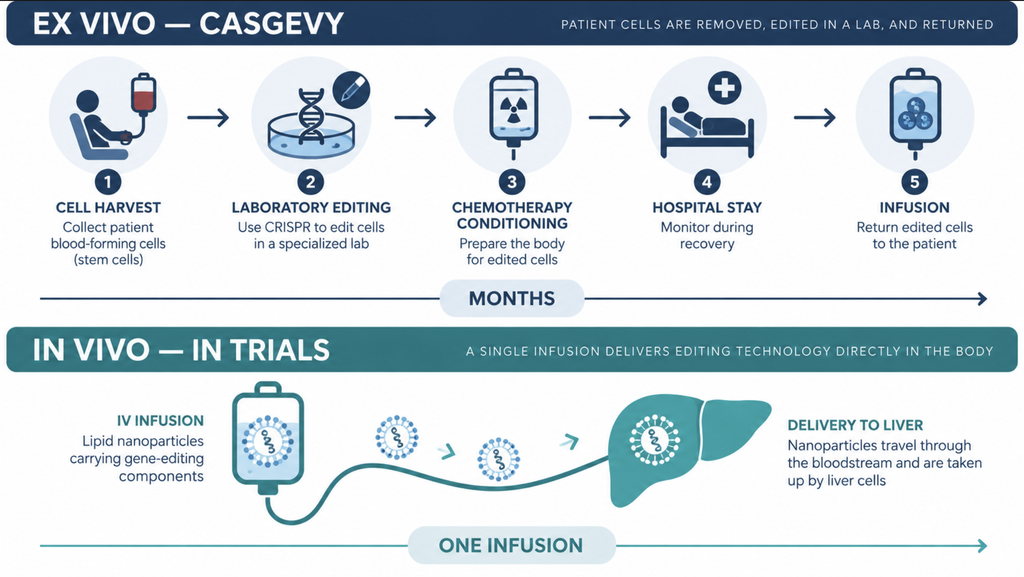
Casgevy is described as a one-time treatment, which is accurate about the editing and misleading about the process. Patients have stem cells harvested, then undergo myeloablative busulfan conditioning: chemotherapy that destroys the existing marrow so edited cells can engraft. The published trials carried a safety profile consistent with myeloablative conditioning and autologous transplantation, because that is essentially what the procedure is [Frangoul, Exagamglogene Autotemcel for Severe Sickle Cell Disease, 2024].
There is a further cost that rarely appears in the coverage. Myeloablative conditioning typically renders patients infertile, male or female, which is why the federal access model obliges participating manufacturers to cover fertility preservation services along with the travel and lodging that go with them. A one-time cure that requires banking gametes first is a different proposition than the phrase suggests.
Manufacturing is its own constraint. Editing a patient’s own cells requires highly specialized facilities, and there are not many of them. A patient needs months of preparation, an extended inpatient stay, and access to one of those centers. None of that is solved by a payer saying yes.
From ex vivo to in vivo
Casgevy is ex vivo: cells are removed, edited in a facility, and returned. In vivo editing delivers the machinery into the body directly, usually via lipid nanoparticles that accumulate in the liver, which avoids the harvest, the chemotherapy and the transplant unit entirely. That may turn out to be the more consequential development, and it is getting less attention.
CRISPR Therapeutics now has three such candidates in Phase 1 trials: CTX310 targeting ANGPTL3 for severe hypertriglyceridemia and refractory hypercholesterolemia, CTX340 targeting angiotensinogen for refractory hypertension, and CTX460 for alpha-1 antitrypsin deficiency. The targets have moved from rare hematologic disease toward conditions that fill general practice waiting rooms.
The same approach has been used at the far end of the rarity spectrum. A customized base-editing therapy was designed, manufactured, cleared by regulators and infused into an infant with carbamoyl-phosphate synthetase 1 deficiency, allowing increased dietary protein and a halved nitrogen-scavenger dose within seven weeks, with no serious adverse events reported [Musunuru, Patient-Specific In Vivo Gene Editing to Treat a Rare Genetic Disease, 2025]. One patient, short follow-up. But it shows the retargeting step can be measured in months.
Clinical perspective
The Casgevy revenue curve reads better as a measure of access than as a business result. Each dollar corresponds to a patient who found a transplant center, tolerated myeloablative conditioning, and got a payer to agree. The curve is rising steeply and still tracing a very small number of people. Most of the remaining work sits between approval and the patient actually being treated.
There is a second reason to pay attention outside hematology. As long as gene editing meant harvesting stem cells and conditioning marrow, it belonged to transplant medicine. Once the target list includes hypertension and lipid disorders delivered by infusion, it stops being a subspecialty topic. Those trials are Phase 1 and may not read out well, but the direction is worth tracking now.
Key takeaways
- Casgevy is the first approved CRISPR-based therapy, treating sickle cell disease and transfusion-dependent beta thalassemia by reactivating fetal hemoglobin.
- In pivotal trials, 97% of evaluable sickle cell patients were free of severe vaso-occlusive crises for at least 12 months, and 91% of beta thalassemia patients achieved transfusion independence.
- Casgevy revenue reached $76 million in the second quarter of 2026, up 151% year over year, and the FDA expanded eligibility to children as young as 2.
- Only 64 patients received Casgevy during all of 2025, while roughly 90% of eligible U.S. patients now have reimbursed access, which points to the procedure rather than payment as the remaining barrier.
- Myeloablative conditioning typically causes infertility, and the federal access model requires manufacturers to fund fertility preservation for patients receiving the therapy.
- Treatment requires myeloablative chemotherapy, an extended inpatient stay, and specialized manufacturing, which constrains real-world access more than the $2.2 million list price does.
- CRISPR Therapeutics has three in vivo editing candidates in Phase 1 trials targeting hypertriglyceridemia, refractory hypertension, and alpha-1 antitrypsin deficiency.
FAQ
How much does Casgevy cost? The U.S. list price is $2.2 million for a single course of treatment. That figure excludes the associated hospital costs, since stem cell collection, myeloablative conditioning, and an extended inpatient stay all add to the total. What payers actually pay differs: 34 Medicaid programs (32 states plus the District of Columbia and Puerto Rico) have joined a federal model under which manufacturers rebate a portion if the therapy does not deliver the agreed outcomes.
How many patients have received Casgevy? 64 patients received Casgevy during 2025, nearly half of them in the final quarter. A cumulative global figure has not been published, but the trajectory is clear: uptake was slow through 2024, accelerated through 2025, and reached $76 million in quarterly revenue by the second quarter of 2026. The running total remains in the low hundreds rather than the thousands.
Is Casgevy a cure for sickle cell disease? It eliminated severe vaso-occlusive crises in 97% of evaluable patients for at least 12 months, which is the strongest published result to date. Whether that constitutes a cure depends on durability over decades, and follow-up so far is measured in a few years. The edit itself is permanent in the treated stem cells.
What is the difference between ex vivo and in vivo gene editing? Ex vivo editing removes a patient’s cells, edits them in a laboratory, and returns them, which requires chemotherapy to clear space for the edited cells. In vivo editing delivers the machinery into the body directly, typically by infusion, avoiding both the harvest and the conditioning.
Can CRISPR treat common conditions like high blood pressure? Trials have begun, but nothing is proven. CTX340, an in vivo candidate targeting angiotensinogen for refractory hypertension, is in Phase 1, the stage that assesses safety and dosing rather than effectiveness. Results are years away.
References
- Jinek M, Chylinski K, Fonfara I, Hauer M, Doudna JA, Charpentier E. A programmable dual-RNA-guided DNA endonuclease in adaptive bacterial immunity. Science. 2012;337(6096):816-21.
- Frangoul H, Locatelli F, Sharma A, et al. Exagamglogene autotemcel for severe sickle cell disease. N Engl J Med. 2024;390(18):1649-1662.
- Locatelli F, Lang P, Wall D, et al. Exagamglogene autotemcel for transfusion-dependent β-thalassemia. N Engl J Med. 2024;390(18):1663-1676.
- Musunuru K, Grandinette SA, Wang X, et al. Patient-specific in vivo gene editing to treat a rare genetic disease. N Engl J Med. 2025;392(22):2235-2243.
Commercial and regulatory figures are drawn from CRISPR Therapeutics’ second quarter 2026 business update. Medicaid access model participation figures are from the Centers for Medicare & Medicaid Services.
Joonpyo Hong, MD is a board-certified otolaryngologist practicing in Korea. This article reflects his clinical interpretation of published research and does not constitute individual medical advice.
For more articles:
https://curiousmd.com/ai-virtual-contrast-enhancement/
https://curiousmd.com/intismeran-autogene-melanoma-phase-3-explained/
https://curiousmd.com/depression-nasal-spray-esketamine/
Link out to:
CMS — Cell and Gene Therapy Access Model — https://www.cms.gov/priorities/innovation/innovation-models/cgt The federal program’s own page, with the current list of participating Medicaid programs and the fertility-preservation requirement.
CMS — CMS Expands Access to Lifesaving Gene Therapies Through Innovative State Agreements — https://www.cms.gov/newsroom/press-releases/cms-expands-access-lifesaving-gene-therapies-through-innovative-state-agreements The announcement explaining how outcomes-based agreements work and which states signed on.
Innovative Genomics Institute — CRISPR Clinical Trials: A 2026 Update — https://innovativegenomics.org/news/crispr-clinical-trials-2026/ A trial-by-trial survey of CRISPR medicine, including Casgevy uptake figures and the in vivo programs now entering the clinic.