
On August 25, 2026, Boston Scientific lost access to its own systems. It was a medical device cyberattack event. The company is one of the world’s largest makers of pacemakers, defibrillators, and neurostimulators, and not a single implanted device was compromised. Procedures were postponed anyway. An Irish manufacturing plant sent its workers home, and two weeks later the company told investors it would miss its annual sales and earnings guidance.
The company has since recovered. Manufacturing, order fulfillment, and shipping were restored as of September 9, and independent assessments by CrowdStrike and other firms reported no evidence of compromise to product development systems, product software, manufacturing and device maintenance systems, or cloud platforms. Remote monitoring activations have resumed.
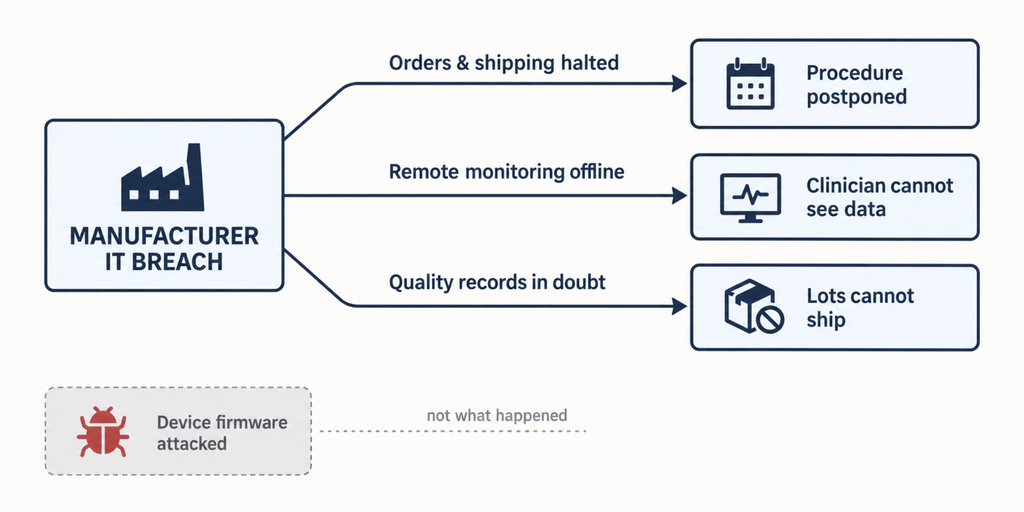
That is a good outcome, and the two weeks in between are still worth looking at. They exposed three routes by which an attack on a manufacturer reaches a patient, none of which requires anyone to touch a device.
Why “device hacking” is the wrong threat model
Public understanding of this problem was shaped by fiction. In 2012, an episode of Homeland killed the Vice President by remotely reprogramming his implantable cardioverter-defibrillator to deliver a fatal shock. Around the same time, security researchers demonstrated wireless attacks on insulin pumps. That image stuck.
Regulators have largely worked inside the same frame. A content analysis of FDA cybersecurity safety communications issued between 2013 and 2025 identified 18 such alerts, of which 94% described high-risk vulnerabilities. The most common concerns were unauthorized remote access to devices, device malfunction, and exposure of patient data [Menon, Cybersecurity breaches in medical devices: analyzing FDA safety communications in response to patient security concerns, 2026]. Every one of those categories describes something happening to the device.
The August 2026 incident did none of that. What went down was the enterprise layer: the operating systems and business software that let a manufacturer take an order, build a product, and put it on a truck. The devices were fine. Manufacturing and distribution, which is how those devices reach an operating room, were not.
This matters because of a property specific to medical devices. You cannot substitute them at the last minute. A hospital facing a shortage of surgical gloves buys a different brand. A hospital facing a shortage of a particular defibrillation lead does not.
The implanting physician selected that system. The patient’s generator is compatible with that manufacturer’s leads, the programmer in the electrophysiology lab speaks that manufacturer’s protocol, and the procedure was planned around all of it. So when one manufacturer goes dark, its share of scheduled procedures does not get redistributed to competitors. Those procedures queue.
This kind of harm is also close to invisible to our measurement systems. A postponed generator replacement does not appear in a mortality statistic, a cancelled ablation does not generate an adverse event report, and no recall database has a field for a procedure that simply never happened on the day it was supposed to.
Evidence from the adjacent case, attacks on hospitals themselves, is not reassuring. When a ransomware attack took a large San Diego health system offline for a month, a neighboring, untargeted academic emergency department saw daily census rise, patients leaving without being seen more than double, median waiting room times lengthen, and confirmed strokes rise from 22 to 47 compared with the preceding month. The authors concluded that a targeted hospital cyberattack should be treated as a regional disaster [Dameff, Ransomware Attack Associated With Disruptions at Adjacent Emergency Departments in the US, 2023].
A companion analysis of the same event examined out-of-hospital cardiac arrests brought to those unaffected neighboring hospitals, and found that survival with favorable neurologic outcome fell from 40.0% before the attack to 4.5% during it, returning to 41.2% afterward [Pham, Ransomware Cyberattack Associated With Cardiac Arrest Incidence and Outcomes at Untargeted, Adjacent Hospitals, 2024]. Those percentages rest on 44 out-of-hospital arrests spread across three study phases, so the confidence intervals are wide and the finding should be read as a signal rather than an effect size.
A European cancer center offers the same lesson in a different specialty. After the 2021 Conti ransomware attack on Ireland’s health service, radiotherapy at Cork University Hospital was interrupted for 113 patients, with a median treatment gap of six days for the highest-priority category. Haematology and radiology capacity each fell by roughly 90% and biochemistry by 75%, histopathology reporting time doubled from 7 to 15 days, and backlogs were not cleared until day 210 [Keogh, Dealing with digital paralysis: Surviving a cyberattack in a National Cancer center, 2024].
The inferential distance is worth stating plainly. Those studies describe attacks on care delivery organizations, not on device manufacturers. A manufacturer sits one step further from the bedside, so the effect is diluted, delayed, and harder to attribute. That does not make it zero. It means nobody has built the instrument that would measure it.
The implant works. The monitoring doesn’t.
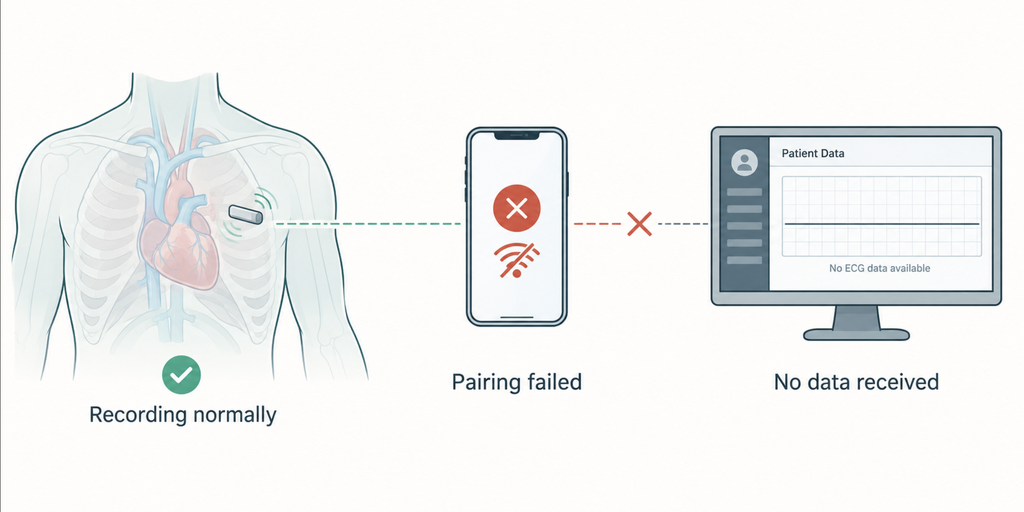
The most telling detail of the August outage was easy to miss. Existing implanted cardiac rhythm management devices were unaffected throughout. But for a period, newly implanted insertable cardiac monitors could not pair with the patient’s remote monitoring phone app, so recorded episode data would not reach the monitoring system until pairing could be completed. That capability was restored on September 9.
The structure behind that sentence is one most patients have never had described to them. The device in the chest works, and it records faithfully. For as long as the outage lasts, none of what it records reaches the clinician who would act on it.
Insertable cardiac monitors exist to catch arrhythmias that intermittent testing misses. In the CRYSTAL AF trial, patients with cryptogenic stroke who received an insertable monitor had atrial fibrillation detected in 12.4% of cases at 12 months versus 2.0% with conventional follow-up, a hazard ratio of 7.3 [Sanna, Cryptogenic stroke and underlying atrial fibrillation, 2014]. That trial measured detection rather than stroke recurrence, but detection carries therapeutic consequences: documented atrial fibrillation moves a patient from antiplatelet therapy toward anticoagulation under current guidelines.
The value of remote transmission specifically is the compression of time between an event and a physician seeing it. In the TRUST trial, which randomized 1,339 defibrillator patients to automatic daily home monitoring versus conventional follow-up, the median time from an arrhythmic event to physician evaluation was under two days with remote monitoring compared with 36 days without it, while total in-hospital device evaluations fell by 45% with no increase in morbidity [Varma, Efficacy and safety of automatic remote monitoring for implantable cardioverter-defibrillator follow-up: the Lumos-T Safely Reduces Routine Office Device Follow-up (TRUST) trial, 2010].
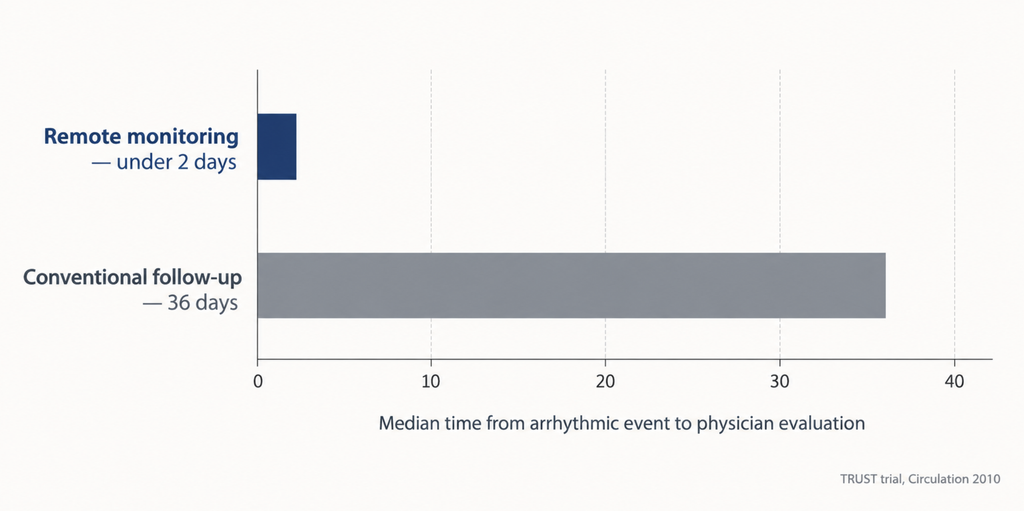
That interval, two days against thirty-six, is the entire clinical product of remote monitoring. When the manufacturer’s servers are unavailable the device does not fail. The interval simply widens back toward where it sat before remote monitoring existed. In-person interrogation at the clinic is a real and appropriate workaround, but it returns patients to exactly the model remote monitoring was invented to replace, and the burden falls hardest on the patients who benefit from remote care most: older, rural, and less mobile ones.
This is not a cardiology problem
Remote programming of cochlear implants is now well established. A study fitting 46 experienced implant users both locally and remotely found no significant difference in impedance field telemetry, threshold levels, maximum comfortable levels, audiometry, or speech understanding between the two methods, in children and adults alike [Schepers, Remote programming of cochlear implants in users of all ages, 2019]. That is a genuine gain in access. A family in a rural province no longer drives four hours for a mapping adjustment.
It is also the same dependency. A cochlear implant is an implanted device whose clinical usefulness is completed by a manufacturer-operated software channel. So is a CPAP machine whose adherence data flows to a manufacturer cloud that insurers consult to authorize continued coverage. The same is true of surgical navigation systems, deep brain stimulators, and continuous glucose monitors.
The relevant category is broader than cardiac devices. It is any device whose function runs from the patient into a company’s data center and back. Medicine adopted that arrangement for good clinical reasons and adopted it quickly, without asking what happens when the data center is unavailable for three weeks.
The regulatory gap nobody is minding
The FDA approves a device. The clinical trials establishing that device’s safety and effectiveness are frequently conducted under conditions where remote monitoring is functioning, which makes CRYSTAL AF and TRUST partly trials of the whole system rather than of hardware alone.
No meaningful regulatory requirement governs the availability of the manufacturer’s cloud infrastructure. There is no uptime standard, no required failover, no defined obligation to notify implanting clinicians when transmission stops. Pre-implantation consent discussions cover surgical risk, device longevity, and MRI compatibility. They do not contain a line reading: “remote surveillance may be suspended without notice if the manufacturer experiences an IT incident.” Perhaps they should.
Why recovery is so hard to finish
The third mechanism is the least discussed, and this incident happens to illustrate it by counterexample.
Medical device manufacturing runs inside a validated quality system under FDA regulation. Sterilization cycle records, lot genealogy, unique device identifiers, process parameters, and nonconformance histories are regulatory evidence rather than business records that happen to live on a server. They are the proof that a given device was made correctly, and the map that locates every patient who received a device from a given lot.
Recovery therefore has two phases, and only the first is about servers. Bringing a system back online is an IT task. Establishing that the data coming out of that system can still be trusted is a quality and regulatory task, and it is far harder.
Boston Scientific was spared the second phase. Independent assessments reported no evidence of compromise to manufacturing or medical device maintenance systems, which is why full operational restoration arrived in roughly two weeks rather than two quarters. The structural point is worth making anyway, precisely because of how close it came.
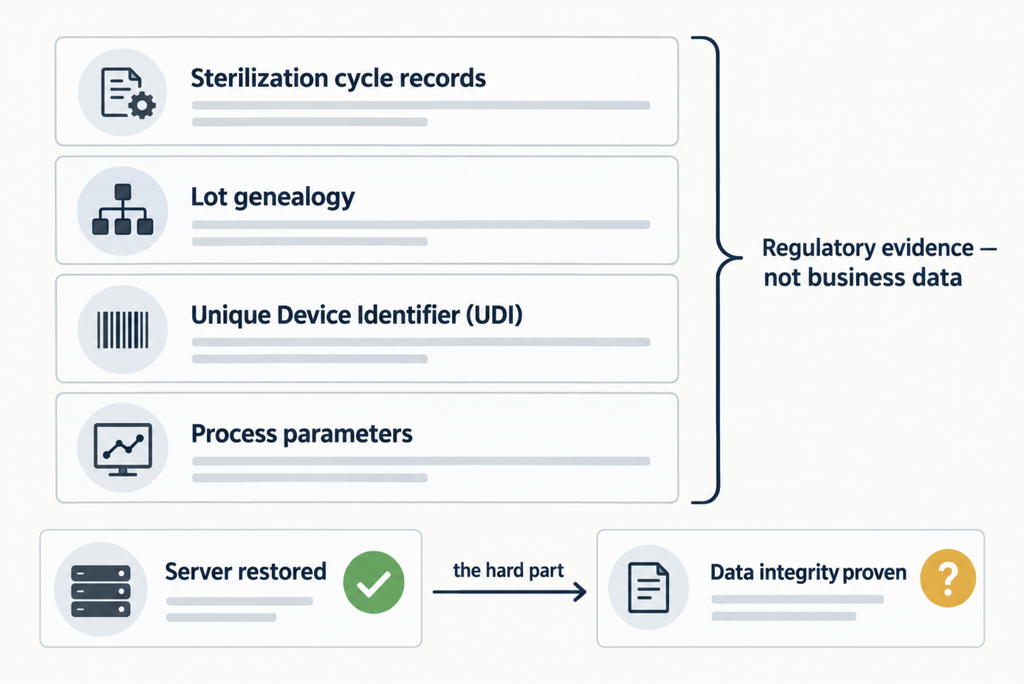
Had those systems been touched, the company would have faced a problem that backups do not solve. The strongest move available to an attacker in this setting is not deletion but doubt. Destroyed data can be restored. Data that might have been subtly modified cannot be, because you do not know what to restore it to.
The consequences follow directly. If there is a one percent chance a sterilization cycle record was edited, that lot does not ship. If lot traceability is uncertain, then three years from now, when a lead fracture recall is issued, the company may be unable to identify reliably which patients received which units. For implanted devices, that approaches catastrophic.
The harm is also latent. A quietly corrupted traceability record causes no symptom today and none next year. It causes a problem at the exact moment the record most needs to be correct.
This explains the economics as well. An attacker targeting a device manufacturer need not destroy anything or endanger anyone directly. They need only make downtime more expensive than the ransom. Because validated systems are structurally slow and costly to revalidate, medtech enters that negotiation with unusually weak leverage, and attackers in this space know it.
Clinical perspective
What I find hard to shake about this incident is not the attack. It is how little of our professional vocabulary fits the damage.
Medicine has well-developed language for device malfunction: recall procedures, adverse event reporting, a regulatory apparatus organized around the question did the device work? It has almost nothing for the question this outage actually raised, which is whether the device’s information reached the person who needed it.
Every specialty has quietly migrated onto this architecture. Remote cochlear implant mapping is now scheduled with the same routine ease as an office visit, and rightly so: the evidence supports it, and it serves patients who would otherwise go without. That decision should not be reversed. It does mean the field has been treating a commercial vendor’s uptime as though it were a law of nature, and that this dependency almost never appears in a consent discussion.
This incident resolved well. Operations came back in two weeks, the forensic findings were clean, and no patient harm has been reported. What that tells us is mostly about scale. A two-week outage at one manufacturer produced a guidance miss, an idled plant, and a gap in cardiac telemetry, and we have no instrument that would have detected the clinical cost if there had been one.
Connected implants have made care better. They have also created a failure mode that nobody monitors, nobody regulates, and nobody can currently measure.
Key takeaways
In the August 2026 Boston Scientific incident, already-implanted cardiac rhythm management devices were unaffected, while newly implanted insertable cardiac monitors temporarily could not pair with their remote monitoring apps; that capability was restored on September 9.
The principal route by which a medical device cyberattack reaches patients is disruption of manufacturing and shipping, not manipulation of devices.
Remote monitoring compresses the time from arrhythmic event to physician evaluation from a median of 36 days to under two days, so an outage removes the core clinical benefit even while the implant functions normally.
FDA regulation governs device approval but sets no meaningful availability requirement for the manufacturer-operated cloud infrastructure that connected implants depend on.
Recovery was fast in this case because forensic review found no evidence of compromise to manufacturing systems. Had those records been touched, proving their integrity would have taken far longer than restoring the servers.
FAQ
Can a medical device cyberattack harm my pacemaker?
Not directly, in the incidents reported to date. Implanted pacemakers and defibrillators deliver therapy independently of any network connection, and Boston Scientific confirmed that existing cardiac rhythm management devices were unaffected throughout its August 2026 outage. The realistic risks are indirect: delayed access to replacement devices or components, and temporary interruption of remote data transmission to the clinic.
What happens to remote cardiac monitoring during a manufacturer outage?
The device continues recording, but transmission to the clinic may stop. During the August 2026 incident, newly implanted monitors could not pair with the patient app, so episode data was recorded but not sent. In-person interrogation at the device clinic remained available throughout, and remote activation capability was restored on September 9.
Has any patient been harmed by a medical device manufacturer cyberattack?
No confirmed patient harm has been publicly reported from the August 2026 incident. That absence is worth interpreting carefully, because the health system has no surveillance mechanism that would reliably detect harm from a postponed procedure or a delayed telemetry transmission. Studies of ransomware attacks on hospitals have documented measurable effects on emergency and cancer care, but no equivalent study exists for manufacturer outages.
Why is recovery from a medical device cyberattack complicated?
Because device manufacturing runs inside FDA-regulated validated quality systems. Bringing servers back online is the fast part; demonstrating that sterilization records, lot traceability, and process data were never altered is a regulatory exercise that can take months. Boston Scientific avoided that path because forensic review found no evidence its manufacturing systems were compromised.
References
- Dameff C, Tully J, Chan TC, Castillo EM, Savage S, Maysent P, Hemmen TM, Clay BJ, Longhurst CA. Ransomware Attack Associated With Disruptions at Adjacent Emergency Departments in the US. JAMA Netw Open. 2023;6(5):e2312270.
- Pham TT, Loo TM, Malhotra A, Longhurst CA, Hylton D, Dameff C, Tully J, Wardi G, Sell RE, Pearce AK. Ransomware Cyberattack Associated With Cardiac Arrest Incidence and Outcomes at Untargeted, Adjacent Hospitals. Crit Care Explor. 2024;6(4):e1079.
- Keogh RJ, Harvey H, Brady C, Hassett E, Costelloe SJ, O’Sullivan MJ, et al. Dealing with digital paralysis: Surviving a cyberattack in a National Cancer center. J Cancer Policy. 2024;39:100466.
- Varma N, Epstein AE, Irimpen A, Schweikert R, Love C. Efficacy and safety of automatic remote monitoring for implantable cardioverter-defibrillator follow-up: the Lumos-T Safely Reduces Routine Office Device Follow-up (TRUST) trial. Circulation. 2010;122(4):325-32.
- Sanna T, Diener HC, Passman RS, Di Lazzaro V, Bernstein RA, Morillo CA, et al. Cryptogenic stroke and underlying atrial fibrillation. N Engl J Med. 2014;370(26):2478-86.
- Schepers K, Steinhoff HJ, Ebenhoch H, Böck K, Bauer K, Rupprecht L, et al. Remote programming of cochlear implants in users of all ages. Acta Otolaryngol. 2019;139(3):251-257.
- Menon V. Cybersecurity breaches in medical devices: analyzing FDA safety communications in response to patient security concerns. Front Digit Health. 2026;8:1701551.
Joonpyo Hong, MD is a board-certified otolaryngologist practicing in Korea. This article reflects his clinical interpretation of published research and does not constitute individual medical advice.
For more articles:
https://curiousmd.com/how-emotional-tts-works-ent-perspective/
https://curiousmd.com/ai-generated-laryngoscopy-images-study/
https://curiousmd.com/ai-speech-clarification-hearing-loss/
Link out to:
Boston Scientific — Update on recent cybersecurity incident https://news.bostonscientific.com/update-on-recent-cybersecurity-incident The company’s own running incident log, including archived daily updates from August 26 onward and the September 9 restoration announcement. Primary source for anything in this article about scope and recovery.
Medical Economics — When a device maker goes dark https://www.medicaleconomics.com/view/when-a-device-maker-goes-dark-what-the-boston-scientific-cyberattack-means-for-your-patients A physician-facing analysis of how a manufacturer outage propagates to the exam room, with useful comparison to the 2024 Change Healthcare disruption.
SecurityWeek — Boston Scientific Still Recovering From Cyberattack https://www.securityweek.com/boston-scientific-still-recovering-from-cyberattack/ Security-press coverage of the containment and forensic response, including the engagement of CrowdStrike.
The HIPAA Journal — Boston Scientific cyberattack coverage https://www.hipaajournal.com/boston-scientific-cyberattack/ A dated timeline of the incident with attention to the SEC filings and the financial disclosure, plus context on the broader run of attacks on medtech firms.