
Samsung announced on August 11, 2026 that its Galaxy Buds Hearing Aid feature had FDA clearance. Compatible earbuds can now work as an over-the-counter hearing aid for adults 18 and older who believe they have mild to moderate hearing loss. Two days later, The Korea Herald pointed out that the clearance covers the US market only, and that Samsung has not announced a Korean rollout of a product it manufactures in Korea.
The technology is real and the clinical reasoning behind it holds up. Most of the coverage, though, reprinted the press release without checking what the clearance actually permits, which is narrower than the headlines suggest.
What the Galaxy Buds hearing aid clearance actually covers
The feature applies to Galaxy Buds3 Pro and Galaxy Buds4 Pro only. It is intended for users 18 years and older with perceived mild to moderate hearing loss, and it requires a compatible Galaxy device running One UI 8 or later. Samsung says the feature and the companion Hearing Test will reach users in the US and select approved markets in the fourth quarter of 2026.
The Hearing Test is registered as Software as a Medical Device. Samsung describes it as a self-administered test of roughly five minutes that uses pure-tone audiometry to examine each ear separately and generate an audiogram, sorting results into normal, mild, moderate, severe, or profound.
Amplification is then fitted using NAL-NL2, a prescriptive fitting formula developed by Australia’s National Acoustic Laboratories and used routinely in clinics to set gain targets for prescription hearing aids. Samsung says it developed the technology with NAL and Samsung Medical Center, with clinical validation studies conducted at Vanderbilt University Medical Center, San Jose State University, and the University of Memphis.
Samsung has been working toward this since 2020, when it put a personal sound amplification feature on Galaxy Buds+. A prospective study of 40 patients with mild to moderate hearing loss using Galaxy Buds Pro found improved scores on the Korean version of the Abbreviated Profile of Hearing Aid Benefit after a two-week trial. In the 14 participants who also underwent audiologic testing, sound-field thresholds and word recognition improved when aided, though speech-in-noise performance did not differ significantly [Han, Real-World Effectiveness of Wearable Augmented Reality Device for Patients With Hearing Loss, 2022]. Aversiveness scores got worse, meaning loud sounds became less comfortable, which is a familiar trade-off with amplification.
Samsung is not first, either. The FDA authorized Apple’s Hearing Aid Feature for AirPods Pro 2 in September 2024, the first software-based OTC hearing aid.
Caveat 1: “perceived” is carrying a lot of weight
The FDA’s OTC hearing aid category took effect on October 17, 2022. An OTC hearing aid is intended for adults 18 and older to compensate for perceived mild to moderate hearing impairment, and that one word decides a great deal.
Perceived means the user decided. Nobody confirms that the loss really falls in the mild to moderate range, and no clinician confirms that amplification is the right answer for whatever is causing it.
The FDA is candid about the limits this creates. Its consumer guidance states that these devices are not intended for severe or profound loss, because OTC hearing aids are capped in maximum output at 111 dB SPL, or 117 dB SPL with input-controlled compression. If you cannot follow speech even in a quiet room, or you have trouble hearing loud sounds like power tools or engines, the FDA advises seeing a professional rather than buying OTC.
Self-perception also works badly for this particular problem. Age-related hearing loss builds over years, and the people around you usually notice before you do. What people do notice is frustration in a noisy restaurant, which happens to be the symptom the FDA lists as an indication.
Caveat 2: a five-minute self-test is screening, not diagnosis
Samsung says the Hearing Test produces an audiogram with accuracy comparable to a professional audiologist’s evaluation. That is a claim about how accurately the test measures thresholds. It is not a claim about diagnosis, and the difference between the two is where the clinical risk sits.
The threshold claim is plausible
A systematic review of automated audiometry in non-clinical settings reported sensitivity and specificity ranging from 71% to 98.5% and concluded that automated testing yields clinically acceptable audiograms [Mohammed Hatta, Validation of self-hearing test in non-clinical setting, 2026]. A validation study of Apple’s Hearing Test Feature found 86.5% of thresholds fell within 10 dB HL of booth audiometry, with acceptable test-retest reliability and a median test time of 5.5 minutes against 10 minutes for conventional testing [Kruger, Apple Hearing Test Feature for the AirPods Pro 2, 2026].
Samsung cites clinical validation studies at three US institutions but has not pointed to a published report, and no validation of the Galaxy Buds Hearing Test appears in the PubMed-indexed literature as of this writing.
The diagnostic gap is real, but not uniform
A pure-tone audiogram obtained through earbuds in a quiet room leaves out several parts of a diagnostic evaluation. Those parts are not all missing for the same reason, and the difference matters if you want to guess where the technology goes next.
| Component | Status on Galaxy Buds | Why |
|---|---|---|
| Air-conduction thresholds | Included | Core of the feature |
| Bone conduction | Not possible with earbud hardware | Requires a calibrated bone vibrator pressed against the mastoid |
| Otoscopic ear canal exam | Not possible with earbud hardware | No camera or optics in the device |
| Tympanometry | Not possible with earbud hardware | Requires a sealed canal, a pressure sweep, and a 226 Hz probe tone |
| Masking of the non-test ear | Not included | Feasible in firmware; not described by Samsung |
| Speech audiometry | Not included | Feasible; digits-in-noise tests already exist in consumer apps |
| Sound-treated booth | Environmental, not a device property | Consumer tests partly compensate by monitoring ambient noise |
Research groups have explored acoustic reflectance measurement using earbud speakers and microphones, but that is not clinical tympanometry, which requires an active pressure sweep.
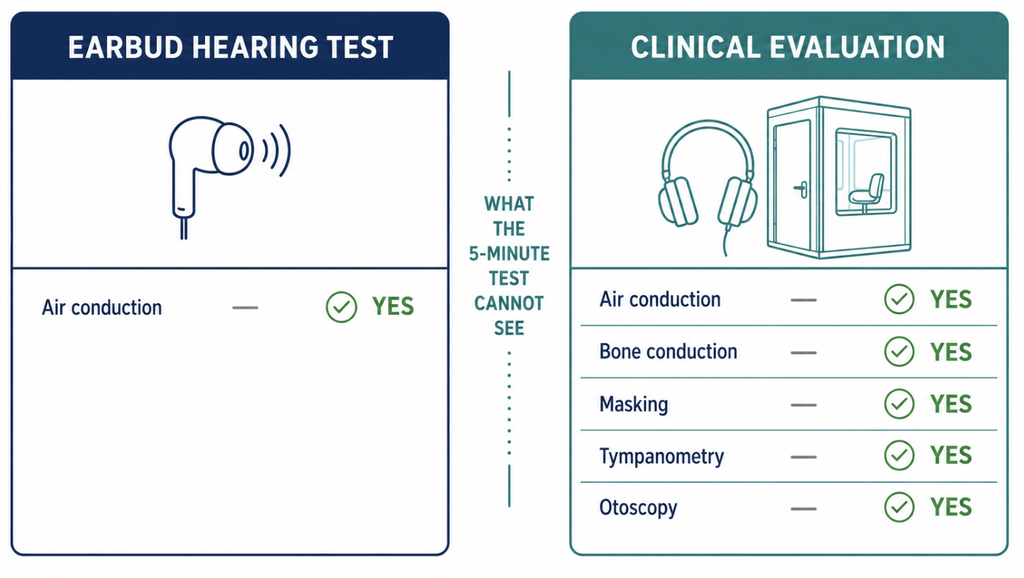
Bone conduction is the limit that matters most. Without it you cannot separate conductive hearing loss from sensorineural hearing loss, so the test tells you that sound is not getting through without telling you where it stalls. Otitis media with effusion, otosclerosis, and a canal packed with cerumen can all produce an audiogram in the mild to moderate range. Amplification will partially compensate for each of them while the underlying problem goes untreated, and two of those three have specific treatments.
Guideline practice reflects the same principle. The AAO-HNS sudden hearing loss guideline, written for sudden presentations rather than gradual ones, makes distinguishing conductive from sensorineural loss its first key action statement and grades it a strong recommendation [Chandrasekhar, Clinical Practice Guideline: Sudden Hearing Loss (Update), 2019]. The urgency there applies to sudden loss, but the diagnostic logic applies more broadly.
Masking is a softer limit. When one ear is substantially worse, sound presented to it can cross the skull and be heard by the better ear, producing thresholds that look better than reality. Detecting genuine asymmetry is what matters clinically, because asymmetry is among the findings that prompt evaluation for retrocochlear pathology. Nothing about earbud hardware prevents masking noise from being delivered to the opposite ear, so this gap could close in a firmware update. Interpretation would still be constrained without bone conduction, but the current absence is a design choice rather than a physical ceiling.
Caveat 3: the red flags are on the box, and they are easy to skip
FDA regulations require OTC hearing aid packaging to carry a list of red-flag conditions. The list on the FDA’s consumer page is short and specific. The FDA advises seeing a doctor, preferably an ENT, if:
Your ear has a birth defect or unusual shape, or was injured or deformed in an accident
You saw blood, pus, or fluid coming out of your ear in the past 6 months
Your ear feels painful or uncomfortable
You have a lot of ear wax, or think something could be in your ear
You get really dizzy, or have a feeling of spinning or swaying
Your hearing changed suddenly in the past 6 months
Your hearing gets worse, then gets better again
You have worse hearing in one ear
You hear ringing or buzzing in only one ear
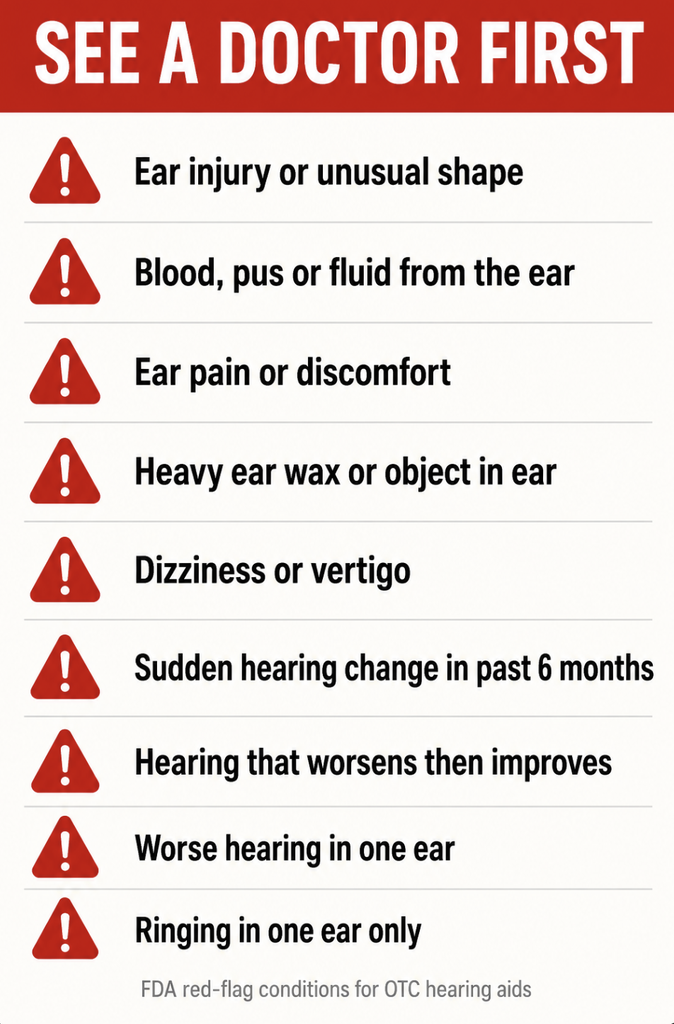
Two of these deserve emphasis.
Sudden hearing loss is time-critical. The AAO-HNS guideline recommends obtaining audiometry as soon as possible and within 14 days of symptom onset, and lists corticosteroids as an option within two weeks of onset [Chandrasekhar, 2019]. Spending those two weeks adjusting an amplification setting wastes the window.
Unilateral findings deserve evaluation. Worse hearing in one ear, or ringing in one ear only, are the findings that lead clinicians toward imaging or auditory brainstem response for retrocochlear pathology. Amplification does nothing to evaluate them.
Does self-fitting actually work?
Yes, on the outcomes that have been measured.
A randomized trial of 64 adults with self-perceived mild to moderate hearing loss compared a self-fitting OTC hearing aid with remote support against the same device fitted by an audiologist using NAL-NL2 and real-ear verification. At two weeks the self-fitting group scored somewhat better on self-reported benefit, though the confidence interval touched no difference. By six weeks, no meaningful difference remained on any outcome [De Sousa, Effectiveness of an Over-the-Counter Self-fitting Hearing Aid Compared With an Audiologist-Fitted Hearing Aid, 2023].
A 2026 systematic review and meta-analysis pooling 15 studies and 774 participants reached the same conclusion, finding no significant differences on the Abbreviated Profile of Hearing Aid Benefit, the SSQ-12, the International Outcome Inventory, or the QuickSIN. The authors were careful about the limits: risk of bias was moderate to high, certainty of evidence was low, most trials ran between 10 days and 8 weeks, and outcomes were largely patient-reported [De Sousa, Effectiveness of Over-the-Counter Hearing Aids Versus Professionally Fitted Devices, 2026].
Setup is not effortless. A study of six self-fitting OTC devices found fitting times ranging from 14.4 to 27.1 minutes, with sound quality ratings differing between devices even though usability and speech-in-noise benefit were broadly similar [Knoetze, Usability and Performance of Self-Fitting Over-the-Counter Hearing Aids, 2025]. A 2026 review noted that many older adults could not complete self-fitting tasks without error, and that most OTC users still ended up seeking professional support [Itatani, Over-the-counter hearing aids and integrated health-monitoring sensors, 2026].
The research base itself is young. An analysis of 106 OTC hearing aid papers found the literature shifted from commentary-dominated before the FDA rule took effect to empirical research afterward [Mo, From policy debate to empirical evidence, 2026]. Both things hold: self-fitting produces comparable short-term satisfaction, and the evidence behind that finding is thin, short term, and built on questionnaires rather than measures of long-term function.
Why Korea is the odd case
It would be easy to assume Korea has no regulatory pathway for earbud hearing aids. It has one, and a competitor has already used it.
On July 8, 2025, Korea’s Ministry of Food and Drug Safety granted Apple two separate Class II device approvals on the same day: the Hearing Test Feature as hearing test software (approval no. SUHEO 25-99HO) and the Hearing Aid Feature as otolaryngology software (SUHEO 25-100HO), both registered to the Korean importer Emergo Korea. Apple’s regulatory documentation lists a September 2025 Korean release, aligning with the iOS 26 cycle. Korea had been left off the roughly 100 launch markets when the feature first shipped in late 2024.
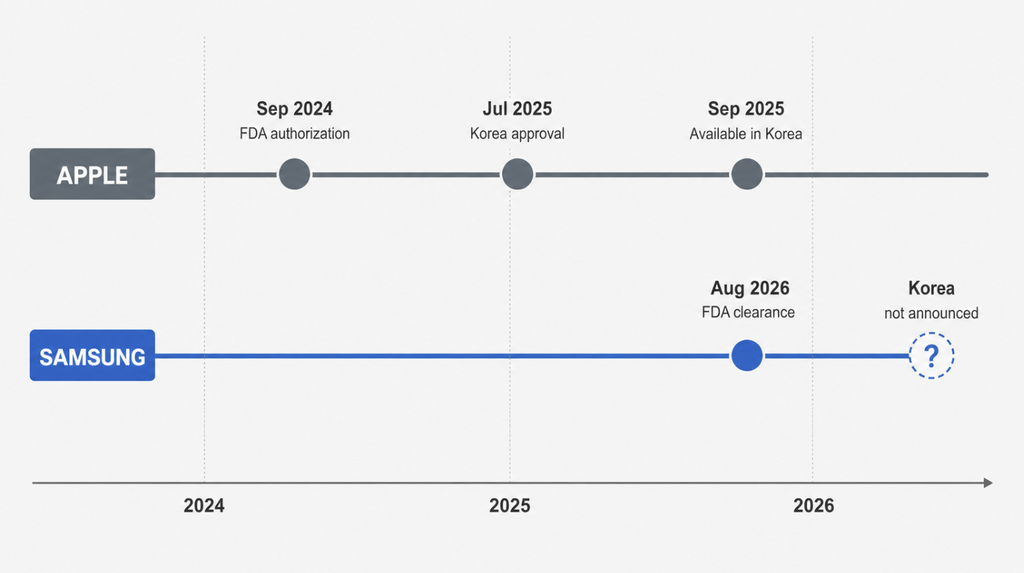
The pair is what counts. Korea did not approve amplification on its own. It approved the whole chain of self-administered hearing test, fitting, and amplification, and that chain has been legally available to Korean consumers for roughly a year, on a foreign company’s earbuds.
Samsung has not said whether or when it will follow. Its announcement names the US and “select approved markets” for Q4 2026 without publishing the country list, and The Korea Herald reported on August 13, 2026 that no Korean rollout has been announced. There is a limit on what can be claimed here: the ministry publishes completed approvals rather than pending reviews, so the absence of a Samsung listing shows that no approval has been granted, not that no application exists.
Market-by-market approval is genuinely required, and staggering launches is ordinary business practice. The picture it leaves is still worth stating plainly. A Korean-made device, developed in part with a Korean hospital, was cleared abroad first, its domestic availability is unstated, and a competitor’s equivalent test-and-fit system has been running in the same market since last autumn.
Clinical Perspective
The barrier to hearing help has rarely been the technology. The FDA and WHO both name the same obstacles to hearing aid uptake: cost, stigma, and limited access to professional care. A device that looks like ordinary earbuds addresses at least two of them.
The larger benefit may turn out to be detection rather than amplification. A five-minute test that someone will actually run, because it lives in the settings menu of earbuds they already own, can surface hearing loss that would otherwise go unmeasured for years. As a screening tool, that has real public health value.
The failure mode is treating the screen as the end of the process. An audiogram that reads mild reports a threshold, not a cause. The sensible sequence is for the earbuds to find the problem and a clinic to characterize it.
The claims made downstream deserve the same restraint. The ACHIEVE trial found no reduction in three-year cognitive decline from hearing intervention in its overall cohort, though a prespecified sensitivity analysis suggested benefit in participants at higher baseline risk [Lin, Hearing intervention versus health education control to reduce cognitive decline in older adults with hearing loss in the USA (ACHIEVE), 2023]. Hearing loss is worth treating for the sake of hearing. A dementia claim goes beyond what the primary analysis supported.
Key Takeaways
-The Galaxy Buds Hearing Aid FDA clearance covers Galaxy Buds3 Pro and Galaxy Buds4 Pro, for adults 18 and older with self-perceived mild to moderate hearing loss, rolling out in the US and select approved markets in Q4 2026.
– The Hearing Test uses pure-tone audiometry and NAL-NL2 fitting, but earbud hardware cannot perform bone conduction, otoscopy, or tympanometry, so it cannot distinguish conductive from sensorineural hearing loss.
– Randomized and pooled evidence shows self-fitting OTC hearing aids produce short-term outcomes comparable to audiologist-fitted devices, on low-certainty evidence from mostly patient-reported measures.
– FDA red-flag conditions, including sudden change within 6 months, one-sided hearing loss or tinnitus, ear pain, discharge, and vertigo, call for medical evaluation rather than an OTC device.
– Korea’s Ministry of Food and Drug Safety approved both Apple’s hearing test software and its hearing aid software on July 8, 2025, and the features shipped in Korea that September; as of August 2026, Samsung has not announced a Korean rollout of its own feature.
FAQ
Can Galaxy Buds replace a hearing aid?
Within a defined range, they are regulated as one. FDA-cleared OTC hearing aids are medical devices intended for adults 18 and older with perceived mild to moderate loss, and trial evidence shows self-fitting matches professional fitting on short-term self-reported benefit. Output is capped at 111 to 117 dB SPL, which places severe and profound loss outside the category. Whether a given device suits a given person is a question for an audiologic evaluation, not a spec sheet.
Is the Galaxy Buds hearing test as accurate as a hospital test?
For air-conduction thresholds, probably close. For diagnosis, no. Validation data for a comparable consumer test show most thresholds landing within 10 dB of booth audiometry. But earbuds cannot perform bone conduction, otoscopy, or tympanometry, so the test cannot identify middle ear disease or cerumen impaction, and it does not currently include masking, which is what confirms true asymmetry between ears.
Who should not use this feature?
Anyone under 18, anyone with severe or profound loss, and anyone with an FDA red-flag condition: sudden hearing change in the past 6 months, fluctuating hearing, worse hearing in one ear, one-sided tinnitus, ear pain, discharge, vertigo, suspected impacted wax or a foreign body, or an injured or malformed ear.
When can Koreans use it?
Unknown as of this writing. Samsung has specified only the US and unnamed approved markets for Q4 2026, and has not announced Korean availability. The pathway exists and is in use: Apple’s hearing test and hearing aid software both received Korean approval in July 2025 and shipped domestically that September.
Samsung or Apple: which is better?
No head-to-head study exists, so any ranking would be speculation. What is verifiable: Apple’s software was FDA-authorized first, in September 2024, independent researchers have since published a validation study of its hearing test, and it holds Korean approval. Samsung’s clearance came in August 2026 and covers Buds3 Pro and Buds4 Pro. A Korean study of an earlier AirPods Pro accommodation feature found performance similar to a validated personal sound amplification product and better than unaided listening [Kim, Apple AirPods Pro as a Hearing Assistive Device in Patients with Mild to Moderate Hearing Loss, 2024].
References
Chandrasekhar SS, Tsai Do BS, Schwartz SR, et al. Clinical Practice Guideline: Sudden Hearing Loss (Update). Otolaryngol Head Neck Surg. 2019;161(1_suppl):S1-S45.
De Sousa KC, Manchaiah V, Moore DR, Graham MA, Swanepoel W. Effectiveness of an Over-the-Counter Self-fitting Hearing Aid Compared With an Audiologist-Fitted Hearing Aid: A Randomized Clinical Trial. JAMA Otolaryngol Head Neck Surg. 2023;149(6):522-530.
De Sousa KC, Almufarrij I, Kruger M, Manchaiah V, Munro KJ, Swanepoel W. Effectiveness of Over-the-Counter Hearing Aids Versus Professionally Fitted Devices: A Systematic Review and Meta-analysis. Otolaryngol Head Neck Surg. 2026 Jun 17. Epub ahead of print.
Han UG, Lee JY, Kim GY, et al. Real-World Effectiveness of Wearable Augmented Reality Device for Patients With Hearing Loss: Prospective Study. JMIR Mhealth Uhealth. 2022;10(3):e33476.
Itatani N, Zavaglia M. Over-the-counter hearing aids and integrated health-monitoring sensors: a review of clinical evidence and implementation. Front Digit Health. 2026;8:1771022.
Kim GY, Yun HJ, Jo M, Jo S, Cho YS, Moon IJ. Apple AirPods Pro as a Hearing Assistive Device in Patients with Mild to Moderate Hearing Loss. Yonsei Med J. 2024;65(10):596-601.
Knoetze M, Manchaiah V, Swanepoel W. Usability and Performance of Self-Fitting Over-the-Counter Hearing Aids. J Am Acad Audiol. 2025;36(1):23-36.
Kruger M, Manchaiah V, Swanepoel W. Apple Hearing Test Feature for the AirPods Pro 2: Accuracy, Reliability, and Time-Efficiency. Otolaryngol Head Neck Surg. 2026;174(6):1484-1493.
Lin FR, Pike JR, Albert MS, et al. Hearing intervention versus health education control to reduce cognitive decline in older adults with hearing loss in the USA (ACHIEVE): a multicentre, randomised controlled trial. Lancet. 2023;402(10404):786-797.
Mo C, Manchaiah V, Wasmann JA, Wang S. From policy debate to empirical evidence: a proof-of-concept bibliometric and LLM-assisted abstract-level content analysis of OTC hearing aid research before and after FDA regulation. Int J Audiol. 2026:1-16.
Mohammed Hatta NH, Wan Mohamad WN, Normani Zakaria M, Nor Rashid MF, Abu Hassan MSN, Hosshan H. Validation of self-hearing test in non-clinical setting: a systematic literature review. Braz J Otorhinolaryngol. 2026;92(3):101803.
Regulatory record: Ministry of Food and Drug Safety (Korea), Hearing Test Software approval no. 수허 25-99호 and Otolaryngology Software (Hearing Aid Feature) approval no. 수허 25-100호, both Class II imports approved July 8, 2025, importer Emergo Korea.
Joonpyo Hong, MD is a board-certified otolaryngologist practicing in Korea. This article reflects his clinical interpretation of published research and does not constitute individual medical advice.
For more articles:
https://curiousmd.com/airpods-hearing-test-what-it-can-and-cannot-do/
https://curiousmd.com/airpods-hearing-test-ent-perspective/
https://curiousmd.com/otc-hearing-aids-2026/
https://curiousmd.com/ai-speech-clarification-hearing-loss/
Link out to:
- https://news.samsung.com/global/samsungs-hearing-aid-feature-on-galaxy-buds-cleared-by-fda — Samsung’s own announcement of the FDA clearance. The primary source for device eligibility, the NAL-NL2 fitting claim, and the Q4 2026 availability window.
- https://www.fda.gov/medical-devices/hearing-aids/otc-hearing-aids-what-you-should-know — The FDA’s consumer page on OTC hearing aids. Contains the full red-flag list and the guidance on when hearing loss needs a professional rather than a device.
- https://www.law.cornell.edu/cfr/text/21/800.30 — The text of 21 CFR § 800.30, the regulation that defines the OTC hearing aid category, including the 111 and 117 dB SPL output limits and mandatory labeling.
- https://www.koreaherald.com/article/10840169 — The Korea Herald’s report confirming that no Korean rollout has been announced and that the FDA clearance applies to the US market only.