
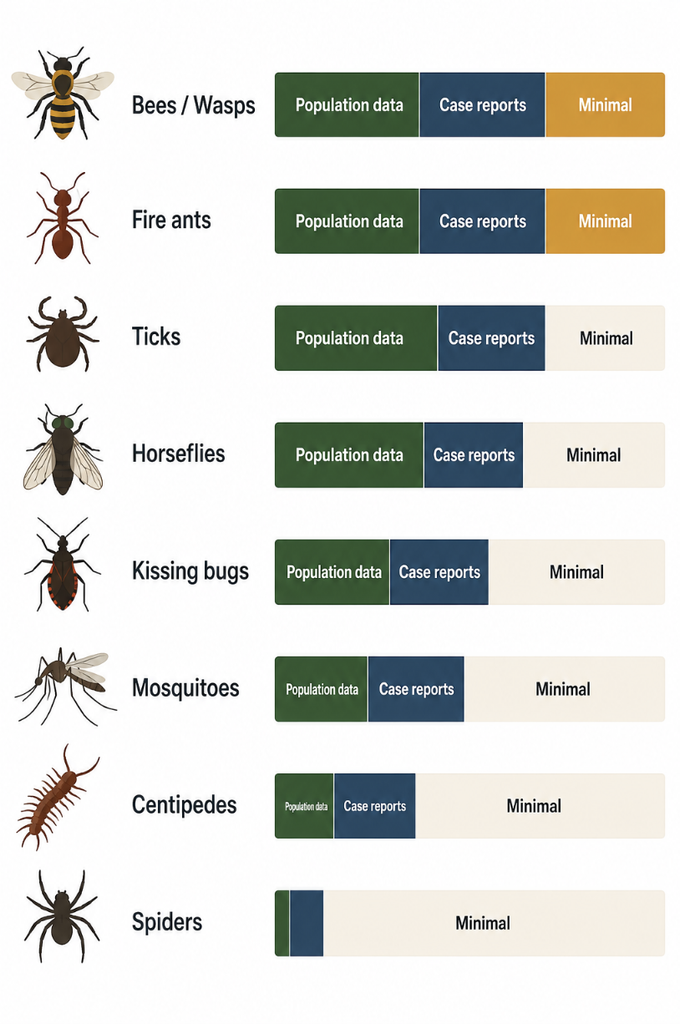
These are the typical progressions of insect bite anaphylaxis. Horsefly bites have caused systemic reactions, and a 69 kd IgE-binding protein from the Chrysops salivary gland is the candidate allergen [Hemmer, Anaphylaxis induced by horsefly bites, 1998]. Triatoma has been recognized as an anaphylaxis trigger for more than a hundred years. The bites happen at night, on skin left uncovered during sleep, and the incidence is still undefined largely because nobody sees the bug that bit them [Moffitt, Allergic reactions to Triatoma bites, 2003]. Mosquito saliva also contains real IgE-binding allergens, though what it usually produces is a big itchy welt rather than shock [Cantillo, Immunological aspects of the immune response induced by mosquito allergens, 2015].
Why the list looks like this
Stinging insects carry a defensive weapon and use it on us repeatedly. Biting insects carry a feeding tool and would mostly rather be left alone. Since IgE sensitization is built by repeated exposure, the ranking above tracks how often people meet a given insect more closely than it tracks how dangerous that insect is.
Five things that run against intuition
Centipedes are under-reported rather than harmless. A ten-year review at a Bangkok tertiary hospital collected 245 centipede bites. Nearly all caused local pain and swelling, twelve cases (5%) had a clinical picture compatible with anaphylaxis, and no patient died [Niruntarai, Patients with centipede bites presenting to a university hospital in Bangkok, 2021]. Five percent is high enough to take seriously. Centipedes come up less often in these conversations because far fewer people ever meet one.
A tick can make you allergic to pork weeks later. In alpha-gal syndrome, tick bites drive an IgE response against galactose-alpha-1,3-galactose, a sugar found in non-primate mammals. The reaction then arrives roughly three hours after eating beef, pork, or lamb, which is long enough to hide the causal chain from both ends: the bite was weeks ago and the meal was hours ago. One 79-year-old woman had her anaphylaxis classified as idiopathic before anyone made the connection [Tripathi, Delayed anaphylaxis to red meat masquerading as idiopathic anaphylaxis, 2014].
Bigger swelling does not mean bigger danger. After a large local reaction (the arm that stays swollen for three days), the risk of anaphylaxis on a future sting is under 5%. It runs 40% to 70% in people who have already had moderate to severe anaphylaxis, and above 90% in mastocytosis [Golden, Update on Insect Sting Anaphylaxis, 2021].
“I’ve been stung before and I was fine” proves very little. Roughly half of the people who die from a sting reaction had no documented history of a previous systemic reaction [Bilò, Epidemiology of insect-venom anaphylaxis, 2008]. Sensitization can build without producing anything you would notice.
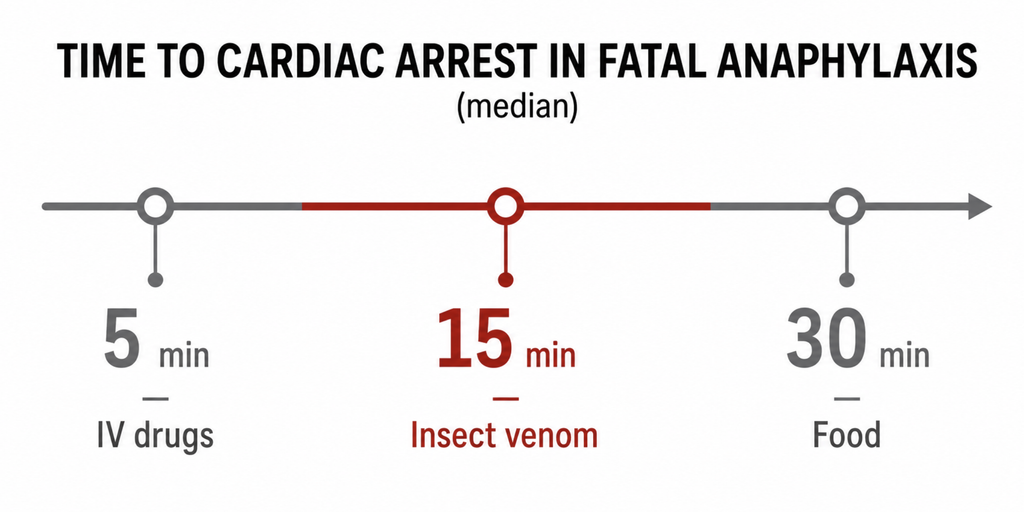
Venom moves faster than food. In a UK registry of fatal anaphylaxis, the median time from exposure to respiratory or cardiac arrest was 30 minutes for foods, 15 minutes for venom, and 5 minutes for iatrogenic causes [Pumphrey, Lessons for management of anaphylaxis from a study of fatal reactions, 2000]. Most people assume a sting leaves them more time than a meal would. The registry says the opposite.
If it happens
The clock
Symptoms usually begin within minutes. In that same UK registry, adrenaline was used in 62% of fatal reactions but reached the patient before arrest in only 14% [Pumphrey, 2000]. The drug was largely available. What came late was the recognition.
Reactions can also come back hours after an apparent recovery, which is why improvement is not a reason to go home.
What it looks like
Skin: hives, flushing, swelling of the face or lips. Airway: hoarseness, throat tightness, difficulty swallowing, wheeze. Circulation: dizziness, pallor, collapse. Gut: vomiting, cramping, diarrhea.
If two or more organ systems are involved after a sting, treat it as anaphylaxis until proven otherwise.
On the street, with nothing
Call 119 (or your local emergency number) first, and give a precise location.
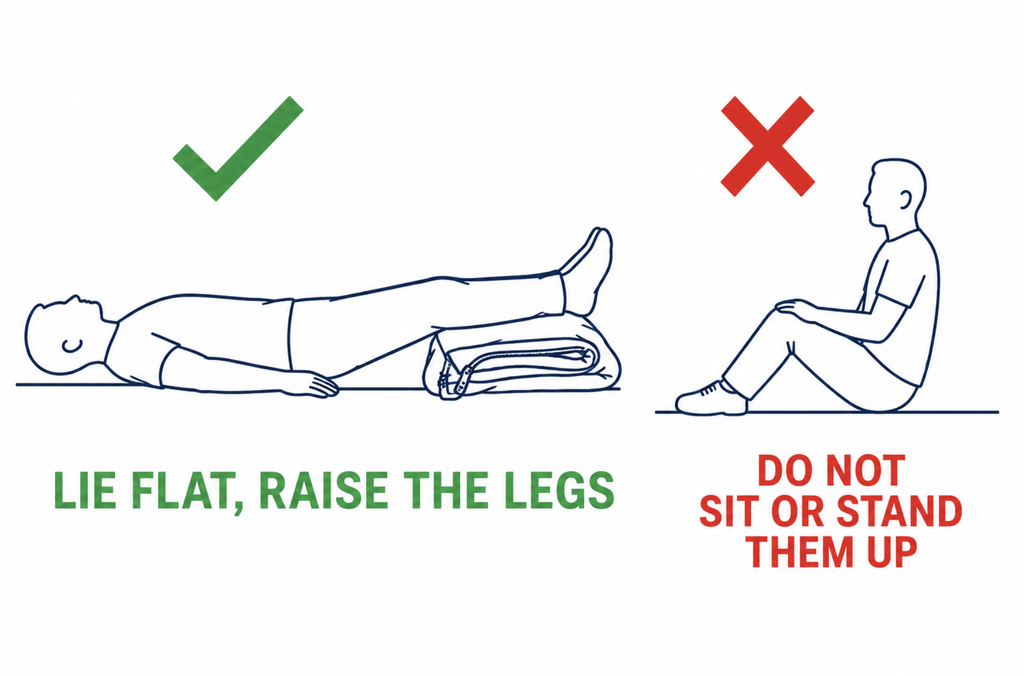
Lay the person flat and raise the legs. Do not sit them up, and do not stand them up to walk to a car. Posture here is treatment rather than comfort: fatal outcomes have been described in patients moved to an upright position during anaphylactic shock, as venous return collapses [Pumphrey, Fatal posture in anaphylactic shock, 2003]. If breathing is the dominant problem, the upper body can be raised slightly, but the person stays down.
Remove a visible stinger quickly. Speed matters more than technique.
Ask loudly whether anyone nearby carries an epinephrine auto-injector. Antihistamines act too slowly and do not stop the reaction, so they are not a substitute. Do not give anything to drink, since the airway may be at risk. If there is no breathing and no response, start CPR. Go to the emergency department even if things improve.
In the hospital
Intramuscular adrenaline into the anterolateral thigh is first-line, repeated as needed, alongside fluids, oxygen, and airway management. The two delays most consistently linked to death are delayed adrenaline and delayed airway control.
For clinicians: where 0.3 to 0.5 mg actually comes from
The standing formula is 0.01 mg/kg intramuscularly, using the 1:1000 (1 mg/mL) preparation, to a maximum single dose of 0.5 mg in adults and 0.3 mg in children [Dreborg, International recommendations on epinephrine auto-injector doses often differ from standard weight-based guidance, 2022].
That range was never derived from average adult body weight. Run the formula on a 70 kg adult and it returns 0.7 mg, which is above the ceiling. The two familiar numbers come from somewhere else entirely: 0.01 mg/kg equals 0.3 mg at 30 kg and 0.5 mg at 50 kg. So 0.3 mg is essentially a device strength inherited from auto-injector manufacturing, and 0.5 mg is a capped maximum. Every adult above 50 kg is, by design, receiving less than the weight-based dose.
That gap is not trivial. Heavy adults carrying a 0.3 mg auto-injector may receive only one-fifth to one-third of the weight-based dose, and underdosing has been proposed as a contributor to anaphylaxis mortality [Dreborg, 2022]. A 2025 retrospective series of 338 adults compared initial doses directly. Escalation of care (a repeat intramuscular dose, an infusion, or intubation) occurred in 29.5% of those given 0.3 mg versus 7.1% of those given 0.5 mg, with no significant difference in adverse effects [Jackson, Retrospective comparison between 0.3 mg and 0.5 mg dosing of intramuscular epinephrine for anaphylaxis, 2025]. It is a single-center retrospective study, so it is suggestive rather than definitive, but it points the same direction as the arithmetic.
For adults over 50 kg, the practical reading is that 0.5 mg makes the better default, and choosing 0.3 mg is a decision that needs a reason.
One more point, about concentration. In Korea the standard epinephrine ampoule is 1 mg in 1 mL, which is the 1:1000 preparation. But 1:10,000 prefilled syringes (0.1 mg/mL) sit in the same crash cart for cardiac arrest, and confusing the two is a classic and occasionally fatal error. Korean regulatory labeling for the 1:10,000 product carries an explicit instruction that intramuscular administration requires the 1 mg/mL preparation. This is why a dose should always be carried in the head as milligrams plus a concentration, never as a count of ampoules.
Clinical Perspective
The hives are the part everyone sees. Laryngeal edema is the part nobody sees. In practice, the most uncomfortable patient to stand next to is not the one covered in wheals. It is the one whose skin looks fine and whose voice has changed in the last ten minutes. A hoarse voice, a sensation of something stuck in the throat, or a subtle change in the quality of speech after a sting deserves more urgency than a dramatic rash. An airway can look adequate until shortly before it closes, and the window in which intubation is straightforward shuts well before the window in which it is necessary.
So why does the body do this
The standard answer used to be that allergy is type 2 immunity misfiring, machinery built for parasites and pointed at the wrong target.
In 1991, Margie Profet proposed something else: that allergy evolved as a last line of defense against environmental toxins, and that vomiting, coughing, tearing, sneezing, and even the drop in blood pressure are expulsion and dilution strategies rather than errors [Profet, The function of allergy: immunological defense against toxins, 1991]. The idea sat largely unexamined for two decades.
Then, in 2013, two independent mouse studies gave it experimental footing. Mice injected with the venom equivalent of one or two bee stings developed a type 2 response and survived a subsequent near-lethal venom dose better than controls, and the protection disappeared in mice lacking IgE or its high-affinity receptor FcεRI [Marichal, A beneficial role for immunoglobulin E in host defense against honeybee venom, 2013]. A parallel study showed that bee venom phospholipase A2 drives this response through membrane cleavage and IL-33 release, and that the resulting IgE response was itself protective [Palm, Bee venom phospholipase A2 induces a primary type 2 response that is dependent on the receptor ST2 and confers protective immunity, 2013]. In those models, IgE was keeping the animals alive rather than killing them.
Two limits are worth stating plainly. These are mouse experiments, and the leap to human physiology is not settled. They also leave the central puzzle untouched: most people with venom-specific IgE never go into shock, and we still cannot predict who will.
What the work does suggest is a reframing. Anaphylaxis may be an old and very fast defensive reflex firing at full power against a threat it was built for, unable to tell the difference between one wasp and a lethal dose.
Key Takeaways
- Bee venom accounted for 55% of emergency department anaphylaxis visits across seven Korean community hospitals, rising to 80% of cases in August.
- Systemic reactions to Hymenoptera stings occur in roughly 0.4% to 3.3% of people, while 15% to 25% carry venom-specific IgE with no history of reaction.
- Ticks, horseflies, kissing bugs, mosquitoes, and centipedes can all cause anaphylaxis, but the evidence is largely at the level of case reports and small series.
- In fatal anaphylaxis, the median time from exposure to arrest is about 15 minutes for venom, compared with 30 minutes for food.
- A person in anaphylactic shock should be laid flat with legs raised. Moving them upright has been linked to fatal outcomes.
- Antihistamines do not stop anaphylaxis. Intramuscular adrenaline is the only first-line treatment.
- The adult dose is 0.01 mg/kg of 1:1000 epinephrine intramuscularly, capped at 0.5 mg. The familiar 0.3 mg figure matches that formula only at 30 kg and reflects auto-injector device strength rather than adult body weight.
- Mouse studies suggest IgE responses to bee venom can be protective, supporting the idea that anaphylaxis is an overshoot of a defense mechanism rather than a purposeless error.
FAQ
How long after a sting does anaphylaxis start? Usually within minutes. In a UK registry of fatal reactions, the median interval from a venom exposure to respiratory or cardiac arrest was 15 minutes, compared with 30 minutes for food-triggered deaths. Faster onset tends to signal a more severe reaction, so any systemic symptom after a sting should be treated as time-critical rather than watched.
Can a mosquito bite cause anaphylaxis? It is possible but rare. Mosquito saliva contains genuine allergens capable of provoking IgE responses, and systemic reactions have been described. Far more commonly, mosquito allergy shows up as an exaggerated local reaction, a large hot itchy swelling that is uncomfortable but not dangerous.
Are centipede bites dangerous? Mostly they cause severe local pain and swelling. In a ten-year Bangkok series of 245 bites, 99.5% had local pain, 5% had a picture compatible with anaphylaxis, and nobody died. The risk is real but low, and it is smaller than the bee risk mainly because encounters are far less frequent.
What can I do if there’s no epinephrine available? Call emergency services immediately, lay the person flat with their legs raised, remove any visible stinger, and ask whether anyone nearby carries an auto-injector. Do not sit them up, do not give them anything to drink, and do not rely on antihistamines. Start CPR if they stop breathing.
If I was fine the last time I was stung, am I safe? Not necessarily. About half of the people who die from sting reactions had no documented previous systemic reaction. Sensitization can develop without warning between exposures.
References
- Cho H, Kim D, Choo Y, Park J, Choi J, Jang D, et al. Common causes of emergency department visits for anaphylaxis in Korean community hospitals: A cross-sectional study. Medicine (Baltimore). 2019;98(4):e14114.
- Fernandez J, Blanca M, Soriano V, Sanchez J, Juarez C. Epidemiological study of the prevalence of allergic reactions to Hymenoptera in a rural population in the Mediterranean area. Clin Exp Allergy. 1999;29(8):1069-74.
- McMurray JC, Schornack BJ, Adams KE, McCoy RL, Marshall AK, Brunader JA, et al. Fire ant-venom anaphylaxis prevalence in the general population and patients with systemic mastocytosis. Front Allergy. 2025;6:1570123.
- Hemmer W, Focke M, Vieluf D, Berg-Drewniok B, Götz M, Jarisch R. Anaphylaxis induced by horsefly bites: identification of a 69 kd IgE-binding salivary gland protein from Chrysops spp. (Diptera, Tabanidae) by western blot analysis. J Allergy Clin Immunol. 1998;101(1 Pt 1):134-6.
- Moffitt JE, Venarske D, Goddard J, Yates AB, deShazo RD. Allergic reactions to Triatoma bites. Ann Allergy Asthma Immunol. 2003;91(2):122-8.
- Cantillo JF, Fernández-Caldas E, Puerta L. Immunological aspects of the immune response induced by mosquito allergens. Int Arch Allergy Immunol. 2015;165(4):271-82.
- Niruntarai S, Rueanpingwang K, Othong R. Patients with centipede bites presenting to a university hospital in Bangkok: a 10-year retrospective study. Clin Toxicol (Phila). 2021;59(8):721-6.
- Tripathi A, Commins SP, Heymann PW, Platts-Mills TA. Delayed anaphylaxis to red meat masquerading as idiopathic anaphylaxis. J Allergy Clin Immunol Pract. 2014;2(3):259-65.
- Golden DBK. Update on Insect Sting Anaphylaxis. Curr Allergy Asthma Rep. 2021;21(3):16.
- Bilò BM, Bonifazi F. Epidemiology of insect-venom anaphylaxis. Curr Opin Allergy Clin Immunol. 2008;8(4):330-7.
- Pumphrey RS. Lessons for management of anaphylaxis from a study of fatal reactions. Clin Exp Allergy. 2000;30(8):1144-50.
- Pumphrey RSH. Fatal posture in anaphylactic shock. J Allergy Clin Immunol. 2003;112(2):451-2.
- Marichal T, Starkl P, Reber LL, Kalesnikoff J, Oettgen HC, Tsai M, et al. A beneficial role for immunoglobulin E in host defense against honeybee venom. Immunity. 2013;39(5):963-75.
- Palm NW, Rosenstein RK, Yu S, Schenten DD, Florsheim E, Medzhitov R. Bee venom phospholipase A2 induces a primary type 2 response that is dependent on the receptor ST2 and confers protective immunity. Immunity. 2013;39(5):976-85.
- Profet M. The function of allergy: immunological defense against toxins. Q Rev Biol. 1991;66(1):23-62.
- Dreborg S, Walter G, Kim H. International recommendations on epinephrine auto-injector doses often differ from standard weight-based guidance: a review and clinical proposals. Allergy Asthma Clin Immunol. 2022;18(1):102.
- Jackson CA, Dillon RC, Fleenor LM, Pauw EK, O’Keefe MM. Retrospective comparison between 0.3 mg and 0.5 mg dosing of intramuscular epinephrine for anaphylaxis. Am J Emerg Med. 2025;99:270-5.
Joonpyo Hong, MD is a board-certified otolaryngologist practicing in Korea. This article reflects his clinical interpretation of published research and does not constitute individual medical advice.
For more articles:
https://curiousmd.com/evolutionary-reason-for-allergies/
https://curiousmd.com/allergen-immunotherapy-for-allergic-rhinitis/
https://curiousmd.com/ai-allergy-forecast-personalized-prediction/
Link out to:
https://www.aaaai.org/tools-for-the-public/conditions-library/allergies/stinging-insect-allergy — The American Academy of Allergy, Asthma & Immunology patient page on stinging insect allergy, including how to identify the insects and remove a stinger. https://www.resus.org.uk/library/additional-guidance/guidance-anaphylaxis/emergency-treatment-anaphylactic-reactions — Resuscitation Council UK’s 2021 emergency treatment guideline for anaphylaxis, with the downloadable treatment algorithm. https://www.cdc.gov/alpha-gal-syndrome/index.html — The US CDC hub for alpha-gal syndrome, covering the tick link, symptoms, and diagnostic testing. https://pubmed.ncbi.nlm.nih.gov/24210352/ — The 2013 Immunity study showing that IgE responses to honeybee venom can protect mice against a lethal dose.