
In one series of 381 patients whose primary complaint was hyperacusis, more than a third of tested ears had entirely normal hearing thresholds [Sheldrake, Audiometric Characteristics of Hyperacusis Patients, 2015]. The audiogram recorded nothing unusual; the patients described everyday sound as intolerable. That gap sits at the center of any discussion of hyperacusis symptoms and causes, and it shapes how the condition is defined, measured, and treated.
Here is what the published evidence supports on five questions patients ask most: what the symptoms look like statistically, why hyperacusis happens, whether any objective test can confirm it, whether it predicts future hearing loss, and how much of it is inherited.
What Hyperacusis Actually Looks Like in the Data
Hyperacusis is intolerance of everyday sounds that most people find unremarkable. A widely used framework divides it into four categories: loudness, annoyance, fear, and pain hyperacusis [Tyler, A Review of Hyperacusis and Future Directions: Part I. Definitions and Manifestations, 2014]. These are not interchangeable — a patient who flinches at a slamming door out of fear is clinically different from one who experiences physical ear pain from a passing bus.
Prevalence estimates vary enormously, and that variation is itself informative. A scoping review pooling 42 studies and 34,796 subjects found rates of 0.2–17.2% in the general population, 3.8–67% in high-noise occupations such as musicians and teachers, and 4.7–95% in patients with specific conditions including Williams syndrome, tinnitus, and autism [Ren, Prevalence of Hyperacusis in the General and Special Populations: A Scoping Review, 2021]. The spread is not sloppiness; it reflects the absence of an agreed diagnostic threshold, a conclusion echoed by a later systematic review of prevalence [Jacquemin, Prevalence of Hyperacusis: A Systematic Review, 2023]. The same scoping review found consistently higher prevalence in women, and peaks in adolescents and older adults. In children and adolescents specifically, estimates span roughly 3% to 17% [Rosing, Prevalence of Tinnitus and Hyperacusis in Children and Adolescents: A Systematic Review, 2016].
The symptom picture extends well past sound itself. In a Swedish population study comparing 313 people with self-reported hyperacusis and 66 with physician-diagnosed hyperacusis against 2,995 controls, the condition clustered with post-traumatic stress disorder, chronic fatigue syndrome, generalized anxiety disorder, depression, fibromyalgia, irritable bowel syndrome, migraine, tinnitus, and hearing impairment [Paulin, Characteristics of Hyperacusis in the General Population, 2016]. A 2025 systematic review found depression reported in 8–80% of hyperacusis patients and anxiety disorders in 39–61% — ranges wide enough that the authors themselves urged caution, since most included studies relied on self-report rather than structured psychiatric interview [Rodrigues, Psychiatric Comorbidities in Hyperacusis and Misophonia: A Systematic Review, 2025].
One asymmetry is worth holding onto: most hyperacusis patients also have tinnitus, but only about 30–40% of tinnitus patients report hyperacusis [Sheldrake, Audiometric Characteristics of Hyperacusis Patients, 2015]. Whatever mechanism produces hyperacusis appears to be a subset of, or an addition to, whatever produces tinnitus.
Why It Happens: The Brain Turns Up the Volume
The most widely supported explanation is central gain enhancement. When the cochlea sends less signal upward — from noise damage, ototoxic drugs, or aging — activity in the inferior colliculus and auditory cortex paradoxically increases at suprathreshold levels, as if the brain has compensated for weak input by raising the amplifier [Auerbach, Central Gain Control in Tinnitus and Hyperacusis, 2014]. Turn up an amplifier fed by a degraded signal and moderate inputs come out too loud. That is a reasonable working analogy for loudness hyperacusis.
Animal work adds an important qualifier. In models where rodents were exposed to noise and then sorted behaviorally into groups with tinnitus only, hyperacusis only, both, or neither, hyperacusis was not primarily tied to elevated hearing thresholds or outer hair cell damage. What separated the groups was how centrally the animals responded to peripheral nerve damage — and prior stress history influenced which direction that response took [Aazh, Insights from the Third International Conference on Hyperacusis, 2018]. This reframes hyperacusis as a disorder of central response rather than one of ear sensitivity.
Two other mechanisms carry real evidence. The limbic system appears to generate a negative emotional valuation of sound and relay it to auditory cortex, which fits the fear and annoyance subtypes better than gain models do. And efferent control may be weakened: children with autism showed reduced suppression of distortion-product otoacoustic emissions during contralateral noise, indicating impaired medial olivocochlear function [Aazh, Insights from the Third International Conference on Hyperacusis, 2018]. Reviews of the underlying neurobiology treat these peripheral and central contributions as interacting rather than competing [Knipper, Advances in the Neurobiology of Hearing Disorders: Recent Developments Regarding the Basis of Tinnitus and Hyperacusis, 2013].
Can Hyperacusis Be Measured, or Only Described?
This is the honest answer patients rarely get: hyperacusis is currently a clinical diagnosis built on self-report, with psychophysical testing playing a supporting role at best. No laboratory test, imaging study, or electrophysiological measure is used routinely to confirm it.
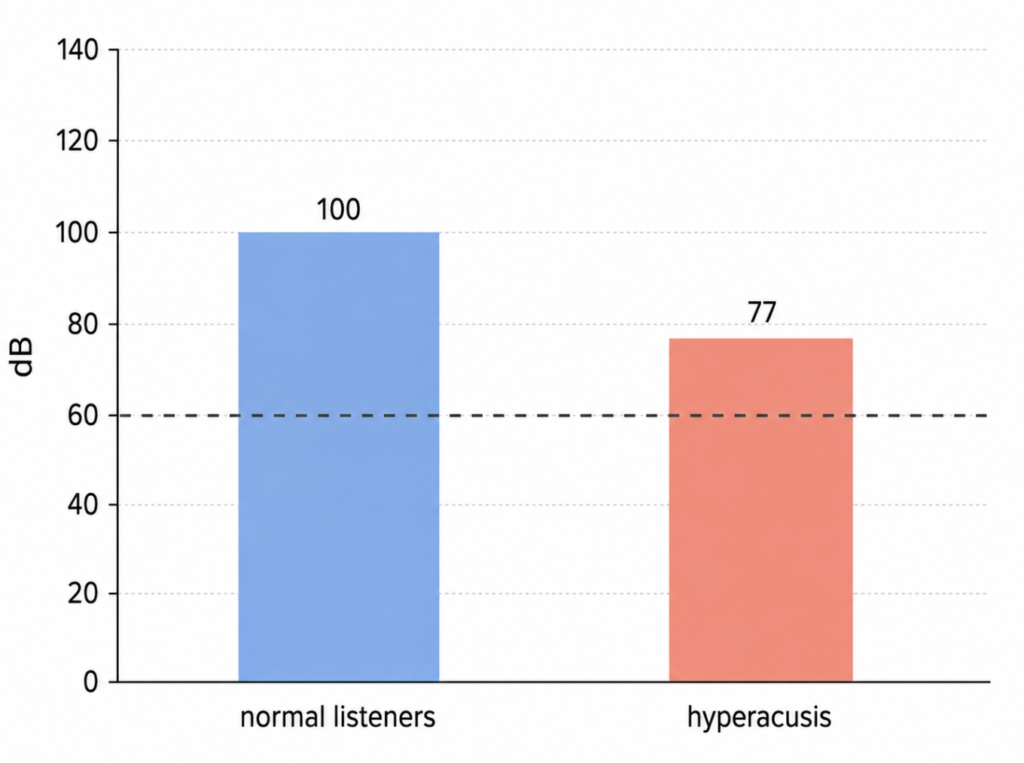
The closest thing to an objective measure is the uncomfortable loudness level (ULL), also called loudness discomfort level. In normal-hearing people without hyperacusis, average ULL sits near 100 dB HL. In hyperacusis patients, reported averages have ranged from 66 to 83 dB HL across studies — a spread that makes any single cutoff hard to defend [Aazh, Insights from the Third International Conference on Hyperacusis, 2018]. When ULLs were measured across the full audiometric range in 381 hyperacusis patients, they were significantly reduced compared with controls, averaging about 85 dB HL. But receiver operating characteristic analysis showed the measure was neither sensitive nor specific enough to stand alone as a diagnostic test [Sheldrake, Audiometric Characteristics of Hyperacusis Patients, 2015].
The workable compromise pairs the two approaches. Combining a ULL cutoff of ≤77 dB HL in the better-tolerating ear with a Hyperacusis Questionnaire score of ≥22 produced 95% agreement between the two criteria in a clinic sample of 573 patients [Aazh, Insights from the Third International Conference on Hyperacusis, 2018]. That is a usable rule — but note what it is: a questionnaire calibrated against a psychophysical test, not an independent biological marker.
Newer candidates are emerging — resting-state fMRI connectivity patterns, cortical evoked potentials, and loudness discomfort levels at extended high frequencies [Bigras, Loudness Discomfort Levels at Extended High Frequencies in Young Adults: A Potential Marker of Hyperacusis, 2025]. None has been validated for clinical use.
Clinical Perspective
There is a finding here that changes practice and almost never reaches patients. When standard British Society of Audiology procedures for pure-tone audiometry were applied to 362 patients seeking help for tinnitus or hyperacusis, 21% would have experienced discomfort during the test itself. For ULL measurement starting at the recommended 60 dB HL, 24% would have. Lowering the starting levels dropped those figures to 0.8% and 0.5% [Aazh, Incidence of Discomfort During Pure-Tone Audiometry and Measurement of Uncomfortable Loudness Levels Among People Seeking Help for Tinnitus and/or Hyperacusis, 2017].
In other words: applying the standard protocol to a hyperacusis patient risks harming roughly one in four during assessment. In a condition where anxiety and sound-avoidance behavior drive much of the disability, a painful first appointment is not a neutral event.
The same authors proposed a straightforward correction: begin audiometry at 0 dB HL at 1 kHz and set each subsequent frequency to the threshold found at the previous one, and for uncomfortable loudness levels, start at the measured threshold for that frequency and never exceed 80 dB HL [Aazh, Incidence of Discomfort During Pure-Tone Audiometry and Measurement of Uncomfortable Loudness Levels Among People Seeking Help for Tinnitus and/or Hyperacusis, 2017]. Diagnostic yield is preserved; the risk of turning a first appointment into an aversive event largely disappears. For clinics that see sound-intolerance referrals, it is worth considering as standing procedure.
Is Hyperacusis an Early Warning Sign of Hearing Loss?
Patients ask this constantly, and the accurate answer is that no longitudinal study has established hyperacusis as a predictor of future hearing loss. What exists is suggestive but circumstantial.
Among 381 hyperacusis patients, the average pattern was mild high-frequency hearing loss — yet more than a third of tested ears had entirely normal thresholds at 20 dB HL or better [Sheldrake, Audiometric Characteristics of Hyperacusis Patients, 2015]. So hyperacusis is neither confined to damaged ears nor independent of them.
The more interesting signal comes from testing above 8 kHz, outside the standard audiogram. Cochlear synaptopathy — loss of synapses between inner hair cells and auditory nerve fibers without hair cell death — produces reduced suprathreshold neural output while leaving conventional thresholds intact, and is a leading candidate substrate for hyperacusis in normal-hearing patients [Auerbach, Central Gain Control in Tinnitus and Hyperacusis, 2014].
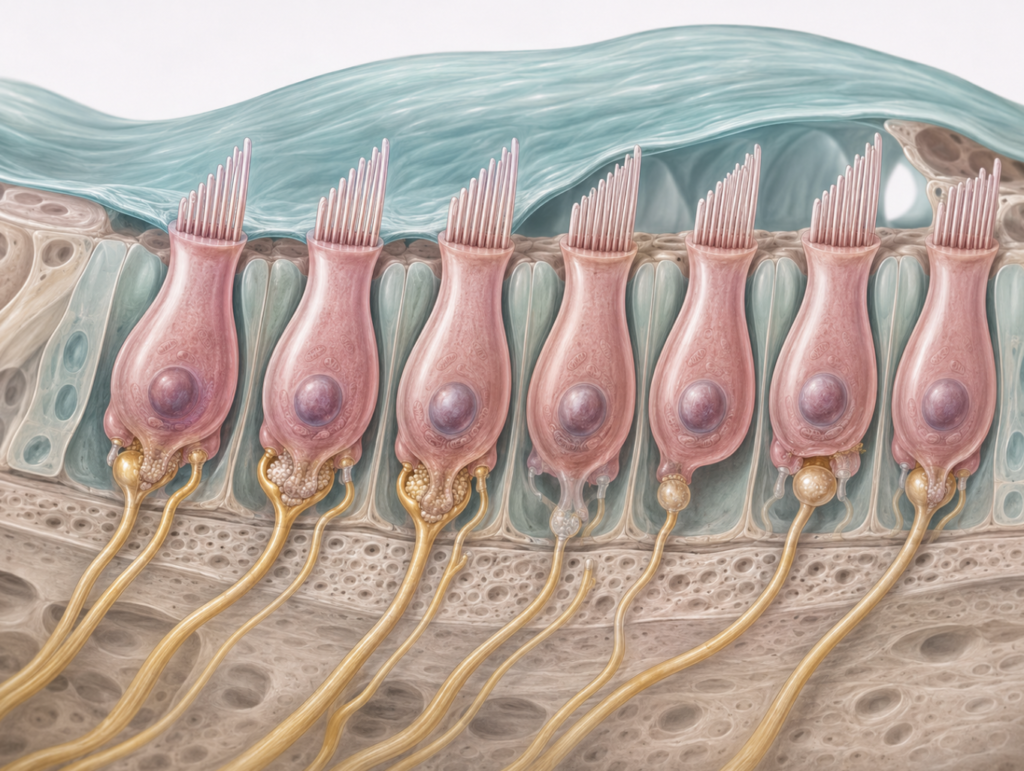
The defensible framing is this: hyperacusis may be a marker of cochlear damage that standard audiometry cannot see, not a prediction of future deafness. A patient with hyperacusis and a normal audiogram deserves extended high-frequency testing and firm noise-protection counseling. They should not be told they are going to lose their hearing.
Genes or Environment?
No twin study has estimated heritability for hyperacusis itself. The closest available figure comes from noise sensitivity, a related trait that aggregates in families: heritability was estimated at 36% in a Finnish twin cohort, with first-degree relatives of noise-sensitive individuals more likely to be sensitive themselves [Heinonen-Guzejev, Genetic Component of Noise Sensitivity, 2005].
Genomic work on misophonia — a neighboring sound-intolerance phenotype — points the same direction. A genome-wide association analysis of a rage-related misophonia symptom found significant genetic correlation with tinnitus, major depression, PTSD, and generalized anxiety disorder (0.12 < rG < 0.22), with stronger correlations to personality clusters covering guilt, neuroticism, irritability, and sensitivity (0.21 < rG < 0.42) [Smit, A Genome-Wide Association Study of a Rage-Related Misophonia Symptom and the Genetic Link with Audiological Traits, Psychiatric Disorders, and Personality, 2023].
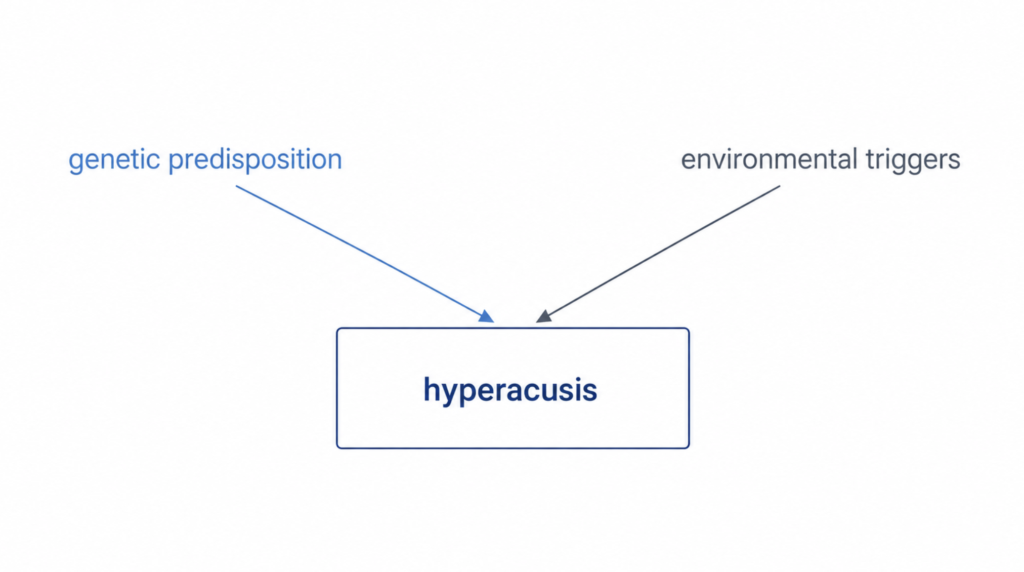
Read together, these suggest genetics contributes a predisposition — perhaps a third of the variance — expressed largely through temperament and stress reactivity rather than through the ear. The triggers are overwhelmingly environmental: acoustic trauma, head injury, migraine, sudden hearing loss, and Bell’s palsy among them. Syndromic causes such as Williams syndrome and autism are a separate category with their own biology; hyperacusis has been documented at far higher rates in autistic populations than in the general population [Williams, Prevalence of Decreased Sound Tolerance (Hyperacusis) in Individuals with Autism Spectrum Disorder: A Meta-Analysis, 2021].
Hyperacusis Symptoms and Causes: Key Takeaways
- Hyperacusis prevalence estimates range from 0.2% to 17.2% in the general population, and that spread reflects the absence of an agreed diagnostic threshold rather than measurement error.
- Hyperacusis is diagnosed clinically; no laboratory, imaging, or electrophysiological test confirms it, and loudness discomfort level testing alone is neither sensitive nor specific enough to serve as a standalone diagnostic.
- Combining an uncomfortable loudness level of ≤77 dB HL with a Hyperacusis Questionnaire score of ≥22 gives 95% agreement between the two criteria — the most practical current standard.
- Applying standard audiometry protocols to hyperacusis patients causes discomfort in roughly one in four; lowering the starting level nearly eliminates it.
- Hyperacusis has not been shown to predict future hearing loss, but it may signal cochlear damage invisible to standard audiometry.
- Heritability of the related trait of noise sensitivity is about 36%, meaning most of the risk is environmental or acquired.
FAQ
Is hyperacusis a real medical condition or is it psychological? It is a real condition with measurable physiological correlates, though it lacks a confirmatory test. Reduced loudness discomfort levels, altered central auditory responses, and elevated extended high-frequency thresholds have all been documented. Psychiatric comorbidity is common — depression in 8–80% and anxiety in 39–61% of patients across studies — but comorbidity is not causation, and much of the distress is plausibly a reaction to the symptom rather than its source.
Can a hearing test diagnose hyperacusis? Not on its own. A standard audiogram is frequently normal in hyperacusis, and more than a third of tested ears in one large series had thresholds of 20 dB HL or better. Loudness discomfort level testing adds information but performs poorly as a solo diagnostic on formal analysis. Diagnosis currently rests on a validated questionnaire plus clinical interview, ideally cross-checked against loudness discomfort levels.
Does hyperacusis mean I will lose my hearing? No evidence supports that. No longitudinal study has shown hyperacusis predicting later hearing loss. What the data do suggest is that hyperacusis can accompany cochlear damage that standard audiometry misses, which is a reason for extended high-frequency testing and careful noise protection — not a reason to expect progressive hearing loss.
Is hyperacusis inherited? Partly. There is no heritability estimate for hyperacusis itself, but the related trait of noise sensitivity shows about 36% heritability in twin data, and genomic work on misophonia points to shared genetics with anxiety, PTSD, and sensitivity-related personality traits. The majority of risk appears environmental.
References
- Tyler RS, Pienkowski M, Roncancio ER, et al. A review of hyperacusis and future directions: part I. Definitions and manifestations. Am J Audiol. 2014;23(4):402-419.
- Ren J, Xu T, Xiang T, et al. Prevalence of hyperacusis in the general and special populations: a scoping review. Front Neurol. 2021;12:706555.
- Paulin J, Andersson L, Nordin S. Characteristics of hyperacusis in the general population. Noise Health. 2016;18(83):178-184.
- Rodrigues ALM, Aazh H. Psychiatric comorbidities in hyperacusis and misophonia: a systematic review. Audiol Res. 2025;15(4):101.
- Sheldrake J, Diehl PU, Schaette R. Audiometric characteristics of hyperacusis patients. Front Neurol. 2015;6:105.
- Auerbach BD, Rodrigues PV, Salvi RJ. Central gain control in tinnitus and hyperacusis. Front Neurol. 2014;5:206.
- Aazh H, Knipper M, Danesh AA, et al. Insights from the Third International Conference on Hyperacusis: causes, evaluation, diagnosis, and treatment. Noise Health. 2018;20(95):162-170.
- Aazh H, Moore BCJ. Incidence of discomfort during pure-tone audiometry and measurement of uncomfortable loudness levels among people seeking help for tinnitus and/or hyperacusis. Am J Audiol. 2017;26(3):226-232.
- Knipper M, Van Dijk P, Nunes I, Rüttiger L, Zimmermann U. Advances in the neurobiology of hearing disorders: recent developments regarding the basis of tinnitus and hyperacusis. Prog Neurobiol. 2013;111:17-33.
- Heinonen-Guzejev M, Vuorinen HS, Mussalo-Rauhamaa H, Heikkilä K, Koskenvuo M, Kaprio J. Genetic component of noise sensitivity. Twin Res Hum Genet. 2005;8(3):245-249.
- Smit DJA, Bakker M, Abdellaoui A, Hoetink AE, Vulink N, Denys D. A genome-wide association study of a rage-related misophonia symptom and the genetic link with audiological traits, psychiatric disorders, and personality. Front Neurosci. 2023;16:971752.
- Williams ZJ, Suzman E, Woynaroski TG. Prevalence of decreased sound tolerance (hyperacusis) in individuals with autism spectrum disorder: a meta-analysis. Ear Hear. 2021;42(5):1137-1150.
- Jacquemin L, Mertens G, Van de Heyning P, Topsakal V. Prevalence of hyperacusis: a systematic review. Otol Neurotol. 2023;44(3):252-260.
- Bigras C, Duda V, Hébert S. Loudness discomfort levels at extended high frequencies in young adults: a potential marker of hyperacusis. Hear Res. 2025;467:109425.
- Rosing SN, Schmidt JH, Wedderkopp N, Baguley DM. Prevalence of tinnitus and hyperacusis in children and adolescents: a systematic review. BMJ Open. 2016;6(6):e010596.
Joonpyo Hong, MD is a board-certified otolaryngologist practicing in Korea. This article reflects his clinical interpretation of published research and does not constitute individual medical advice.
For more interesting content:
https://curiousmd.com/age-related-hearing-loss-hear-not-understand/
https://curiousmd.com/music-genre-and-hearing-loss/
https://curiousmd.com/ai-speech-clarification-hearing-loss/
Link out to:
- Hyperacusis — StatPearls, NCBI Bookshelf: clinician-facing overview of etiology, evaluation, and differential diagnosis, updated January 2026.
- Tinnitus and Hyperacusis — ASHA Practice Portal: the American Speech-Language-Hearing Association’s assessment and management guidance, including loudness discomfort level testing.
- Prevalence of Hyperacusis in the General and Special Populations: A Scoping Review — Frontiers in Neurology: the open-access source for the prevalence figures cited above, covering 42 studies and 34,796 subjects.