
Until very recently, almost nobody had asked what microplastics were doing in the upper airway. The particles themselves changed categories first. For years they were an environmental pollutant, something in the ocean, in the soil, in a photograph of a seabird with a bottle cap in its stomach. Then they started turning up in people: in blood [Leslie, Discovery and Quantification of Plastic Particle Pollution in Human Blood, 2022], in placenta [Ragusa, Plasticenta, 2021], and in liver, kidney, and brain tissue, with brain concentrations higher in autopsy samples collected in 2024 than in samples collected in 2016 [Nihart, Bioaccumulation of Microplastics in Decedent Human Brains, 2025].
That list has a gap. The organs most directly open to the outside world, the nose and throat and ear, were largely missing from it, and the reason was that almost nobody had looked. Research on inhaled particles went straight to the lungs, past the structures built to catch things before they get that far.
The gap has started to close. Some of the findings point at the environment, and at least one points back at the clinic itself.
Why microplastics in the upper airway went unstudied
The nose is not a passive tube. It filters particles, moves a mucus blanket toward the pharynx by ciliary action, humidifies and warms incoming air, and carries out immune surveillance at the epithelial surface [Harkema, The Nose Revisited, 2006]. Anything airborne meets this apparatus before it meets anything else.
Airborne plastic is largely fibrous in shape, shed from synthetic textiles, urban dust, tire wear, and the slow degradation of plastic-containing materials [Dris, Synthetic Fibers in Atmospheric Fallout, 2016]. Many of those fibers fall inside the size range that can be drawn into the respiratory tract, so deposition in the nasal cavity is what the anatomy would predict.
Indoor air matters here, since synthetic fibers accumulate in enclosed spaces where people spend most of their time. The estimates come from breathing-manikin simulations rather than from measurements in actual noses [Vianello, Simulating Human Exposure to Indoor Airborne Microplastics, 2019].
What has actually been found
The nose and the sinuses
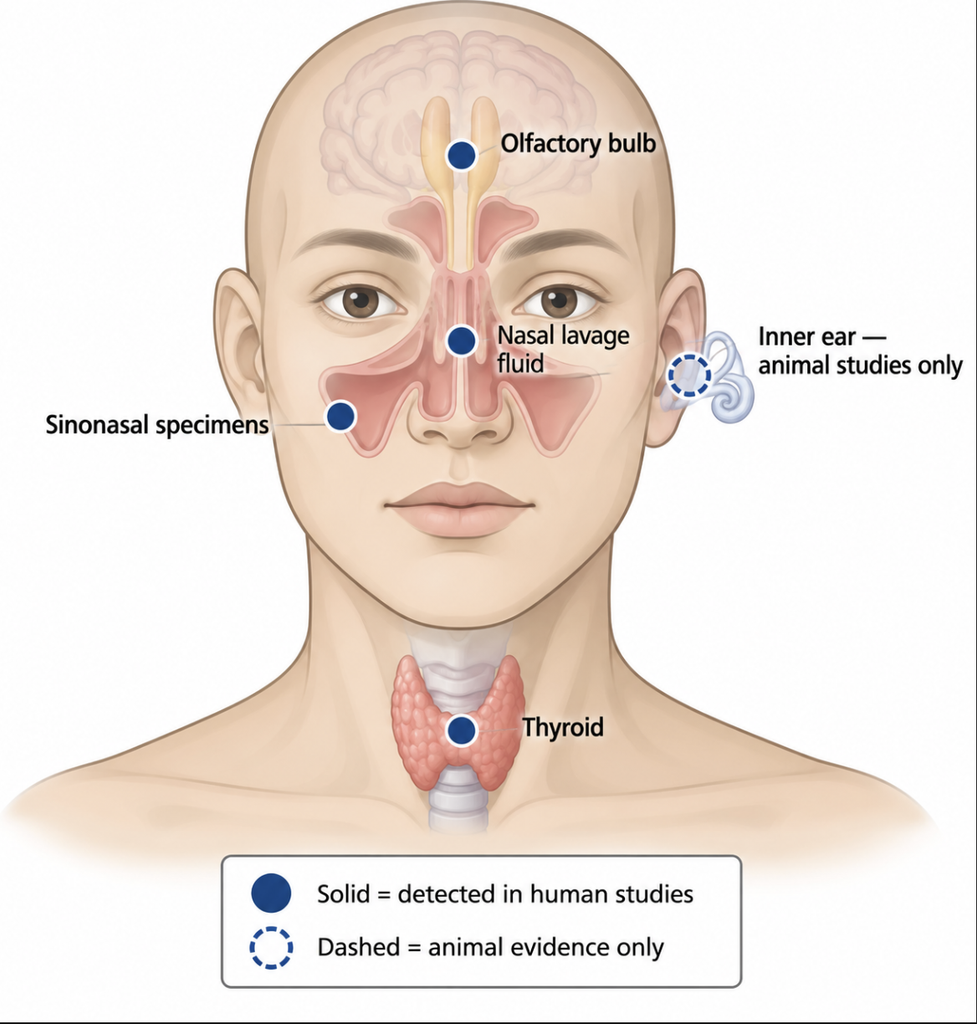
Several independent groups have recovered microplastics from human nasal lavage fluid. One pilot study of eighteen adults measured an average of roughly twenty-eight particles per five milliliters of nasal rinse, spanning eight polymer types in the twenty to three hundred micrometer range [Torres-Agullo, Nasal Lavage Technique Reveals Regular Inhalation Exposure of Microplastics, 2023].
Two case-control studies have gone further and compared patients with disease against controls. In thirty-three patients with allergic rhinitis and twenty-two controls, particle density in the nasal cavity was higher in the rhinitis group [Xue, Preliminary Study of Microplastic in Allergic Rhinitis, 2026]. In fifty patients with chronic rhinosinusitis without nasal polyps and thirty controls, particle counts were again higher in the disease group, and microplastics were detected in every single participant, patient and control alike [Taş, Role of Microplastics in Chronic Rhinosinusitis Without Nasal Polyps, 2024].
Both are early results from single centers with small numbers, and neither can establish which way the causal arrow runs.
The olfactory pathway
One finding sits a step deeper. In a case series of fifteen deceased adults in São Paulo, microplastics were identified in the olfactory bulb of eight, a little over half. Sixteen particles and fibers were recovered in total, polypropylene being the most common at roughly two in five, with particle sizes between five and twenty-six micrometers. Procedural blanks and negative controls came back clean, which matters more than the headline number, because contamination is the standing threat to every study in this field [Amato-Lourenço, Microplastics in the Olfactory Bulb of the Human Brain, 2024].
The anatomy behind this is not in dispute. Olfactory sensory neurons pass through the cribriform plate, giving the nasal cavity a direct structural continuity with the central nervous system that bypasses the vasculature entirely. Whether particles actually travel that route is a separate claim, and a much weaker one. It remains a proposed pathway that has not been demonstrated.
The thyroid and the inner ear
Two further sites extend the picture beyond the airway proper.
In twenty-nine patients with autoimmune thyroiditis matched against twenty-nine patients operated on for thyroid nodules, total microplastic concentration in thyroid tissue was about ten times higher in the autoimmune group, a median of 19.9 versus 1.9 micrograms per gram, with polyvinyl chloride driving most of the difference [Yu ST, Preliminary Evidence of Microplastics in the Human Thyroid, 2026]. The control group here was not healthy volunteers but surgical patients, which limits how far the comparison travels.
Hearing has been examined only in animals. Mice given polyethylene orally for four months accumulated particles in the cochlea and vestibular region, showed raised hearing thresholds and impaired balance, and had reduced glucose metabolism in auditory cortex [Zaheer, Microplastic Polyethylene Induced Inner Ear Dysfunction in Murine Model, 2024]. No equivalent human data exists. The mouse ear differs from the human ear, and four months of forced oral dosing does not resemble ambient environmental exposure.
The limits of what these studies can show
Every association above comes from a cross-sectional or case-control design. That design cannot separate cause from consequence, and there are at least three specific reasons for restraint.
The first is contamination. Synthetic fibers are ubiquitous in clinical and laboratory environments, including the air of the room where a specimen is processed. Without filtered reagents, procedural blanks, and non-synthetic laboratory materials, a study can end up measuring its own equipment [Min, Microplastics in the Human Nasal Cavity and Upper Airway, 2026]. When a study reports particles in one hundred percent of participants including controls, that result is compatible with universal exposure and equally compatible with universal contamination.
The second is mechanism. Laboratory work shows that polypropylene particles can stimulate immune cells and raise cytokine and histamine levels under specific conditions of high concentration and small particle size, though overall cytotoxicity in that work was low [Hwang, An Assessment of the Toxicity of Polypropylene Microplastics in Human Derived Cells, 2019]. Epithelial barrier disruption and impaired mucociliary clearance have been proposed as the route from particle to disease. Proposed is the operative word, since none of these mechanisms has been demonstrated in human sinonasal tissue.
The third is that chronic rhinosinusitis is multifactorial, shaped by both host and environmental factors [Min, Microplastics in the Human Nasal Cavity and Upper Airway, 2026]. A single environmental particle class is unlikely to be an isolated cause of anything.
Current evidence is insufficient to establish that microplastics cause any rhinologic disease, and insufficient even to determine whether they are a driver of inflammation or simply a marker of living in a polluted environment [Min, Microplastics in the Human Nasal Cavity and Upper Airway, 2026].
The devices clinicians hand their patients
The finding most relevant to otolaryngologists points back at the clinic.
A group in Seoul bought commercially available polypropylene nasal irrigation bottles and simulated one, three, and six months of reuse. In rinse fluid from new bottles they found an average of about thirty-three particles per three hundred milliliters. After simulated three-month reuse that figure was roughly 262, close to an eightfold rise. Six-month bottles came in lower, around 204, so the relationship is not a clean upward line. Most particles were fragment-shaped, between ten and one hundred micrometers, and predominantly polypropylene, matching the bottle material itself [Kim KS, Measurement of Microplastic Release After the Use of Polypropylene Nasal Irrigation Bottles, 2024].
This reframes the earlier nasal lavage studies. The first paper to identify microplastics in nasal irrigation fluid noted in its own results that the polypropylene it detected was the principal material of the device nozzle [Kim SH, Identification and Characterization of Microplastics in Nasal Irrigation Fluids, 2024]. Some fraction of what has been measured “in the nose” may have arrived from the bottle seconds earlier.
The authors of the bottle study did not recommend abandoning irrigation. They recommended developing guidance on how long a bottle should be used, which is a materially different conclusion and the correct one.
Continuous positive airway pressure devices attracted similar suspicion, on the reasoning that tubing degradation and humidification might shed particles into the airway. That hypothesis has now been tested. Among forty-two patients with obstructive sleep apnea (twenty-one regular CPAP users and twenty-one who had not started therapy), total microplastic counts in nasal lavage did not differ between groups. Only one of fifteen identified polymers, ethylene vinyl acetate, was higher in the CPAP group. Particle counts did correlate with inflammatory markers including interleukin-1 beta and interleukin-6, but that correlation appeared in both groups and says nothing about the device [Mauad, Does the Use of CPAP Devices Pose a Risk of Microplastic Exposure to the Upper Airway?, 2026].
Disposable face masks followed the same arc. Laboratory work confirmed that mask materials shed particles under stretching, friction, and ultraviolet exposure [Sullivan, An Investigation into the Leaching of Micro and Nano Particles from Disposable Face Masks, 2021]. The human nasal lavage study found no association between mask use and particle burden [Torres-Agullo, Nasal Lavage Technique Reveals Regular Inhalation Exposure of Microplastics, 2023].
Can anyone measure the burden?
Patients ask a simple question: how much of this is in the body? The honest answer is that no clinical test can say.
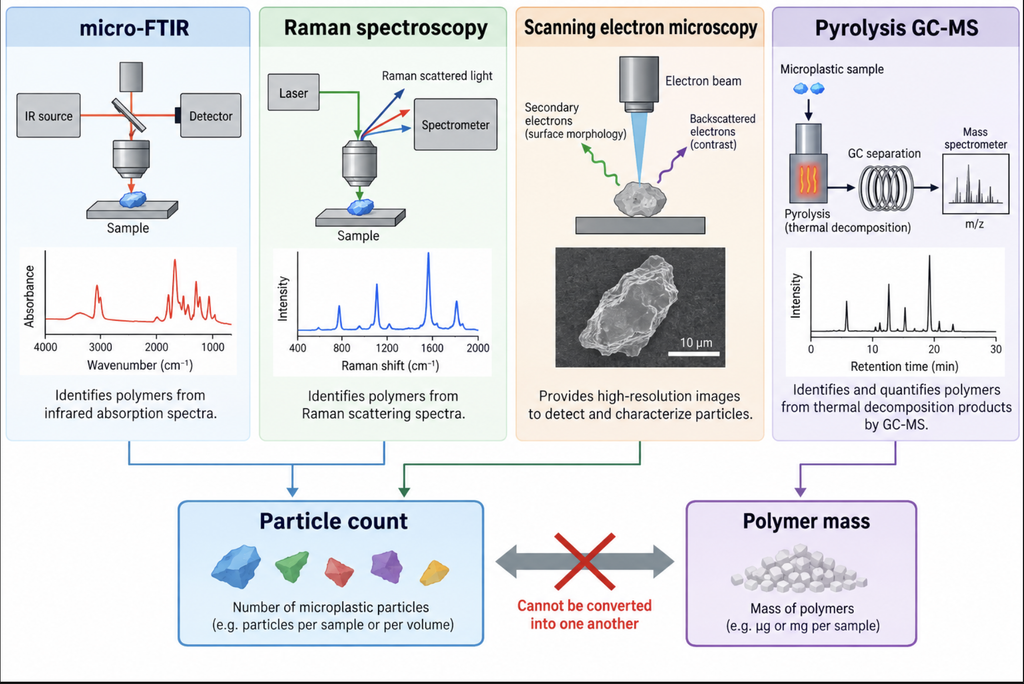
Four techniques dominate the research literature, and they do not measure the same thing [Shim, Identification Methods in Microplastic Analysis, 2017; Min, Microplastics in the Human Nasal Cavity and Upper Airway, 2026].
| Method | What it measures | Principal limitation |
|---|---|---|
| Micro-Fourier-transform infrared spectroscopy (μFTIR) | Polymer identity of individual particles | Spatial resolution falls off below roughly 10 to 20 μm |
| Raman spectroscopy | Polymer identity at finer resolution | Fluorescence interference; slow throughput |
| Scanning electron microscopy (with or without elemental analysis) | Particle shape, surface, size | Cannot confirm polymer composition alone |
| Pyrolysis gas chromatography-mass spectrometry (Py-GC/MS) | Total polymer mass | Particles are destroyed; matrix interference |
Py-GC/MS has become the default for quantifying mass, which makes its limitations consequential. A dedicated validation study in human blood found extraction recoveries ranging from 7 to 109 percent, meaning that in the worst case more than nine of every ten particles present went uncounted. Realistic detection limits ran up to twenty times higher than the nominal figures calculated in pure water. The authors concluded that the method is currently unsuitable for polyethylene and polyvinyl chloride in biological matrices, and that plausible human exposure concentrations sit uncomfortably close to the technique’s floor [Rauert, Assessing the Efficacy of Pyrolysis-GC-MS for Nanoplastic and Microplastic Analysis in Human Blood, 2025].
There is a deeper problem than any single method. A particle count from Raman microscopy and a polymer mass from Py-GC/MS answer different questions and cannot be converted into one another. Without a harmonized measurand, results across studies are not comparable, and laboratory-medicine commentary has argued that microplastic testing belongs to research biomonitoring, occupational surveillance, and translational cohorts rather than to individual patient care [Alum, Micro- and Nanoplastics as Emerging Clinical Analytes, 2026].
Nasal lavage has been proposed as a non-invasive window onto inhalation exposure, which is an appealing idea for an otolaryngologist [Torres-Agullo, Nasal Lavage Technique Reveals Regular Inhalation Exposure of Microplastics, 2023]. It also runs directly into the bottle problem described above, since the device doing the sampling may release the particles the sample is meant to detect.
Where exposure is headed
The trajectory is not encouraging, and the reasons are structural rather than scientific.
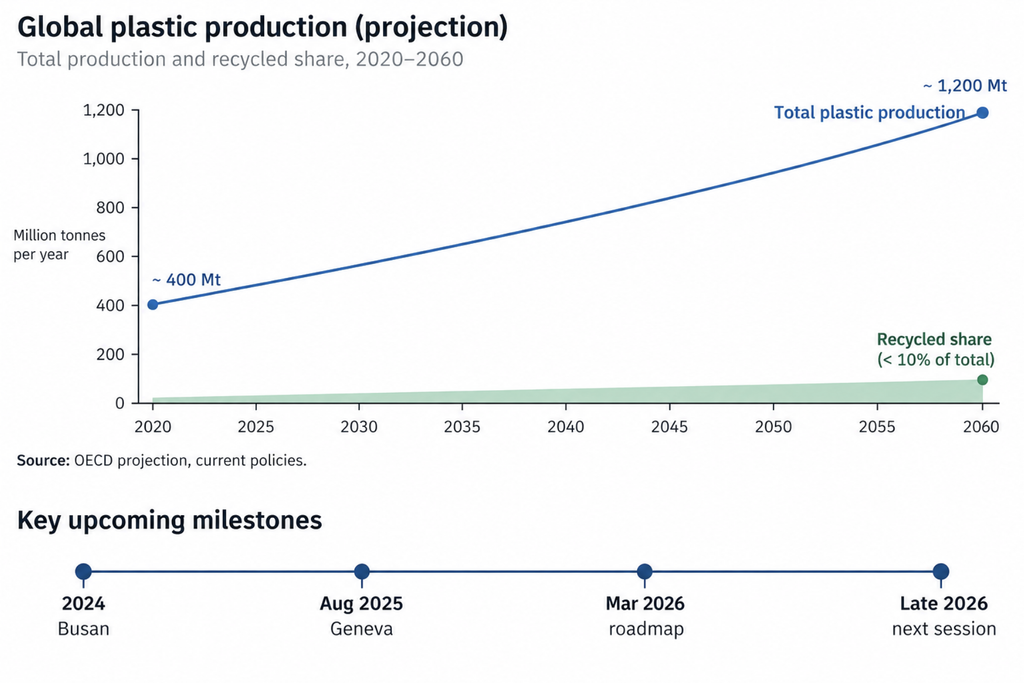
Under current policy, the Organisation for Economic Co-operation and Development projects that global plastic production will roughly triple by 2060, with waste reaching about 1.7 billion tonnes and recycling remaining below one tenth of output [OECD, Global Plastics Outlook, 2022].
International negotiation has stalled. The session convened to finalize a legally binding global plastics treaty, held in Geneva from 5 to 15 August 2025, closed without consensus, following an earlier failure in Busan in 2024 [De-la-Torre, Deadlock at INC-5.2, 2026]. The process remains unfinished: a roadmap issued in March 2026 set out informal meetings ahead of a next formal session expected no earlier than late 2026 [Climate Home News, Roadmap to Restart Deadlocked Plastics Treaty Talks, 2026].
Even a production freeze would not produce an immediate fall in exposure. Plastic already in the environment continues to fragment into smaller pieces, so ambient particle counts are expected to rise for some time regardless of what is manufactured next.
Individual measures exist, though their evidence is narrower than the advice columns imply. Boiling hard water (above 120 milligrams per liter of calcium carbonate) removed at least 80 percent of polystyrene, polyethylene, and polypropylene particles in laboratory testing, with soft water managing around a quarter [Yu Z, Drinking Boiled Tap Water Reduces Human Intake of Nanoplastics and Microplastics, 2024]. Tap water generally carries fewer particles than bottled [Gambino, Occurrence of Microplastics in Tap and Bottled Water, 2022]. A single plastic teabag steeped at 95 degrees Celsius released roughly 11.6 billion micro-sized and 3.1 billion nano-sized particles into one cup [Hernandez, Plastic Teabags Release Billions of Microparticles and Nanoparticles into Tea, 2019]. That number is worth stating carefully, since it measures what leaves the bag rather than what stays in the body, and it applies to plastic mesh and heat-sealed bags rather than to paper or loose leaf.
Complete avoidance is not possible, but the dose can still be reduced.
Clinical Perspective. In the consulting room the question arrives as: should saline irrigation be stopped? It should not. Current guidelines recommend saline nasal irrigation, intranasal corticosteroids, or both for symptom relief in chronic rhinosinusitis, though the comparison against simple sprays remains unsettled and the recommendation is weaker for acute and viral disease [Payne, Clinical Practice Guideline: Adult Sinusitis Update, 2025]. There is no reason to give up an established benefit for a risk that has not been established. The reasonable adjustment is a small one: replace the bottle on a sensible schedule.
Key takeaways
- Microplastics have been detected in human nasal lavage fluid, sinonasal disease specimens, thyroid tissue, and the olfactory bulb, which covers every anatomical site where investigators have so far looked.
- The olfactory nerve provides a direct anatomical link between the nasal cavity and the brain, but whether particles travel it remains a proposed pathway that has not been demonstrated.
- No study has established that microplastics cause any disease of the nose, sinuses, or throat. The association studies cannot distinguish cause from marker.
- Evidence that microplastics affect hearing comes entirely from animal models and should not be extended to people.
- No validated clinical test measures a person’s microplastic burden, and particle-count and polymer-mass methods produce results that cannot be compared.
- Polypropylene nasal irrigation bottles release particles with repeated use, which argues for replacing them on schedule rather than for abandoning irrigation.
FAQ
Can microplastics cause sinus problems or allergic rhinitis? Not proven. Patients with chronic rhinosinusitis and with allergic rhinitis have shown higher particle counts in nasal rinse fluid than controls, but these are small single-center comparisons that cannot separate cause from consequence. Particles were found in every participant in one study, including healthy controls [Taş, Role of Microplastics in Chronic Rhinosinusitis Without Nasal Polyps, 2024].
Is there a blood test for microplastics? No. No harmonized clinical assay exists, reference ranges have not been established, and the two dominant laboratory methods measure different quantities that cannot be converted into one another [Alum, Micro- and Nanoplastics as Emerging Clinical Analytes, 2026].
Do nasal rinse bottles release microplastics? Should irrigation stop? Yes to the first, no to the second. Polypropylene bottles shed particles with reuse, rising substantially by a simulated three months of use, and the investigators recommended guidance on replacement intervals rather than discontinuation [Kim KS, Measurement of Microplastic Release After the Use of Polypropylene Nasal Irrigation Bottles, 2024].
Does CPAP increase microplastic exposure? Apparently not. In a pilot study of forty-two patients with obstructive sleep apnea, regular CPAP users and non-users had similar total particle counts in nasal lavage fluid [Mauad, Does the Use of CPAP Devices Pose a Risk of Microplastic Exposure to the Upper Airway?, 2026].
References
- Nihart AJ, Garcia MA, El Hayek E, et al. Bioaccumulation of microplastics in decedent human brains. Nat Med. 2025;31(4):1114-1119. https://doi.org/10.1038/s41591-024-03453-1
- Min HJ. Microplastics in the human nasal cavity and upper airway: emerging evidence and rhinologic implications. J Rhinol. 2026;33(2):81-86. https://doi.org/10.18787/jr.2026.00020
- Amato-Lourenço LF, Dantas KC, Júnior GR, et al. Microplastics in the olfactory bulb of the human brain. JAMA Netw Open. 2024;7(9):e2440018. https://doi.org/10.1001/jamanetworkopen.2024.40018
- Torres-Agullo A, Karanasiou A, Lacorte S. Nasal lavage technique reveals regular inhalation exposure of microplastics, not associated from face mask use. Environ Int. 2023;178:108129. https://doi.org/10.1016/j.envint.2023.108129
- Kim SH, Kim J, Park SA, Jung J, Kim KS, Min HJ. Identification and characterization of microplastics in nasal irrigation fluids: a preliminary study. Int Forum Allergy Rhinol. 2024;14(1):135-137. https://doi.org/10.1002/alr.23239
- Kim KS, Min HJ. Measurement of microplastic release after the use of polypropylene nasal irrigation bottles. Clin Exp Otorhinolaryngol. 2024;17(4):310-316. https://doi.org/10.21053/ceo.2024.00182
- Taş BM, Tuna A, Başaran Kankılıç G, et al. Role of microplastics in chronic rhinosinusitis without nasal polyps. Laryngoscope. 2024;134(3):1077-1080. https://doi.org/10.1002/lary.30926
- Xue J, Li X, Lv X, Xue J. Preliminary study of microplastic in allergic rhinitis. Ear Nose Throat J. 2026;105(5):289-294. https://doi.org/10.1177/01455613251374489
- Yu ST, Fu J, Fan Z, Ye Q, Zhang S, Guan H. Preliminary evidence of microplastics in the human thyroid and their potential association with autoimmune thyroiditis. Thyroid. 2026;36(6):693-697. https://doi.org/10.1177/10507256261442506
- Zaheer J, Lee HS, Kim S, et al. Microplastic polyethylene induced inner ear dysfunction in murine model. J Hazard Mater. 2024;476:135193. https://doi.org/10.1016/j.jhazmat.2024.135193
- Mauad T, Carvalho-Oliveira R, Faria CS, Fahl K, Antonangelo L, Cahali MB. Does the use of continuous positive airway pressure devices pose a risk of microplastic exposure to the upper airway? A pilot study. J Clin Sleep Med. 2026;22(1):25. https://doi.org/10.1007/s44470-025-00021-3
- Rauert C, Charlton N, Bagley A, Dunlop SA, Symeonides C, Thomas KV. Assessing the efficacy of pyrolysis–gas chromatography–mass spectrometry for nanoplastic and microplastic analysis in human blood. Environ Sci Technol. 2025;59(4):1984-1994. https://doi.org/10.1021/acs.est.4c12599
- Alum EU, Uti DE. Micro- and nanoplastics as emerging clinical analytes: analytical validation, interpretive uncertainty, and laboratory actionability in human specimens. Clin Chim Acta. 2026;592:121214. https://doi.org/10.1016/j.cca.2026.121214
- Payne SC, McKenna M, Buckley J, et al. Clinical practice guideline: adult sinusitis update. Otolaryngol Head Neck Surg. 2025;173(Suppl 1):S1-S56. https://doi.org/10.1002/ohn.1344
- Hwang J, Choi D, Han S, Choi J, Hong J. An assessment of the toxicity of polypropylene microplastics in human derived cells. Sci Total Environ. 2019;684:657-669. https://doi.org/10.1016/j.scitotenv.2019.05.071
- Hernandez LM, Xu EG, Larsson HCE, Tahara R, Maisuria VB, Tufenkji N. Plastic teabags release billions of microparticles and nanoparticles into tea. Environ Sci Technol. 2019;53(21):12300-12310. https://doi.org/10.1021/acs.est.9b02540
- Harkema JR, Carey SA, Wagner JG. The nose revisited: a brief review of the comparative structure, function, and toxicologic pathology of the nasal epithelium. Toxicol Pathol. 2006;34(3):252-269. https://doi.org/10.1080/01926230600713475
- Dris R, Gasperi J, Saad M, Mirande C, Tassin B. Synthetic fibers in atmospheric fallout: a source of microplastics in the environment? Mar Pollut Bull. 2016;104(1-2):290-293. https://doi.org/10.1016/j.marpolbul.2016.01.006
- Vianello A, Jensen RL, Liu L, Vollertsen J. Simulating human exposure to indoor airborne microplastics using a breathing thermal manikin. Sci Rep. 2019;9(1):8670. https://doi.org/10.1038/s41598-019-45054-w
- Sullivan GL, Delgado-Gallardo J, Watson TM, Sarp S. An investigation into the leaching of micro and nano particles and chemical pollutants from disposable face masks. Water Res. 2021;196:117033. https://doi.org/10.1016/j.watres.2021.117033
- Gambino I, Bagordo F, Grassi T, Panico A, De Donno A. Occurrence of microplastics in tap and bottled water: current knowledge. Int J Environ Res Public Health. 2022;19(9):5283. https://doi.org/10.3390/ijerph19095283
- Organisation for Economic Co-operation and Development. Global Plastics Outlook: Policy Scenarios to 2060. Paris: OECD Publishing; 2022. https://www.oecd.org/en/publications/global-plastics-outlook_aa1edf33-en.html
- Leslie HA, van Velzen MJM, Brandsma SH, Vethaak AD, Garcia-Vallejo JJ, Lamoree MH. Discovery and quantification of plastic particle pollution in human blood. Environ Int. 2022;163:107199. https://doi.org/10.1016/j.envint.2022.107199
- Ragusa A, Svelato A, Santacroce C, et al. Plasticenta: first evidence of microplastics in human placenta. Environ Int. 2021;146:106274. https://doi.org/10.1016/j.envint.2020.106274
- Yu Z, Wang JJ, Liu LY, Li Z, Zeng EY. Drinking boiled tap water reduces human intake of nanoplastics and microplastics. Environ Sci Technol Lett. 2024;11(3):273-279. https://doi.org/10.1021/acs.estlett.4c00081
- De-la-Torre GE, Walker TR. Deadlock at INC-5.2: understanding the blocked progress of the Global Plastics Treaty negotiations. Cambridge Prisms: Plastics. 2026;4:e8. https://doi.org/10.1017/plc.2026.10044
- Climate Home News. Roadmap launched to restart deadlocked UN plastics treaty talks. Published March 18, 2026. https://www.climatechangenews.com/2026/03/18/roadmap-launched-to-restart-deadlocked-un-plastics-treaty-talks/
- Shim WJ, Hong SH, Eo SE. Identification methods in microplastic analysis: a review. Anal Methods. 2017;9(9):1384-1391. https://doi.org/10.1039/C6AY02558G
Joonpyo Hong, MD is a board-certified otolaryngologist practicing in Korea. This article reflects his clinical interpretation of published research and does not constitute individual medical advice.
This article is not intended to advertise or promote any specific company or product.
For more articles:
https://curiousmd.com/is-covid-over-2026/
https://curiousmd.com/skipping-antibiotic-doses/
https://curiousmd.com/antibiotics-vs-antivirals-why-antivirals-are-rare/
Link out to:
https://www.entnet.org/resource/cpg-adult-sinusitis-update/
https://www.unep.org/about-un-environment/inc-plastic-pollution
https://www.oecd.org/en/about/news/press-releases/2022/06/global-plastic-waste-set-to-almost-triple-by-2060.html
https://www.nih.gov/news-events/nih-research-matters/plastic-particles-bottled-water