
Pinch your nose shut, drop a jelly bean in your mouth, and start chewing. For the first few seconds you get sweetness and almost nothing else. Let go of your nose, and the flavor — strawberry, buttered popcorn, whatever it happens to be — arrives all at once. That little party trick exposes the outsized role of smell in flavor, and one of the stranger facts about eating: most of what you call “taste” never happens on your tongue.
This matters far beyond jelly beans. It explains why food turns to cardboard during a head cold, why a lost sense of smell can quietly drain the joy out of meals, and why the tongue gets credit for work the nose is actually doing. Here is what smell really contributes to flavor, and why an ear, nose, and throat physician thinks about it every week.
Taste Is Not Flavor: The Difference Most People Miss
The first thing to untangle is vocabulary, because “taste” and “flavor” are not the same thing. Taste is what the tongue does, and it is surprisingly limited: sweet, salty, sour, bitter, and umami (the savory taste of glutamate). That is the entire palette of taste — five qualities, no more.
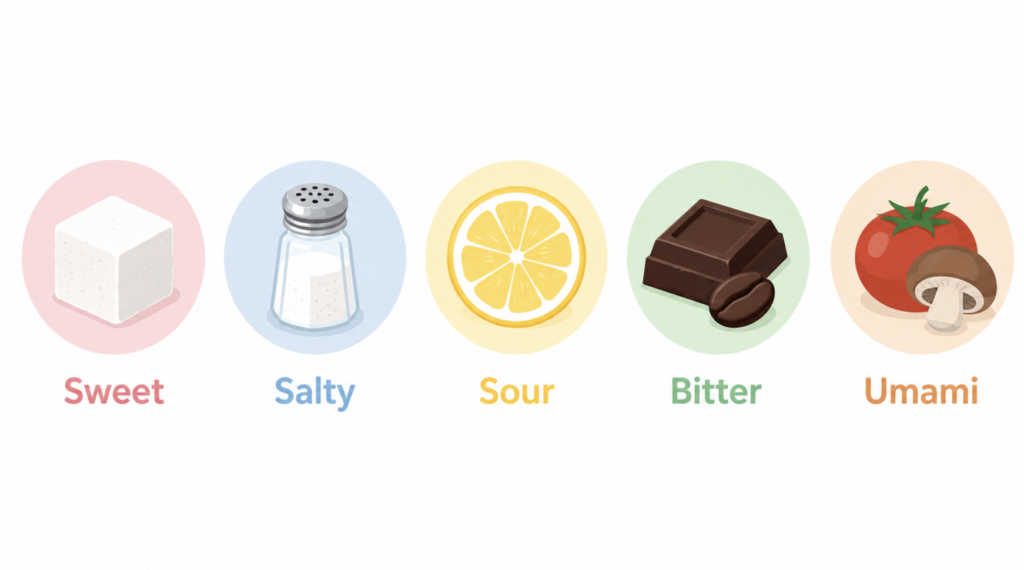
Flavor is the bigger, richer experience your brain assembles when you eat. It combines taste with smell, the texture and temperature of food, and a third chemical sense called chemesthesis — the burn of chili, the tingle of carbonation, the cool of menthol — carried to the brain by the trigeminal nerve, the fifth cranial nerve. When you bite into a strawberry and perceive “strawberry,” your tongue only reports “sweet” and “a little sour.” Everything that makes it specifically a strawberry — and not a cherry or a raspberry — comes from smell.
So the honest version of the sentence is this: the tongue tastes, but the nose flavors. Reviews of the sensory science describe olfaction as a critical element of fully experiencing flavor, not an optional garnish [Goldberg, Factors affecting the ortho- and retronasal perception of flavors: A review, 2017].
How Much of “Taste” Is Actually Smell? Role of Smell in Flavor
You have probably heard a confident number here — that 80 or even 90 percent of taste is really smell. It is a great hook, and it points in the right direction, but it deserves an asterisk.
There is no clean experiment that has pinned down a single percentage, and the figure varies depending on the food and how you measure it. What is solid is the direction of the effect: smell dominates flavor, and the five tongue tastes are the smaller contribution. A more useful way to say it is that the basic tastes form the skeleton of a flavor, while smell fills in nearly all of the detail. Treat “80 percent” as a memorable estimate, not a measured constant.
The Hidden Back Door: Retronasal Smell
Here is the part that surprises people. You smell food two completely different ways, and only one of them feels like smelling.
The first route is orthonasal — air moving in through your nostrils when you lean over a cup of coffee and inhale. That is the smelling everyone knows. The second route is retronasal, and it is the secret engine of flavor. When you chew and swallow, warm volatile molecules rise from your mouth, travel back through the oropharynx, up through the nasopharynx, and reach the same smell receptors high in your nose — this time from behind [Goldberg, Factors affecting the ortho- and retronasal perception of flavors: A review, 2017].
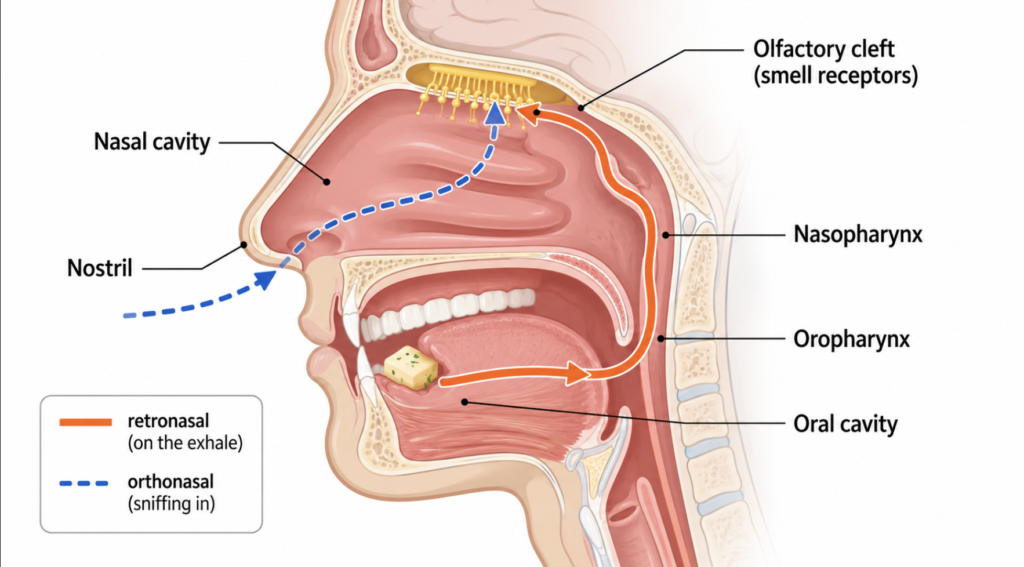
That is why the jelly bean trick works. Pinching your nose closes the retronasal path, so the aroma molecules never reach the receptors and the candy collapses into plain sweetness. It also reframes a common scene: when someone laughs mid-sip and sends a drink out their nose, they are demonstrating that the mouth and the nasal cavity are one connected space. Because this back-door smelling happens while you are busy eating, your brain files the whole experience under “taste” — which is exactly why the nose’s contribution goes unnoticed.
Why a Cold Makes Food Taste Bland
Now the everyday mystery solves itself. When you have a cold and complain that you “can’t taste anything,” your tongue is usually working fine. You can still detect sweet and salty. What has failed is the retronasal route: swollen, congested nasal passages block the aroma molecules from reaching your smell receptors, so flavor flattens into the five bare tastes.
This is not just a head-cold curiosity. People with genuine olfactory dysfunction rate food as less pleasant, less intense, and less appetizing than people with a normal sense of smell, and they like specific foods, such as chocolate, measurably less [Zang, Influence of olfactory dysfunction on the perception of food, 2019]. The tongue is intact; the flavor is gone — which is exactly what you would predict once you know where flavor really comes from.

Clinical Perspective
Outside the laboratory, this stops being a fun fact and becomes a quality-of-life issue. When people lose their sense of smell, the complaint that dominates is rarely about missing perfume or fresh-cut grass — it is that food has become boring and meals feel like a chore.
The evidence bears this out. In patients with olfactory loss, it is the decline in flavor perception during eating and drinking — more than the loss of ordinary nose-first smelling — that most strongly tracks with reduced quality of life [Liu, Self-perceived taste and flavor perception: associations with quality of life in patients with olfactory loss, 2020]. Some patients still report flavor enjoyment despite measurable smell loss, likely because the brain leans on memory and cross-modal cues to fill the gap [Liu, Retronasal olfactory function in patients with smell loss but subjectively normal flavor perception, 2020]. The clinical takeaway is that “just” losing smell is never just losing smell — it reaches the dinner table, and from there into mood, nutrition, and social life.
Key Takeaways
- Taste is only five qualities — sweet, salty, sour, bitter, and umami — while flavor is the brain’s blend of taste, smell, texture, and chemesthesis (the trigeminal “chemical” sense behind chili heat and carbonation).
- Most of what you experience as “taste” is actually smell delivered through the retronasal route, from the mouth up to the nose.
- The widely quoted “80 to 90 percent of taste is smell” is a useful estimate, not a precisely measured figure.
- A cold makes food bland because congestion blocks aroma from reaching smell receptors, not because the tongue stops working.
- For patients with smell loss, the most distressing part is often the loss of flavor at meals, which closely tracks reduced quality of life.
FAQ
Is flavor taste or smell? Both, but smell does most of the work. Taste contributes the five basic qualities your tongue detects, while smell supplies nearly all of the specific character that lets you tell strawberry from cherry. The brain merges the two into the single experience we call flavor.
Why does food taste bland when you have a cold? Because your tongue is fine but your nose is blocked. Congestion stops aroma molecules from reaching the smell receptors through the retronasal route, so you are left with only the five basic tastes. The “taste” you lost was mostly smell all along.
Can you taste without smell? You can still detect the five basic tastes — sweetness, salt, sourness, bitterness, and umami — without smell. What disappears is flavor: the rich, specific identity of a food. That is why people who lose their sense of smell often say food has become dull or boring.
References
- Goldberg EM, Wang K, Goldberg J, Aliani M. Factors affecting the ortho- and retronasal perception of flavors: a review. Crit Rev Food Sci Nutr. 2017;58(6):913-923.
- Zang Y, Han P, Burghardt S, Knaapila A, Schriever V, Hummel T. Influence of olfactory dysfunction on the perception of food. Eur Arch Otorhinolaryngol. 2019;276(10):2811-2817.
- Liu DT, Besser G, Prem B, Sharma G, Speth MM, Sedaghat AR, Mueller CA. Self-perceived taste and flavor perception: associations with quality of life in patients with olfactory loss. Otolaryngol Head Neck Surg. 2020;164(6):1330-1336.
- Liu DT, Besser G, Renner B, Seyferth S, Hummel T, Mueller CA. Retronasal olfactory function in patients with smell loss but subjectively normal flavor perception. Laryngoscope. 2020;130(7):1629-1633.
Joonpyo Hong, MD is a board-certified otolaryngologist practicing in Korea. This article reflects his clinical interpretation of published research and does not constitute individual medical advice.
For more interesting contents:
https://curiousmd.com/ai-electronic-nose/
https://curiousmd.com/smell-loss-parkinsons-alzheimers-ai-biomarker/
Link out to:
https://www.nidcd.nih.gov/health/smell-disorders
https://doi.org/10.1080/10408398.2016.1231167