
Google health AI now covers almost every step of care. In 2026, Google launched a paid health coach that can read medical records. Its DeepMind lab announced an AI co-clinician that talks with patients under a doctor’s authority. Google also published its own method for grading health AI.
Clinicians need to know whether any of it has been tested on real patients. Earlier CuriousMD reviews covered four other tools: a personal health agent, a diagnostic benchmark, Claude for Healthcare, and OpenEvidence. For those four tools and Google’s three releases, the answer is mostly no. The evidence comes from benchmarks, simulations, and company metrics rather than from real patients and real outcomes.
What Google Health AI Released in 2026
Google’s three releases are a product, a research system, and an evaluation method. The Health Coach is the product. Google announced it on May 7, 2026, and the rollout began May 19 [Abramson, Google Health Coach, 2026].
The AI co-clinician is the research system. DeepMind announced it on April 30, 2026, and says it is not meant for diagnosis or treatment [Karthikesalingam, AI Co-Clinician, 2026]. The evaluation framework is the method, and Google published it on November 4, 2026 [Montgomery-Taylor, Evaluating Health AI at Scale, 2026].
Each kind supports a different claim, so reading all three as one “launch” blurs what each can show. Paying customers use a product today, and a research system is tested in controlled settings. A method describes how a company grades its own models.
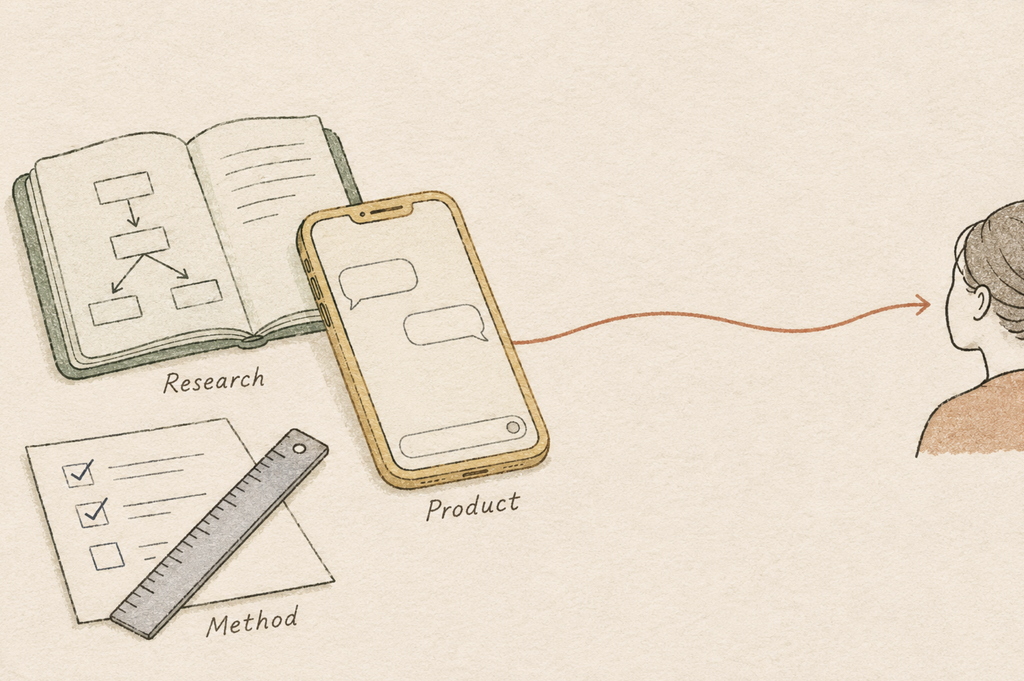
Only one of the three is available to patients today, and it has the least public evidence. The co-clinician has more published test data, but none of it comes from real patients. On October 29, 2026, Google said it is evaluating the co-clinician tool with Singapore’s National University Health System [Google, Partnering with Singapore, 2026]. No results from that work have been published.
Health Coach: A Research Agent Becomes a Subscription
The Health Coach runs on Gemini inside the Google Health app, which replaced the Fitbit app. It covers fitness, sleep, nutrition, and cycle tracking, and it can read linked medical records. Record syncing works only in the U.S. Google first announced record linking on March 17, 2026, as a U.S. preview [Thng, Fitbit’s Personal Health Coach, 2026]. The coach costs $9.99 a month or $99 a year in the U.S. Google labels it “not intended for medical purposes” [Abramson, Google Health Coach, 2026].
Google lists its personal health agent paper among the research behind the coach. It has not said which parts, if any, are in the product [Patel, Research Behind the Personal Health Coach, 2025]. That paper, now in Nature, describes in detail how such a system behaves.
In Google’s own study, the domain-expert sub-agent beat the base Gemini model only slightly on exam questions: 83.6% versus 81.8%. Yet 17 lay raters, judging 50 questions, rated its answers trustworthy 96.9% versus 38.7% of the time. Five clinicians then reviewed health summaries for 30 participants. They found possible harm in some: 15% mild and 2% moderate to severe [Heydari, The Anatomy of a Personal Health Agent, 2026].
The gap between trust and accuracy matters more once the coach can read lab results. A separate preregistered trial enrolled 1,298 participants and used ten written scenarios. Language models alone named the right condition 94.9% of the time. People using the same models did so in fewer than 34.5% of cases, no better than controls [Bean, Reliability of LLMs as Medical Assistants, 2026]. The authors traced the failures to the interaction between people and the models, which is where a patient-facing coach operates.
As of November 2026, Google has published research on earlier prototypes. It has not published a peer-reviewed study of the Health Coach product’s accuracy, safety, or health effects. Google says the coach was checked for safety, accuracy, and other qualities with more than 100,000 hours of human evaluation [Patel, Research Behind the Personal Health Coach, 2025]. The results of that work are not public.
Regulation leaves a similar gap. FDA revised its general wellness guidance on January 6, 2026, and that guidance excludes products that name specific diseases [King & Spalding, FDA Updates General Wellness and CDS Guidance, 2026]. Whether summarizing medical records crosses that line has not been publicly addressed.
AI Co-Clinician: An Agent That Works Under the Doctor
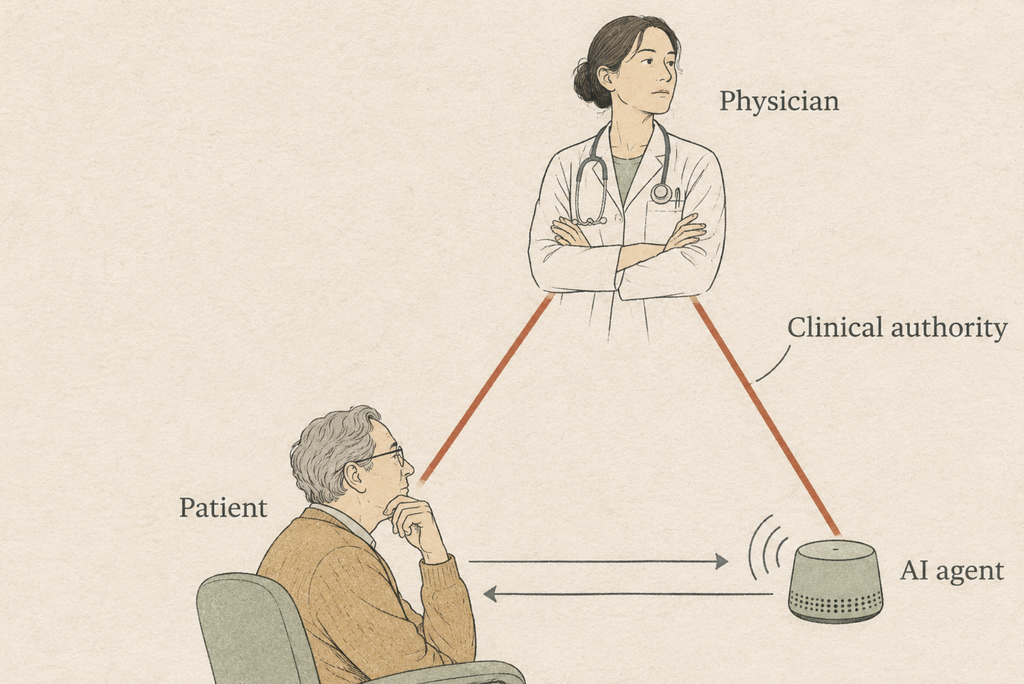
DeepMind built the co-clinician around what it calls triadic care. In this model, AI agents help patients during their care, under the clinical authority of their physician [Karthikesalingam, AI Co-Clinician, 2026]. The system uses live voice and video, not only text. Its technical paper describes a real-time telemedicine consultation with audio and visual cues [Shah, Conversational Medical AI with Eyes, Ears and a Voice, 2026].
DeepMind’s own tests show promising early results. In blinded comparisons, physicians preferred its answers over two widely used AI systems. In 97 of 98 primary care queries, its answer had zero critical errors [Karthikesalingam, AI Co-Clinician, 2026].
The team also ran a randomized crossover simulation. It covered 120 simulated visits across 20 scenarios, with 10 internal medicine residents playing the patients [Shah, Conversational Medical AI with Eyes, Ears and a Voice, 2026]. The AI matched or beat primary care doctors on 68 of 140 measures. The doctors still did better overall, most clearly on red flags and on guiding the physical exam [Karthikesalingam, AI Co-Clinician, 2026].
Microsoft’s MAI-DxO is the closest comparison. It also splits work among several AI roles. It reached 83.2% and 80.3% accuracy on two case sets, versus 36.1% and 46.8% for generalist doctors [Nori, Sequential Diagnosis with Language Models, 2026]. That work has since been published in Science. Its benchmark was still built by Microsoft’s own team, and a search for this review found no independent replication.
The co-clinician study tests something broader: a whole consultation, scored against working doctors, with the AI’s weak points reported openly. None of the published co-clinician tests involved real patients [Karthikesalingam, AI Co-Clinician, 2026]. The design also assumes that a supervising doctor will catch the AI’s errors, an assumption with weak evidence of its own.
Five Tools on One Care Pathway
Placed together, the five tools cover most of a patient’s path through care. The Health Coach works before the visit. OpenEvidence works during evidence lookup (earlier review). MAI-DxO works on diagnostic reasoning (earlier review). Claude for Healthcare works on chart review and paperwork (earlier review). The co-clinician works inside the consultation.
The personal health agent study behind Google’s coach was covered in a separate review.
| Tool | Main users | Step of care | Who built the main test | Real patients in main test | Peer-reviewed main test |
|---|---|---|---|---|---|
| Google Health Coach | Consumers | Before the visit | No public product test | No | No |
| OpenEvidence | Clinicians | Evidence lookup | Independent research groups | No (real queries, no patient outcomes) | Yes |
| Microsoft MAI-DxO | Research only | Diagnostic reasoning | Developer | No (curated cases) | Yes |
| Claude for Healthcare (Elation) | Clinicians | Chart review | Company | Used in practice, method not published | No |
| Google AI co-clinician | Research only | Supervised consultation | Developer | No (simulated) | No (preprint) |
Three of the systems discussed here split work among several AI roles: the personal health agent, MAI-DxO, and the co-clinician. In tests run by their developers, these systems beat single-model setups.
In the personal health agent study, users ranked the multi-agent system first 46.7% of the time. A parallel design came first 28.9% of the time and a single agent 24.4%. Experts ranked it first 66.7% of the time [Heydari, The Anatomy of a Personal Health Agent, 2026]. One proposed reason is that separate roles force the system to keep testing its first guess. This has not been measured directly [Nori, Sequential Diagnosis with Language Models, 2026].
Medical records are also moving into consumer AI. Within a few months in early 2026, OpenAI, Anthropic, and Google each linked medical records to a consumer AI product. ChatGPT Health came first in January, and Claude for Healthcare was announced on January 11, 2026 [Digital Health News, Anthropic and Google Follow OpenAI, 2026]. Google followed in March [Thng, Fitbit’s Personal Health Coach, 2026].
Some tools offer company metrics in place of independent evidence. Elation reports a 61% reduction in median time to first insight in chart review [Anthropic, Elation Health Case Study, 2026]. That figure measures how fast the first insight appears on screen, not total documentation time, and the method has not been published.
OpenEvidence has the opposite situation: outside groups have tested it, and their results disagree. A Nature Medicine study used 500 exam questions, 500 HealthBench items, and 100 real clinical queries reviewed by 12 clinicians. General-purpose models beat OpenEvidence in all three tests [Vishwanath, General-Purpose LLMs Outperform Specialized Clinical AI Tools, 2026]. A single-topic study of tinnitus questions rated it highest [Hack, Quality of Tinnitus Information From Generative AI Systems, 2026]. No published study has yet shown better patient outcomes.
These tools also rely on human oversight. DeepMind puts the physician in charge of the co-clinician, and Google puts a disclaimer on the coach. Both choices leave the final check to a person, which shifts the burden of safety to clinicians and users.
The Shared Limit: Developers Still Grade Their Own Work
Google’s November framework is a serious attempt to fix how health AI is graded. It scores answers on three areas: accuracy, safety, and usefulness. It combines multiple-choice tests, AI graders, and expert review, and it was built with health experts Elizabeth McGlynn and Dana Gelb Safran [Montgomery-Taylor, Evaluating Health AI at Scale, 2026]. It also sets out three lifecycle phases and makes monitoring after launch one of them, which is real progress [Montgomery-Taylor, Multi-Method Evaluation of AI in Health, 2026].
The framework is still Google’s own method, and it reports no results for any Google product. Its reliance on AI graders also needs checking, because AI graders do not always agree with doctors. In one rheumatology chatbot study, agreement between AI ratings and physician ratings was weak [Wilhelmi, Guideline-Grounded LLM Chatbots in Rheumatology, 2026].
The wider literature shows how common this pattern is. A JAMA review covered 519 studies of language models in health care through early 2024. Only 5% used real patient care data, and 44.5% tested exam-style knowledge. In all, 95.4% used accuracy as the main measure, and 4.6% looked at deployment [Bedi, Testing and Evaluation of Health Care Applications of LLMs, 2025].
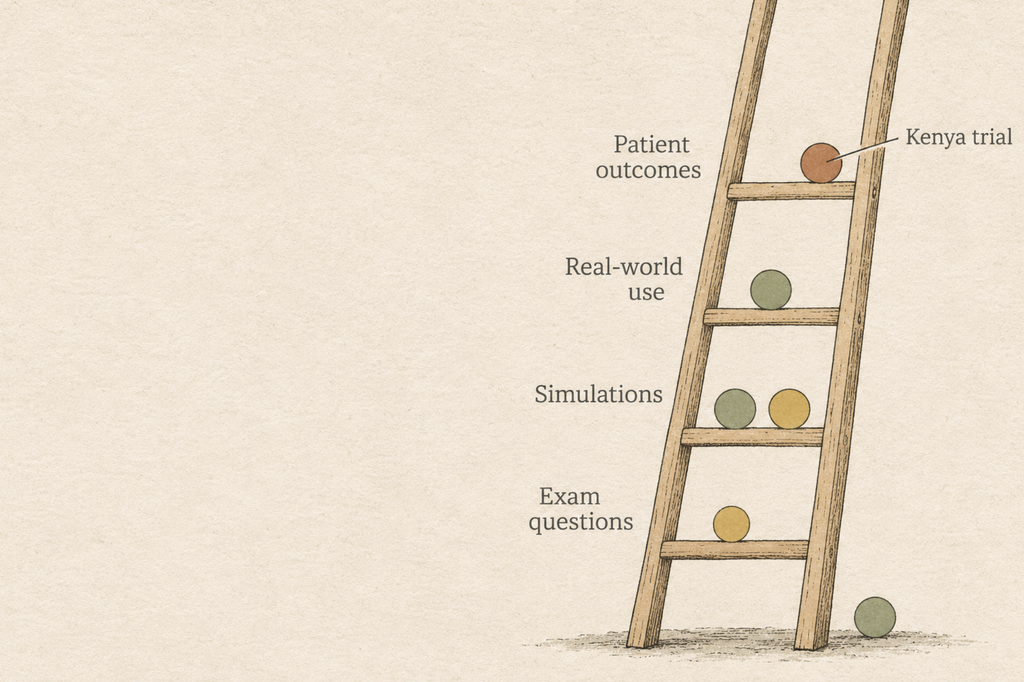
Where real use was tested, high scores on those tests did not predict performance. In the preregistered trial described above, strong model scores did not carry over to the people using the models [Bean, Reliability of LLMs as Medical Assistants, 2026]. Randomized trials are also often reported incompletely. A 2026 review found 73 randomized trials of generative AI for medical use, with 24,150 participants. Only about a third (33.8%) described how people and the AI interacted [Ko, Reporting Gaps in Randomized Trials of Generative AI, 2026].
The five tools follow the same pattern. Four of them rely on a test their developer built, on a company metric, or on no public test at all. OpenEvidence is the exception, because outside groups have tested it, and their results conflict.
What Health AI Still Has to Prove

In Kenya, researchers have tested a language model tool directly against patient outcomes. An early study covered 39,849 visits in 15 clinics. Clinicians with an AI safety net made 16% fewer diagnostic errors and 13% fewer treatment errors [Korom, AI-Based Clinical Decision Support for Primary Care, 2025]. That study was not randomized, and the developers were co-authors.
A later cluster-randomized trial covered 16 clinics and 9,691 patients. Its main outcome was treatment failure within 14 days of enrollment. Treatment failure occurred in 2.2% versus 2.0% of patients (adjusted odds ratio 0.77, 95% CI 0.55 to 1.08), with no clear difference [Agweyu, Generative AI-Enabled Clinical Decision Support in Primary Care, 2026]. The tool appeared safe.
The first study reported fewer clinician errors, but the randomized trial, which measured a patient outcome, found no clear benefit.
The human oversight these tools rely on has weak evidence of its own. In a trial of 50 physicians using written cases, doctors with a language model scored 76% versus 74% without it, a difference that was not significant. The model alone scored 16 points higher than the doctors without it [Goh, LLM Influence on Diagnostic Reasoning, 2024]. In a second trial of 92 physicians, the model helped with treatment plans: scores were 6.5% higher. Doctors with the model still did no better than the model alone (−0.9%) [Goh, GPT-4 Assistance for Physician Performance, 2025].
Wrong AI suggestions also lower clinician accuracy. Among 27 radiologists, the most experienced readers were correct on 82.3% of mammograms when the AI suggestion was right and on 45.5% when it was wrong [Dratsch, Automation Bias in Mammography, 2023]. That study used an older AI tool, not a chatbot.
FDA advisers have pointed to the same gap. FDA’s digital health advisory committee met on November 20–21, 2024. It urged ongoing monitoring of generative AI tools after launch, including how people use them and what happens to patients [FDA, Digital Health Advisory Committee Summary, 2024]. The recommendations were advisory.
Across Google’s releases and the four earlier tools, AI is now present at nearly every step of care, from the patient’s phone to the consultation room. Almost none of it has been tested on whether patients do better. The Kenyan randomized trial that did measure a patient outcome found no clear benefit.
Benchmark wins, simulation results, and company metrics cannot answer the outcome question. The next standard for health AI should be independent trials with patient outcomes. Until those trials exist, these tools should support clinical decisions that clinicians make.
Key Takeaways
- In 2026, Google released a consumer product, a research agent, and an evaluation method, and only the product reaches patients today.
- Google has not published a peer-reviewed evaluation of the Health Coach, even though it can read U.S. medical records.
- The co-clinician did well in developer-run simulations but trailed primary care doctors on red flags, and no real patients were involved.
- Four of the five tools compared here rely on developer-built tests, company metrics, or no public test at all.
- A large randomized trial in Kenyan primary care, measuring a patient outcome, found no clear drop in treatment failure.
- Health AI should now be judged by independent trials with patient outcomes, and until then the tools should support decisions that clinicians make.
FAQ
Is Google Health Coach a medical device?
Not officially. Google labels the coach “not intended for medical purposes” and sells it as part of a subscription [Abramson, Google Health Coach, 2026]. FDA’s 2026 wellness guidance excludes products that name specific diseases. Whether reading and summarizing medical records crosses that line has not been publicly addressed [King & Spalding, FDA Updates General Wellness and CDS Guidance, 2026].
Has Google’s AI co-clinician been tested on real patients?
No. All published tests used queries, quizzes, or simulated visits with internal medicine residents playing patients [Shah, Conversational Medical AI with Eyes, Ears and a Voice, 2026]. Google is evaluating the tool in Singapore, but no results are public.
Do AI clinical tools improve patient outcomes?
Not yet shown. In a cluster-randomized trial in 16 Kenyan clinics, treatment failure within 14 days was 2.2% with AI assistance and 2.0% without it [Agweyu, Generative AI-Enabled Clinical Decision Support in Primary Care, 2026]. The tool appeared safe, but it did not clearly improve outcomes.
Do high benchmark scores mean a medical AI works in practice?
No. In a preregistered trial of 1,298 participants, models alone named the right condition 94.9% of the time. People using the same models did so in fewer than 34.5% of cases [Bean, Reliability of LLMs as Medical Assistants, 2026].
References
- Abramson A. Google Health Coach is becoming globally available [Internet]. Mountain View (CA): Google; 2026 May 7 [cited 2026 Nov 12]. Available from: https://blog.google/products-and-platforms/products/google-health/google-health-coach
- Karthikesalingam A, Natarajan V, Kohli P. Enabling a new model for healthcare with AI co-clinician [Internet]. London: Google DeepMind; 2026 Apr 30 [cited 2026 Nov 12]. Available from: https://deepmind.google/blog/ai-co-clinician/
- Montgomery-Taylor S. Evaluating health AI at scale [Internet]. Mountain View (CA): Google; 2026 Nov 4 [cited 2026 Nov 12]. Available from: https://blog.google/innovation-and-ai/technology/health/evaluating-health-ai-at-scale/
- Montgomery-Taylor S, et al. Towards multi-method evaluation of AI in health: integrating benchmarks, autoraters, and expert evaluation [Preprint]. arXiv. 2026. Available from: https://arxiv.org/abs/2611.05127
- Google. Partnering with Singapore to bring frontier AI to public health [Internet]. Mountain View (CA): Google; 2026 Oct 29 [cited 2026 Nov 12]. Available from: https://blog.google/innovation-and-ai/technology/health/google-for-health-summit-singapore/
- Thng F. Get a fuller picture with Fitbit’s personal health coach [Internet]. Mountain View (CA): Google; 2026 Mar 17 [cited 2026 Nov 12]. Available from: https://blog.google/products-and-platforms/devices/fitbit/fitbit-personal-health-coach-updates-2026/
- Patel S. Learn more about the research behind the new personal health coach [Internet]. Mountain View (CA): Google; 2025 Oct 27 [cited 2026 Nov 12]. Available from: https://blog.google/products-and-platforms/devices/fitbit/research-behind-personal-health-coach-preview/
- Heydari AA, Gu K, Srinivas V, et al. The anatomy of a personal health agent. Nature. 2026;659(8139):197-207.
- Bean AM, et al. Reliability of LLMs as medical assistants for the general public: a randomized preregistered study. Nat Med. 2026.
- Shah M, Gusdorf J, Palepu A, et al. Towards conversational medical AI with eyes, ears and a voice [Preprint]. arXiv. 2026. Available from: https://arxiv.org/abs/2605.09272
- Nori H, et al. Sequential diagnosis with language models. Science. 2026.
- Digital Health News. Anthropic and Google follow OpenAI to launch healthcare AI [Internet]. 2026 Jan 19 [cited 2026 Nov 12]. Available from: https://www.digitalhealth.net/2026/01/anthropic-and-google-follow-chatgpt-to-launch-healthcare-ai/
- Anthropic. Elation Health delivers faster clinical insights with Claude [Internet]. 2026 [cited 2026 Nov 12]. Available from: https://claude.com/customers/elation-health
- Vishwanath K, Alyakin A, Ghosh M, et al. General-purpose large language models outperform specialized clinical AI tools on medical benchmarks. Nat Med. 2026;32(7):2405-9.
- Wilhelmi T, et al. Development and nationwide multicentre evaluation of guideline-grounded large language model chatbots to support patient self-management and education in rheumatology. J Med Syst. 2026.
- Bedi S, et al. Testing and evaluation of health care applications of large language models: a systematic review. JAMA. 2025.
- Ko JE, Hwang JW, Kim SM, Kwon JY. Reporting gaps and challenges in randomized trials of generative AI for medical use: insights from a systematic review. J Med Internet Res. 2026;28:e94543.
- Korom R, Kiptinness S, Adan N, et al. AI-based clinical decision support for primary care: a real-world study [Preprint]. arXiv. 2025. Available from: https://arxiv.org/abs/2507.16947
- Agweyu A, Mwaniki P, Menon V, et al. Generative AI-enabled clinical decision support system in primary care: a pragmatic, cluster-randomized trial. Nat Med. 2026;32(8):3032-9.
- Goh E, et al. Large language model influence on diagnostic reasoning: a randomized clinical trial. JAMA Netw Open. 2024.
- Goh E, Gallo RJ, Strong E, et al. GPT-4 assistance for improvement of physician performance on patient care tasks: a randomized controlled trial. Nat Med. 2025;31(4):1233-8.
- Dratsch T, Chen X, Rezazade Mehrizi M, et al. Automation bias in mammography: the impact of artificial intelligence BI-RADS suggestions on reader performance. Radiology. 2023;307(4):e222176.
- King & Spalding. FDA updates general wellness and clinical decision support guidance documents [Internet]. 2026 Jan 9 [cited 2026 Nov 12]. Available from: https://www.kslaw.com/insights/articles/fda-updates-general-wellness-and-clinical-decision-support-guidance-documents
- U.S. Food and Drug Administration. 24 hour summary of the Digital Health Advisory Committee, November 20-21, 2024 [Internet]. Silver Spring (MD): FDA; 2024 [cited 2026 Nov 12]. Available from: https://www.fda.gov/media/184078/download
- Hack S, et al. Quality of tinnitus information from generative AI systems and web search: an expert-rated comparative study. Otol Neurotol. 2026.
Joonpyo Hong, MD is a board-certified otolaryngologist practicing in Korea. This article reflects his clinical interpretation of published research and does not constitute individual medical advice.
This article is not intended to advertise or promote any specific company or product.
For more articles:
https://curiousmd.com/personal-health-agent-ai-team-before-the-clinic/
https://curiousmd.com/sequential-diagnosis-ai-dxo-sdbench/
https://curiousmd.com/claude-for-healthcare/
https://curiousmd.com/openevidence-ai-evidence-based-medicine/
Link out to:
Google Health Coach launch announcement: Google’s post on the coach’s features, pricing, and disclaimers.
AI co-clinician research overview: DeepMind’s summary of the co-clinician and its simulation results.
Evaluating health AI at scale: Google’s framework for grading health AI on accuracy, safety, and usefulness.
FDA Digital Health Advisory Committee summary: FDA advisers’ recommendations on generative AI devices across the product lifecycle.
FDA 2026 wellness and decision support guidance: a legal summary of the revised FDA guidance documents.