
Roughly 400 keys and more chords than anyone has managed to count. Science has barely begun to read the score.
Olfactory receptors are the keys of an instrument most people never think about. Humans carry roughly 400 working types of them, and a single odor can press many at once [Billesbølle, Structural Basis of Odorant Recognition, 2023]. Each odor molecule presses its own set of keys, and the brain hears the result as one familiar chord.
The instrument works remarkably well. The sheet music is missing. For most of those keys, science still cannot say which molecules press them, and there is no agreed ruler for how far apart two smells are. When someone loses their sense of smell, clinicians can measure how much is gone but not which keys went silent. Mammalian noses regrow their nerve cells throughout life, yet nobody can check whether the new keys are attached to the right strings.
This deep dive follows the music from the bottom up: how the chord is built, why the score is mostly blank, what three lines of research are doing to fill it in, and what the blanks cost patients. Each part points the same way. Hearing the chord is not the same as reading the score.
How Olfactory Receptors Build a Chord
The modern picture dates to 1999. A Harvard team studying single mouse smell neurons showed that one receptor responds to several molecules, one molecule activates several receptors, and different molecules activate different combinations [Malnic, Combinatorial Receptor Codes for Odors, 1999]. Smell is a combinatorial code. The brain does not identify a molecule through a single dedicated sensor. It reads which receptors fired, and how strongly.
A piano makes the logic concrete. Receptors are the keys, an odor molecule is a hand that presses several keys at once, and the smell is the chord. Picture a keyboard with four keys. Molecule A presses the first and third keys and sounds like one smell. Molecule B presses the first, third and fourth and sounds like another. Molecule C presses the second and third and sounds like a third. These molecules are made up for illustration and do not correspond to real receptors. Even a single molecule plays a chord, and with roughly 400 keys the number of possible chords is astronomically large.

The wiring is unusually orderly. In mice, each smell neuron uses exactly one receptor type, and neurons that share a receptor send their fibers to the same small relay stations, called glomeruli, in the olfactory bulb at the front of the brain [Hirota, Differentiation and Class Choice of Olfactory Sensory Neurons, 2024]. Human anatomy looks broadly similar but less tidy. A human bulb holds more than 5,500 glomeruli, roughly 16 per receptor type. The mouse has about 2 per type, so the human ratio is roughly eight times higher [Maresh, Glomerular Organization in the Human Olfactory Bulb, 2008]. In people, each key seems to ring several strings.

The chord also changes with volume and company. At higher concentrations more receptors join in, and researchers think this can sometimes change the smell itself [Malnic, Combinatorial Receptor Codes for Odors, 1999] [McClintock, Mixture and Concentration Effects, 2020]. Mixtures are not simple sums either. One team imaged about 10,000 mouse smell neurons at once and found that blends routinely muted or amplified individual receptors [Xu, Receptor-Driven Modulation in Peripheral Olfactory Coding, 2020]. In people, blends of about 30 evenly balanced molecules mostly smell alike even when they share no ingredient. The researchers who found this called it an olfactory white [Weiss, Olfactory White, 2012].
The combinatorial model may not be the whole story. A 2025 screen of human receptors found receptors for signature odors such as ambrox from ambergris, the peppery note rotundone, and the cork taint in wine. Many had nanomolar sensitivity and unusually narrow tuning, and the authors argue that this challenges the combinatorial model at the level of individual receptors [Emter, Decoding Human Olfaction, 2025]. Most keys may play in chords, while a few appear to be soloists. The score does not yet say which pattern is the rule.
How Many Smells Can a Nose Tell Apart?
For decades the stock answer was 10,000, a figure no one had ever tested. In 2014, a team at Rockefeller University used carefully built mixtures to estimate that humans can discriminate at least 1 trillion odor stimuli. By comparison, people can tell apart several million colors and almost half a million tones [Bushdid, Humans Can Discriminate More Than 1 Trillion Olfactory Stimuli, 2014].
The number did not last. The following year, two independent analyses showed that the estimation method could produce almost any answer from the same data, and that its formula gives an upper bound rather than a lower one [Gerkin, Number of Olfactory Stimuli Still Unknown, 2015] [Meister, Dimensionality of Odor Space, 2015]. The real count is unknown. The old figure was never tested, and the new one did not hold up.
Smell also lacks a ruler. Color has a well-mapped three-dimensional perceptual space tied to the wavelength of light, and pitch is ordered by the frequency of sound. Smell has no agreed axes [Meister, Dimensionality of Odor Space, 2015], and no model yet predicts what a person will perceive from the pattern of receptors that fire [Trimmer, Genetic Variation Across the Human Olfactory Receptor Repertoire, 2019].
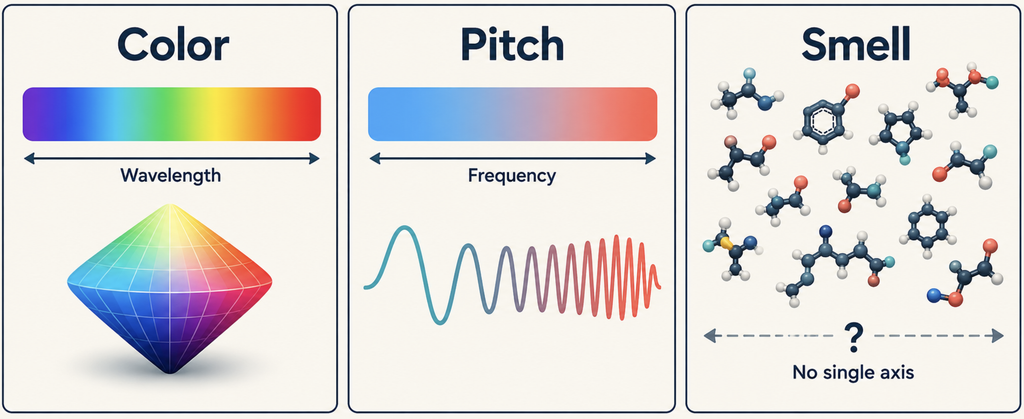
| Sense | Physical axis | Discriminable stimuli (estimate) | Map of perception |
|---|---|---|---|
| Color vision | Wavelength of light | Several million colors | Three-dimensional color space |
| Pitch | Frequency of sound | Almost half a million tones | Ordered along frequency |
| Smell | No single axis; molecules differ in many ways at once | Unknown; a trillion was claimed, then disputed | No agreed axes |
The missing ruler shows up in the clinic. The widely used Sniffin’ Sticks battery scores three skills: the threshold at which a person detects an odor, discrimination between odors, and identification by name. The three add up to a TDI score, and a total below 30.75 counts as reduced smell, based on norms from 9,139 people [Oleszkiewicz, Updated Sniffin’ Sticks Normative Data, 2019]. These tools grade the loss well. They cannot say which receptors, or which stretch of the pathway, have failed [Whitcroft, Position Paper on Olfactory Dysfunction, 2023].
The Empty Score: Why Most Olfactory Receptors Are Still Orphans
For most of the roughly 400 keys, science still does not know what presses them. Receptors without a known partner molecule are called orphan receptors, and in human smell they are the majority.
In 2015, published partner molecules existed for only about 10% of intact human receptors, roughly one in ten [Mainland, Human Olfactory Receptor Responses to Odorants, 2015]. A 2023 account put the share with even a rough idea of their activators at about a quarter [Parry, How a Human Smell Receptor Works Is Finally Revealed, 2023], and a 2025 screen still described reproducible receptor–molecule pairs as known for only a minority [Emter, Decoding Human Olfaction, 2025]. The three figures use different definitions, so they do not form a trend line. They agree on one thing: the score is mostly blank.

The obstacle is practical. In standard laboratory cells, smell receptors reach the cell surface poorly, and the surface is where they would meet odor molecules. Two helper proteins found only in smell neurons, RTP1 and RTP2, help move receptors outward [Saito, RTP Family Members Induce Functional Expression, 2004]. One newer workaround engineers the receptor’s tail to improve delivery to the surface [Emter, Decoding Human Olfaction, 2025]. The keys exist, but they are hard to keep in place on a laboratory bench.
The score is not even the same for every listener. Receptor genes vary widely between people, and the variation changes perception. People describe androstenone, a steroid odor, as sweaty, as sweet and floral, or as odorless. Carriers of a common, weakly functioning version of its receptor, OR7D4, find it less intense and less unpleasant [Keller, Genetic Variation in a Human Odorant Receptor, 2007]. A single variant in another receptor, OR5A1, explains more than 96% of the difference in sensitivity to β-ionone, a floral note added to foods and drinks [Jaeger, A Mendelian Trait for Olfactory Sensitivity, 2013].
Across 332 sequenced people, single-receptor variants were repeatedly linked to how they perceived odors. In 8 of 10 cases checked in the laboratory, a weaker receptor meant a weaker smell [Trimmer, Genetic Variation Across the Human Olfactory Receptor Repertoire, 2019]. Each nose plays a slightly retuned piano.
Animal models help less than researchers hoped. Mice have about 1,100 receptor types, nearly three times as many as humans, with different wiring ratios [Maresh, Glomerular Organization in the Human Olfactory Bulb, 2008]. Human smell tissue sits in small patches high in the nasal cavity, so even landmark human studies rest on modest biopsy series.
Three Ways to Fill In the Score
Three lines of research go after the blanks. One photographs the keys, one tests keys against molecules in bulk, and one skips the keys altogether.
Seeing the keys: receptor structures
In 2023, a team from UCSF and Duke used cryo-electron microscopy to capture the first 3D structure of a natural human smell receptor gripping its odor molecule: OR51E2 holding propionate, a short fatty acid, inside a closed pocket [Billesbølle, Structural Basis of Odorant Recognition, 2023]. When the team mutated that pocket, the receptor shifted which fatty-acid chain lengths it responded to. This suggests that tight physical packing between molecule and pocket determines selectivity.
According to UCSF, the team solved the structure with about one-hundredth of a milligram of protein, a hundredth of the roughly 1 milligram such experiments typically need [UCSF, First Molecular Images of Olfaction, 2023]. Most later structures came from laboratory-designed stand-ins: four engineered consensus receptors built from the sequences of 17 human receptor subfamilies [de March, Engineered Odorant Receptors, 2024]. Few natural keys have been photographed in full, and researchers infer most from their relatives.
Matching keys to molecules: large-scale screens
A 2009 screen ran 93 odorants against 464 receptors and found activators for just 10 human receptors. At the time, partners were known for fewer than 50 of more than 1,400 human and mouse receptors [Saito, Odor Coding by a Mammalian Receptor Repertoire, 2009]. A 2015 dataset expanded the grid to 511 human receptor clones and 73 odorants [Mainland, Human Olfactory Receptor Responses to Odorants, 2015], and a curated database now holds 51,395 receptor–molecule pairs across species [Lalis, M2OR, 2024]. Each round fills in a few more squares of a very large grid.
Skipping the keys: AI odor maps
The third approach ignores receptors entirely. A team from Google and the Monell Chemical Senses Center trained a graph neural network on about 5,000 molecules to build a principal odor map that predicts smell from structure [Lee, A Principal Odor Map, 2023]. The team tested it on 400 molecules the model had never seen and analyzed 323 of them. For 53% of those molecules, just over half, the model’s descriptions came closer to the consensus of a 15-person trained panel than the median panelist did. A prospective test against human judges is the right design, and the result is real.
The authors are candid about the limits. The map has no receptor-level basis, offers no rule for mixing molecules into new smells, leaves out concentration, and predicts an average nose rather than any individual one [Lee, A Principal Odor Map, 2023]. It is a single study, and talk of digitizing smell runs well ahead of it. Predicting the chord well does not mean the model can read the score.
| Approach | What it fills in | Landmark result | Main limit |
|---|---|---|---|
| Receptor structures | How a key grips its molecule | First natural human receptor structure, 2023 | Very few natural receptors; later structures mostly engineered |
| Large-scale screens | Which molecules press which keys | Hundreds of receptors tested against dozens of odorants | Most receptors still unmatched |
| AI odor maps | Which chord a molecule produces | Closer to a trained panel than the median panelist for 53% of molecules | No receptor basis; single molecules; an average nose |
The Cost of Playing Without a Score: Smell Loss and Regrowth
Smell neurons are among the few nerve cells that mammals keep replacing throughout life, supplied by stem cells at the base of the nasal lining [Schwob, Stem and Progenitor Cells of the Mammalian Olfactory Epithelium, 2017]. This capacity has limits. With age, patches of the lining can run out of neuron-making stem cells and even turn into ordinary airway tissue. In mouse models, the rewiring after heavy injury is incomplete [Child, Neuroregenerative Capacity of Olfactory Stem Cells, 2018].
COVID-19 turned this biology into a public-health question. The virus enters cells through ACE2, which sits on the support and stem cells around smell neurons rather than on the neurons themselves, so the damage falls largely on the neurons’ neighborhood [Brann, Non-Neuronal Expression of SARS-CoV-2 Entry Genes, 2020].
Most people recovered quickly. A 2022 meta-analysis of 18 studies and 3,699 patients estimated that 74.1% had their sense of smell back within 30 days, about three in four within a month, and 95.7% by 180 days. It also estimated that 5.6%, roughly one in eighteen, were left with lasting problems, and cautioned that this figure may be an underestimate [Tan, Prognosis and Persistence of Smell and Taste Dysfunction, 2022]. Later variants such as Omicron appear to cause smell loss substantially less often [von Bartheld, Olfactory Dysfunction With Omicron, 2024].
For people who do not recover, biopsies offer a clue. A small study examined 24 biopsies, including 9 from people with long-term loss. The virus was gone, but immune T cells were still inflaming the lining and smell neurons were depleted. The authors proposed this as an explanation [Finlay, Persistent Post-COVID-19 Smell Loss, 2022].
Then there is parosmia, in which familiar smells turn distorted and often unpleasant. It tends to appear some time after the initial loss and usually improves with time. One leading idea is that regrowing neurons rewire imperfectly, so a familiar molecule lights up the wrong pattern. Other researchers point to changes in how the brain processes the signal. Neither idea has been proven, and there is still no objective test for parosmia [Xu, Parosmia: Pathophysiology and Management, 2025]. In piano terms, the keys are coming back, but no one can yet check whether each is attached to the right string.

The treatments show how little of the score anyone can read. Smell training means sniffing a set of strong scents twice a day for months. It is the most widely recommended option, and a pooled analysis of 13 studies showed improvement [Sorokowska, Effects of Olfactory Training, 2017]. A 2025 trial in 65 people, however, compared it with 12 weeks of sniffing odor-free oils and found no clear advantage. How much of the gain comes from the training itself remains unsettled [Mogensen, Olfactory Training Placebo-Controlled Trial, 2025].
Injections of platelet-rich plasma (PRP), a concentrate made from the patient’s own blood, are a newer option. The first randomized trial enrolled people whose smell loss had persisted 6 to 12 months after COVID-19. Of those who received PRP, 57.1% improved meaningfully, versus 8.3% on saline, about 57% versus 8%. Only 26 of 35 enrolled participants finished, and self-rated improvement did not differ between groups [Yan, Platelet-Rich Plasma for COVID-19-Related Olfactory Loss, 2023].
A 2026 meta-analysis of 7 studies and 473 patients points the same way, but it rests on small trials with inconsistent methods [Barnawi, Intranasal Platelet-Rich Plasma Meta-Analysis, 2026]. A parosmia trial was listed as recruiting at Stanford as of October 2026 [Stanford Health Care, PRP for Parosmia Trial Listing, 2026]. PRP looks promising, but the evidence is not settled.
The most radical idea bypasses the nose. In a pilot with 5 volunteers who had a normal sense of smell, researchers placed an electrode in the ethmoid sinus beside the olfactory bulb. Three of the five perceived a smell, though brain recordings could not confirm it [Holbrook, Induction of Smell Through Transethmoid Electrical Stimulation, 2019]. A 2025 international expert opinion paper still describes olfactory implants as experimental and untested in patients [Whitcroft, Olfactory Implants Opinion Paper, 2025], and working devices are likely years away [Boles, A Smell Test for Science, 2025]. Apart from training, no treatment for post-viral smell loss has yet earned firm standing [Shi, Anti-Neuroinflammatory Supplement With Olfactory Training, 2026].
Clinical Perspective. For patients, the practical message is modest but real. Most COVID-related smell loss improves, smell training is a reasonable first step, and newer options are best pursued within trials or specialist care. The larger lesson is about measurement. The nose is good at regrowing; medicine is poor at verifying the result. Until clinicians can test which keys have returned and whether each strikes the right string, they will judge recovery by the patient’s report alone, and the score will stay mostly blank.
Key Takeaways
- Smell is a combinatorial code read from patterns of olfactory receptors, though some receptors appear to be narrow specialists.
- Humans have roughly 400 receptor types, yet for most of them the molecules that switch them on are still unknown.
- No one knows how many smells a person can distinguish; the widely publicized trillion-odor estimate did not survive reanalysis.
- The same molecule can smell different to different people, partly because receptor genes vary between individuals.
- Smell neurons regrow throughout life, but no test yet shows whether they rewire correctly, a gap that may underlie parosmia.
- For lasting post-viral loss, smell training is the standard option and PRP a promising newer one, but the evidence for both remains unsettled.
FAQ
Can a smell test show which receptors are damaged?
No. Standard tests such as Sniffin’ Sticks score detection threshold, discrimination and identification, which grades how much smell has been lost. They cannot identify which receptors or which part of the pathway failed, because the map linking receptors to perception is still incomplete [Whitcroft, Position Paper on Olfactory Dysfunction, 2023].
Does the sense of smell come back after COVID-19?
Usually, yes. A 2022 meta-analysis estimated that about three in four people recovered within a month and 95.7% by 180 days. Roughly one in eighteen were estimated to have lasting problems, and that figure may be an underestimate [Tan, Prognosis and Persistence of Smell and Taste Dysfunction, 2022].
Why do people disagree about how something smells?
Partly genetics. Receptor genes vary between individuals, and some variants change how intense or pleasant an odor seems. A single variant in the OR5A1 receptor explains more than 96% of the difference in sensitivity to β-ionone, a floral note [Jaeger, A Mendelian Trait for Olfactory Sensitivity, 2013].
Is there a proven treatment for parosmia?
No. Parosmia often improves with time, but no treatment yet has firm evidence, and there is no objective test to measure it [Xu, Parosmia: Pathophysiology and Management, 2025]. In a 2025 placebo-controlled trial, people with parosmia responded less to smell training [Mogensen, Olfactory Training Placebo-Controlled Trial, 2025].
References
- Billesbølle CB, de March CA, van der Velden WJC, et al. Structural basis of odorant recognition by a human odorant receptor. Nature. 2023;615(7953):742-749.
- Malnic B, Hirono J, Sato T, Buck LB. Combinatorial receptor codes for odors. Cell. 1999;96(5):713-723.
- Hirota J. Molecular mechanisms of differentiation and class choice of olfactory sensory neurons. Genesis. 2024;62(2):e23587.
- Maresh A, et al. Principles of glomerular organization in the human olfactory bulb–implications for odor processing. PLoS One. 2008;3(7):e2640.
- McClintock TS, et al. Mixture and concentration effects on odorant receptor response patterns in vivo. Chem Senses. 2020.
- Xu L, et al. Widespread receptor-driven modulation in peripheral olfactory coding. Science. 2020;368(6487):eaaz5390.
- Weiss T, et al. Perceptual convergence of multi-component mixtures in olfaction implies an olfactory white. Proc Natl Acad Sci U S A. 2012;109(49):19959-19964.
- Emter R, Merillat C, Buchli F, Flachsmann F, Natsch A. Decoding human olfaction by high heterologous expression of odorant receptors detecting signature odorants. Curr Biol. 2025;35(21):5252-5263.e4.
- Bushdid C, Magnasco MO, Vosshall LB, Keller A. Humans can discriminate more than 1 trillion olfactory stimuli. Science. 2014;343(6177):1370-1372.
- Gerkin RC, Castro JB. The number of olfactory stimuli that humans can discriminate is still unknown. Elife. 2015;4:e08127.
- Meister M. On the dimensionality of odor space. Elife. 2015;4:e07865.
- Trimmer C, Keller A, Murphy NR, et al. Genetic variation across the human olfactory receptor repertoire alters odor perception. Proc Natl Acad Sci U S A. 2019;116(19):9475-9480.
- Oleszkiewicz A, Schriever VA, Croy I, Hähner A, Hummel T. Updated Sniffin’ Sticks normative data based on an extended sample of 9139 subjects. Eur Arch Otorhinolaryngol. 2019;276(3):719-728.
- Whitcroft KL, et al. Position paper on olfactory dysfunction: 2023. Rhinology. 2023;61(33):1-108.
- Mainland JD, Li YR, Zhou T, Liu WL, Matsunami H. Human olfactory receptor responses to odorants. Sci Data. 2015;2:150002.
- Parry W. How a human smell receptor works is finally revealed. Quanta Magazine. Published May 1, 2023.
- Saito H, Kubota M, Roberts RW, Chi Q, Matsunami H. RTP family members induce functional expression of mammalian odorant receptors. Cell. 2004;119(5):679-691.
- Keller A, Zhuang H, Chi Q, Vosshall LB, Matsunami H. Genetic variation in a human odorant receptor alters odour perception. Nature. 2007;449(7161):468-472.
- Jaeger SR, McRae JF, Bava CM, et al. A Mendelian trait for olfactory sensitivity affects odor experience and food selection. Curr Biol. 2013;23(16):1601-1605.
- Finlay JB, Brann DH, Abi Hachem R, et al. Persistent post-COVID-19 smell loss is associated with immune cell infiltration and altered gene expression in olfactory epithelium. Sci Transl Med. 2022;14(676):eadd0484.
- UCSF. First molecular images of olfaction sets the stage to create novel smells. Republished by AZoLifeSciences. Published March 16, 2023.
- de March CA, et al. Engineered odorant receptors illuminate the basis of odour discrimination. Nature. 2024;635(8038):499-508.
- Saito H, Chi Q, Zhuang H, Matsunami H, Mainland JD. Odor coding by a mammalian receptor repertoire. Sci Signal. 2009;2(60):ra9.
- Lalis M, Hladiš M, Khalil SA, Briand L, Fiorucci S, Topin J. M2OR: a database of olfactory receptor-odorant pairs for understanding the molecular mechanisms of olfaction. Nucleic Acids Res. 2024;52(D1):D1370-D1379.
- Lee BK, Mayhew EJ, Sanchez-Lengeling B, et al. A principal odor map unifies diverse tasks in olfactory perception. Science. 2023;381(6661):999-1006.
- Schwob JE, et al. Stem and progenitor cells of the mammalian olfactory epithelium: taking poietic license. J Comp Neurol. 2017;525(4):1034-1054.
- Child KM, et al. The neuroregenerative capacity of olfactory stem cells is not limitless: implications for aging. J Neurosci. 2018;38(31):6806-6824.
- Brann DH, Tsukahara T, Weinreb C, et al. Non-neuronal expression of SARS-CoV-2 entry genes in the olfactory system suggests mechanisms underlying COVID-19-associated anosmia. Sci Adv. 2020;6(31):eabc5801.
- Tan BKJ, et al. Prognosis and persistence of smell and taste dysfunction in patients with covid-19: meta-analysis with parametric cure modelling of recovery curves. BMJ. 2022;378:e069503.
- von Bartheld CS, et al. An explanation for reports of increased prevalence of olfactory dysfunction with Omicron: asymptomatic infections. J Infect Dis. 2024;229(1):155-160.
- Xu X, et al. Parosmia: pathophysiology and management. Curr Allergy Asthma Rep. 2025;25(1):10.
- Sorokowska A, Drechsler E, Karwowski M, Hummel T. Effects of olfactory training: a meta-analysis. Rhinology. 2017;55(1):17-26.
- Mogensen DG, Aanaes K, Andersen IB, Jarden M, Backer V. Effect of olfactory training in COVID-19 related olfactory dysfunction—a placebo-controlled trial. Laryngoscope. 2025;135(12):4849-4857.
- Yan CH, Jang SS, Lin HC, et al. Use of platelet-rich plasma for COVID-19-related olfactory loss: a randomized controlled trial. Int Forum Allergy Rhinol. 2023;13(6):989-997.
- Barnawi AB, et al. Navigating the efficacy, safety and outcome of intranasal platelet-rich plasma for persistent olfactory loss: a systematic review and meta-analysis. Eur Arch Otorhinolaryngol. 2026;283(10):6225-6236.
- Stanford Health Care. Randomized clinical trial of intranasal injection of platelet-rich plasma for treatment of parosmia (NCT06283745). Accessed October 21, 2026.
- Holbrook EH, et al. Induction of smell through transethmoid electrical stimulation of the olfactory bulb. Int Forum Allergy Rhinol. 2019;9(2):158-164.
- Whitcroft KL, et al. Olfactory implants: international opinion paper on emerging technologies and clinical applications. Rhinology. 2025;63(Suppl 35):1-37.
- Boles S. A smell test for science. Harvard Gazette. Published September 4, 2025.
- Shi Y, et al. Therapeutic effect of anti-neuroinflammatory supplement combined with olfactory training on post-covid olfactory dysfunction: a systematic review and meta-analysis. Eur Arch Otorhinolaryngol. 2026;283(6):3503-3512.
Joonpyo Hong, MD is a board-certified otolaryngologist practicing in Korea. This article reflects his clinical interpretation of published research and does not constitute individual medical advice. This article is not intended to advertise or promote any specific company or product.
For more articles:
https://curiousmd.com/olfaction-memory-brain-neurodegenerative-disease/
https://curiousmd.com/neuralink-voice-speech-first/
https://curiousmd.com/role-of-smell-in-flavor/
https://curiousmd.com/smell-loss-parkinsons-alzheimers-ai-biomarker/
https://curiousmd.com/ai-electronic-nose/
Link out to:
Smell (Olfactory) Disorders — NIDCD, National Institutes of Health: plain-language overview of smell disorders, including anosmia and parosmia, and their causes and treatment.
How a Human Smell Receptor Works Is Finally Revealed — Quanta Magazine: how researchers captured the first 3D structure of a human smell receptor holding its odor molecule.
Nasal injections could treat long-term COVID-19-related smell loss — Stanford Medicine: report on the randomized trial of platelet-rich plasma injections.
A smell test for science — Harvard Gazette: olfactory implant research and the hurdles that remain.
First molecular images of olfaction sets the stage to create novel smells — UCSF press release via AZoLifeSciences: how the first human odor-receptor structure was solved.
PRP for parosmia trial listing (NCT06283745) — Stanford Health Care: listing for a randomized trial of platelet-rich plasma for parosmia.